

Line near the top, room quiet: the reeds are saturated and stalled. Flip all six. This is the commonest cause by a wide margin.
Line barely above the oil: the reeds are not wicking — too few reeds, clogged rattan, or a reed that has done a year of service. Add reeds or refresh them.
Level not dropping at all over weeks: almost always a still, cold, sealed room. Delivery is happening; distribution is not.
2. Lift a reed and look at the wet line. That is the whole diagnostic. High wet line, dark reed, quiet room means saturated and stalled — flip all six. Low wet line means the reeds are not drinking — too few, clogged, or spent.
3. Flip first, always. All six reeds, end for end, gloves on, once a week. Projection typically returns within a few hours. If your diffuser has never been flipped and is three weeks old, stop reading and go and do that.
4. Check the count and the fit. Six fibre reeds is what every SOSA bottle ships with and what each composition is dosed for. Four reeds in a wide-necked vessel is a common cause of a full bottle and a silent room, and adding reeds is free.
5. Consider the reeds' age. Reeds are consumable even though we do not sell them separately. After many months the fibre carries so much heavy residue that it stops moving fresh oil, and no amount of flipping recovers it. Our guidance is to refresh reeds every few months.
6. Only then suspect the oil. Fragrance stored for a long time in heat or direct sunlight loses its lighter, more volatile notes first, leaving a base that reads as faint rather than absent — which is why we ask you to keep bottles out of west-facing windows.
Composed and handmade in small batches in Pune, and a portion of every order supports girl-child education through Nanhi Kali.
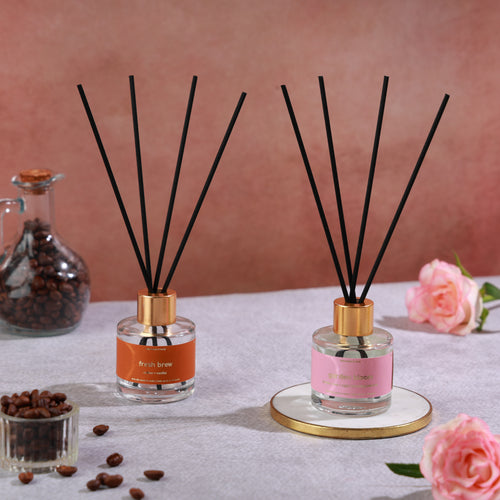
Part one — the wet-line test, and how to read it
Almost every question in this article is answered by one observation. Lift a single reed straight up out of the bottle, hold it against the light, and find the boundary between the darker, oil-soaked lower section and the drier upper section. That boundary is the wet line, and where it sits tells you whether the system is delivering, stalled or dead. It takes ten seconds, costs nothing, and is more useful than any amount of guessing about the fragrance itself.
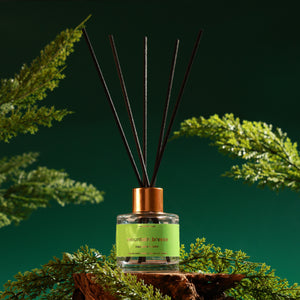
 Mountain Breeze₹849 · 6 fibre reedsThe wet line sits barely above the oil after a week or more. Capillary action is not happening properly, and there are three usual reasons. Too few reeds — four reeds in a wide-necked vessel simply cannot present enough surface, and adding two is free. Clogged fibre — this is where reed material matters enormously. Rattan's natural pores swell and block in humidity, which is why so many imported diffusers die in week two of an Indian monsoon; SOSA ships six fibre reeds precisely because they wick consistently at 85% relative humidity. Or the reed has done its time — after many months even fibre carries enough heavy residue to stop moving fresh oil, at which point flipping recovers nothing. New reeds in the same oil is the fix, and the difference is usually dramatic and immediate.
Part two — the five causes, ranked
Every version of "full bottle, no fragrance" that has come through our inbox, in the order it turns out to be the answer. Note that the first three are free to fix and the fourth costs almost nothing.
| Cause | What the reeds look like | How often | The fix | Cost |
|---|---|---|---|---|
| Reeds saturated and never flipped ★ | Wet line high, fibre dark, oil level static | Most common by far | Flip all six, then weekly | Free |
| Too few reeds for the vessel | Wet line low, only three or four reeds standing | Common where reeds were split between two bottles | Return to six, or add two to four | Free |
| No airflow around the bottle | Reeds healthy, wet line normal, reeds smell strong up close | Very common in alcoves and cabinets | Move near a doorway at chest height | Free |
| Reeds clogged or spent | Wet line barely above the oil after a week; fibre very dark | After many months of service, or with old rattan reeds | Fresh reeds in the same oil | Free with a new bottle |
| Top notes lost to heat or sunlight | Reeds fine; what you smell is flat and base-heavy | Uncommon — usually long storage in a sunny spot | New oil; store bottles in the dark | ₹2,399 |
| And the one that is not on the list: a faulty batch of oil. It is the first thing people suspect and very nearly the last thing it turns out to be — the fragrance compound is the most stable part of the system, while the reed is the consumable part. If a fresh reed in your existing bottle produces scent, the oil was never the problem. | ||||
Oil refill · keep the vessel₹2,399Shop → 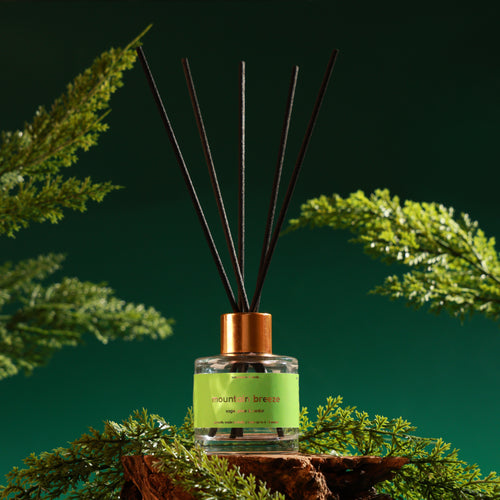 A new bottle · six fresh reedsfrom ₹849Shop →
  Sukoon · a different format₹1,899Shop →
Part three — the rare case where the oil really is the problem
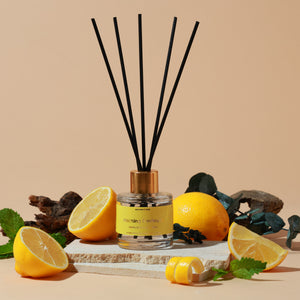
It happens, and it is worth describing honestly rather than pretending fragrance is immortal. A composition is a structure with a top, a heart and a base, and the three do not age at the same rate. The top notes — citrus in Morning Freshness, the green pine edge in Mountain Breeze — are the lightest and most volatile molecules, and they are the first to go if a bottle is stored badly. What remains is the base, which in a well-built composition is perfectly pleasant but quiet and undramatic. People describe this accurately as "there is something there, but it is nothing".
Two conditions cause it and both are avoidable. Sustained heat and direct sunlight are the big one: a sealed bottle standing in a west-facing window through a Delhi summer is being cooked, and UV degrades some aroma molecules directly. Our compositions are built on a heat-stable coconut-derived CCT base precisely so they hold at 45°C in use, but that is a different demand from months of storage in a hot window. Long open storage is the other: a bottle that has stood open with reeds in for a year and a half has effectively been running that whole time, whether or not you were smelling it. Keep unopened bottles in their box, in a cupboard, away from sun and heat, and open them when you intend to use them.
One thing that is not a fault, and gets reported as one: a phthalate-free reed diffuser behaves differently from the cheap ones. Phthalate solvents push fragrance off a reed hard and fast, which produces a spectacular first fortnight and then a chemical, slightly acrid fade as the solvent breaks down in heat. Ours are phthalate-free, paraben-free and IFRA-compliant, which means a flatter, longer, steadier curve by design. If your previous diffuser was noticeably louder in week one and unpleasant by week six, you were experiencing that trade rather than a better product. I would rather explain the trade than win the first fortnight.
Part four — what to do, in order
The whole sequence, cheapest first. Four of the six lines cost nothing at all.
| Do this | What it tells you or changes | When it is the right answer | Cost |
|---|---|---|---|
| 1. The wet-line test ★ | Identifies which of the five causes you have | Always first — ten seconds, no purchase | Free |
| 2. Flip all six reeds, then weekly | Restores delivery from a stalled, saturated reed | Wet line high, fibre dark, oil static | Free |
| 3. Return to six reeds, or add more | Presents enough surface for the vessel | Three or four reeds standing, wet line low | Free |
| 4. Move it into passing air | Lets a healthy envelope become a scented room | Reeds smell strong up close, room does not | Free |
| 5. Fresh reeds in the same oil | Replaces the actual consumable in the system | Reeds many months old, very dark, refusing to wick | Free with a new bottle |
| 6. 300ml oil refill, or a new bottle | New oil and, with a bottle, six new reeds | Oil long-stored in heat or sun, or you want a change | ₹2,399 / from ₹749 |

Versailles
There is a mental model people bring to reed diffusers that causes almost all of this, and it comes from candles. With a candle the wax is the product and the wick is trivial — nobody thinks about the wick. With a reed diffuser it is precisely the reverse. The oil is the stable part and the reed is the consumable, and because the reed is a plain-looking stick that came free in the box, it is the last thing anybody suspects.
So when someone writes to say the bottle is full and the room is silent, my first question is never about the fragrance. It is: pull one out and tell me where the wet line is. That answer sorts it in a sentence, and four times in five the reply is that they have never flipped them, at which point the fix is free and takes ten seconds.
The part I would ask you to take seriously is refreshing reeds. We do not sell them separately, which is an honest gap in our range and one I am aware of. But a reed that has been standing in oil for a year is not the same object it was, and pouring a beautiful ₹2,399 refill over spent reeds is a way to be disappointed by good oil. Everything is composed and handmade in Pune, and a part of every order funds a girl's classroom through Nanhi Kali.
Frequently asked questions
- Why can't I smell my reed diffuser? — the full diagnostic, including the free test to run first.
- Why have my sticks stopped absorbing oil? and how often should you replace them?
- Should you flip reed diffuser sticks? — the free lever, in full.
- Lasting a long time but barely smelling? — the sister problem to this one.
- Brand: the SOSA founder story.
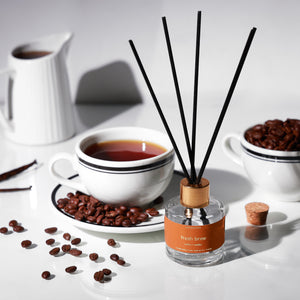
SOSA reed diffuser range & prices (verified August 2026): alcohol-free, phthalate-free, paraben-free and IFRA-compliant compositions on a heat-stable coconut-derived (CCT) carrier, low-VOC, supplied in a refillable glass bottle with six fibre reeds; 50ml lasts 6–8 weeks and 130ml lasts 14–18 weeks. Morning Freshness (Malabar lemon · peppermint · Nilgiri eucalyptus) 50ml ₹749 · 130ml ₹1,249 · 9.0/10; Garden Bloom (British rose · night-blooming jasmine) 50ml ₹799 · 130ml ₹1,299 · 8.9/10; Evening Calm (Kashmir lavender · chamomile) 50ml ₹799 · 130ml ₹1,299 · 8.9/10; Fresh Brew (Coorg coffee · Kerala vanilla) 50ml ₹849 · 130ml ₹1,349 · 9.5/10; Mountain Breeze (Himalayan pine · sage · Indian cedar) 50ml ₹849 · 130ml ₹1,349 · 9.4/10. Reed diffuser refills are oil only — you reuse your own vessel and reeds: 300ml ₹2,399 (roughly 8–11 months) · 500ml ₹3,499 (roughly 14–18 months), about ₹7–8 per ml against ₹15–17 per ml for a 50ml bottle. Duo sets ₹1,498–₹1,598 for 2 × 50ml and ₹2,498–₹2,598 for 2 × 130ml. Strength figures are positions on SOSA’s own internal strength scale, not an industry standard. Replacement reeds are not sold as a separate SKU; SOSA guidance is to refresh reeds every few months. The reed line is separate from the water-based Hotel Collection for ultrasonic machines (15ml ₹299 · 100ml ₹999 · 300ml ₹1,799) and the two are not interchangeable. Diffusers: Boond 300ml ₹899 · Sukoon 500ml ₹1,899 · Megh 6L ₹3,499 · waterless Vaayu ₹11,999. Composed and handmade in small batches in Pune, India; tested through 45°C summer heat and 85% monsoon humidity. Free shipping above ₹499. A portion of every order supports girl-child education through Nanhi Kali. Prices subject to change — see the live product pages.