



The fix is a twenty-minute opening routine, and it costs nothing. Doors and windows open, air handling on fan only, every trap flushed, bins already emptied the night before. Do it for a fortnight before you consider buying anything.
Stop running any diffuser overnight. This is the single most common mistake I see on this question. A source emitting into a closed unventilated building for fourteen hours does not perfume the morning; it thickens it.
Fragrance is a footnote here, not a fix. If the room still deserves a scent after the routine is working, it is one source at a low setting in the arrival zone only, started after the purge — Mountain Breeze ₹849 or a Sukoon ₹1,899 on a timed window. Nothing goes past the consultation door.
2. This is why the room smells worst in the first ninety seconds and then seems to improve. It has not improved; you have adapted. Use the first thirty seconds of the day as your only reliable measurement, and write down what you meet rather than trusting your memory of it at noon.
3. Open the building before you do anything else. Front door, back door, any window that opens, for fifteen to twenty minutes, before the air conditioning goes to cooling. Cross-ventilation for twenty minutes moves more air than a machine will move all day, and it is free.
4. Run the air handling on fan only during the purge. Circulating without cooling while the building is open to outside air is the difference between stirring the old air and replacing it. Whether your system can do that, and whether it has a fresh-air path at all, is a question for whoever maintains it rather than for me.
5. Flush every trap every evening, and move the bin round to the evening too. A floor drain whose water seal has evaporated is an open pipe, and it is the commonest single source of a morning smell in an Indian clinic building. Twenty seconds of water down each one on the way out costs nothing. Anything organic left in a sealed building overnight is a source with fourteen hours to work, and emptying it in the morning treats the symptom long after the cause.
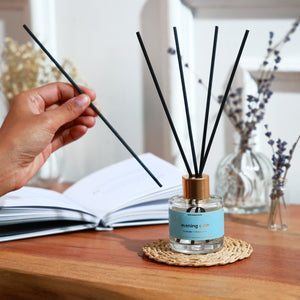
7. Stop running any fragrance overnight — this is the recommendation most people arrive here needing. A reed diffuser cannot be switched off, so it must be moved to a cupboard at close if the morning is your problem. A machine must be on a run window that ends when you lock up. Fragrance emitting into an unventilated building all night is not a head start on the morning; it is a fourth source added to the three you already had.
8. Only then, and only maybe, consider a scent — and only in the arrival zone. If two weeks of the routine has given you a clean morning and you still want reception to have a character, that is a legitimate and separate decision. Nothing on this page goes past the consultation door: examination rooms, diagnostics, consultation cabins, the procedure suite and any post-operative area stay fragrance-free, and that is the practice's own clinical judgement rather than mine. Composed and made in small batches in Pune, and a portion of every order supports girl-child education through Nanhi Kali.

Part one — what fourteen sealed hours actually do
Practices describe this smell in almost identical words — closed, heavy, like the room has been shut — and then reach for a product, because a product is the thing you can buy on a Tuesday. The description is accurate and the instinct is backwards, and the reason is that the morning smell is not a substance the building lacks but a balance the building lost. Three things are worth understanding before you decide anything.
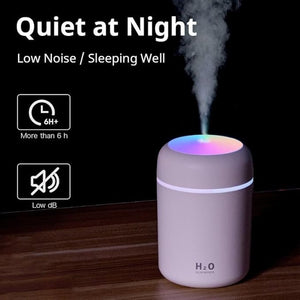
 Sukoon 500ml₹1,899 · remote, 2H/4HI get this in about a third of the letters on this subject, always phrased as a reasonable idea: leave it on overnight so the room smells good when we open. Understand what that actually produces. The same fourteen hours of zero removal that concentrated everything else concentrates your fragrance too, and the room you unlock is not fresh — it is stale and heavily scented, which is the specific combination people describe as cloying. Worse, it is the combination that most reliably makes a patient wonder what the fragrance is there to cover. A reed diffuser has no off switch by design; it is passive capillary diffusion and it runs whenever it exists, so if your morning is the problem the bottle has to physically leave the room at close and come back after the purge. A machine is easier: a Sukoon at ₹1,899 has 2H and 4H timer modes, a Boond at ₹899 exhausts a fill in roughly six hours and stops on its own, and a Vaayu at ₹11,999 takes scheduled run windows and day selection with a key-lock so nobody can quietly extend them.
Part two — the overnight sources, ranked, and what each responds to
Eight sources that accumulate in a sealed clinic overnight, in the order I would investigate them, with the smell each tends to produce, the free test that identifies it, and what actually resolves it. The last column is the same on every row, and that repetition is the point of the table.
| Overnight source | What it tends to smell like at opening | The free test | What actually resolves it | What a diffuser would do |
|---|---|---|---|---|
| Dry floor or basin trap ★ | Sour, faintly sulphurous, strongest low down and near the wash area | Pour a mug of water down every trap at close; if the morning is different, you have found it | Twenty seconds of water down each trap every evening, written into the closing list | Add a second smell on top of the first. Nothing else |
| Waste left in the building | Sweetish, organic, worst near reception and the back corridor | Empty everything one evening and compare the next morning | Move the bin round and the waste handover to the evening, permanently | Add a second smell on top of the first |
| Air-conditioning condensate tray and drain | Damp, earthy, arrives with the first cooling cycle rather than on entry | Note whether the smell appears before or after the compressor starts | A service visit from whoever maintains the system — not a fragrance decision and not mine to advise on | Add a second smell on top of the first |
| The evening clean itself | Sharp, chemical, flat — recognisable as a product | Clean four hours before close for one week instead of at close | Dilution, timing and ventilation after cleaning. There is a whole page on this and it recommends buying nothing | Make it materially worse — two strong smells become a third nobody designed |
| Upholstery, foam and carpet | Dull, warm, textile-ish; strongest in the seating block | Kneel by the seating first thing and compare against the doorway | Deep cleaning on a schedule, and hard flooring at the next refit | Add a second smell on top of the first |
| Cardboard record storage and the pantry | Papery and musty, or food and tea leaves — both usually contained behind one door | Open each door separately at opening and smell it apart from the room | Sealed plastic boxes instead of cardboard, a cleared sink, and door discipline | Add a second smell on top of the first |
| The building itself, if it is old or damp | Musty, mineral, worse in monsoon and after rain | Compare a dry week against a wet one in the opening notebook | Finding and drying the moisture. SOSA sells no dehumidifier and no air purifier, and this is not our problem to solve | Add a second smell on top of the first |
| The honest caveat: the last column is identical on every row because it describes the mechanism rather than the source. A diffuser adds a scent to the air; it does not clean, purify, filter, neutralise, disinfect or freshen it, and it removes nothing that is already there. Any fragrance decision on this page applies to the arrival zone only — reception and waiting. Examination rooms, diagnostic areas, consultation cabins, the procedure suite and any post-operative area take nothing, in any format, at any level, at any hour, and that boundary is the practice's own clinical judgement rather than a supplier's recommendation. Nothing here is medical, clinical, ventilation, air-handling, infection-control or regulatory advice; where a row points at your air conditioning or your drainage, it points at the person who maintains them. No claim is made in either direction about how any patient or member of staff perceives, tolerates or responds to fragrance, and no SOSA product or setting is described as safe or unsafe for any group. Some people are sensitive to airborne fragrance, which is exactly why the clinical pathway stays fragrance-free and why a fragrance-free seat must genuinely exist. | ||||
Mountain Breeze · no off switch, so it moves₹849Shop →  Sukoon · 2H and 4H windows₹1,899Shop →
 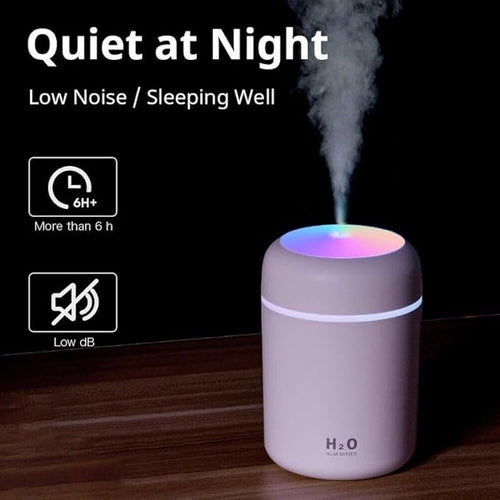 Boond · ends by itself, ~6 hrs a fill₹899Shop →
Part three — the practice that should spend nothing here
I would rather say this plainly than imply it. If your only complaint is the first two minutes of the morning, the correct outcome of reading this page is that you buy nothing from SOSA and change your closing checklist instead. A stale morning is a self-clearing condition: it exists because removal stopped, and removal restarts the moment the building opens. Nothing you can buy improves on that, because nothing sold anywhere removes an odour from a room the way an open door does. What a purchase would do is convert a two-minute problem into a nine-hour presence — a constant bought to solve a transient, at somewhere between ₹749 and ₹11,999. When a practice tells me the mornings are difficult and the rest of the day is fine, the recommendation is a notebook, a trap flush and twenty minutes of open doors, and it ends there.
There is a second version of this where the answer is also nothing, and it is the one that needs more courage to accept. If your building has no fresh-air path at all — sealed glazing, no openable windows, ducted cooling with no outside-air intake, and a front door onto an internal lobby rather than the street — then you have a ventilation limitation that fragrance not only fails to fix but actively worsens. Air that is recirculated is not renewed, and a scent released into a volume that is only ever stirred rather than replaced does not disperse in the way people imagine; it distributes, thins slightly, and then holds. Practices in that position describe the same arc: they buy a machine, the first fortnight is pleasant, and by week four the room is heavier than before and nobody can say why. The answer is that nothing left. That is a conversation with your building's services engineer, and if outside air genuinely cannot be brought in, my recommendation is that you do not add anything to the air you have.
The third case is the one where fragrance eventually earns a place, and I want to describe it precisely so the permission is not read as general. The purge routine has been running for a fortnight, the opening notebook shows a clean morning most days, your reception is a defined arrival zone with a door or a real distance between it and the corridor to consultation, and somebody senior has said out loud that they want the room to have a character rather than that they want a smell removed. That last clause is the test. A practice trying to remove something should not be buying fragrance at all; a practice trying to add something can. Even then, start low and start late — one source, two or three of six reeds, or a machine on its lowest setting inside a run window that begins after the purge. Ask your reception staff a fortnight later with an open question, because they sit in that air eight or nine hours a day against a patient's forty minutes; if they would rather have nothing, that is a complete answer. A practice is judged on competence, and the target for an arrival zone is considered, never scented.
Part four — the opening routine, minute by minute
Here is the routine I would give any clinic with this complaint, timed against the moment the first patient is due. Every line before the last one is free, and most practices never need the last one.
| Clock | Action | Cost | What it changes | The mistake it replaces |
|---|---|---|---|---|
| The night before ★ | Water down every trap; all waste out of the building; pantry sink cleared; any reed bottle moved to a cupboard | Nothing, plus about four minutes of somebody's time | Removes the three sources with the longest run-up. On its own this settles a large share of cases | Emptying bins in the morning, which treats a symptom fourteen hours after the cause |
| T minus 25 | Unlock and open front and rear doors and every openable window before anything else | Nothing | Starts genuine air exchange. Cross-ventilation moves more air in twenty minutes than any machine moves in a day | Switching the cooling on first, which seals the building and starts recirculating what is already in it |
| T minus 25 | Air handling on fan only, no cooling, while the building is open | Nothing beyond the electricity for the fan | Turns a passive airing into a driven one. Ask your maintenance contractor whether your system has a fresh-air path — that question is theirs, not mine | Assuming recirculated air is fresh air. It is not, and there is a whole page in this family on that |
| T minus 20 | Open every cupboard, the record store and the pantry so their air joins the exchange | Nothing | Contained pockets are why a room smells fine at ten and stale again when a door is opened at eleven | Airing only the space you can see |
| T minus 15 | Wipe reception surfaces with plain water, not the evening's cleaner | Nothing extra | Keeps the strongest chemical smell of the day away from the hour when patients arrive | A full chemical clean at opening, in the arrival zone, at the worst possible moment |
| T minus 8 | Close up, switch cooling on, let the system stabilise | Nothing | You start the day with renewed air rather than yesterday's air chilled | Cooling a room that was never aired, which is what most clinics with this complaint are doing |
| T minus 5 | Thirty-second check by whoever opened, and one line in the notebook | A notebook | Gives you the only unadapted reading of the day, and a baseline recorded before you spend anything | Deciding whether the room is better by asking somebody who has been in it for an hour |
| T minus 5, optional and only after a fortnight of clean readings | Start the arrival-zone scent — reeds returned to the shelf, or a machine's run window opening | ₹749–₹1,349 for one bottle, or ₹1,899 for a Sukoon | Adds a character to reception. It does not and cannot remove anything, which is why it is last | Buying this first and never doing any of the rows above it |
Versailles
A practice manager in a two-doctor clinic wrote to ask which of our compositions would be strongest, because the mornings were bad and she wanted something that would hold from eight until the room filled up. It was a well-researched letter. She had shortlisted three scents, worked out the reed counts, and priced a second bottle for the far end of the waiting area.
I asked her four questions instead of answering the one she had sent. Does the smell go away by ten on its own. What time do the bins leave the building. Is there a wash area with a floor drain near reception. And does anything in the clinic run overnight. The replies came back the same evening: yes it goes by about half past nine, the bins go out in the morning, there is a floor drain in the dressing area about four metres from the desk, and yes — a diffuser had been left running every night for a year because the previous manager had set it up that way.
She moved the bins to the evening, put a mug of water down the drain at close, and stopped the overnight running. Three weeks later she wrote to say the mornings were fine and she had not bought anything, and then asked, almost apologetically, whether it would be all right to have a scent in reception anyway now that there was nothing to hide. That is the right order and the right question, and the answer was yes — one bottle, three reeds, at the far end. Composed and made in small batches in Pune, and a part of every order funds a girl's classroom through Nanhi Kali.
Frequently asked questions
- When to fix ventilation, moisture or cleaning instead of increasing fragrance — the decision rule for this whole family.
- Why a fully air-conditioned clinic can smell closed and how to find the source before adding anything.
- Should you cover a disinfectant smell with fragrance? — the page that recommends buying nothing.
- Why a clinic smells different by evening and what to do about mustiness in monsoon.
- Brand: the SOSA founder story.
SOSA range, specifications and prices used in this guide (verified August 2026): Vaayu ₹11,999 — waterless cold-air nebulisation of undiluted fragrance oil; no water, no heat, no added humidity, no white mineral dust. Coverage up to 1000 m³, about 2,000–3,000 sq ft. 400ml refillable tank lasting roughly 90+ days at a mid setting. Bluetooth app plus onboard controls, 1h / 4h / 8h / 24h run windows, day selection, adjustable intensity, auto-stop and key-lock. Under 38 dB. DC 12V / 1A, 5W. Freestanding or wall / HVAC mount. CE, RoHS and SGS certified. SOSA does not currently sell a separate Vaayu cold-air refill oil; the 400ml supplied in the box is the fragrance available at the time of writing, so a practice planning continuous or multi-site use should confirm current refill availability with SOSA before committing. The water-based Hotel Collection is made for ultrasonic machines and must not be used in a Vaayu. Other machines: Boond 300ml ₹899 (~150 sq ft, ultrasonic) · Sukoon 500ml ₹1,899 (270–320 sq ft, 16–18 hours on low, remote and steady/2H/4H timers, three 15ml fragrances included, ultrasonic) · Megh 6L ₹3,499 (~215 sq ft — a runtime and humidity machine that covers less than a Sukoon, never a coverage upgrade) · Safar ₹3,999 (waterless cold diffusion, cordless, 20ml, about 6.9cm, three speeds, 1/2/3-hour auto-off — sold as a car and travel diffuser, personal-scale only; SOSA publishes no coverage figure for it) · Aangan ₹25,999 (HVAC nebulising, ~8,000–10,000 sq ft) · Meenar ₹38,500 (commercial HVAC, 12,000–18,000 sq ft). Water-based Hotel Collection for ultrasonic machines: 15ml ₹299 · 100ml ₹999 · 300ml ₹1,799 · pack of seven ₹1,799; scents are inspired by the atmosphere of well-known hotels — SOSA is an independent Indian brand and is not affiliated with, endorsed by or supplying any hotel group. Reed diffusers ₹749–₹1,349 (50ml 6–8 weeks, 130ml 14–18 weeks, six fibre reeds, no 100ml size; replacement reeds are not sold separately). Reed oil cannot be used in an ultrasonic machine and Hotel Collection oil cannot be used in reeds. SOSA sells no room spray or home spray — every SOSA spray is a car perfume. Nothing in this guide is medical, clinical or safety advice. A fragrance diffuser adds a scent to the air. It does not clean, purify, filter, sanitise or disinfect air, does not remove or neutralise disinfectant, damp or occupancy smells, and has no effect on comfort, anxiety, waiting time, recovery or any clinical outcome. Some people are sensitive to airborne fragrance, which is why this guide recommends that examination rooms, diagnostic areas, consultation cabins, procedure suites and post-operative areas remain fragrance-free, that a fragrance-free seating option always exist, and that a diffuser is never mounted into shared HVAC in a clinical building. Decisions about clinical policy, ventilation standards, infection control and patient suitability rest entirely with the practice and its clinicians. A persistent stale, damp or disinfectant smell is a ventilation, moisture or cleaning problem — SOSA sells no dehumidifier and no air purifier, and fragrance should never be used to cover one. Coverage, runtime and longevity figures are manufacturer specifications and typical ranges, not guarantees, and vary with room volume, ceiling height, air exchange, occupancy and season. SOSA publishes no commercial or bulk pricing, no corporate account, no annual maintenance contract, no installation service, no stated warranty term and no multi-location programme; warranty length, spare parts, servicing and app platform availability are unconfirmed, and larger or multi-site enquiries should go through the contact page before any commitment. Composed and made in small batches in Pune, India. Free shipping above ₹499. A portion of every order supports girl-child education through Nanhi Kali. Prices subject to change — see the live product pages.