




Why cleaning does not fix it: musty is a microbial metabolite, not dirt. Removing dust from a problem made of water changes nothing.
The fixes, in order: air it on the driest part of a dry day rather than continuously; run a fan into the open cupboard; use the AC's dry mode in the room with the doors open; keep the cupboard off an external wall; put nothing even slightly damp in; and use a desiccant — silica gel, or a commercial calcium-chloride moisture absorber, which SOSA does not sell and which is the right product here.
And not this month: a cool-mist ultrasonic adds 30–50 ml of water an hour. It is the wrong machine for a room you are drying out.
2. Musty is a smell produced by something living, not by dirt. It is the metabolic output of microbial activity on cotton, on the starch and sizing in fabric, and on the glue and board of the cupboard itself. This is why a cupboard you have just wiped out still smells the same an hour later.
3. Air it on the driest part of a dry day, rather than continuously. Mid-afternoon, doors fully open, windows open. Leaving a cupboard open through a wet morning imports saturated air into it, which is the one situation where ventilating makes things worse.
4. Then move air rather than merely admitting it. A pedestal fan pointed into the open cupboard for an hour does several times the work of an hour of stillness, and an air conditioner on dry mode with the cupboard doors open dehumidifies the room the cupboard is breathing.
5. And use a desiccant, which is the right product here and one SOSA does not sell. Silica gel sachets, recharged in the sun or a low oven, or a commercial calcium-chloride moisture absorber of the kind sold in every hardware shop in the country. That is the honest recommendation.
6. Fragrance over musty is a second smell on top of the first. And a cool-mist ultrasonic adds 30 to 50 millilitres of water an hour, so it is the wrong machine for the room you are drying out.
A portion of every order supports girl-child education through Nanhi Kali.

What musty actually is, and why cleaning does not touch it
The word musty gets used for anything unpleasant and closed, but it names something quite specific, and knowing what it names changes what you do about it. Musty is the smell of microbial metabolism: the volatile compounds released by moulds and related organisms as they break down the materials they are growing on. The characteristic earthy, cellar-like, faintly mushroom note is a family of these compounds, and your nose is startlingly good at detecting them at very low concentrations, which is why a cupboard can smell distinctly musty with nothing visible on any surface in it. It is a biological signal, not a hygiene one, and that distinction is the whole of this page.
The fixes, in order of how much water they remove
Ranked by the thing that actually matters in a monsoon, which is water rather than cleanliness or scent. The first five cost nothing or almost nothing and the sixth is a product SOSA does not sell. Fragrance appears at the bottom, described accurately as something to do afterwards rather than instead.
| What to do | How much water it removes | When to do it | The catch | Cost |
|---|---|---|---|---|
| A fan into the open cupboard ★ | The most, per hour, of anything free — moving air strips the saturated layer sitting against the fibre | An hour, mid-afternoon, on a day without rain, doors fully open | Needs the room's air to be drier than the cupboard's, so the day matters as much as the fan | ₹0 |
| AC on dry mode, doors open | A great deal — dry mode is designed to remove water rather than heat | Two hours with the cupboard standing open, ideally on the wettest days | Only useful if the room is closed while it runs, and only if the room has an AC | ₹0 beyond the running cost |
| A desiccant inside | Steady and continuous, which is what a closed box actually needs | All season, replaced or recharged as it saturates | Silica gel must be dried out to be reused; calcium chloride fills with water and is replaced. SOSA makes neither | ₹100–₹400 |
| Airing on the driest hour | Moderate, and negative if you do it on a wet morning | Weekly, mid-afternoon, on a dry day, with the room's windows open too | This is the one case where ventilating at the wrong time imports moisture rather than removing it | ₹0 |
| Two inches off the wall, and space on the rail | Indirect but permanent — it removes the cold surface and the still air between garments | Once, and then leave it that way | Not always possible with built-in joinery; clear the back rail instead | ₹0 |
| Wiping the shelves | None. It adds a film of water and removes dust that was never the source | For dust, which is a different problem | The improvement lasts as long as the surface takes to dry, which is why people repeat it | ₹0 |
| A reed in the room, afterwards | None, and it does not claim to | Once the cupboard is dry and airing on a schedule | Adds no water either, which is why it is the format I would use in July. 24 to 72 hours to establish | ₹849 |

The driest hour, the fan, and the desiccant
Start with the timing, because in monsoon the hour you choose matters more than the effort you make. Indoor relative humidity is not constant through a day: it peaks overnight and in the early morning, when the air is coolest, and falls to its daily minimum in the middle of the afternoon. So the instruction is precise rather than general — open the cupboard fully between about two and five on an afternoon when it is not actually raining, with the room's windows open at the same time, and shut it again before evening. An hour then is worth considerably more than a day of standing open at the wrong time, and leaving a cupboard open through a wet night is actively harmful, since you are equilibrating a box of cotton with the most saturated air of the twenty-four hours. This is the exception to everything else this cluster says about opening things up, and it is worth stating without hedging. Then put a fan on it, which is the step that separates people who fix this from people who manage it. Evaporation from a fibre surface is limited by a thin saturated layer of air sitting directly against that surface; still air lets the layer persist, and moving air strips it away continuously. A pedestal fan two feet from the open doors, on medium, for an hour, dries the interior several times faster than an hour of open stillness. If the room has an air conditioner, run it on dry mode with the room closed and the cupboard open for a couple of hours on the wettest days; dry mode is a dehumidifier setting rather than a cooling one, and it removes real quantities of water from the air the cupboard is breathing.
Then the desiccant, and I am going to be direct about it because a fragrance brand recommending a hardware shop is unusual enough to be worth trusting. The right product for a musty cupboard in monsoon is a moisture absorber, and SOSA does not make one. There are two kinds and both work. Silica gel comes as sachets or as loose beads in a perforated box; it adsorbs water vapour, saturates over a few weeks, and is then recharged by an hour in strong sun or twenty minutes in a low oven, after which it works again — the indicator variety changes colour when it is full, which takes the guesswork out. Calcium chloride absorbers are the tubs sold in every hardware and general store in the country: the salt deliquesces, water collects in the reservoir below, and you can watch the level rise, which is oddly convincing evidence that the problem was water all along. Put one at the base of the cupboard and one on the top shelf, since the top of a closed box is where warm moist air collects. Alongside that, three habits: nothing goes in that is not cold and dry to the back of the hand; the rail stays loose enough for air to move between garments; and the unit stands two or three inches clear of an external wall so its back panel is not the coldest surface in the room. If the cupboard is built in and the wall behind it is genuinely wet rather than merely cool, that is a building repair and no amount of housekeeping substitutes for it.
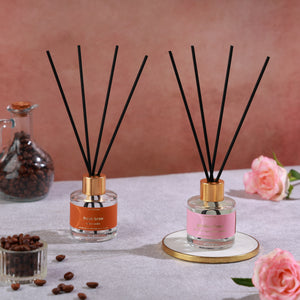
Then the fragrance, which comes last and comes with two plain statements. The first is that a scent over a musty cupboard is a second smell on top of the first rather than a replacement for it. The musty note is being produced continuously by something living; adding a fragrance does not slow that production by any amount, so what arrives at your nose is both, and the more considered the fragrance the more obvious the layering. The second is about the machine, and it is the recommendation I refuse most often in this cluster: a cool-mist ultrasonic diffuser adds 30 to 50 millilitres of water an hour to a room. In a dry month that is unnoticeable. In a bedroom already at 85% relative humidity, with a cupboard you are trying to dry out in the corner of it, it is the wrong machine, and I would rather lose the order than have you write to me in September. So for these particular weeks the formats that make sense are the ones that add no moisture at all: an alcohol-free reed diffuser holds one level for months with nothing to plug in — Mountain Breeze at ₹849 is Himalayan pine, sage and cedar, which is dry and resinous and reads well against monsoon air, and Morning Freshness at ₹749 is lemon, peppermint and eucalyptus if you want the corner to read clean — and a candle such as the Bookshop candle at ₹379 puts scent into a room in fifteen to twenty minutes and must be attended and put out. The Sukoon at ₹1,899 is a good machine and the right purchase in October, and it will still be there.
The SOSA edit
For the monsoon months specifically, in the order that removes the most water first. The one product I would insist on is a desiccant, and it is not mine; the SOSA rows are the two formats that put nothing back into the air of a room you are trying to dry.
| Do | What it is | Why it works | Cost |
|---|---|---|---|
| 1. A fan into the open cupboard ★ | Doors fully open mid-afternoon on a dry day, a pedestal fan two feet away on medium, for an hour | Moving air strips the saturated layer against the fibre; still air lets it sit. Several times the drying of open doors alone | ₹0 |
| 2. AC on dry mode, cupboard open | Two hours with the room closed and the cupboard doors standing open, on the wettest days | Dry mode removes water rather than heat, so the cupboard is breathing genuinely dehumidified air | ₹0 beyond running cost |
| 3. A desiccant, top shelf and base | Silica gel recharged in sun or a low oven, or a calcium-chloride absorber tub. SOSA does not make either | It works continuously in a closed box, which is the only place continuous drying is possible. The right product, named honestly | ₹100–₹400 |
| 4. Off the wall, loose on the rail, nothing damp in | Two or three inches of clearance behind; a hand's width between garments; nothing folded warm and no shoes worn that day | Removes the coldest surface, the still air between garments, and the single damp item that raises the whole box | ₹0 |
| 5. Mountain Breeze or Morning Freshness | Alcohol-free reeds, no electricity and no water added, 24–72 hours to establish, one level for months | The formats that scent a monsoon bedroom without putting anything back into its air. On a shelf in the room, not in the cupboard | ₹849 / ₹749 |
| 6. Bookshop candle | 80g, roughly 15–18 hours of burn, scent in a room in fifteen to twenty minutes, attended and put out | For an evening rather than a season. Adds no moisture, and the flame is a small amount of warmth in a damp room | ₹379 |
| Not this month: a cool-mist ultrasonic | The Sukoon, Boond and Megh all add 30–50 ml of water an hour to the air of the room they stand in | Said rather than sold. Buy it in October for the same room, and it will be the right machine then | — |

Versailles
Every July I answer some version of this letter, and it usually arrives with a list of everything the writer has already tried: emptied the cupboard, washed everything, wiped the shelves, laid fresh newspaper, bought something scented. None of it works, and the reason is that musty is not dirt. It is the smell of something living, and it is being produced continuously for as long as the humidity allows it. Above about 60% relative humidity that production accelerates, and a monsoon flat runs at 80 to 95%. Your cupboard has not become unclean. It has become habitable.
So the honest recommendation on this page is a fan, an afternoon, and a box of silica gel from the hardware shop, and I am aware that none of those is something I sell. I am also going to talk you out of the one thing you might reasonably have come here to buy: a cool-mist diffuser adds thirty to fifty millilitres of water an hour to a room, which is the last thing a damp bedroom needs. When the cupboard is dry and airing on a schedule, a reed on a shelf in the room adds nothing to the air but scent and holds one level for months, and a candle gives you twenty minutes of it on an evening you want the room to feel finished. That is the whole of my commercial interest in this page, and it comes fifth.
Everything is made and supported from Pune, and a part of every order funds girl-child education through Nanhi Kali. You get a home that smells like somewhere you chose; a girl gets a classroom. That equation has always felt right to me.
Frequently asked questions
- Why the area around your wardrobe smells stale — the airflow half of the same cupboard.
- What humidity level makes a house start smelling musty — the threshold, in full, room by room.
- Should you use an ultrasonic diffuser in a room that is already damp — the machine question, answered honestly.
- Why your wardrobe smells stale, and how to fix it properly — the complete guide for this group.
- Brand: the SOSA founder story.
Facts verified August 2026: Diagnostic facts used in this guide: a closed room accumulates what it cannot exchange, so cross-ventilation needs two openings rather than one; a drain's U-bend water seal evaporates in roughly two to four weeks of disuse and then admits sewer gas, which is corrected by pouring water down the drain; microbial growth in fabric and on surfaces accelerates above about 60% relative humidity, and Indian monsoon indoor humidity commonly runs 80–95%, which is the one situation where ventilating on a wet day can import moisture rather than remove it; an air-conditioner's cold, wet evaporator coil and filter grow biofilm that is blown into the room on start-up; textiles adsorb cooking aerosol and body oils and re-release them for weeks; and olfactory adaptation makes a constant household smell undetectable to its residents within about a fortnight while visitors still perceive it. Timings: a scented candle scents a normal room in roughly 15–20 minutes, a Sukoon ultrasonic diffuser reaches a steady level in about 20 minutes from cold, and a reed diffuser needs roughly 24–72 hours. SOSA products and prices: Sukoon 500ml ₹1,899 (270–320 sq ft, 16–18h on low, 9–12h high, 30–50 ml/h, 2.4MHz cool mist, remote, steady/2H/4H timers, BPA-free, auto shut-off, includes three 15ml Hotel Collection scents of your choice); Boond 300ml ₹899; Megh 6-litre ₹3,499; waterless Vaayu ₹11,999 (up to 1000m³); Aangan ₹25,999. Hotel Collection water-based fragrance 15ml ₹299, 100ml ₹999, 300ml ₹1,799, Pack of 7 at 15ml ₹1,799; dose 3–6 drops per tank. Reed diffusers (separate alcohol-free line): Morning Freshness from ₹749, Garden Bloom and Evening Calm from ₹799, Fresh Brew and Mountain Breeze from ₹849; 130ml from ₹1,249; duos from ₹1,498; 300ml refills ₹2,399. Scented candles: Bookshop 80g ₹379, Amber Rose 130g ₹599 and 220g ₹799, Smoked Oudh 130g ₹449, ceramic jar candles ₹949, Pure Calm wax melt set ₹854. Free shipping above ₹499. SOSA does not make a room or linen spray for the home. The Hotel Collection scents are SOSA's own interpretations; SOSA is not affiliated with or endorsed by any hotel brand. Prices subject to change — see the live product pages.