Why Does My Bedroom Smell Better the Day I Change the Bedsheets?

Why Does My Bedroom Smell Better the Day I Change the Bedsheets?

★ The sofa is usually the answer · why a clean room can still smell of six months of dinnersCandle ₹379 · reed ₹749 · Boond ₹899 · Sukoon ₹1,899 · free shipping above ₹499A portion funds girl-child education
★ SOSA · find the cause, then scent the room
Air changes in twenty minutes. Fabric does not. Textiles are where a room keeps its memory, and that is where most of these smells actually live
★ ★ ★ ★ ★
★★★★★
"Standing up it was fine, sitting down it was awful. That single observation told me it was the sofa, and I would never have thought of it."
Gaurav P. Sofa, Bengaluru
Diagnosed by height
★★★★★
"Cushion covers in the machine, throws in the sun, vacuum with the upholstery head. Cost nothing and the living room stopped smelling closed."
Anjali M. Free fix · washed covers
Living room
★★★★★
"Asked whether to spray the sofa. Was told to wash the covers instead, because spraying fabric that already holds a smell gives you both. Obvious once said."
Sanjay R. Told not to spray
Sofa, Delhi
★★★★★
"Curtains. Four years, never washed, right beside an open kitchen. They came out of the machine and the room changed."
Fatima Q. Curtains, Mumbai
Free fix · laundry
★★★★★
"Monsoon made the carpet unbearable and I assumed it was the carpet's fault. It was the humidity. Different problem, different fix."
Vivek S. Carpet, Kochi
Humidity, not dirt
★★★★★
"Once the fabric was dealt with, the reed finally worked. Before that I was scenting a sofa. Now the room holds one level all month."
Divya L. Reed after cleaning
from ₹749
★★★★★
"Standing up it was fine, sitting down it was awful. That single observation told me it was the sofa, and I would never have thought of it."
Gaurav P. Sofa, Bengaluru
Diagnosed by height
★★★★★
"Cushion covers in the machine, throws in the sun, vacuum with the upholstery head. Cost nothing and the living room stopped smelling closed."
Anjali M. Free fix · washed covers
Living room
★★★★★
"Asked whether to spray the sofa. Was told to wash the covers instead, because spraying fabric that already holds a smell gives you both. Obvious once said."
Sanjay R. Told not to spray
Sofa, Delhi
★★★★★
"Curtains. Four years, never washed, right beside an open kitchen. They came out of the machine and the room changed."
Fatima Q. Curtains, Mumbai
Free fix · laundry
★★★★★
"Monsoon made the carpet unbearable and I assumed it was the carpet's fault. It was the humidity. Different problem, different fix."
Vivek S. Carpet, Kochi
Humidity, not dirt
★★★★★
"Once the fabric was dealt with, the reed finally worked. Before that I was scenting a sofa. Now the room holds one level all month."
Divya L. Reed after cleaning
from ₹749
Reed diffusers: no electricity, no routine, one level for months · from ₹749 A reed needs 24–72 hours to establish — the right buy for a habit, the wrong one for tonight Air the room first · scent layers on clean air, it never replaces it


Founder Diaries · Home Fragrance · Sofas, Curtains & Soft Furnishings
By Sonal Sahani · ISIPCA Versailles 10 min read Updated August 2026
This is the nicest question in the group, because the answer is that you have done something genuinely effective and it feels even better than it was. Two things happen on sheet-change day and only one of them is the one you are thinking of. You have removed a week of accumulated body oils, sweat and skin from the largest area of fabric you are in direct contact with for eight hours a night. You have also introduced a completely new smell into a room whose baseline your nose had stopped reporting — and that second effect is why the whole bedroom reads as fresher than clean sheets alone could account for.
Quick answers — read this first
The obvious half: you removed a week of body oils, sweat, skin and hair product from the largest fabric surface in the room, and those oils oxidise over days into the compounds a nose reads as stale.

The less obvious half: you also introduced a new smell — clean cotton and detergent — into a room your nose had habituated to. A nose reports change, so the change itself is part of what you are enjoying.

The intervals: sheets weekly, more often in summer; pillowcases more often than sheets; duvet cover and mattress protector on longer cycles that almost everybody forgets entirely.

The commercial note: the bedroom is the room to under-scent, because it already has a weekly reset built into it.
The short answer
Short answer: because two things happen at once. You remove a week of body oils, sweat and skin from the largest fabric surface in the room, and you introduce a new smell into a room your nose had gone blind to. The second effect is why it feels dramatic rather than merely better.
What to do about it: weekly for sheets and more often through an Indian summer; pillowcases more often than sheets, because they take hair, face and product; duvet cover monthly at least; mattress protector on a real schedule rather than never. Fold the duvet back for twenty minutes before making the bed so the night's moisture can leave.
And the fragrance note: the bedroom needs less than any other room, because it already has a weekly reset. A reed diffuser from ₹799 with half its sticks turned, or three drops in a Boond at ₹899 for two hours before bed. The Sukoon is ₹1,899 with three 15ml Hotel Collection scents included. Free shipping above ₹499.
Straight answer
Why does my bedroom smell so much better on the day I change the bedsheets?
1. Because you removed the largest single deposit of body oil in the house. Skin, sweat, sebum, hair oil and whatever you put on your face all transfer into bedlinen across a week, and once there they oxidise into shorter, more volatile compounds — which is what a nose reads as stale.

2. And because you introduced a new smell into a room that had stopped reporting its old one. A nose reports change and discards constants, so after a few days you cannot smell your own bed at all. Clean cotton and detergent give the receptors something to say, and the contrast is part of the pleasure.

3. Which is why the effect feels larger than the sheets alone can explain. You are enjoying a subtraction and an addition at the same moment, in the room where you spend more consecutive hours than anywhere else.

4. Weekly is the right interval for most people, and more often through summer. Pillowcases more often than sheets, because they take hair, face, hair oil and skincare all at once. The duvet cover and the mattress protector run on longer cycles and are the two items almost everybody forgets.

5. And fold the duvet back for twenty minutes before you make the bed. A night's moisture leaves a bed far better through an open surface than through a made one, and it costs nothing at all.

A portion of every order supports girl-child education through Nanhi Kali.
TL;DR: two things happen at once — you remove a week of body oils from the largest fabric surface you touch, and you introduce a new smell into a room your nose had habituated to. The second is why it feels dramatic. Weekly for sheets, more often for pillowcases, and the bedroom is the room to under-scent.
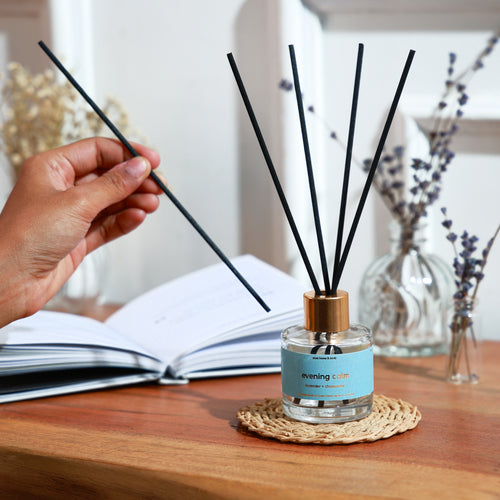
Evening Calm reed diffuser
The bedroom scent, at the lowest useful level
Evening Calm reed diffuser from ₹799
Himalayan lavender and chamomile, alcohol-free, unplugged and silent. A bedroom already has a weekly reset built into it, which no other room in the house does, so it needs less added fragrance than anywhere else — and a reed is the easiest way to run a level deliberately low, because you control it by how many sticks you turn rather than by a dial. Start with half the sticks in the liquid and leave the rest dry. Put it on a chest of drawers rather than the bedside table, and give it a day to three days before deciding. From ₹799, 130ml from ₹1,299, 300ml refills ₹2,399.

The two things that happen at once

Sheet-change day is a small experiment that most people run once a week without noticing what it demonstrates. You change one variable and the room changes out of proportion to it, and the reason is that you did not change one variable — you changed two, in opposite directions, at the same moment. Separating them is worth doing, because one of the two tells you how often to wash things and the other tells you how much fragrance a bedroom actually needs, and those are the only two questions this room ever really raises.

1
THE OBVIOUS HALF
A week of body oil off the largest fabric surface you touch
Start with the subtraction, which is real and larger than people assume. A bed is not a passive object you lie on. It is a warm, enclosed, poorly ventilated system in contact with your entire body for roughly a third of your life, and it collects accordingly. Across an ordinary night an adult loses something in the region of half a litre of moisture, considerably more through an Indian May, along with sebum from skin and scalp, shed skin cells, and whatever was on you when you got in — hair oil, night cream, the residue of the day. Almost all of that goes into the sheet, the pillowcase and the top few millimetres of whatever is under them. None of it smells of anything on the night it arrives, which is exactly why the accumulation goes unnoticed. It smells several days later, because oils oxidise: exposed to air over time they break down into shorter, more volatile compounds, and those are the ones a nose reads as stale, closed or faintly sour. This is also why the smell is worst in the morning and why it is worse in summer — more sweat, more sebum, warmer fabric and faster oxidation all arrive together. So on the day you strip the bed you remove several days of that in one movement, and you replace it with cotton that has been through hot water and detergent. That part is straightforwardly a good thing and it is why weekly is the right rhythm rather than a fussy one.
2
THE HALF NOBODY MENTIONS
You also introduced a new smell into a room your nose had gone blind to
Now the addition, which is the part that makes the day feel dramatic rather than merely better. Your nose reports change and discards constants. A smell that is present continuously stops being reported within minutes of exposure, and a smell that is present every day in your own home becomes effectively invisible within about a fortnight while every visitor still receives it perfectly well. Your bedroom's baseline — you, your bedding, your wardrobe, the room's own materials — is the most habituated smell in your life, because it is the one you are exposed to for eight unbroken hours a night with a closed door. You are not smelling it. You have not smelled it for years. Then you put clean cotton and warm detergent into that room, and suddenly there is a difference for the receptors to report, and everything gets re-evaluated against it. The room does not merely smell of clean sheets. It smells noticeably fresher overall, brighter, more looked-after, and that surplus is the contrast rather than the linen. It is the same mechanism that makes your own house smell unfamiliar for thirty seconds when you come back from a week away, and it fades on the same schedule: by Wednesday the new baseline has been absorbed and the room reads as neutral again. Nothing has gone wrong when that happens. You have simply stopped being given new information, which is what a nose is for.
The consequence worth taking from this, and it applies well beyond the bedroom: part of what you enjoy about any home fragrance is the change rather than the level. Which is why adding drops rarely helps, and why a second scent in another room frequently does.
3
WHAT FOLLOWS
Weekly, pillowcases more often, and the two items everybody forgets
So the practical programme falls out of the first half and the fragrance advice falls out of the second. Weekly is the right interval for sheets for most people, and five or six days is better through an Indian summer or for anybody who sweats at night. There is no virtue in a fortnight; the oxidation curve is what it is, and by day ten you are sleeping in something that has started reporting itself. Pillowcases should be changed more often than sheets, and this is the single highest-return adjustment on the page. A pillowcase takes your face, your scalp, your hair oil, your skincare and your breath, over a very small area, and it is the closest fabric in the world to your own nose all night. Twice a week is not excessive and many people find that alone settles the morning smell they have been blaming on the room. Keeping a couple of spare pillowcases makes this cost nothing but a drawer. Then the two items nobody thinks about at all: the duvet or quilt cover, and the mattress protector. The cover is a large piece of fabric held against your body for eight hours and it is frequently washed twice a year, if that; monthly is a reasonable target. The protector is the layer actually doing the work of keeping everything above out of the mattress below, and it is usually put on once when the bed was bought and never removed again, which defeats the entire purpose of owning one. Both are dealt with in the table below, along with the pillow and the mattress themselves, which have their own pages in this cluster and the one beside it.

The bed, item by item, with real intervals

Everything on a bed, what each item actually takes, how often it genuinely needs dealing with, and what happens if it does not. Every row costs ₹0 to act on. The intervals are the ones I would give a friend rather than the ones that sound impressive, and the bottom two rows are the items almost nobody on this page is currently doing anything about.

The bed, item by item
What each layer takes, and how often it actually needs dealing with
Item What it takes Real interval What happens if you do not Cost
Pillowcases ★ Face, scalp, hair oil, skincare and breath, over a small area, inches from your nose all night Twice a week, and more in summer The classic morning smell people blame on the whole room. This one item settles it surprisingly often ₹0
Sheets Roughly half a litre of moisture a night, sebum, shed skin, and whatever was on you when you got in Weekly; every five or six days through an Indian summer Oils oxidise into shorter volatile compounds over days, which is the stale note that arrives around day ten ₹0
Duvet or quilt cover The same as the sheet, from above, across a large area held against you all night Monthly at least, and fortnightly in summer Frequently washed twice a year. It is one of the largest untreated fabric surfaces in the house ₹0
Mattress protector Everything the sheet lets through, which is the entire reason the item exists Every one to two months Put on once when the bed was new and never removed, which defeats the point of having bought one ₹0
The duvet or quilt itself Moisture and body oil through the cover, slowly Aired in sun a few times a year; washed or professionally cleaned annually per the label It becomes the reservoir instead of the cover, and then washing the cover stops making a difference ₹0
Pillows and the mattress Years of everything above, plus dust and moisture Pillows sunned monthly and replaced on the label's schedule; mattress vacuumed and sunned or aired seasonally See the pillow page and the mattress page — both are their own problem ₹0
Shop this guide
For the bedroom, at the lowest useful level
The SOSA principle
You did two things at once: you took a week of body oil out, and you put a change in. Only the first was cleaning. The second is why it felt like more.
A nose reports change and discards constants, which is also why the effect has faded by Wednesday, and why nothing has gone wrong when it does.

The weekly routine, and the room to under-scent

The routine first, because it is short and most of it is habit rather than work. Strip the bed in the morning rather than the evening, and while it is stripped open two windows on opposite or adjacent walls for twenty minutes — one window is ventilation and two is exchange — so the mattress and the room get moving air across them at the one moment in the week when nothing is covering either. Wash bedlinen at the warmest temperature the label allows, since body oil responds to heat and detergent in the same way cooking residue does, and dry it completely. Then the free habit that does the most for the other six days: fold the duvet back off the bed for twenty minutes after you get up, before you make it. A night's moisture leaves an open bed easily and leaves a made one very slowly, and a bed made at once every morning spends its day as a warm, enclosed, slightly damp box. Twenty minutes of exposure, ideally with a window open, is the difference between that and a bed that is dry by nine. Add a monthly item to the same rhythm — the duvet cover one month, the protector the next — so that the two forgotten layers get dealt with without anybody having to remember a schedule. And on any dry sunny morning, put the pillows out for two hours a side, standing on edge; direct sun is dry heat and ultraviolet at once, and it is the most underused resource in an Indian home.

Then the fragrance, which in this room is a smaller decision than anywhere else in the house and should be treated as one. A bedroom is the smallest scented volume you own, it has the fewest air changes, it spends the night with the door shut, and it contains you for eight unbroken hours — so everything you add simply stays. It is also the only room in the house with a weekly reset already built into it, which is the whole point of this page: the linen change is doing a job that in a living room you would have to buy a product to approximate. So the correct instruction here is less rather than more. Three drops rather than four in a Boond at ₹899 or a Sukoon at ₹1,899, on while you are getting ready for bed and off before you are actually in it — the Sukoon's 2H timer exists for exactly this, and a scent that has stopped carries on working in a closed room long after the mist has gone. Never run a machine through the night. Stand it across the room from the pillow and well away from the wardrobe, at waist height or above, because cool mist falls rather than rises and bedding hands a scent back for days. If you would rather not have a routine at all, a reed diffuser at ₹799 in the alcohol-free line is the better product for this room, and Evening Calm — Himalayan lavender and chamomile — is the obvious one. Put half the sticks in and leave the rest dry; you can always add another. Allow 24 to 72 hours before judging it, and put it on a chest of drawers rather than the bedside table.

Then the constraints and the honest limits. Fragrance does not substitute for the linen change and nothing on this page should be read as suggesting it might. A scented bedroom with three-week-old sheets in it smells of two things, and the one you are lying on wins because it is four inches from your face. If mornings are the problem, the order is linen, then air exchange, then humidity, then anything with a price on it — and if the smell persists through all of that, the mattress and the pillows are the next suspects rather than the fragrance being insufficient. On the products themselves: the Hotel Collection is water-based and runs in the Sukoon, the Boond and the Megh only, never in a reed and never in the waterless Vaayu at ₹11,999. Reed oil does not go into an ultrasonic either, since it is undiluted and clogs the 2.4MHz plate. SOSA does not make a linen spray, so there is nothing here to put on the sheets themselves, and I would not recommend it if there were: the pleasure of clean bedlinen is its own detergent and a night's worth of nothing else. Buy the 15ml at ₹299 before the 300ml 300ml refill at ₹1,799, and in this room expect a bottle to last a very long time, because three drops twice a week is the whole of it. A bedroom that needs more than that is usually a bedroom with a laundry backlog.

The bedroom is the one room in the house with a reset already built into it. Which is exactly why it is the room to under-scent.
— Sonal Sahani, SOSA

The SOSA edit

In order, and it is a short list because this room genuinely needs the least. Four free lines, then the smallest fragrance decision in the house, then the absence stated plainly — because a page about bedlinen is one where a reader will reasonably wonder whether we sell something to spray on it.

The SOSA edit
A bedroom that smells best on laundry day, in order
Step What it is Why it comes here in the order Cost
1. Pillowcases twice a week, sheets weekly ★ The two items closest to your face, washed at the warmest temperature the label allows and dried completely First, and for many readers it is the entire answer. Pillowcases are the highest-return change on the page ₹0
2. The duvet back for twenty minutes before making the bed A night's moisture leaving through an open surface rather than being sealed under a made bed all day Second. It costs nothing, takes no time, and it works on the six days you are not changing linen ₹0
3. Twenty minutes of real exchange while the bed is stripped Two openings on opposite or adjacent walls, at the one moment in the week when the mattress is uncovered Third. The mattress and the room get moving air simultaneously, which never otherwise happens ₹0
4. The duvet cover monthly, the protector every one to two months The two layers almost nobody launders, alternated so neither needs remembering Fourth. If the smell survives steps one to three, this is where it has been living ₹0
5. Evening Calm or three drops in a Boond Lavender and chamomile reeds from ₹799 with half the sticks turned, or a 300ml ultrasonic at ₹899 run for two hours before bed Fifth, and deliberately small. This is the room to under-scent, because it already resets itself every week from ₹799 / ₹899
Not in the range: a linen spray SOSA makes no linen, fabric or room spray for the home. The sprays in the range are car perfumes Stated here because bedlinen is the classic linen-spray page, and because clean sheets do not need one
Honest notes for buyers: fragrance is the last step, never the first. It layers on air that is already clean and moving, and it will not remove a source — not damp, not a dry drain trap, not a loaded sofa, not a filter that needs washing. Deal with the cause, change the air, then scent the room. On timing: a candle puts scent into a room in fifteen to twenty minutes and a Sukoon reaches a steady level in about twenty, while a reed diffuser needs a day to three days before it is doing its job — the wrong buy for a deadline and the right buy for a room you want to hold one level for months. SOSA does not make a room or linen spray for the home; the sprays in the range are car perfumes. A cool-mist ultrasonic adds 30–50 ml of water an hour to the air, so it is the wrong machine for a room you are trying to dry out. The Hotel Collection is water-based and runs in the Sukoon, Boond and Megh only — not in reeds and not in the waterless Vaayu. Reed diffusers are a separate alcohol-free line with their own scents. Candles must be attended and put out. The Hotel Collection scents are SOSA's own interpretations inspired by the world's finest hotels; SOSA is an independent Indian fragrance house, not affiliated with or endorsed by any hotel brand. A portion of every order supports girl-child education through Nanhi Kali.
SOSA Boond
A small machine, run for two hours, in the smallest room in the house
SOSA Boond ₹899
A 300ml ultrasonic diffuser taking the same water-based Hotel Collection bottles at the same three to six drops per tank — the dose is per tank rather than per litre, since you are scenting the mist and not the water. In a bedroom the smaller machine is the better one rather than merely the cheaper one, because a bedroom is the smallest scented volume in the house, has the fewest air changes and contains you for eight unbroken hours. Three drops, on while you are getting ready for bed, off before you are in it. Across the room from the pillow and away from the wardrobe.
SS
ISIPCA
Versailles
A note from Sonal

I like this question because the answer contains a compliment. Whatever else is going on in your flat, you have found the one weekly habit that resets the room you spend the most consecutive hours in, and you found it without anybody selling you anything. Most of what I write in this cluster is an attempt to persuade people to do something free before they do something expensive. Here the free thing is already happening and my job is mostly to explain why it works better than it should.

The half people are surprised by is the second one. You are not only enjoying clean sheets; you are enjoying a change, in a room whose ordinary smell your nose stopped reporting to you some years ago. That is worth knowing, because it means the fading by Wednesday is normal rather than a failure of your detergent, and because it explains why a bedroom needs less fragrance than any other room in the house. It has a reset built into it. So: half the sticks in a reed on the chest of drawers, or three drops on a two-hour timer while you get ready for bed. Then leave it alone and change the pillowcases twice a week, which will do more than either.

Everything is made and supported from Pune, and a part of every order funds girl-child education through Nanhi Kali. You get a home that smells like somewhere you chose; a girl gets a classroom. That equation has always felt right to me.

Frequently asked questions

Why does my bedroom smell so much better after changing the sheets?
Two reasons at once. You removed a week of body oils, sweat and skin from the largest fabric surface you touch, and those oils oxidise over days into the compounds a nose reads as stale. You also introduced a new smell into a room your nose had habituated to, and a nose reports change, so the contrast itself is part of what you are enjoying.
How often should bedsheets actually be changed?
Weekly for most people, and every five or six days through an Indian summer or for anybody who sweats at night. Pillowcases should go more often than sheets — twice a week is reasonable — because they take face, scalp, hair oil and skincare over a small area inches from your nose.
Why does the fresh smell fade after two or three days?
Because your receptors have adapted to it. A constant smell stops being reported within minutes of exposure, and a daily one becomes effectively invisible in your own home within about a fortnight. Nothing has gone wrong; you have simply stopped being given new information.
What do people forget to wash on a bed?
The duvet or quilt cover and the mattress protector. The cover is one of the largest untreated fabric surfaces in the house and is frequently washed twice a year; monthly is a fair target. The protector is often fitted once and never removed, which defeats the reason for owning one.
How much fragrance does a bedroom need?
Less than any other room. It is the smallest scented volume in the house, it has the fewest air changes, it spends the night closed and it already has a weekly reset built into it. Three drops in a Boond at ₹899 for two hours before bed, or a reed diffuser at ₹799 with half its sticks turned.
The one room that resets itself
Pillowcases twice a weekand the smallest fragrance decision in the house
Evening Calm is Himalayan lavender and chamomile from ₹799 in the alcohol-free reed line, with 130ml from ₹1,299 and 300ml refills at ₹2,399; allow 24 to 72 hours to establish and start with half the sticks. The Boond is ₹899 for 300ml and the Sukoon ₹1,899 for 270–320 sq ft with steady, 2H and 4H timers and three 15ml Hotel Collection scents of your choice included. Hotel Collection scents are ₹299 for 15ml. Free shipping above ₹499, and a portion of every order supports girl-child education through Nanhi Kali.
See Evening Calm → See the Boond · ₹899
Continue the read
More from SOSA
Editorial standards & sources
About this guide: Written by Sonal Sahani, ISIPCA Versailles-trained founder and perfumer at SOSA Home & Body, on why a bedroom smells better on laundry day than on any other — the removal of a week of body oils from the largest fabric surface in the room, the simultaneous introduction of a new smell into a habituated nose, the real washing intervals for pillowcases, sheets, duvet covers and mattress protectors, and why a bedroom with a weekly reset already built into it is the room to under-scent.

Facts verified August 2026: Diagnostic facts used in this guide: a closed room accumulates what it cannot exchange, so cross-ventilation needs two openings rather than one; a drain's U-bend water seal evaporates in roughly two to four weeks of disuse and then admits sewer gas, which is corrected by pouring water down the drain; microbial growth in fabric and on surfaces accelerates above about 60% relative humidity, and Indian monsoon indoor humidity commonly runs 80–95%, which is the one situation where ventilating on a wet day can import moisture rather than remove it; an air-conditioner's cold, wet evaporator coil and filter grow biofilm that is blown into the room on start-up; textiles adsorb cooking aerosol and body oils and re-release them for weeks; and olfactory adaptation makes a constant household smell undetectable to its residents within about a fortnight while visitors still perceive it. Timings: a scented candle scents a normal room in roughly 15–20 minutes, a Sukoon ultrasonic diffuser reaches a steady level in about 20 minutes from cold, and a reed diffuser needs roughly 24–72 hours. SOSA products and prices: Sukoon 500ml ₹1,899 (270–320 sq ft, 16–18h on low, 9–12h high, 30–50 ml/h, 2.4MHz cool mist, remote, steady/2H/4H timers, BPA-free, auto shut-off, includes three 15ml Hotel Collection scents of your choice); Boond 300ml ₹899; Megh 6-litre ₹3,499; waterless Vaayu ₹11,999 (up to 1000m³); Aangan ₹25,999. Hotel Collection water-based fragrance 15ml ₹299, 100ml ₹999, 300ml ₹1,799, Pack of 7 at 15ml ₹1,799; dose 3–6 drops per tank. Reed diffusers (separate alcohol-free line): Morning Freshness from ₹749, Garden Bloom and Evening Calm from ₹799, Fresh Brew and Mountain Breeze from ₹849; 130ml from ₹1,249; duos from ₹1,498; 300ml refills ₹2,399. Scented candles: Bookshop 80g ₹379, Amber Rose 130g ₹599 and 220g ₹799, Smoked Oudh 130g ₹449, ceramic jar candles ₹949, Pure Calm wax melt set ₹854. Free shipping above ₹499. SOSA does not make a room or linen spray for the home. The Hotel Collection scents are SOSA's own interpretations; SOSA is not affiliated with or endorsed by any hotel brand. Prices subject to change — see the live product pages.
Zurück zum Blog