


Why Do Reed Diffusers Feel Too Weak in Large Luxury Apartments?

Why Do Reed Diffusers Feel Too Weak in Large Luxury Apartments?

★ You are spraying before every viewing · here is what a spray can and cannot doVaayu ₹11,999 · Aangan ₹25,999 · Sukoon ₹1,899 · free shipping above ₹499A portion funds girl-child education
★ SOSA · property viewings & premium presentation
A spray peaks in a minute and is gone in thirty. A reed takes two days to arrive. Neither is built for a scheduled appointment in a large empty flat
★ ★ ★ ★ ★
★★★★★
"Sprayed before every viewing for three years. Strong at the door, gone by the time we reached the bedrooms. That gap was the whole problem and I had never named it."
Kunal Marwah Premium resale, Mumbai
Spray → machine
★★★★★
"Reeds in a 3,000 sq ft flat did nothing and I assumed they were bad reeds. They were the wrong format for the volume."
Sarita Pillai Large apartments, Chennai
Format, not quality
★★★★★
"Asked for a SOSA room spray and was told they do not make one for the home, and why. I respected that more than a sale."
Vivek Sharma Luxury broker, Delhi
Told plainly
★★★★★
"Back-to-back viewings on a Saturday. The machine holds a level for six hours; a spray needed redoing between each one."
Ishita Chaudhary Weekend viewings, Gurgaon
Six viewings, one setting
★★★★★
"Waterless was the deciding factor. No tank to empty, nothing to spill in somebody else's flat, no residue on stone."
Prakash Nambiar Marble interiors, Kochi
Nothing to spill
★★★★★
"I still keep reeds in the two listings that are shown constantly. Different job, and that was explained rather than upsold."
Rhea Kapadia Long-running listings, Pune
Reeds still have a role
★★★★★
"Sprayed before every viewing for three years. Strong at the door, gone by the time we reached the bedrooms. That gap was the whole problem and I had never named it."
Kunal Marwah Premium resale, Mumbai
Spray → machine
★★★★★
"Reeds in a 3,000 sq ft flat did nothing and I assumed they were bad reeds. They were the wrong format for the volume."
Sarita Pillai Large apartments, Chennai
Format, not quality
★★★★★
"Asked for a SOSA room spray and was told they do not make one for the home, and why. I respected that more than a sale."
Vivek Sharma Luxury broker, Delhi
Told plainly
★★★★★
"Back-to-back viewings on a Saturday. The machine holds a level for six hours; a spray needed redoing between each one."
Ishita Chaudhary Weekend viewings, Gurgaon
Six viewings, one setting
★★★★★
"Waterless was the deciding factor. No tank to empty, nothing to spill in somebody else's flat, no residue on stone."
Prakash Nambiar Marble interiors, Kochi
Nothing to spill
★★★★★
"I still keep reeds in the two listings that are shown constantly. Different job, and that was explained rather than upsold."
Rhea Kapadia Long-running listings, Pune
Reeds still have a role
Vaayu: waterless cold-air nebulisation · no water, no heat, no dampness · under 38 dB 1000 m³ (≈2,000–3,000 sq ft) · 400ml tank ≈75 days · app + 1h/4h/8h/24h timers · key-lock 0.9 kg and smaller than a shoebox — one machine can serve a whole portfolio of listings


Founder Diaries · Property Viewings · Sprays, Reeds & Professional Machines
By Sonal Sahani · ISIPCA Versailles 11 min read Updated September 2026
This is a question about format rather than about quality, and the distinction matters because the reeds are almost certainly not the problem. A reed diffuser produces a small, steady output determined entirely by its own construction — the diameter and number of the reeds, how much of their length is exposed, the viscosity of the oil and the temperature of the room — and it has no way of knowing whether it is standing in a cloakroom or in an 800 cubic metre living volume. In the cloakroom that fixed output is close to ideal. In the living volume the same output is being asked to fill sixty or seventy times as much air, and there is no dial on the bottle. Nothing has gone wrong. A small source has been put in front of a large problem.
Quick answers — read this first
The mechanism: capillary action draws oil up the rattan and it evaporates passively from the exposed length. Output is set by exposed surface area, not by the room — so it is small, constant and identical in a 12 m³ bathroom and a 975 m³ apartment.

The arithmetic: the same output distributed through four times the volume gives you roughly a quarter of the concentration, and a reed cannot be turned up. Flipping the sticks gives a short bump and then returns to the same level.

The second limit: 24 to 72 hours to reach working level. Useless for a viewing arranged tomorrow, excellent for a listing shown over months.

The recommendation: keep reeds — from ₹749 — in bathrooms, halls and long-running listings. Use the Vaayu at ₹11,999, up to 1000 m³ with adjustable intensity, where the problem is volume.
The short answer
Short answer: because a reed's output is fixed by its own exposed reed surface and is completely independent of the room it stands in. Spread that same small output through a large apartment and the concentration falls roughly in proportion to the volume, and unlike a machine a reed has no setting to raise. It is a format mismatch rather than a quality fault.
The pick: the Vaayu at ₹11,999 for volume — waterless, up to 1000 m³, adjustable intensity, 1h/4h/8h/24h timers; a reed diffuser from ₹749 kept for bathrooms, entrance halls and any listing shown repeatedly over months, where its 24 to 72 hours to establish is an advantage rather than a problem; and the Aangan at ₹25,999 only where the volume genuinely runs past 1000 m³.
Shop: reed diffusers from ₹749 for Morning Freshness, ₹799 for Garden Bloom and Evening Calm, ₹849 for Fresh Brew and Mountain Breeze, 130ml from ₹1,249 and 300ml refills at ₹2,399. The Vaayu is ₹11,999 with a 400ml tank lasting about 75 days, and the Aangan is ₹25,999 for up to 3,000 m³. Free shipping above ₹499.
Straight answer
Why do reed diffusers feel too weak in a large luxury apartment?
1. Because a reed's output is set by the reed, not by the room. Oil travels up the rattan by capillary action and evaporates from the exposed length of the sticks. The rate depends on how many sticks are in the bottle, how much of each is above the neck, how viscous the oil is and how warm and moving the air is. None of those terms contains the size of the apartment.

2. So the concentration falls as the volume rises, and it falls in proportion. Take a bottle that reads correctly in a 200 m³ hall and put it in an 800 m³ living volume and you are asking the same output to fill four times the air. In principle you get about a quarter of the concentration, and no amount of standing closer to it changes the arithmetic.

3. And you cannot turn a reed up. This is the part that makes it feel like a fault rather than a limit. Flipping the sticks gives a short bump as the freshly wetted length evaporates and then returns to the same level within a day. The only genuine lever is more bottles, which is linear and expensive: four times the output means four times the purchase.

4. The second limit is time, and it decides half of all reed disappointments. A reed takes 24 to 72 hours to reach its working level while the oil climbs the sticks and the room comes into equilibrium. That makes it the wrong object entirely for a viewing arranged for tomorrow morning, and a very good one for a listing you have had for five months.

5. None of this makes them bad products, and they should stay in your kit. A bathroom of twelve cubic metres, an entrance hall, a dressing room, a study — these are exactly the volumes a reed was designed around, and in them it is silent, unpowered, unattended and safe in a way nothing with a flame is. Morning Freshness is ₹749, Mountain Breeze ₹849.

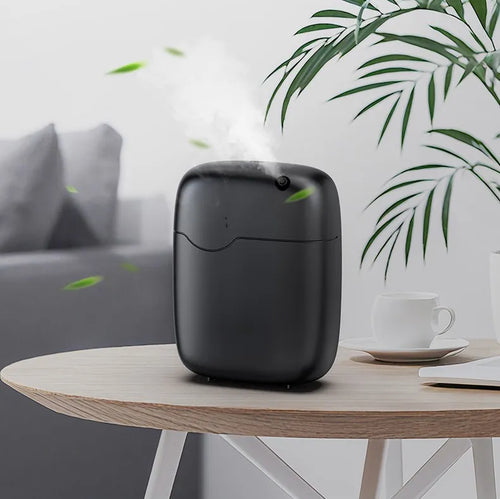
6. For volume, use something whose output is a setting rather than a constant. The Vaayu at ₹11,999 covers up to 1000 m³ with adjustable intensity and 1h/4h/8h/24h timers, and it is waterless, so a closed flat receives fragrance and no moisture.

A portion of every order supports girl-child education through Nanhi Kali.
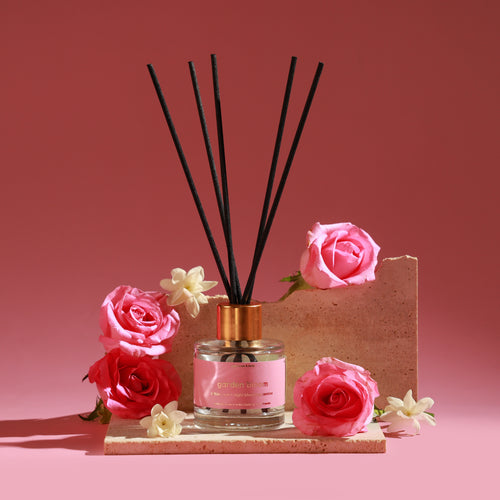
TL;DR: a reed evaporates passively from a fixed exposed surface area, so its output is small, constant and independent of the room — which is a virtue in a 12 m³ bathroom and a real limit in 975 m³ of apartment. It also needs 24 to 72 hours to establish. Keep reeds from ₹749 for bathrooms, halls and long-running listings; use the Vaayu at ₹11,999 where the problem is volume.
SOSA reed diffusers · alcohol-free
The format doing exactly what it was designed to do
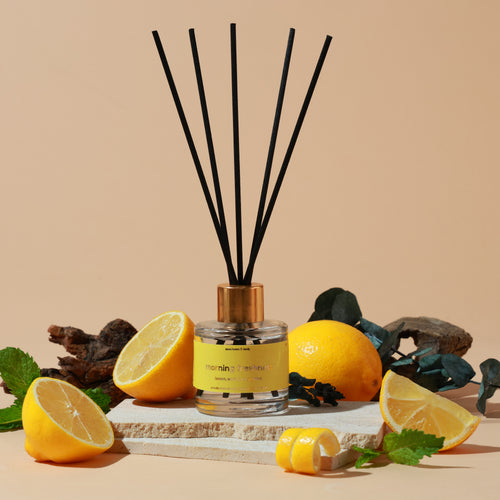
SOSA reed diffusers · alcohol-free from ₹749
Morning Freshness from ₹749, Garden Bloom and Evening Calm from ₹799, Fresh Brew and Mountain Breeze from ₹849, 130ml from ₹1,249 and 300ml refills at ₹2,399. A reed is a small, constant, silent, unpowered source, and in a guest bathroom of twelve cubic metres that specification is close to perfect — nothing to switch on, nothing to attend, nothing to explain to a buyer who opens the door. It needs 24 to 72 hours to reach its working level, which is the reason it suits a listing you will still be showing in March and the reason it is the wrong purchase for an appointment tomorrow morning. Neither of those is a fault in the product.

How a reed actually works, and what that fixes

Almost nobody who buys a reed diffuser is told how it functions, which is a pity, because the mechanism predicts every one of its strengths and every one of its limits in about two sentences. Oil rises through the porous channels of the rattan by capillary action until the sticks are wet along their length, and fragrance then leaves the wetted surface above the neck of the bottle by ordinary passive evaporation into whatever air happens to be touching it. There is no pump, no fan, no heater and no atomiser. The entire output of the object is the evaporation rate from a few square centimetres of damp rattan — which is why it is silent, why it lasts for months, why it never fails, and why it cannot be adjusted.

1
THE FIXED SOURCE
Exposed surface area is the whole specification, and the room is not in it
Write out what actually determines the rate and the answer becomes obvious. The output of a reed diffuser is governed by the exposed surface area of the sticks, the volatility and viscosity of the oil, the temperature of the room and how much air is moving past. That is essentially the list. The dimensions of the apartment do not appear anywhere in it, and neither does the ceiling height, the number of rooms or whether the doors are open. A reed standing in a guest cloakroom and the identical reed standing in a double-height living room are emitting at the same rate, to within the small difference a warmer or draughtier room makes. What differs is what happens to the emission afterwards. In the cloakroom it is released into perhaps twelve cubic metres of air that barely moves, so the concentration climbs to something clearly perceptible and sits there. In the living room it is released into eight hundred cubic metres that are being turned over continuously by air conditioning, by a door to a balcony and by the ordinary leakage of a large building. The concentration you experience is roughly the source rate divided by the volume it is spreading through, and the source rate is the one term you are not allowed to change. So the same bottle that reads as generous in a bathroom reads as absent in a drawing room, and the difference between those two experiences is arithmetic rather than quality. This is also why walking towards a reed in a large flat works: within half a metre of the sticks you are inside the plume, at a concentration that has not yet been diluted by the room. Buyers do not walk towards the reed. They walk through the middle of the room.
2
THE 24 TO 72 HOURS
The second limit, and the one that ruins viewings arranged at short notice
The other constraint is time, and I would put it in larger type if I could, because it produces more disappointment than the volume problem does. A reed diffuser needs somewhere between 24 and 72 hours to reach its working level. The oil has to climb the full exposed length of every stick, the surface has to become properly wetted, and the room has to arrive at an equilibrium between what is evaporating in and what is leaving through the doors and vents. Until all three of those have happened, what you have is a bottle of fragrance oil with some sticks in it and very little in the air. An agent who buys a reed on Friday afternoon for a Saturday morning viewing has bought a product that will be working properly on Monday, and will reasonably conclude that it was a poor product. It was not. It was the correct product consulted at the wrong hour. Turn that around and the same fact becomes the strongest argument for reeds that exists in this trade: a listing that has been on your books for months, that gets shown at four hours' notice, that you cannot always get to in advance — that property wants a source which established itself weeks ago and has been holding a level ever since without a single visit from you. A reed does that better than any powered object, because it needs nothing: no socket, no timer, no app, no collection at the end, and no anxiety about what a stranger might do to it while you are in another room.
3
THE MISMATCH, NAMED
Good products in the wrong place, which is not the same as bad products
So let me say the thing this page exists to say. If your reeds feel weak in a 3,000 sq ft apartment, the reeds are not weak. They are small constant sources doing exactly what they were engineered to do, in a volume they were never engineered for. Everything that makes a reed excellent — that it is passive, silent, unpowered, unattended, incapable of surging and incapable of failing — comes from the same design decision that makes it incapable of scaling. You cannot have both. A format that has no motor has no output control either, and a format with output control needs a motor, a power supply and somebody to set it. I would rather sell you the right one of the two for each room than persuade you that one of them is a disappointment. In practice most working portfolios end up with both, and the split is by volume rather than by preference: reeds in the small enclosed spaces and in the long-running listings, a machine wherever the number of cubic metres is the actual problem. And in either case, the same rule governs the whole exercise. If a property has a smell with a cause — damp, a leak, a dry trap, smoke — no format in this paragraph is the answer, because that is a material fact about the building. Find it, fix it or disclose it, and scent only a property that is genuinely sound.
The sentence I would like every agent to have available when a colleague says reeds do not work: reeds work. They work at a fixed rate, and the question is only ever whether that rate is right for the number of cubic metres you have put them in.

The same bottle in six different volumes

One reed diffuser, unchanged, standing in six different spaces, with the volumes worked out in the open: square feet divided by 10.76 gives square metres, multiplied by the ceiling height in metres gives cubic metres, and a 10 ft ceiling is about 3 m. The first row is the space a reed is genuinely the best object for, which is why it is at the top rather than at the bottom.

One reed, six volumes
Where a fixed small output is correct, and where it stops being enough
The space Volume, in round numbers What a single reed does there Verdict What to use
Guest bathroom or cloakroom ★ About 12 m³ Reaches a clear, steady level and holds it for months with no attention at all The format at its best. Nothing powered belongs here A reed from ₹749
Entrance hall of an occupied flat About 35 m³ Comfortably perceptible at the door, which is the one place it needs to be Correct, and the highest-value spot in the property for a small source Morning Freshness ₹749
Study, dressing room or home office About 60 m³ Present but quiet — noticeable on entering, not while sitting Still within the format. Add a second bottle rather than a machine One or two reeds
1,000 sq ft flat, doors open About 280 m³ Perceptible within a metre of the sticks and very little beyond that The point at which agents start to think the product has failed Vaayu on low
2,000 sq ft apartment About 560 m³ Effectively a local effect around the console table it stands on A format mismatch. Four or five bottles would be needed, and would look it Vaayu ₹11,999
3,500 sq ft apartment, 10 ft ceilings About 975 m³ Undetectable through most of the plan, however good the oil is Eighty times the volume of the bathroom, from an identical source Vaayu or Aangan
Shop this guide
Reeds and a machine, each doing its own job
The SOSA principle
A reed has no dial because it has no motor, and it has no motor because that is what makes it silent, passive and unfailing. You cannot have the virtue without the limit.
Concentration is roughly the source rate divided by the volume it spreads through. A reed fixes the numerator and a large apartment multiplies the denominator, which is arithmetic rather than quality.

Where reeds belong, and what to run everywhere else

Start with the placement of the reeds you already own, because most of them are in the wrong room rather than in the wrong property. Move them into the smallest enclosed volumes in the plan — bathrooms, cloakrooms, dressing rooms, a study with a door that shuts — and out of the drawing room, where they have been quietly failing an unwinnable test. A bathroom is the single best place for a reed in any listing: perhaps twelve cubic metres, almost no air movement, a door that stays shut between viewings, and a space where a buyer will be alone for thirty seconds and will notice everything. Give the sticks their 24 to 72 hours before it matters, use six or eight of them rather than the whole bundle in a small room, and flip them at most every fortnight; flipping more often does not raise the level, it only shortens the life of the bottle. Morning Freshness at ₹749 is the cleanest of the line and the one I would put in an entrance hall; Mountain Breeze at ₹849 — Himalayan pine, sage and cedar — suits a property that reads cool and formal; Evening Calm at ₹799 is lavender and chamomile and belongs in a bedroom rather than anywhere a buyer arrives. The 130ml bottles from ₹1,249 and the 300ml refills at ₹2,399 are the sizes to buy once you know which listing keeps one permanently.

Then the properties where the number is the problem, and here the choice is a machine with a setting rather than a source without one. Do the volume before you do anything else: square feet divided by 10.76 gives you square metres, multiplied by ceiling height in metres gives cubic metres, and every room whose door will be shut during the viewing comes straight back out of the total. Most large listings come in well under their brochure impression once that subtraction is honest, and a single Vaayu at ₹11,999, rated to 1000 m³, covers a great deal more apartment than agents expect. Set it low, in the entrance zone, at waist height or above, away from an air-conditioning vent, two hours before the appointment, on the 4h timer. The waterless part matters more here than the coverage figure: a closed vacant flat in monsoon does not need another 30 to 50 ml of water an hour in its air, which is what the ultrasonic Sukoon, Boond and Megh add and the reason those three belong in occupied, air-conditioned rooms rather than in an empty listing. Past 1000 m³, the Aangan at ₹25,999 is the honest answer for a sales gallery or a clubhouse, and for very little else.

Then the two habits that decide whether any of this reads correctly. The first is that you should never judge the level of a property from inside it. Whether you are running reeds or a machine, you have been in the flat for an hour and your nose has already discounted whatever is there; the only honest reading is taken by walking out of the front door, standing in the corridor for a couple of minutes and walking back in as a stranger would. Adjust down if you notice the fragrance as a thing. Never up. The second is the order of work, and it comes before every product on this page: air the property twenty-four hours ahead with openings on opposite walls, run water down every drain trap including the ones in unused bathrooms, deal with fabrics and cleaning, and only then think about fragrance. If what the property has is damp, a leak, a drain, smoke damage or anything with a structural cause, no reed and no machine is the correct response — that is a material fact and it belongs in a disclosure. On the constraints: reeds are a separate alcohol-free line with their own scents, so the water-based Hotel Collection bottles never go into a reed and never into the Vaayu, which takes its own undiluted oil and arrives with four hotel-inspired scents. And the principle the whole cluster rests on: the buyer should walk out remembering the property rather than the fragrance.

Your reeds are not weak. They are small constant sources doing exactly what they were built to do, in a volume nobody built them for.
— Sonal Sahani, SOSA

The SOSA edit

In buying order for an agent whose reeds have gone quiet in a large listing. The reeds stay in the list, near the top, because moving the ones you already own into the right rooms costs nothing and is the first thing I would do. The last row is the limit stated as a specification rather than as an apology.

The SOSA edit
Reeds and machines, sorted by volume rather than by preference
Buy What it is Which volume it is right for Price
1. SOSA Vaayu Waterless cold-air nebulisation, adjustable intensity, up to 1000 m³, 400ml tank for about 75 days, 1h/4h/8h/24h timers, key-lock, 0.9 kg Anything from roughly 250 m³ upwards, which is most of a 1,000 sq ft flat and all of a large one ₹11,999
2. Reed diffusers Alcohol-free, unpowered, silent, 24 to 72 hours to reach working level, months of life per bottle Bathrooms, cloakrooms, dressing rooms, entrance halls — and any listing shown repeatedly over months from ₹749
3. Morning Freshness or Mountain Breeze Malabar lemon, peppermint and eucalyptus, or Himalayan pine, sage and cedar The hall of an occupied listing, and a cool formal property respectively. 130ml from ₹1,249 ₹749 / ₹849
4. SOSA Aangan Up to 3,000 m³, 800ml reservoir, HVAC-connected or standalone, programmable schedules, under 42 dB Only once the honest volume calculation passes 1000 m³ — a sales gallery, a clubhouse, a ducted villa ₹25,999
5. 300ml reed refills Refills for the listings that keep a reed permanently rather than occasionally Once a property has had a reed in its hall for three months and you have stopped thinking about it ₹2,399
The limit, stated: a reed has no output setting Flipping the sticks gives a short bump and returns to the same level within a day; more output means more bottles Printed rather than discovered. It is the cost of a format that is silent, passive and cannot fail
Honest notes for buyers: fragrance is the last step in preparing a property, never the first, and it must never be used to cover a defect. Damp, a leak, drains, smoke or anything structural is a material fact about a property: find it, fix it or disclose it. Scent a listing that is genuinely sound. On the machines: the Vaayu at ₹11,999 is waterless cold-air nebulisation — no water, no heat and no dampness — covering up to 1000m³ or roughly 2,000–3,000 sq ft, with a 400ml tank lasting about 75 days, Bluetooth app control, 1h/4h/8h/24h timers, under-38dB running, auto-stop and a key-lock, at 0.9 kg and smaller than a shoebox, so one machine can serve a whole portfolio. The Aangan at ₹25,999 covers up to 3,000m³ for sales galleries and clubhouses. The ultrasonic Sukoon, Boond and Megh are water-based and add 30–50 ml of water an hour to the air, which makes them the wrong choice for a closed or humid vacant property. A reed diffuser needs 24–72 hours to establish, so it suits a listing shown over months rather than a viewing tomorrow. A candle must be attended and put out, which rules it out of an unoccupied property. SOSA does not make a room spray for the home; the sprays in the range are car perfumes. The Hotel Collection scents are SOSA's own interpretations inspired by the world's finest hotels; SOSA is an independent Indian fragrance house, not affiliated with or endorsed by any hotel brand. A portion of every order supports girl-child education through Nanhi Kali.
SOSA Vaayu · up to 1000 m³
The only lever in the range that answers a cubic-metre figure
SOSA Vaayu · up to 1000 m³ ₹11,999
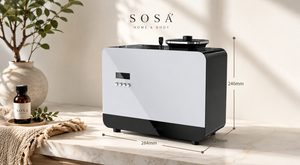
A 3,500 sq ft apartment under 10 ft ceilings is about 325 m² of floor and roughly 975 m³ of air. A reed cannot be told about that number and a machine can, which is the whole of the difference: intensity is adjustable on the Vaayu, and the setting is chosen against the volume rather than against the label on a bottle. Waterless cold-air nebulisation, so a flat with marble, veneer and closed windows receives fragrance and not a gram of moisture. 400ml tank, about 75 days a fill, Bluetooth app plus onboard buttons, 1h/4h/8h/24h timers, under 38 dB, CE, RoHS and SGS certified, four hotel-inspired scents supplied.
SS
ISIPCA
Versailles
A note from Sonal

I make reed diffusers and I am not going to write them down to sell a machine. The alcohol-free line is one of the things I am proudest of, and in the room it was designed for there is no better object: it asks nothing of you, it makes no sound, it cannot be left on, it cannot be knocked over into a socket, and it holds the same quiet level in a guest bathroom for months. When an agent tells me their reeds are not working in a 3,000 sq ft flat, my first question is not about the reeds. It is about the cubic metres, and the answer is nearly always a number two orders of magnitude away from what the bottle was designed around.

What I try to do on the phone is separate the two failures, because they need different answers. If the complaint is that it is too faint, that is volume, and the honest fix is a machine with a setting rather than four more bottles on a console table. If the complaint is that it did nothing at all, that is nearly always the 24 to 72 hours: the reed was bought the day before a viewing and consulted before it had finished arriving. Neither of those is a fault in the product and neither is solved by buying a stronger oil. Put the reeds where the volumes are small and the visits are unpredictable, put a machine where the volume is the actual problem, and you will stop having this argument with yourself before every appointment.

Everything is made and supported from Pune, and a part of every order funds girl-child education through Nanhi Kali. You get a space that smells like somewhere considered; a girl gets a classroom. That equation has always felt right to me.

Frequently asked questions

Why do reed diffusers seem to stop working in a big apartment?
They have not stopped. A reed's output is fixed by the exposed surface area of its sticks and is entirely independent of the room, so spreading that same small output through four times the volume gives you roughly a quarter of the concentration. There is no setting on a reed to compensate.
Will more reeds fix a large room?
In principle yes, and in practice it is linear and visible. Four times the output means four times the bottles, standing somewhere a buyer can see them. In a 975 m³ apartment that is a great many bottles for a result a single machine on a low setting reaches without being noticed.
Does flipping the reeds make them stronger?
Only briefly. Flipping presents a freshly wetted length to the air, so there is a short bump, and within a day the level returns to what the exposed surface area supports. Flipping more often mainly shortens the life of the bottle rather than raising the level of the room.
How long does a reed diffuser take to start working?
24 to 72 hours. The oil has to travel the full exposed length of the sticks and the room has to reach an equilibrium. That makes a reed the wrong purchase for a viewing arranged for tomorrow and a very good one for a listing you will still be showing in three months.
So where should I still use reeds in a listing?
Bathrooms, cloakrooms, dressing rooms, a study with a door that shuts, and the entrance hall of an occupied property — all small volumes with little air movement. Also in any listing shown repeatedly at short notice, where a source that established itself weeks ago is worth more than one you have to drive over and switch on.
Format, not quality
A fixed source in a variable volumewhich is arithmetic rather than a fault
Reed diffusers are ₹749 for Morning Freshness, ₹799 for Garden Bloom and Evening Calm, ₹849 for Fresh Brew and Mountain Breeze, with 130ml from ₹1,249 and 300ml refills at ₹2,399, and they need 24 to 72 hours to reach their working level. The Vaayu is ₹11,999 — waterless, up to 1000 m³, adjustable intensity, 1h/4h/8h/24h timers, 400ml for about 75 days, under 38 dB, key-lock, 0.9 kg — and the Aangan is ₹25,999 for up to 3,000 m³. Free shipping above ₹499, and a portion of every order supports girl-child education through Nanhi Kali.
See the Vaayu · ₹11,999 See the reed diffusers →
Continue the read
More from SOSA
Editorial standards & sources
About this guide: Written by Sonal Sahani, ISIPCA Versailles-trained founder and perfumer at SOSA Home & Body, on why a reed diffuser feels weak in a large luxury apartment — how capillary action and passive evaporation from a fixed exposed reed surface produce an output that has no knowledge of the room, why concentration falls in proportion to volume when the source rate cannot be changed, why the 24 to 72 hours to establish makes reeds wrong for tomorrow and right for a listing shown over months, and where in a property a reed is still the best object available.

Facts verified August 2026: Product facts used in this guide. SOSA Vaayu ₹11,999: waterless cold-air nebulising diffuser, atomises undiluted fragrance oil to a dry residue-free nano-mist, coverage up to 1000m³ (approximately 2,000–3,000 sq ft), 400ml refillable tank lasting up to about 75 days per fill, Bluetooth app plus onboard control, 1h/4h/8h/24h timer scheduling, adjustable intensity, under 38 dB, DC 12V/1A at 5W, 165 × 80.5 × 215 mm and 0.9 kg, freestanding or wall/HVAC mounted, auto-stop and key-lock, CE, RoHS and SGS certified, supplied with four hotel-inspired fragrances. SOSA Aangan ₹25,999: HVAC-connected or standalone commercial nebulising diffuser, coverage up to 3,000m³ (roughly 8,000–10,000 sq ft), 800ml reservoir, metal body, programmable schedules, under 42 dB. Ultrasonic machines are water-based and consume 30–50 ml of water an hour: Sukoon ₹1,899 (500ml, 270–320 sq ft, 16–18 hours on low, 3–6 drops per tank, steady/2H/4H timers, three 15ml Hotel Collection scents included), Boond ₹899 (300ml), Megh ₹3,499 (6 litres). Hotel Collection water-based fragrance 15ml ₹299, 100ml ₹999, 300ml ₹1,799, Pack of 7 at 15ml ₹1,799 against ₹2,093 bought singly; the Vaayu and Aangan take their own undiluted oil rather than these water-based bottles. Reed diffusers (separate alcohol-free line) from ₹749, requiring 24–72 hours to reach their working level. Scented candles from ₹379, scenting a room in roughly 15–20 minutes but requiring attendance. Free shipping above ₹499. Timings: a nebulising diffuser reaches a working level within minutes and a stated viewing level well inside two hours. This guide makes no claim that fragrance affects a property's price, offer level or time on market; it is presentation, in the same category as photography, styling and lighting. Fragrance must never be used to conceal a material defect. SOSA is not affiliated with or endorsed by any hotel brand. Prices subject to change — see the live product pages.
Zurück zum Blog