



This is a free daily measurement. Take it in the first seconds, before shoes, windows or kettle — everything after that contaminates it.
Read the fortnight, not the day. One dramatic reading is how people end up buying a second bottle they did not need.
If re-entry keeps reporting something other than your fragrance — a bin, a drain, damp — that is a source to find and ventilate. Fragrance sits alongside it and removes nothing.
2. Your nose did change, by leaving. Several hours in other air means you arrive back without your home's fragrance already in you — and a nose reports change rather than level.
3. That makes re-entry a genuine measurement, and a free one. It is the closest you get to being a visitor in your own home, and it happens daily.
4. Take it in the first seconds, consistently. Before shoes, bags, windows or the kettle, standing two or three steps inside the door, in the same spot each time.
5. Write down three words. "Clear, lemony, fine." "Faint today." "Kitchen bin." A note turns a vague impression into a record you can read later.
6. Judge the fortnight, never the day. A single strong or absent reading tells you about that day's weather and what you were breathing beforehand. The pattern across two weeks is the signal.
7. Most fortnights end in buying nothing, which is the correct outcome. Buy only when two things coincide: the readings fade across the two weeks and the bottle is at or past its range — 6–8 weeks on a 50ml, 14–18 on a 130ml.
Everything is composed and handmade in small batches in Pune, tested through 45°C summer heat and 85% monsoon humidity, and a portion of every order supports girl-child education through Nanhi Kali.
Part one — the measurement you already take and discard
You come home most days, which hands you a properly conditioned reading of your own flat several times a week at no cost — and almost nobody uses it, because the first half-minute of getting home is busy. Treating re-entry as an instrument rather than a pleasant surprise is the most useful habit in this whole cluster.
 Mountain Breeze₹849 · 50mlStand two or three steps inside the door. Breathe once, normally. Note three words on your phone. That is the whole protocol. The five ways people ruin it: opening a window on the way in; taking the reading after unpacking or sitting down; running it only on days you are already suspicious; standing next to the bottle instead of in the room; and comparing a day you came home from a smoky restaurant against a day you came back from a walk. Keep the conditions boring and the record honest, including the days it reads of nothing. A test you only run when you expect a particular answer is not a test.
Part two — a fortnight of readings, and what each pattern means
Two weeks of three-word notes produce one of these shapes. Read the shape, never a single day — that is the entire discipline.
| The pattern across a fortnight | What it most likely means | What to do next | When to decide |
|---|---|---|---|
| Steady and pleasant on most days ★ | The bottle is doing exactly what it was built to do | Nothing. Keep flipping the six reeds weekly | Never. Stop measuring and enjoy it |
| Clear in week one, fading through week two | A bottle genuinely approaching the end of its range | Confirm with the calendar and the wet line | At the end of the fortnight, not before |
| Nothing on any day, but the bottle is well inside its range | The room — too large, too open, or too well ventilated | Reposition: inner wall, waist-to-chest, clear space | After three more readings from the new spot |
| Good on the days you left everything shut, absent when the balcony stayed open | Airflow, and normal — you cannot out-fragrance it | Nothing to buy. Adjust the expectation | Immediately. This one is already settled |
| Swinging with the weather across the two weeks | Warmth raises the evaporation rate; humidity slows it | Nothing. Expect a quieter, longer-lasting bottle when it is humid | Seasonally, if at all |
| Something other than your fragrance arrives first — bin, drain, damp | A source in the flat, which fragrance cannot answer | Find it, clean or dry it, ventilate. Then scent | Today, and before buying anything |
| You keep forgetting to take the reading at all | Nothing is bothering you — its own answer | Nothing. A problem you forget is not a problem | Never |
| The honest caveat: a re-entry reading measures your impression of the whole flat, not the state of the bottle, so pair it with the calendar and the wet line before concluding anything about the product. Nothing here removes adaptation on demand and no technique is offered as doing so — being out simply gives you a fresh comparison. Evaporation and airflow effects are directions rather than measured rates. And a reed diffuser adds a fragrance alongside whatever is already in your air; it removes, neutralises, masks and purifies nothing, so a reading dominated by another smell is a source problem first and a fragrance question afterwards. | |||
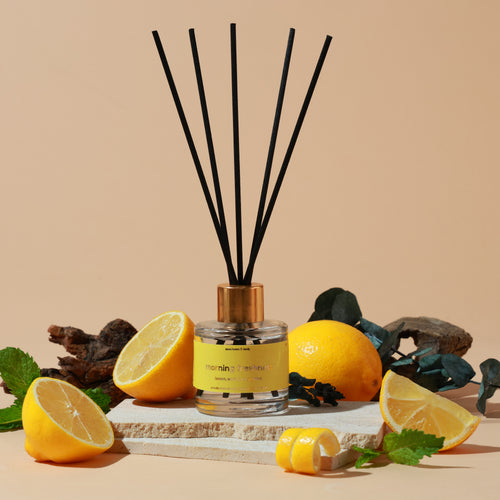 Morning Freshness · easiest to register in a first breath₹749Shop →
  Mountain Breeze · dry and green for an entrance₹849Shop →
 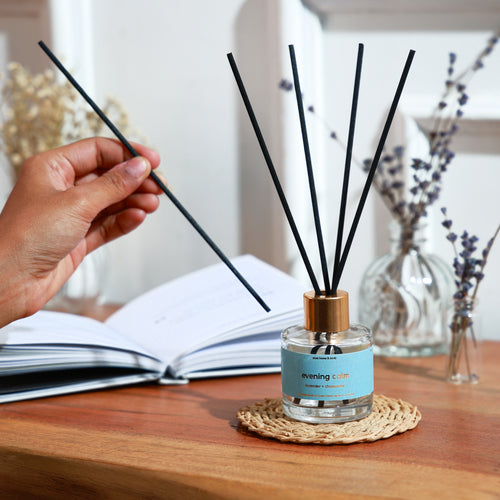 Evening Calm · the room you reach later₹799Shop →
Part three — what re-entry cannot tell you
The decision rule is narrow on purpose. Buy only when two independent things agree: the readings fade across the fortnight, and the bottle is at or past its stated range — 6–8 weeks on a 50ml, 14–18 on a 130ml — with a reed barely wet above the oil when you lift it. One without the other is not a verdict. Fading readings on a three-week-old bottle usually mean the weather changed or you came home from somewhere unusual. A bottle past its range that still reads at the door is beating its range, and there is no reason to replace it early. When both line up, the purchase is the 300ml oil refill at ₹2,399 — roughly 8–11 months at about ₹7–8 per ml against ₹15–17 for a fresh 50ml, oil only, into your own glass and reeds, since replacement reeds are not sold separately. If the reeds have darkened, buy a new bottle instead; that is the only way to get fresh reeds.
The limitation that matters most is what the reading includes. Through a front door you get one mixed verdict, and on some days the loudest thing in it will not be your diffuser. If your notes keep saying bin, drain, damp or last night's fish, that is a source, and it needs finding, cleaning, drying or ventilating. A reed diffuser adds a fragrance alongside whatever is already in the air; it does not remove, neutralise, mask or cancel anything, and layering scent onto a smell you dislike produces a third smell nobody designed. A musty note that returns after cleaning means something is still wet, and SOSA sells nothing that addresses damp. Deal with the source, ventilate, then let the bottle do the job it is for.
There is also a version of this question that sounds like a machine and is not. Some readers want the flat to read specifically at the moment they walk in, every day, reliably. That is what a reed diffuser already does, and it is the one job where a passive bottle beats a machine outright. It runs unattended all day with nobody home, no socket and no timer to remember, so you arrive to a room that has been holding a level since morning. A Sukoon at ₹1,899 is the right purchase when you want control — on demand, timed, off when you prefer, across 270–320 sq ft with a remote and steady, 2H and 4H timers. It is the wrong purchase for a homecoming, because you would be running a machine into an empty flat. It also delivers fragrance by aerosolising water, so it adds moisture where reeds add none, and takes only the water-based Hotel Collection.
Part four — what two weeks of readings should make you buy
Seven fortnights, seven conclusions. Two end in spending nothing at all, which is roughly how it works out.
| After two weeks of readings | The purchase, if any | Price | What you are actually buying |
|---|---|---|---|
| It reads well at the door on most days ★ | Nothing whatsoever | ₹0 | Knowing your flat is fine and your nose was the variable |
| Fading readings, and the bottle is at the end of its range | 300ml oil refill into your own glass and reeds | ₹2,399 | 8–11 months at about ₹7–8 per ml against ₹15–17 |
| Same, but the reeds have darkened and stiffened | A fresh 50ml bottle — the only route to new reeds | ₹749–₹849 | Six new fibre reeds and a refillable vessel |
| The entrance reads but nothing else does | A second source for the room you actually sit in | ₹749–₹849 | More sources, never more oil in one place. |
| Neither the entrance nor the bedroom reads, in a two-room flat | Day & Night duo, one bottle in each | ₹1,498 · 2 × 50ml | Two destinations, within a step of each other |
| Readings dominated by cooking, damp or the bin | Nothing until the source is dealt with | ₹0 today | An honest refusal — fragrance answers none of those |
| You want the room scented only while you are in it | Sukoon, bought for control rather than strength | ₹1,899 | Timers and a remote. It adds moisture; Hotel Collection only |
Versailles
When we were trialling the early compositions I could not judge them at home, for the obvious reason. So I started a habit I still keep: the first breath through my own front door goes into a note on my phone before I have put anything down. Three words, no editing, including the evenings when the answer is "nothing" or "fried onions".
What that record taught me is how much of a home's smell is not the product. Some weeks the notes were all building and no bottle — a neighbour's cooking on the stairs, wet paint, the bins on collection day. A perfumer's instinct is to fix that with fragrance, and it is the wrong instinct. Find the source, open the windows, and only then does anything you make have a fair chance.
The other thing it taught me is patience with my own doubts. A single evening's reading is almost worthless; two weeks of them is a picture. Half the messages I get about a failing bottle would resolve themselves if the writer had fourteen notes on their phone instead of one bad Tuesday. Made in small batches in Pune, and a part of every order funds a girl's classroom through Nanhi Kali.
Frequently asked questions
- Why you smell it entering but not sitting — the indoor version of this reading.
- Weak bottle or adapted nose? — the four checks, when a fortnight is too long to wait.
- Guests can smell it and you cannot and how a new bottle settles.
- Move it rather than buying bigger — the free fix before the paid one.
- Brand: the SOSA founder story.
SOSA range, specifications and prices used in this guide (verified from the live store, 27 August 2026): Reed diffusers — alcohol-free, phthalate-free, paraben-free and IFRA-compliant compositions on a heat-stable coconut-derived (CCT) carrier, low-VOC, in a refillable glass bottle with six fibre reeds; flip weekly. 50ml lasts 6–8 weeks and 130ml lasts 14–18 weeks; there is no 100ml reed diffuser size. Morning Freshness (Malabar lemon · peppermint · Nilgiri eucalyptus) 50ml ₹749 · 130ml ₹1,249; Garden Bloom (British rose · night-blooming jasmine) ₹799 · ₹1,299; Evening Calm (Kashmir lavender · chamomile) ₹799 · ₹1,299; Fresh Brew (Coorg coffee · Kerala vanilla) ₹849 · ₹1,349; Mountain Breeze (Himalayan pine · sage · Indian cedar) ₹849 · ₹1,349. Duo sets ₹1,498–₹1,598 for 2 × 50ml and ₹2,498–₹2,598 for 2 × 130ml. Oil-only refills 300ml ₹2,399 · 500ml ₹3,499 — the glass vessel and reeds are not included, and replacement reeds are not sold as a separate product. Machines: Boond 300ml ₹899 (~150 sq ft, about 6 hours a fill) · Sukoon 500ml ₹1,899 (270–320 sq ft, 16–18 hours on low, three 15ml fragrances included) · Megh 6L ₹3,499 (~215 sq ft — a runtime and humidity machine that covers less than a Sukoon, never a coverage upgrade) · waterless Vaayu ₹11,999 · Safar ₹3,999 (a car and travel product) · Aangan ₹25,999 · Meenar ₹38,500. The water-based Hotel Collection for ultrasonic machines (15ml ₹299 · 100ml ₹999 · 300ml ₹1,799 · pack of seven 15ml ₹1,799) cannot be used in a reed bottle or a Vaayu. Below ₹749: jar candles ₹379, Sandalwood or Smoked Oudh candle ₹449, wax melts ₹474 (a burner is required and not included), mugs ₹474, bubble and taper candles ₹569, Amber Rose candle ₹599, ceramic trinket dish and candle two-pack ₹664. A reed diffuser adds fragrance to a room. It does not clean, purify or filter air, remove or neutralise cooking, damp or smoke smells, reduce humidity, or change how anyone feels. A reed diffuser adds no moisture to the air; ultrasonic machines work by aerosolising water and therefore do. A persistent musty smell indicates moisture that needs finding and drying, and SOSA sells no dehumidifier or air purifier. Ventilate or extract first; add fragrance second. Evaporation rate rises with warmth and falls with humidity, and airflow carries scent away from the bottle — so performance varies with season, ventilation, ceiling height and room use; longevity figures are typical ranges, not guarantees. Not noticing a constant fragrance is ordinary olfactory adaptation; the reliable checks are leaving the room and returning, or asking someone who has just arrived. Strength figures are positions on SOSA’s own internal scale, not an industry standard. Fragrance oil is flammable — keep bottles away from open flame and out of direct sunlight, and out of reach of children and pets. Composed and handmade in small batches in Pune, India; tested through 45°C summer heat and 85% monsoon humidity. Free shipping above ₹499. A portion of every order supports girl-child education through Nanhi Kali. Prices subject to change — see the live product pages.