

The wet-line test: lift one reed and find the boundary between soaked and dry. High and dark means saturated and stalled — flip it. Barely above the oil means it is not wicking. Normal wet line plus a quiet house is the answer this page is about.
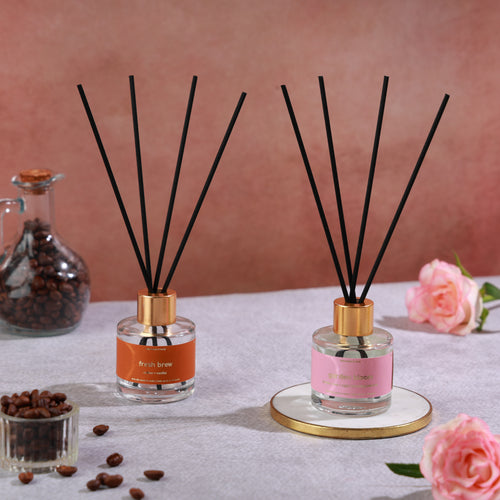
The arithmetic nobody does: a 50ml reed diffuser releases its whole 50ml over six to eight weeks — roughly a millilitre a day, and that number does not change however large the house is.
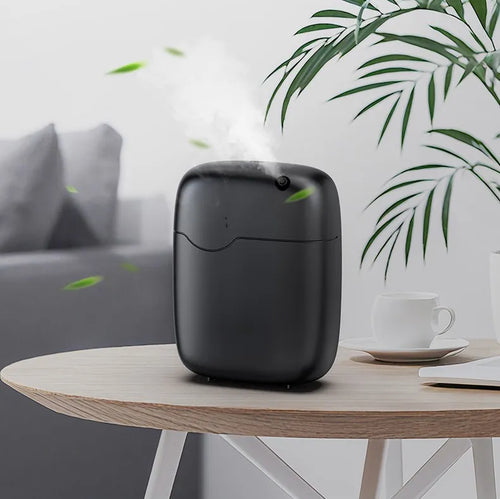
When it is genuinely a size problem: past roughly 250–300 sq ft of connected open volume per bottle, a reed cannot reach further. A Sukoon at ₹1,899 handles one proper room; the waterless Vaayu at ₹11,999 is rated up to 1000m³.
2. Because the bottle may genuinely have stalled. Lift one reed and look for the wet line. Soaked portion high and dark means the exposed ends have loaded up with the heavy end of the composition and delivery has slowed; flip all six, gloves on. A wet line barely above the oil means the reeds are not wicking and want refreshing.
3. Because a villa has more dead air than a flat. Long corridors, double-height voids and furniture-heavy corners hold still air that never comes to you. A reed diffuser releases and waits for the room to distribute. Waist to chest height, near a doorway or walkway, several feet clear of a split AC and out of direct sun.
4. Because the ground floor of a villa breathes hard. Doors to the garden, staff moving through, a stairwell drawing air upward — the air in a large house is replaced far more often than in a sealed 2BHK, and fragrance leaves with it.
5. And then, when all of that is right: because the output is fixed. A 50ml bottle releases 50ml over six to eight weeks — roughly a millilitre a day, whether it stands in a study or in a 5,000 sq ft villa. Nothing in the free ladder raises that number. More reeds spends the same oil faster; a 130ml spends it for longer. Neither makes more per hour.
6. Which makes the branch point simple. Specific dead zones mean a placement problem, and one or two more bottles will answer it cheaply. A uniformly working, uniformly quiet house means the villa is larger than its sources, and no further bottle changes that.
The reed range is composed and handmade in small batches in Pune and the Vaayu is made in India; a portion of every order supports girl-child education through Nanhi Kali.
Part one — the three checks worth running before you spend anything
There is a version of this article that goes straight to the machine, and I am not going to write it. Roughly one villa in three that writes to me has a genuine, correctable placement problem hiding behind what feels like a capacity problem, and it costs nothing to find out which one you have. What follows is the diagnostic I would run in my own house, in order, and each step tells you something the next one depends on. Do all three before you read Part three, because Part three is the conclusion you reach only if these come back clean.
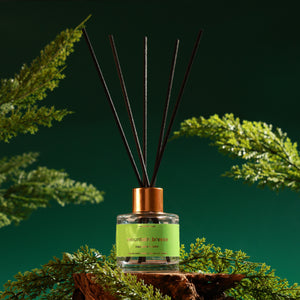
 Mountain Breeze₹849 · 9.4/10Lift a single reed and find the boundary between the oil-soaked portion and the dry portion. There are three readings. High and dark means saturated and stalled — the exposed end has accumulated the heavy, slow part of the composition; flip all six, gloves on, and give it a few hours. Barely above the oil line means the reed is not wicking and wants refreshing. Normal — a clear line partway up, the exposed end dry-looking — while the house is quiet is the reading that matters here, because it says the bottle is doing exactly what it was built to do. In a villa, check one reed in every bottle; it is common to find one stalled bottle in an otherwise healthy set, and that bottle is usually the zone that felt dead.
Part two — the walk-in audit, zone by zone
Do this once, properly, with paper. Come in from outside, walk your normal route through the house at normal speed, and in each zone write one of four words: clear, faint, nothing, or wrong. Then read the table. The value of the exercise is that it converts a vague dissatisfaction — "the villa does not smell of anything" — into a map, and a map can be acted on cheaply. Below is how each reading translates, and what it costs to answer.
| What you wrote down | What it usually means | First move | Cost | If that does not work |
|---|---|---|---|---|
| Clear at the source, nothing three metres away ★ | Dead air — an alcove, a niche, behind furniture | Move the bottle to a console near a doorway, waist to chest height | Free | The zone is larger than one point source |
| Faint everywhere, including at the bottle | Stalled reeds, or a bottle near the end of its life | Flip all six; check the wet line and the fill level | Free | Oil refill ₹2,399 for 300ml |
| Nothing at all, but the bottle looks healthy | Air exchange — the zone is being flushed faster than it fills | Run the closed-room hour; move away from vents and open doors | Free | Add a source at the zone's entry point |
| Clear near the stairs, nothing on the floor above | Vertical movement — each floor is its own problem | Give the upper landing its own bottle rather than expecting a climb | From ₹749 | One machine per connected floor |
| Two scents meeting in a corridor and reading as neither | A seam — the compositions do not share a note | Match them: Mountain Breeze and Morning Freshness meet on green eucalyptus | From ₹749 | One source, one scent, whole floor |
| Everything clean, everything faint, nothing broken | Capacity — the honest finding this article exists for | Stop buying bottles; read Part three | — | Sukoon ₹1,899 per room, or Vaayu ₹11,999 per floor |
| The honest caveat: this audit is a structured way of paying attention, not a measurement. It depends on your own nose on one day, in one season, with the doors in one configuration — and a villa in August behaves differently from the same villa in January. Run it twice, a week apart, before you act on it, and give more weight to what arriving guests tell you than to what you notice yourself. | ||||
Vaayu · up to 1000m³₹11,999Shop →  Sukoon · 270–320 sq ft₹1,899Shop →
  Oil refill · keeps the bottles running₹2,399Shop →
Part three — the arithmetic, and the villas that should ignore it
Here is the ledger, and it is arithmetic on our published figures rather than a measurement of anything. A 50ml reed diffuser is rated at six to eight weeks — forty-two to fifty-six days — so it is releasing something in the region of one millilitre of fragrance oil per day, and that figure is the same in a study and in a 5,000 sq ft villa. A 130ml at ₹1,349 lasts fourteen to eighteen weeks at roughly the same daily rate, which is precisely why a bigger bottle lasts longer without smelling stronger. Six bottles in six rooms gives you six independent millilitres a day, each spreading from its own point and none of them reaching the others. The Vaayu, by comparison, carries 400ml rated at 90+ days a fill at a mid intensity setting — around four millilitres a day, and critically, propelled rather than left to drift. Both numbers move with settings, season and how often your doors open.
That comparison is why the free ladder stops working above a certain size. Flipping restores a rate that has slipped; it cannot exceed the rate. Moving the bottle into passing air improves distribution of what is released; it does not release more. Adding reeds spends the same oil faster, buying a louder fortnight and a shorter bottle. A second bottle at the far end is a genuinely good idea — but it is addition, one millilitre at a time, against a house measured in hundreds of cubic metres. At some point the correct response stops being another bottle and becomes a different category of machine, and the useful thing is knowing where that point sits for your house rather than discovering it after the fifth purchase.
Now the part that matters more: when you should ignore everything I have just written. Most villas do not need an ₹11,999 machine. If your audit found specific dead zones rather than a uniformly quiet house, placement and one extra bottle will fix it for under a thousand rupees. If what you actually want is for the entrance to smell good when guests arrive, that is one zone, and a single well-placed reed diffuser answers it — the entrance is the highest-value spot in a large house and the cheapest to solve. If your villa is a set of rooms whose doors are usually shut, you do not have a large-space problem at all; you have several small-space problems, each a ₹749 to ₹1,349 bottle rather than a shared machine. If the ground floor is the only part you entertain in, scent the ground floor and let the rest be. And if what you want is a strong room on demand — before dinner, not all week — a Sukoon at ₹1,899 with timers does that for one room at a sixth of the price. The Vaayu earns its money when a large connected volume must smell the same all the time and you do not want to touch anything. Those are narrower conditions than the price tag suggests.
Part four — what to do, in the order I would do it
The first four lines cost nothing and roughly a third of villa owners finish there. The rest is arranged so that each step is only worth taking if the one above it did not settle the question.
| Step | What it rules in or out | Time or cost | Stop here if |
|---|---|---|---|
| 1. Fifteen minutes outside, then the walk-in audit ★ | Your own adaptation, and the map of dead zones | 20 minutes · free | Guests can smell what you cannot |
| 2. Wet line on one reed per bottle, then flip all six | Stalled delivery, poor wicking, a bottle near its end | 10 minutes · free | The house wakes up within a few hours |
| 3. Move each bottle into gentle passing air | Alcoves, dead corners, draughts from a split AC | Free — and it often extends the bottle | The quiet zone was a placement zone |
| 4. The closed-room hour in your worst zone | Air exchange versus genuine under-capacity | 1 hour · free | The closed room reads clearly |
| 5. Add a bottle at the far end, or a matched duo | Whether the zone needed two point sources rather than one | From ₹749 · duos from ₹1,548 | Two sources cover the zone evenly |
| 6. One Sukoon in the room you actually use | Whether the want is on demand rather than everywhere | ₹1,899 · 270–320 sq ft · timers | One controllable room is enough |
| 7. Vaayu on the main connected floor | The capacity finding — one identity across a large volume | ₹11,999 · up to 1000m³ · 400ml in the box | Ask about refill supply first |
| Not a step: a Megh bought for coverage | 6L and ~100 hours of runtime, but only about 215 sq ft — less than the Sukoon | ₹3,499 · a runtime and humidity machine | Buy it for runtime, never for reach |
Versailles
The letters that stay with me are the ones from people who have bought four or five of our reed diffusers for a large house and feel quietly cheated. They are not cheated, and the bottles are not defective — but I understand entirely why it feels that way, because nobody sold them a specification, they sold them a mood. A reed diffuser is a constant, passive, deliberately low background with no fan and no switch, and it is superb at that job in the rooms it was built for. It was simply asked to do something outside its range.
So I would rather publish the arithmetic than let anyone find it by spending. One millilitre a day is one millilitre a day. If your villa needs more than several of those, that is a category decision and it deserves to be made once, with clear eyes, rather than in six increments of ₹849.
And I will keep saying the uncomfortable part: most large houses do not need our most expensive machine. They need one bottle moved, one bottle flipped, one bottle added at the entrance, and permission to stop worrying about the guest bedroom nobody has slept in since March. Everything we make is composed in Pune, the Vaayu is made in India, and a part of every order funds a girl's classroom through Nanhi Kali.
Frequently asked questions
- Why is my reed diffuser too weak for my villa? — the specification behind the ceiling.
- Why isn't my ultrasonic scenting the whole villa? — what water does to reach.
- Getting one smell rather than four and scenting the junctions, not the rooms.
- The complete large-villa guide — this page and the eight around it in one place, plus why can't I smell my reed diffuser?
- Brand: the SOSA founder story.
SOSA Vaayu specifications (verified from the live product page, August 2026): ₹11,999 (the product page displays a rounded ₹12,000). Waterless cold-air nebulisation — pressurised air atomises undiluted fragrance oil into a dry nano-mist; no water, no heat, residue-free. Coverage up to 1000m³, about 2,000–3,000 sq ft. 400ml refillable tank, 90+ days per fill at a mid intensity setting. Bluetooth app plus onboard buttons, 1h / 4h / 8h / 24h timers, adjustable mist intensity, auto-stop and key-lock. Under 38 dB. DC 12V / 1A, 5W. 165 × 80.5 × 215 mm, 0.9 kg, black or white. Freestanding or wall / HVAC mount. CE, RoHS and SGS certified. Ships with four SOSA Hotel Collection fragrances at 100ml each (400ml in total) in one of three combos chosen at checkout. SOSA does not currently sell a separate Vaayu refill oil; the 400ml supplied in the box is the fragrance available at the time of writing, and buyers who need long-term supply should confirm current refill availability with SOSA before purchasing. The cold-air oil supplied with the Vaayu is a different product from the water-based Hotel Collection sold for ultrasonic machines (15ml ₹299 · 100ml ₹999 · 300ml ₹1,799), which must not be used in a Vaayu despite sharing scent names. Other SOSA machines: Boond 300ml ₹899 (~150 sq ft) · Sukoon 500ml ₹1,899 (270–320 sq ft) · Megh 6L ₹3,499 (~215 sq ft — a runtime and humidity machine, not a coverage upgrade) · Aangan ₹25,999 (~8,000–10,000 sq ft) · Meenar ₹38,500 (12,000–18,000 sq ft) · Safar car diffuser ₹3,999. Reed diffusers 50ml ₹749–₹849 (6–8 weeks) · 130ml ₹1,249–₹1,349 (14–18 weeks) · duo sets ₹1,498–₹1,598 · oil-only refills 300ml ₹2,399 / 500ml ₹3,499. Runtime, consumption and coverage figures are manufacturer specifications and vary with intensity setting, run hours, ceiling height, ventilation and season; any per-month or per-day figure in this guide is arithmetic on those specifications, not a measurement. Electricity costs vary by state tariff. No claim is made that scenting affects ratings, reviews, bookings, occupancy, revenue, health, mood or air quality. Free shipping above ₹499. A portion of every order supports girl-child education through Nanhi Kali. Prices subject to change — see the live product pages.