




Different scent: only behind a closed door. A bedroom, a bathroom, a study you shut.
The money: two bottles of one blend share a ₹2,399 refill. Two blends need one each, ₹4,798 — and over a year that gap is about ₹2,399, entirely in remainders.
2. When the second bottle shares air with the first. An entrance that opens into a sitting room, a living room continuous with the dining area, a kitchen with no door, a 1RK. These are not two rooms in fragrance terms — they are one air space with furniture in between. Two blends in one air space mix rather than alternate, and the meeting point is usually the busiest walking line in the flat. Use the same blend and set the reed counts differently instead: six at the arrival end, four at the quiet end.
3. When a hallway will do the mixing for you. Even where two rooms have doors, if those doors stand open all day and a corridor connects them, you have effectively one long air space. The test is not whether a door exists but whether it is shut. If nobody in your house ever closes the bedroom door, treat the bedroom as continuous with the passage and give it the same blend as the passage.
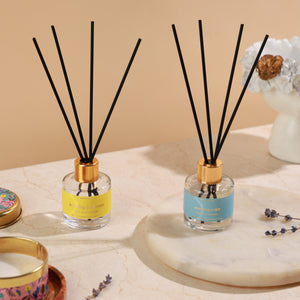
4. Buy a different scent when a closed door separates the two. A bathroom is behind a door. A bedroom you shut at night is behind a door. A study is behind a door. Those are free choices, and they are where variety belongs — a different blend behind a door costs nothing in coherence and buys you the small pleasure of a room that reads differently when you walk into it. Evening Calm in a bedroom with Morning Freshness in the hall is a standard and good arrangement.
5. And there is a real financial reason to repeat yourself. Two bottles of one blend share a refill; two blends do not. Over a year, two rooms on six reeds get through about 6.5 fills — roughly 845ml — which is three 300ml refills at ₹7,197 if the blend is the same. On two different blends each room needs its own pair of refills, four in total, at ₹9,596. The ₹2,399 difference is almost entirely stranded remainders.
Made in India, composed by an ISIPCA Versailles-trained perfumer — and a portion of every order supports girl-child education through Nanhi Kali.
Why a closed door is the only honest place to change a scent
Fragrance moves through a home by ordinary air movement — convection, the draught under a door, somebody walking past. A closed door interrupts nearly all of that, which is why the door count, not the floor area, is the real map of a home in fragrance terms. A 900 sq ft flat with five doors shut is five air spaces; the same flat with everything open is one long one. That map is the whole answer to this question. Inside one air space a second blend does not sit alongside the first, it blends with it, and the blending happens in whatever volume connects them — normally the passage or the space between a sofa and a dining table, which is precisely where people walk. You did not choose the resulting smell and you cannot predict it, because the ratio changes with the wind, the fan and the time of day.
There is also a reason not to over-apply the rule and put one blend everywhere, which is adaptation. Your nose stops registering a constant, unchanging smell within about twenty minutes, and it registers change far more readily than it registers presence. A home with one blend in every room gives you nothing to notice on the walk from the hall to the bedroom, so you adapt to the entire house at once and conclude, incorrectly, that all your bottles have gone weak. A home with one blend in the connected zone and a different one behind each closed door gives your nose a small event at each threshold. Standardise the air space, not the address. In most Indian flats that means one blend across the entrance, living and dining, and free choices in the bedroom, the bathroom and the study.
The three cases where the same scent is the right buy
 Same againFrom ₹749A room you have enjoyed for a season is not a problem waiting to be solved. Changing the blend there is an experiment with a fourteen-to-eighteen-week commitment and a ₹1,299 price tag, and if it does not suit the room you cannot undo it — you can only wait. So repeat. Better still, do not buy a bottle at all: buy a 300ml refill at ₹2,399, which is ₹8.00 a millilitre against ₹9.61 for a new 130ml and fills that bottle roughly twice. Fit fresh reeds while you are doing it, because clogged fibre is the commonest reason a settled room quietly goes quiet.
Sizing by space — same blend or a new one
The question in every row is the same: is there a shut door between this space and the one you already scent? One row recommends buying nothing at all.
| Space | What it needs | How many | Cost |
|---|---|---|---|
| A room that is already working, bottle nearly finished ★ | Same blend. And buy the refill rather than new glass — ₹8.00 a millilitre against ₹9.61 | Same — refill it | ₹2,399 for two fills |
| Dining end of an open-plan living-dining | Same blend, different reed count. Six at the arrival end, four at the far end | Same | from ₹1,249 |
| Entrance or foyer opening into the living room | One air space with a threshold, not two rooms. Same blend, and put the stronger setting at the door | Same | from ₹1,249 |
| Main bedroom behind a door you actually close | Free choice. A separate air space, so a different blend costs nothing in coherence | Different, if you like | from ₹1,299 |
| Main bathroom | The best place in the house to vary — small, behind a door, and entered with a fresh nose | Different | from ₹749 |
| The corridor connecting the two | Nothing. It is a transit space, and it is also where a badly chosen second blend would announce itself | None | ₹0 |
| A note on all of the above: the test is whether the door is shut, not whether it exists. If nobody in your house ever closes the bedroom door, the bedroom is continuous with the passage and should carry the passage blend. Doors that stand open all day are thresholds, not boundaries. | |||
One room · the unitFrom ₹749Shop → 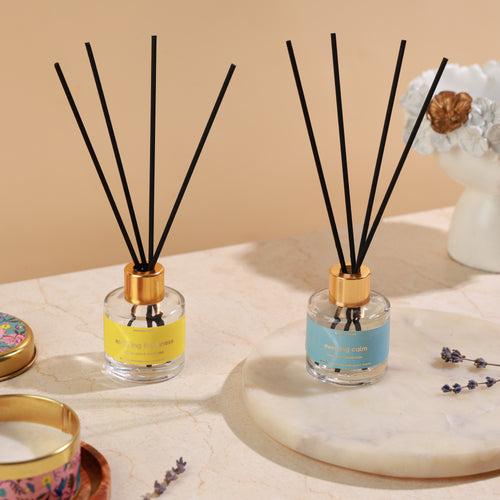 Two rooms · better value₹1,498Shop →
  Large room · a switch₹1,899Shop →
How to add a second bottle of the same scent well
Set the two bottles to different reed counts, because they are doing different jobs. A second bottle of the same blend in the same air space is not there to double the strength — it is there to give the far end of a long or bent room its own starting point. So run the arrival end on six reeds and the far end on three or four. That produces an even room rather than two loud corners, and it also staggers the two bottles: the six-reed bottle will finish around sixteen weeks and the four-reed bottle around twenty-one, so you get two small reorders five weeks apart instead of one large one. Staggering by reed count is free and it is the simplest scheduling tool in the range.
Then buy liquid rather than glass from that point onwards. Once two bottles in one blend are standing in a home, the sensible purchase is a 300ml refill at ₹2,399 rather than a third bottle. It fills a 130ml about 2.3 times, works out at ₹8.00 a millilitre against ₹9.61 for a new bottle, and two same-blend bottles between them will absorb the whole jug including the 40ml remainder, which is the part people usually waste. Top each bottle up at about two-thirds down rather than waiting for either to run dry, and fit fresh reeds each time — a refill replaces liquid and nothing else.
And when you do want to try something new, try it at ₹749 and behind a door. The 50ml is the test instrument in this range: six to eight weeks, a small price, and no obligation. Put the new blend in the bathroom or the bedroom, live with it for a season, and only then decide whether it deserves a 130ml or a refill. What you should not do is experiment in the room you arrive into, because that is the room carrying the impression of the whole flat, and a blend you turn out to dislike there is ₹1,299 and four months of walking past it. Keep every bottle out of direct sunlight, off bare polished wood, and out of reach of children and pets.
What to buy
Two of the same in one air space, or one each side of a door. The prices below are the real ones and the totals in the text are checked.
| Buy | What it covers | Lasts | Price |
|---|---|---|---|
| One 50ml | A single reed diffuser — testing a new blend behind a closed door before you commit a 130ml or a refill to it | 6–8 weeks | from ₹749 |
| One 130ml ★ | The value size — a second position in the same air space, or the same blend again in a room that is working | 14–18 weeks | from ₹1,249 |
| The duo | Day & Night duo — two rooms separated by a door, in two blends composed to sit beside each other, at ₹1,498 | 6–8 weeks each | ₹1,498 |
| Sukoon | 500ml ultrasonic — one large air space where two bottles of the same blend would still not reach the far end | Runs when you switch it on | ₹1,899 |
| 300ml refill | The running cost — the reason to repeat yourself — one jug tops up two bottles of one blend, ₹8.00 a millilitre | Roughly 2 × 130ml fills | ₹2,399 |
Versailles
People assume a perfumer wants them to own all five blends. What I actually want is for your home to make sense when somebody walks through it, and that usually means fewer blends than you think, arranged by door. One across the entrance and living, one in the bedroom, one in the bathroom. Three blends is a well-dressed flat. Five blends in four connected rooms is a chemist's shop.
The mistake I see most is buying a different scent for the dining end of the same room, because two of the same felt boring on the order page. It is not boring in the flat — it is invisible, which is the point. The two scents you chose will meet somewhere near the middle and produce a third one you did not choose, and the place they meet is the walking line. Same blend, different reed count. That is the whole technique.
And repeat yourself in a room that is working. I know that is not much of a sales pitch. But a settled room is worth more than a new blend, and if you want something new, buy a 50ml at ₹749 for the bathroom and try it there for two months. If you love it, it can move. If you do not, you are out ₹749 rather than a refill and four months of a room you walk through every day. A portion of every order supports girl-child education through Nanhi Kali.
Frequently asked questions
- Two different scents or two of the same? — the choice, from the other side.
- Why counting doors beats counting square feet — the map this page is built on.
- Refills or new bottles for multiple rooms? — why repeating yourself is cheaper.
- The complete sizing and quantity guide — every home type, three builds.
- Brand: the SOSA founder story.
SOSA products & prices (verified August 2026): Hotel Collection water-based ultrasonic diffuser fragrance 15ml ₹299 · 100ml ₹999 · 300ml ₹1,799 · Pack of 7 (15ml, all fragrances) ₹1,799; refills 100ml from ₹999. Seven scents: The Ritz-Carlton-inspired (white tea · bergamot · cedar), Westin-inspired (white tea · aloe · cedar), 1 Hotels-inspired (cedarwood · vetiver · green leaves), The St. Regis-inspired (amber · violet · woods), Shangri-La-inspired (jasmine · green tea · white tea), Four Seasons-inspired (citrus · floral · sandalwood), W Hotels-inspired (citrus · pepper · amber). Diffusers: Boond 300ml ₹899 · Sukoon 500ml ₹1,899 · Megh 6L ₹3,499. Water-based, phthalate-free, composed to IFRA standards for home diffusion; 3–6 drops per tank. Made in India, Pune. The Hotel Collection scents are SOSA's own interpretations inspired by the world's finest hotels; all hotel names are trademarks of their respective owners and are used only to describe the scent style — SOSA is an independent Indian fragrance house, not affiliated with or endorsed by any hotel brand. Prices and availability subject to change — see the live product pages.