Founder Diaries · Clinics & Medical Centres · The Complete Decision Path, Start to Finish
By Sonal Sahani · ISIPCA Versailles 18 min read Updated November 2026
This is the page I would hand somebody doing this for the first time, and it is meant to be executed rather than admired. It goes through the four decisions in the order you asked for them — the fragrance, the intensity, the zones, the machine — and it puts one step in front of all four: a free housekeeping week, because a facility that scents on top of an unresolved smell has bought a background for a building that still has something of its own to say, and because a good number of clinics that do the free week properly decide they no longer want the rest. Everything here is worked on one real facility: 5,000 square feet, six departments, one shared waiting hall, a 3.1 metre ceiling. Of that plan, 2,410 square feet is clinical and comes out of the sum entirely because clinical rooms stay fragrance-free with their doors shut; 2,590 square feet is public; and once the administrative cabin is excluded as well the scented volume is about 660 cubic metres, which is one machine rather than the two a quotation written against 5,000 square feet would propose. Year one on that facility is ₹25,341 in total and about ₹13,342 a year after it. At the end there are three documents — a one-page procedure, a veto register and a review date ninety days out — and they are the reason the decision survives a change of staff. Fragrance here is housekeeping and presentation. It is not a treatment, a diffuser is not an air purifier, and nothing on this page claims any clinical effect of any kind.
Quick answers — read this first
Step zero, free, this week: a mug of water down every floor gully, sluice, unused basin and unused shower sixty minutes before opening, every day, by a named person with a sheet to sign · dressing-waste and sharps bins on a named collection time with lids that close · soiled linen in closed bags off the public route · mop heads laundered nightly and dried flat · air-conditioning filters fortnightly in season · the fresh-air damper confirmed open and a tissue held to every toilet extract grille · every indoor unit set to run fan-only for the last ten minutes of the day.
Step one, the fragrance: the lightest thing in the box, trialled one scent a week for four weeks in the actual building at the actual hours. The front desk and the housekeeping supervisor vote; a veto beats a preference. The rule is that a patient should not be able to tell you what it is.
Step two, the intensity: set so it is just detectable walking in from outside and not detectable in the seating at six. Write it as a numeral. Engage the key-lock. Nobody raises it because the hall got busy.
Step three, the zones: hatch the floor plan. Scented — entrance, reception, shared and departmental waiting, inter-departmental corridors, lift lobbies, administration, the café corner. Fragrance-free — consultation, examination, procedure, day-care surgery, dressing, sample collection, laboratory, dispensing, sterile stores, imaging, oncology day-care and every paediatric clinical area.
Step four, the machine: 2,590 sq ft public, less 300 sq ft of admin behind a shut door, is 2,290 sq ft ÷ 10.76 × 3.1 m = about 660 m³.
One Vaayu at ₹11,999, plus an alcohol-free reed diffuser at ₹749 for the admin cabin, plus about ₹12,593 of oil a year.
The short answer
Short answer: in this order — a free housekeeping week first, then the fragrance (the lightest option, trialled one scent a week for four weeks in your own building, with a veto from any clinician beating any preference), then the intensity (just detectable walking in from outside, not detectable in the seating at six, written as a numeral and key-locked), then the zones (hatched on the floor plan and signed by the medical director), then the machine (sized by volume, not floor area).
On a 5,000 sq ft six-department clinic that is one Vaayu at Rs 11,999, one alcohol-free reed set at Rs 749, and about Rs 12,593 of oil a year.
The order, and why: housekeeping first because fragrance must never cover a source, and because a persistent smell is information about a dry drain trap, a bin, a linen route or an air-conditioning drain pan. Fragrance before intensity because you cannot set a level for a scent you have not chosen. Intensity before zones because the level is what makes a zone boundary hold. Zones before the machine because the zone map is what the coverage sum is calculated on — clinical rooms come out entirely, which on this facility removes 2,410 of 5,000 square feet and turns a two-machine quotation into one machine.
The last line, costed: the
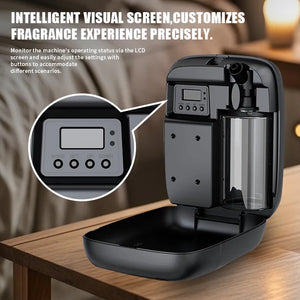
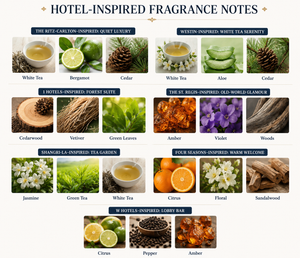
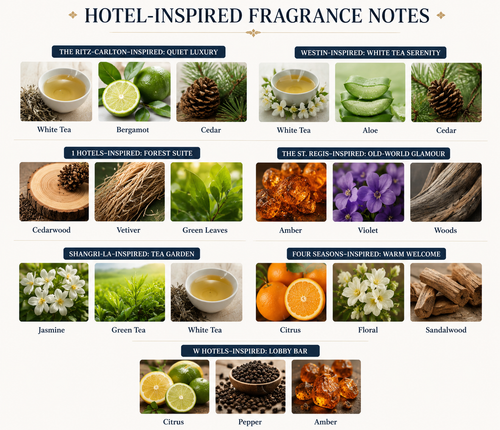
Vaayu at Rs 11,999 — waterless cold-air nebulisation with no standing water tank, up to 1000 m³ against this facility's 660, a 400ml fill lasting about seventy-five days so roughly five fills a year, app control with 1h/4h/8h/24h timers, under 38 dB, auto-stop and a key-lock for public areas, four hotel-inspired scents included. A
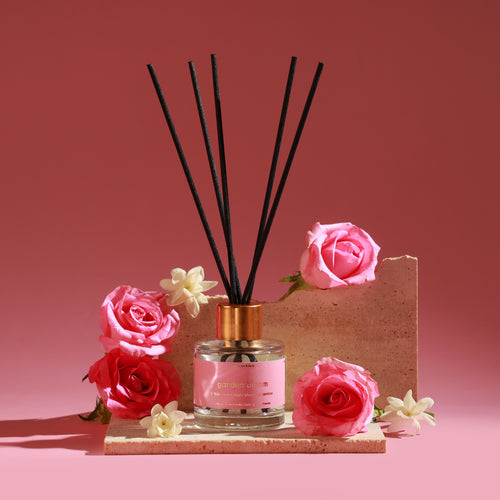
300ml refill at Rs 1,799, about seven a year. Alcohol-free reeds from Rs 749 for the administrative cabin. The
Aangan at Rs 25,999 is for an atrium or 8,000 to 10,000 sq ft and is overselling here. Free shipping above Rs 499, and no clinical claim of any kind.
Straight answer
We have never scented a clinic before. How do we choose the fragrance, the intensity, the zones and the machine?
Step zero. Give the building a free week first, and do not skip this because it is the only step that sometimes ends the project. A mug of water down every floor gully, sluice, unused basin, unused shower and every toilet in every department, sixty minutes before opening, every day, by a named person with a sheet to sign — a U-bend water seal evaporates in two to four weeks of disuse and then the drain vents into the room, and this is the commonest single cause of a clinic that smells. Dressing waste and sharps on a named collection time with lids that close. Soiled linen in closed bags on a route that does not cross a public corridor. Mop heads laundered nightly and dried flat and open rather than standing in a bucket behind a shut door. Air-conditioning filters moved from quarterly to fortnightly in season. The fresh-air damper confirmed open, and a tissue held to every toilet extract grille to confirm the fan runs. Every indoor unit set to run fan-only for the last ten minutes of the day so the coil dries before the building is locked.
Then walk the building yourself at nine, at two and at six and write one line each time. If anything is still there at the end of that week, it has a source and
the full twenty-six-line checklist is the page to work down. Fragrance must never cover a source, because covering it removes the signal that told housekeeping something was wrong.
Step one, the fragrance, and choose it last among the candidates rather than first among the adjectives. The
Vaayu arrives with four hotel-inspired scents, so the trial costs nothing: run one scent a week for four weeks, in your own building, at your own hours, on the setting you expect to keep. Do not judge a scent in a showroom or on a blotter, because a blotter is a paper surface at nose height and a waiting hall is 660 cubic metres with forty people in it.
The rule to hold every candidate to is that a patient should not be able to tell you what the fragrance is, only that the place did not smell of anything unpleasant. Choose the lightest and least interesting of the four. The people who vote are the front desk and the housekeeping supervisor, because they are in the building for twelve hours and you are not; the owner's preference is the least reliable instrument in the room. And one rule above all the others: a veto beats a preference. If any clinician says no to a scent or to a zone, it is out, and nobody asks why.
Where to scent when patients have asthma or fragrance sensitivity is the page to read before the trial rather than after it.
Step two, the intensity, and this is the decision that goes wrong most often. Set it by walking in from outside, because your nose is only honest for about the first thirty seconds in a space and after that it stops reporting. Go out of the building, stand in the street for two minutes, walk in, and ask one question: is it just detectable at the entrance. Then go and sit in the furthest seat at six in the evening and ask the opposite question: is it detectable here now.
The target is yes at the door and no in the seating at the evening peak, and if you cannot get both, you are at the correct setting when the second one is satisfied, not the first. Write the setting down as a numeral in the procedure, photograph the app screen, and engage the key-lock. The single most important operating rule in this cluster is that nobody raises the setting because the room got busy: busy is a ventilation and occupancy problem,
which has its own arithmetic, and turning fragrance up over a crowded hall gives patients two smells rather than one.
Step three, the zones, and draw them rather than describe them. Print the floor plan and hatch it in two colours. Scented: main entrance and lobby, reception and registration, the shared waiting hall, departmental sub-waiting, inter-departmental corridors, lift and stair lobbies, administrative and back-office rooms, the café or refreshment corner, and staff rooms if the staff want them. Fragrance-free: consultation and examination rooms, treatment and procedure rooms, day-care surgery and recovery, dressing rooms, blood- and sample-collection rooms, diagnostic laboratories, pharmacy dispensing, sterile stores and CSSD, imaging and radiology rooms, oncology and chemotherapy day-care, every paediatric clinical area, and any room in which a patient undresses.
The second list is longer than the first and that is the point: a clinic that is told plainly where not to put a machine can trust what it is told about where to put one. The reasons are specific rather than decorative — a clinician is trained to notice what a room and a patient smell of, people faint in collection rooms, smell aversion during chemotherapy is real and any oncology nurse knows it, children cannot consent and their parents did not choose it, and a laboratory or a sterile store is a contamination conversation with your own quality lead.
Which departments get it and which do not and
the full fragrance-free list carry the reason for every entry. Get the plan signed by the medical director, because “public areas” written in a sentence will be interpreted four ways by four departments and a hatched plan will not.
Step four, the machine, and the sum comes before the catalogue. The arithmetic is cubic metres equals floor area in square feet divided by 10.76, multiplied by ceiling height in metres, counting only the volumes a door closes. On this facility: 5,000 square feet of plan, of which 2,410 is clinical and excluded entirely — eight consultation cabins at about 120 square feet, two procedure rooms at 180, a dressing room at 100, sample collection at 90, the laboratory at 320, dispensing at 120, imaging at 250, a sterile store at 60, and 150 of staff sanitary and stores. That leaves 2,590 square feet public: entrance and reception 420, the shared waiting hall 900, departmental sub-waiting 260, inter-departmental corridors 420, lift and stair lobby 140, administration and back office 300, the café corner 150.
Take the 300 square feet of administration out too, because it sits behind a door that is always shut and it gets a ₹749 reed set instead. 2,290 square feet divided by 10.76 is 212.8 square metres; times 3.1 metres is about 660 cubic metres. The Vaayu is rated to 1000 cubic metres, so this is one machine with real headroom — against the two that a quotation written on 5,000 square feet would propose at ₹23,998. Waterless cold-air nebulisation with no standing water tank, which matters in a building open twelve hours a day that would otherwise need a named person emptying, rinsing and drying a reservoir daily; a 400ml fill lasting about seventy-five days, so roughly five fills a year; app control and 1h/4h/8h/24h timers so it runs the opening hours and stops; under 38 dB, quieter than the reception's own air conditioning, which matters because a consultation cabin may be two metres away; auto-stop; and the key-lock, which is the only reason a machine can stand in a public waiting hall at all. The
Aangan at ₹25,999 covers up to 3,000 cubic metres and belongs in an atrium or a whole floor; proposing it here is overselling and
the comparison page says so plainly. The ultrasonic
Sukoon at ₹1,899,
Boond at ₹899 and
Megh at ₹3,499 are water-based, hold standing water and add 30 to 50 millilitres of water an hour to the air: honest for one administrative cabin with a named owner, wrong for public clinical property. Candles are out of scope because an open flame in a healthcare facility is a fire-safety and insurance matter, and SOSA does not make a room spray.
Then site it, which takes four minutes and is usually done badly. Just inside the entrance or near the return-air path rather than in the middle of the seating; at about 1.8 metres, wall-mounted or on a shelf rather than on the floor where it will be kicked and where a child will reach it; out of the direct throw of an air-conditioning supply grille, which otherwise carries the output straight into the return; cable managed; key-lock engaged. Run it on the opening sequence: housekeeping opens up and waters the traps at sixty minutes before opening, air conditioning on at forty-five, diffuser on low at thirty, first appointment at zero, and the timer stops it at close.
And then the three documents, because without them the whole thing lasts one quarter. A one-page procedure — zones by reference to the signed plan, intensity as a numeral, start and stop times, the opening sequence, the refill cadence and stock held, the named owner, the monthly check, the veto register, the review date. A veto register: four columns — date, zone, who asked, action — with the rule that any clinician may have any zone switched off without giving a reason and the request is recorded rather than reviewed. And a review date ninety days out in the diary of whoever signed the procedure, with four questions and none of them about sales: has anybody turned it up, has any clinician vetoed a zone, has a refill been missed, and does the building still smell of nothing in particular at nine and at six.
The procedure template and
the question of who owns the refill are the two pages to read beside this one.
None of this is a treatment. Nothing here reduces anxiety, aids recovery, improves sleep, cleans or disinfects air, or has any clinical effect whatsoever, because it does not and a diffuser is not an air purifier. It is housekeeping and presentation, and the wording that keeps it that way is worth fixing before the machine arrives rather than after.A portion of every order supports girl-child education through Nanhi Kali.
TL;DR: free housekeeping week; then the fragrance (lightest of the four in the box, one a week for four weeks, veto beats preference); then the intensity (just detectable at the door, not detectable in the seating at six, written as a numeral, key-locked); then the zones (hatched plan, signed, clinical rooms out); then the machine (2,290 sq ft ÷ 10.76 × 3.1 m = about 660 m³, so one Vaayu at ₹11,999 and not two). Reeds ₹749 for admin, oil about ₹12,593 a year. Then a one-page SOP, a veto register and a ninety-day review.
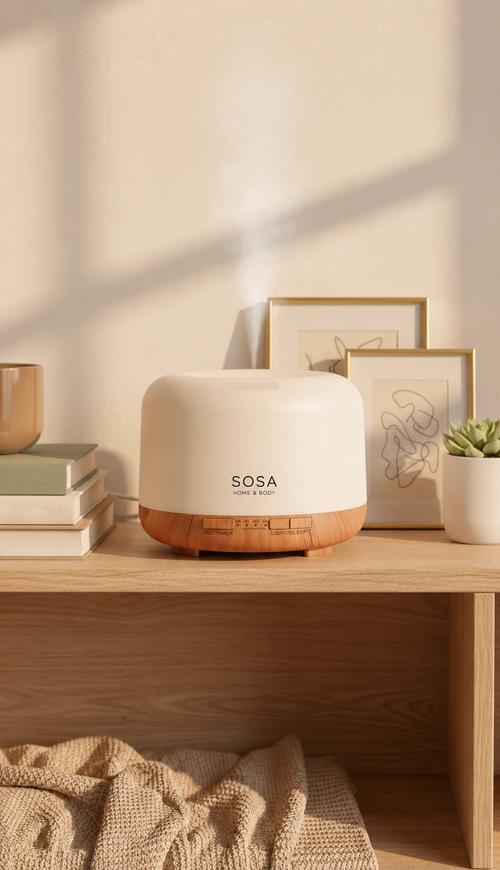
The whole decision path, and what each step costs
SOSA commercial scenting from ₹899
Five steps and three documents, and the first step is free.
Step zero is a housekeeping week and costs nothing. Step one is the fragrance, trialled from the four scents already in the box, and costs nothing. Step two is the intensity, which is a numeral and a key-lock. Step three is the zone map, which is a printed floor plan and two highlighters. Only step four has money in it. On a 5,000 sq ft six-department clinic: one
Vaayu at ₹11,999 for about 660 cubic metres of public volume, an alcohol-free
reed diffuser at ₹749 for the administrative cabin, and about ₹12,593 of oil a year. The
Aangan at ₹25,999 is for an atrium or a whole floor. Free shipping above ₹499.
Step zero, and it is free
I have put a free week in front of the four decisions you asked about, and I want to justify that rather than just assert it. A fragrance is a background. If a building already has something of its own to say — a dry trap, a bin on the wrong schedule, a soiled-linen route through a public corridor, biofilm in an air-conditioning drain pan, a dead toilet extract — then adding a background does not replace that voice, it joins it, and patients notice the pair more clearly than they noticed the single thing. Worse, it removes the signal that told your housekeeping supervisor something was wrong. So the week below comes first, and it comes first with a second benefit: it is free, it needs no quotation, no purchase order and no conversation with finance, and it can be started tomorrow morning by whoever has read this page. A reasonable number of clinics that do it properly find that the building has very little left to say, at which point steps one to four become a genuine presentation choice rather than a rescue — and a few decide they are done, which is a legitimate and good outcome. Where a clinic should spend first sets the same question out as a budget, and the twenty-six-line checklist is the version to print and put on a wall.
1
STEP ZERO AND STEP ONE
The free week, then choosing the fragrance from the four in the box
The free week, day by day, with one name against each line. Monday: the trap round. A mug of water down every floor gully, every sluice, every basin not in daily use, every unused shower and every toilet in every department, at sixty minutes before opening, by a named person with a sheet to sign. A U-bend seal evaporates in two to four weeks of disuse and the drain then vents into the room; every clinic has gullies and basins nobody uses, and this one line resolves more complaints than anything else available to you at any price. Tuesday: bins and linen. Dressing waste and sharps on a named collection time with lids that actually close, never parked in a public corridor; soiled linen in closed bags on a route that does not cross a public area and never left in a service lobby over a weekend. Wednesday: the cleaning store and the mops. Every mop head laundered nightly and dried flat and open on a rack rather than standing in a bucket behind a shut door, one head per zone per day, and the store itself vented or its door left ajar, because a closed damp cupboard full of wet textile is a source in its own right and almost nobody thinks of it. Thursday: the air, which is mostly settings. Filters moved from quarterly to fortnightly in season and put on the housekeeping sheet rather than a contractor's visit; the fresh-air damper confirmed open, because in a surprising number of buildings somebody closed it to save on cooling; a tissue held to every toilet extract grille, which takes four minutes for a floor; every indoor unit set to run fan-only for the last ten minutes of the day. Friday: the wash hour and the walk. Move the public-area wash out of the half-hour before opening, where it puts your first forty patients into the drying phase, and into the quiet gap between your two peaks. Then walk the building yourself at nine, at two and at six, and write one line each time.
Then step one, the fragrance, and the good news is that it costs nothing either. The Vaayu ships with four hotel-inspired scents, so run one a week for four weeks in your own building at your own hours on the setting you expect to keep. Not on a blotter and not in a showroom: a blotter is paper at nose height, a waiting hall is hundreds of cubic metres with people in it, and the two bear no relation.
Hold every candidate to one rule — a patient should not be able to tell you what the fragrance is, only that the place did not smell of anything unpleasant — and then pick the lightest and least interesting of the four. The votes that count belong to the front desk and the housekeeping supervisor, who are in the building twelve hours a day. And the rule that overrides every other rule in this section: a veto beats a preference. Any clinician who says no to a candidate or a zone is final, nobody asks why, and it goes in the register.
Patients who are sensitive to fragrance is the page that shaped that rule.
2
STEPS TWO AND THREE
The intensity, set by walking in from outside, and the zone map on paper
Step two, the intensity, and the first thing to know is that your nose is not a reliable instrument after thirty seconds in a room. Olfactory adaptation is why every clinic that sets its own level sets it too high: the person adjusting it has been standing in the hall for ten minutes, cannot smell it any more, and turns it up. So set it this way instead. Go outside, stand in the street for two minutes, walk back in through the main entrance, and ask one question: is it just detectable here. Then at six in the evening, with the hall at its fullest, sit in the furthest seat and ask the opposite question: is it detectable here now.
The target is yes at the door and no in the seating at the evening peak. If you cannot have both, the setting is correct when the second answer is satisfied, not the first — a hall that is quietly under-scented reads as a hall that smells of nothing, which is exactly what you are aiming at. If a patient asks your receptionist what the fragrance is, that is not a compliment; it is a reading, and the reading says turn it down. Then write the setting as a numeral in the procedure, photograph the app screen, file the photograph, and engage the key-lock. The operating rule that follows from all of this is the one I would print and tape inside the cupboard door:
nobody raises the setting because the room got busy. Busy is occupancy and ventilation, and
holding one level from opening to closing is the whole job of a timed machine.
Step three, the zones, and draw them on a plan rather than writing them in a sentence. Print the floor plan at A3, take two highlighters, and hatch it. Scented, in one colour: main entrance and lobby, reception and registration, the shared waiting hall, departmental sub-waiting, inter-departmental corridors, lift and stair lobbies, administrative and back-office rooms, the café or refreshment corner, and staff rooms if — and only if — the staff want them, which is a question to ask rather than assume. Fragrance-free, in the other: consultation and examination rooms, treatment and procedure rooms, day-care surgery and recovery, dressing rooms, blood- and sample-collection rooms, diagnostic laboratories, pharmacy dispensing, sterile stores and CSSD, imaging and radiology rooms, oncology and chemotherapy day-care, every paediatric clinical area, and any room in which a patient undresses.
Then have the medical director sign the plan. The signature is not ceremony: it is what makes the boundary survive a department head who decides in month three that the corridor outside the dressing rooms would be nicer scented. And the reason the fragrance-free list is longer than the scented one is worth saying out loud to whoever signs, because it is the basis on which they can trust the rest: a clinician is trained to notice what a room and a patient smell of and you should not take that instrument away from them; people faint in sample-collection rooms; smell aversion during chemotherapy is real and any oncology nurse will tell you so; children cannot consent and their parents did not choose it; and a laboratory or a sterile store is a contamination conversation with your own quality lead rather than with me.
The departmental breakdown carries the reason for each line.
3
STEP FOUR, AND THE THREE DOCUMENTS THAT KEEP IT
The arithmetic worked on 5,000 sq ft, the siting, and the page that survives a staff change
Step four, and the sum comes before the catalogue. Cubic metres equals floor area in square feet divided by 10.76, multiplied by ceiling height in metres, counting only the volumes a door closes. Worked on this facility, 5,000 square feet with a 3.1 metre ceiling.
Out of the sum entirely, 2,410 square feet: eight consultation and examination cabins at about 120 square feet each, 960; two treatment and procedure rooms at 180, 360; a dressing room, 100; blood- and sample-collection, 90; the diagnostic laboratory, 320; pharmacy dispensing, 120; imaging, 250; a sterile store, 60; staff sanitary accommodation and stores, 150. That is 48 per cent of the plan gone before anything is sized, and it is gone legitimately, because every one of those rooms is fragrance-free with its door shut.
In the sum, 2,590 square feet: entrance and reception 420, the shared waiting hall 900, departmental sub-waiting 260, inter-departmental corridors 420, lift and stair lobby 140, administration and back office 300, the café corner 150.
Then take administration out as well, 300 square feet behind a door that is always shut, and give it an alcohol-free reed diffuser at ₹749 instead — a room of that size is roughly 86 cubic metres and a reed set is the right product and the right money for it, as the reeds-in-a-large-hall question explains from the other direction. 2,290 square feet divided by 10.76 is 212.8 square metres; multiplied by 3.1 metres is about 660 cubic metres. One Vaayu, rated to 1000 cubic metres, with headroom — against the two machines at ₹23,998 that a quotation written against 5,000 square feet of plan would propose. The specification, for the purchase note: waterless cold-air nebulisation with no standing water tank; up to 1000 m³; a 400ml refillable tank lasting about seventy-five days per fill; Bluetooth app plus onboard control; 1h/4h/8h/24h timers; adjustable intensity; under 38 dB; DC 12V/1A at 5W; 165 × 80.5 × 215 mm and 0.9 kg; freestanding, wall or HVAC mounted; auto-stop and key-lock; CE, RoHS and SGS certified; four hotel-inspired fragrances supplied.
Site it properly, which takes four minutes and is usually done badly: just inside the entrance or near the return-air path rather than in the middle of the seating; at about 1.8 metres on a wall bracket or a shelf rather than on the floor, where it is kicked and where a child can reach it; out of the direct throw of a supply grille, which would otherwise carry the output straight into the return; cable managed; key-lock engaged. Run the opening sequence: traps watered and housekeeping open at T-60, air conditioning at T-45, diffuser on low at T-30, first appointment at T-0, timer stops it at close.
And then the three documents, because a decision with no paper behind it lasts one quarter. One: a one-page procedure — zones by reference to the signed plan, intensity as a numeral, start and stop times, the opening sequence, the refill cadence and the stock held on site, the named owner by name rather than by job title, the monthly check, the veto register and the review date. Two: the veto register, four columns, any clinician may switch off any zone without giving a reason, recorded rather than reviewed. Three: a review date ninety days out in the diary of whoever signed, with four questions — has anybody turned it up, has any zone been vetoed, has a refill been missed, and does the building still smell of nothing in particular at nine and at six.
The instruction I would give whoever is executing this page: do step zero before you ask anybody for a quotation, write the four decisions down in the order they appear here, and put the cubic-metre figure on the purchase note. A quotation written against a floor-plan area is a quotation against the wrong number, and on this facility the difference between the right number and the wrong one is ₹11,999.
The whole decision path as one table
This is the page in one sheet. Print it, put one name and one date against every step, and work downwards. Steps zero to three cost nothing at all; step four is the only row with money in it; and the last row is the one to read twice.
Print this
Five steps, three documents, and one costed line
| Step |
The decision |
How it is made |
What it costs |
| 0. The free housekeeping week ★ |
Whether there is anything to find before a background is added at all |
Traps at T-60 daily, bins and linen on schedule, mops dried flat, filters fortnightly, damper open, extracts tissue-tested, fan-off delay, wash hour moved — then walk at nine, two and six |
₹0 |
| 1. The fragrance |
Which of the four scents in the box the building keeps |
One scent a week for four weeks in your own building at your own hours. Front desk and housekeeping supervisor vote. A clinician's veto beats any preference |
₹0 — four scents are supplied |
| 2. The intensity |
One setting, for the whole day, written as a number |
Walk in from the street: just detectable at the door. Sit in the furthest seat at six: not detectable there. Write the numeral, photograph the app, engage the key-lock |
₹0 |
| 3. The zones |
Which volumes are scented and which are fragrance-free |
Hatch the floor plan in two colours and have the medical director sign it. Clinical rooms out entirely — here that is 2,410 of 5,000 sq ft. The list
|
₹0 |
| 4. The machine |
How many, which one, and where it stands |
2,290 sq ft public and non-admin ÷ 10.76 = 212.8 m² × 3.1 m = about 660 m³. One Vaayu, rated to 1000 m³. Sited at 1.8 m, out of the supply throw, key-locked |
₹11,999 |
| 4b. The admin cabin |
What a 300 sq ft room behind a shut door gets instead |
About 86 m³. An alcohol-free reed diffuser, 24–72 hours to establish, no tank, no electricity, no setting to be adjusted |
₹749 |
| The three documents |
Whether any of this survives a change of staff |
A one-page procedure; a four-column veto register in which any clinician may switch off any zone without giving a reason; a review date ninety days out. The template
|
₹0 |
| Never |
The things that are not on the list at any price |
A machine over a smell nobody has identified; the setting raised because the hall got busy; the Aangan for a 660 m³ building; a water tank with no named owner; any scenting in a clinical or paediatric clinical area; a candle in a healthcare building |
— |
Shop this guide
Everything this facility actually buys
The SOSA principle
Fragrance, intensity, zones, machine — and a free week in front of all four. On this facility the first four steps cost nothing and the fourth removes 2,410 of 5,000 square feet from the sum before a machine is chosen. Which is how a two-machine quotation becomes one machine, ₹11,999 instead of ₹23,998.
A mug of water in a dry trap. Four scents already in the box. A numeral and a key-lock. Two highlighters and a signature. None of it is interesting and all of it works.
The arithmetic, the three documents, and the ninety-day review
Give the free week a shape and then give the fragrance trial a month, because the two together are what turn this from a purchase into a decision. Week one is step zero, five lines with one name against each: the trap round at T-60 with a signed sheet; bins and linen on named times and closed routes; mop heads laundered nightly and dried flat with the store vented; filters fortnightly, the damper confirmed open, every toilet extract tissue-tested and the fan-off delay set; and the public-area wash moved out of the half-hour before opening into the quiet gap between your two peaks. Then walk at nine, at two and at six and write one line each time. At the end of that week you have one of three situations. If something is still there, it has a source: trace it rather than cover it, and the checklist is the page for it. If the building is fine in the morning and tired by the evening, that is air changes against occupancy rather than fragrance, and the nine-to-six arithmetic will show you the gap in a fortnight for about ₹3,500. And if the building is simply clean and quiet, you are at step one and the next four weeks are the fragrance trial: one of the four supplied scents a week, in the building, at your hours, with the front desk and the housekeeping supervisor keeping notes and any clinician holding a veto. Five weeks in total, no money spent, and at the end of it you know what you want and why.
Two things about the money, because this is where a first-time buyer is most likely to be oversold and most likely to under-specify the parts that matter. The first is the sizing, and it is worth being blunt: a quotation written against your floor-plan area is a quotation against the wrong number. This facility has 5,000 square feet of plan, and at the usual rule of thumb of one machine per 2,500 square feet that is two machines and ₹23,998. The honest sum says 2,410 square feet is clinical and fragrance-free with the doors shut, 300 more is administration behind a shut door that takes a ₹749 reed set, and the remaining 2,290 square feet at 3.1 metres is about 660 cubic metres — which is one machine rated to 1000 cubic metres, with headroom, at ₹11,999. The difference is the price of the machine itself, and it comes from arithmetic rather than negotiation. The second is the recurring cost, which first-time buyers almost always leave out of the approval and then discover in month four. A 400ml fill lasts about seventy-five days, so 365 divided by 75 is just under five fills a year; five fills at 400ml is 2,000 millilitres; at 300ml a bottle that is six and two-thirds, so buy seven a year and treat the seventh as your buffer. Seven 300ml refill bottles at ₹1,799 is ₹12,593, and the reed set for the admin cabin is replaced rather than topped up annually at ₹749. Year one is ₹11,999 + ₹749 + ₹12,593 = ₹25,341. Every year after is ₹13,342. Put it in facilities, alongside housekeeping consumables, rather than in marketing or patient experience, because the budget line decides the language and a facilities consumable never needs a benefit attached to it.
And then the part that decides whether any of this is still true next year, which is three pieces of paper and one date. The one-page procedure has nine lines: the zones, by reference to the signed and hatched plan rather than to the phrase “public areas”; the intensity, as a numeral, with the app screenshot filed beside it; the start and stop times, held by the 1h/4h/8h/24h timer rather than by a person; the opening sequence — traps and housekeeping at T-60, air conditioning at T-45, diffuser on low at T-30, first appointment at T-0, timer stop at close; the refill cadence and the stock held on site; the named owner, by name and not by job title, because “facilities” is not an owner; the monthly check, in which that person confirms the setting against the written numeral and that the key-lock is engaged, and signs one line; the veto register; and the review date. The veto register is four columns — date, zone, who asked, action — and one rule: any clinician may have any zone switched off without giving a reason, and the request is recorded rather than reviewed. It is the single most useful document in this set, because it converts the conversation a first-time buyer is quietly worried about into a line of administration, and because a clinic that can show one has visibly never overridden its own clinicians. The review is ninety days out, in the diary of whoever signed, and it asks four questions: has anybody turned it up; has any clinician vetoed a zone; has a refill been missed; and does the building still smell of nothing in particular at nine and at six. If the answer to the first is yes, the key-lock is not being used and the numeral is not being checked. If the answer to the last is no, go back to step zero rather than to the app, because fragrance is not the correction for a source or for an air-change gap and never becomes one by being raised. And if all four answers are good, write the date of the next review and leave it alone for a year. Nothing on this page is a treatment. Nothing here reduces anxiety, aids recovery, improves sleep, cleans or disinfects air, or has any clinical effect of any kind, because it does not and a diffuser is not an air purifier. Public areas only, clinical rooms fragrance-free with their doors shut, and the exact wording to use internally and with patients is the last page I would read before the machine arrives.
Fragrance, intensity, zones, machine — and a free week in front of all four. If you do this page in order, the only money you spend is on the step where the arithmetic has already told you what to buy.
— Sonal Sahani, SOSA
The SOSA edit
The costed shortlist for the worked facility, in the order a first-time buyer should approve it. Two of the six rows are free, three are the purchase, and the last is the row that protects the other five.
The SOSA edit
What a 5,000 sq ft six-department clinic actually buys
| Tier |
What is in it |
When it earns its place |
Cost |
| 1. The free week and the free trial ★ |
Traps, bins, linen, mop drying, filters, damper, extracts, the fan-off delay and the wash hour — then one of the four supplied scents a week for four weeks, in your own building, at your own hours |
Five weeks, starting tomorrow morning. No quotation, no purchase order, and for some clinics it is the whole answer |
₹0 |
| 2. The zone map and the numeral |
The floor plan hatched in two colours and signed by the medical director; the intensity set by walking in from the street and recorded as a number; the key-lock engaged |
Before the machine is ordered, because the map is what the coverage sum is calculated on |
₹0 |
| 3. An alcohol-free reed diffuser for the administrative cabin |
A 300 sq ft room behind a shut door is about 86 m³. Alcohol-free, 24–72 hours to establish, no tank, no power, nothing to adjust. Morning Freshness ₹749, Evening Calm ₹799, Mountain Breeze ₹849 |
At the same time as the machine. Replace annually rather than topping up |
From ₹749 |
| 4. One Vaayu
|
2,290 sq ft ÷ 10.76 × 3.1 m = about 660 m³ against a 1000 m³ rating. Waterless, no standing water tank, 400ml lasting about 75 days, app and 1h/4h/8h/24h timers, under 38 dB, auto-stop, key-lock, four scents included |
After tiers one and two. One machine, not the two a 5,000 sq ft quotation proposes |
₹11,999 |
| 5. The oil for a year |
About five fills a year at 400ml, so seven 300ml refill bottles with the seventh as buffer. Year one ₹25,341 all in; ₹13,342 a year after |
Approve it with the machine, not in month four. Free shipping above ₹499 |
₹12,593 a year |
| Not on the list at any price |
The Aangan at ₹25,999 for a 660 m³ building; a second machine bought on plan area; an ultrasonic water tank with no named owner; a stronger setting because the hall got busy; any scenting in a clinical or paediatric clinical area; a candle anywhere in a healthcare facility |
Never. A persistent smell is information, so find it and fix it rather than covering it |
— |
Honest notes for buyers: every area, ceiling height and cost on this page belongs to a worked example and should be re-derived against your own floor plan before it goes anywhere near a purchase order. The ventilation, infection-control and signage decisions referred to here belong to your own facilities contractor, infection-control lead and medical director rather than to a fragrance supplier. On fragrance itself, fragrance in a medical facility is housekeeping and presentation, never treatment. Nothing here claims that a fragrance reduces anxiety, aids recovery, improves sleep, cleans or disinfects air, or has any clinical effect whatsoever, because it does not and a diffuser is not an air purifier. Scenting belongs to the entrance, reception, shared waiting areas, inter-departmental corridors and administrative rooms. Consultation and examination rooms, treatment and procedure rooms, day-care surgery, dressing rooms, blood- and sample-collection rooms, laboratories, pharmacy dispensing, sterile stores, imaging rooms, oncology day-care and paediatric clinical areas should be left fragrance-free. A persistent smell is information about a dry drain trap, a bin, a soiled-linen route or an air-conditioning drain pan: find it and fix it rather than covering it. On the machines: the
Vaayu at ₹11,999 is waterless cold-air nebulisation with no standing water tank, covering up to 1000m³ or roughly 2,000–3,000 sq ft, with a 400ml tank lasting about 75 days, app control, 1h/4h/8h/24h timers, under-38dB running, auto-stop and a key-lock for public areas. The
Aangan at ₹25,999 covers up to 3,000m³ and connects to HVAC for a whole floor or an atrium. The ultrasonic
Sukoon,
Boond and
Megh are water-based, hold standing water and add 30–50 ml of water an hour to the air, which suits a single administrative cabin with a named person emptying and drying the tank daily and is unsuitable for public clinical property. An alcohol-free
reed diffuser needs 24–72 hours to establish and suits a small lobby rather than a large waiting hall. Candles are not appropriate in a healthcare facility because an open flame is a fire-safety matter. SOSA does not make a room spray. The Hotel Collection scents are SOSA's own interpretations inspired by the world's finest hotels; SOSA is an independent Indian fragrance house, not affiliated with or endorsed by any hotel brand. A portion of every order supports girl-child education through Nanhi Kali.
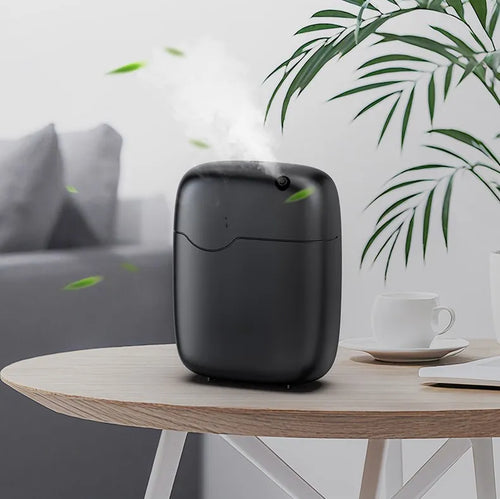
Step four, once steps zero to three are on paper
SOSA Vaayu ₹11,999
The last decision on the page, and the only one with money in it. Of 5,000 square feet of plan, 2,410 is clinical and fragrance-free with the doors shut and 300 more is administration behind a shut door that takes a ₹749 reed set. The remaining 2,290 square feet at 3.1 metres is about 660 cubic metres, and this machine is rated to 1000 — so one unit with headroom, against the two a quotation written on floor-plan area would propose. Waterless cold-air nebulisation with no standing water tank, a 400ml fill lasting about seventy-five days, app control with 1h/4h/8h/24h timers, under 38 dB, auto-stop, key-lock, CE, RoHS and SGS certified, four hotel-inspired scents included. Public areas only, on one low setting, for the opening hours.
A note from Sonal
This page is the hundredth I have written about fragrance in multi-speciality clinics, and the honest summary of the ninety-nine before it is that almost none of them were about fragrance. They were about drain traps, bin schedules, linen routes, drain pans, extract fans wired to the wrong circuit, mop heads left in buckets, fresh-air dampers closed to save on cooling, fabric seating, and the twelve kinds of room where a clinic should put nothing in the air at all. The fragrance part — the part I am actually trained in and the part I sell — turned out to be the shortest chapter every single time. I did not expect that when I started. I expected to write about scent families and accords, and instead I have spent a hundred pages explaining a sum, a sequence and a list of rooms to leave alone.
What I would say to somebody standing at the beginning of this, with no machine and no experience of it, is the thing I have ended up saying on nearly every page. Do the free week first, because it is free and because it sometimes ends the project; let your clinicians veto anything without explaining themselves, because that single rule removes almost every argument this subject can generate; and put the cubic metres on the purchase note, because the difference between sizing on floor area and sizing on volume is, in the facility worked above, exactly the price of the machine. And then describe the thing accurately for the rest of its life. It is housekeeping. It makes a building smell of nothing in particular instead of smelling of its own regime, which is a real and modest achievement, and anybody who offers you more than that is handing you a sentence to defend rather than a product to use. A clinic that keeps a veto register and a review date and one numeral written in a procedure has, in my experience, no further trouble with any of this.
A hundred pages in, the thing I am most pleased about is how many of them end with a reader deciding to buy less than they intended, or nothing at all. I would rather sell one machine into a building that is already right than four into one that is not, and that has not changed since the first page. Everything is made and supported from Pune, and a part of every order funds girl-child education through Nanhi Kali. You get a space that smells like somewhere looked after; a girl gets a classroom. That equation has always felt right to me.
Frequently asked questions
What is the right order for choosing fragrance, intensity, zones and a machine in a clinic?
A free housekeeping week first, then the fragrance, then the intensity, then the zones, then the machine. Housekeeping first because fragrance must never cover a source. Fragrance before intensity because you cannot set a level for a scent you have not chosen. Intensity before zones because the level is what makes a boundary hold. And the zones before the machine, because the zone map is what the coverage sum is calculated on, and the clinical rooms coming out of that sum is what decides how many machines you need.
How do we choose the fragrance for a multi-speciality facility?
Run a trial rather than a tasting. The machine ships with four hotel-inspired scents, so use one a week for four weeks in your own building, at your own hours, on the setting you expect to keep, and ignore blotters and showrooms entirely. Pick the lightest and least interesting of the four. The votes that matter belong to the front desk and the housekeeping supervisor, who are there twelve hours a day, and any clinician's veto beats any preference without needing a reason.
How do we set the intensity, and who is allowed to change it?
Set it by walking in from the street, because a nose stops reporting after about thirty seconds in a space, which is why clinics that adjust from inside always set it too high. The target is just detectable at the entrance and not detectable in the furthest seat at the evening peak, and if you can only have one, take the second. Record it as a numeral in the procedure, photograph the app screen, and engage the key-lock. Nobody raises it because the hall got busy.
How many diffusers does a 5,000 sq ft six-department clinic need?
One, on the worked example here, and not the two that a quotation written against floor-plan area would propose. Of 5,000 square feet, 2,410 is clinical and fragrance-free with the doors shut, and another 300 is administration behind a shut door that takes a reed set instead. The remaining 2,290 square feet divided by 10.76 and multiplied by a 3.1 metre ceiling is about 660 cubic metres, against a machine rated to 1,000 cubic metres. Count the volumes a door closes.
What should we write down so this still works next year?
Three things. A one-page procedure covering the zones by reference to the signed plan, the intensity as a numeral, the start and stop times, the opening sequence, the refill cadence, the named owner, the monthly check and the review date. A veto register with four columns, in which any clinician may have any zone switched off without giving a reason and the request is recorded rather than reviewed. And a review date ninety days out, asking whether anybody turned it up, whether a zone was vetoed, whether a refill was missed, and whether the building still smells of nothing in particular at nine and at six.
Five steps, and only the fifth has money in it
Do the free week, then the four decisions in order — and put the cubic metres on the purchase note
The Vaayu is ₹11,999: waterless cold-air nebulisation with no standing water tank, up to 1000 m³ or roughly 2,000–3,000 sq ft, a 400ml tank lasting about seventy-five days for roughly five fills a year, Bluetooth app control with 1h/4h/8h/24h timers, under 38 dB, auto-stop and a key-lock for public areas, CE, RoHS and SGS certified, supplied with four hotel-inspired fragrances so the trial costs nothing. A 300ml refill is ₹1,799. The Aangan is ₹25,999 for 8,000–10,000 sq ft or an atrium, and alcohol-free reeds from ₹749 suit an administrative cabin. Free shipping above ₹499, and a portion of every order supports girl-child education through Nanhi Kali.
See the Vaayu · ₹11,999 All commercial scenting
Continue the read
More from SOSA
Editorial standards & sources
Product facts used in this guide. SOSA Vaayu Rs 11,999: waterless cold-air nebulising diffuser, no water reservoir, coverage up to 1000m3 (approximately 2,000-3,000 sq ft), 400ml refillable tank lasting up to about 75 days per fill, Bluetooth app plus onboard control, 1h/4h/8h/24h timer scheduling, adjustable intensity, under 38 dB, DC 12V/1A at 5W, 165 x 80.5 x 215 mm and 0.9 kg, freestanding or wall or HVAC mounted, auto-stop and key-lock, CE, RoHS and SGS certified, supplied with four hotel-inspired fragrances. SOSA Aangan Rs 25,999: HVAC-connected or standalone commercial nebulising diffuser, coverage up to 3,000m3 (roughly 8,000-10,000 sq ft), 800ml reservoir, metal body, programmable schedules, under 42 dB. Ultrasonic machines are water-based, hold standing water and consume 30-50 ml of water an hour: Sukoon Rs 1,899 (500ml, 270-320 sq ft, 16-18 hours on low, three 15ml Hotel Collection scents included), Boond Rs 899 (300ml), Megh Rs 3,499 (6 litres). Hotel Collection water-based fragrance 15ml Rs 299, 100ml Rs 999, 300ml Rs 1,799. Alcohol-free reed diffusers from Rs 749, requiring 24-72 hours to reach their working level. Free shipping above Rs 499. Coverage arithmetic: cubic metres equal floor area in square feet divided by 10.76 and multiplied by ceiling height in metres, counting only the volumes that are actually scented. This guide makes no medical, therapeutic or clinical claim of any kind for fragrance: a diffuser does not purify, disinfect or clean air, and does not treat, calm or affect any patient or condition. Fragrance is housekeeping and presentation. Clinical areas should be left fragrance-free, and a persistent odour should be traced to its source and corrected rather than covered. SOSA is not affiliated with or endorsed by any hotel brand. Prices subject to change - see the live product pages.

 Refill · about seven a year₹1,799Shop →
 Reeds · the admin cabinfrom ₹749Shop →