

The order that works: extraction at the hob while you cook, cross-ventilation for ten or fifteen minutes after, then attention to the fabric in the room, and only then fragrance.
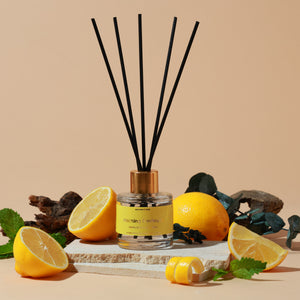
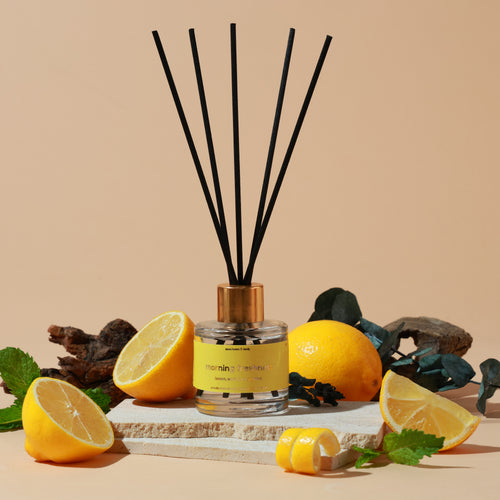
What to use once the room is aired: Morning Freshness — Malabar lemon, peppermint, eucalyptus globulus. ₹749 for 50ml, ₹1,249 for 130ml if the living room is above about 150 sq ft.
The honest limit: no reed diffuser and no machine removes a cooking smell. SOSA does not make an odour eliminator or an air purifier, and a fragrance laid over an un-aired room gives you a mixture rather than a solution.
2. Shut the kitchen doorway during the cooking, not after. Most Indian flats push kitchen air into the living room by accident: the kitchen window is open, the living-room balcony door is open, and the flat becomes one channel with the hob at the upstream end. Closing the connecting door for the fifteen minutes that matter, and opening the kitchen window wide instead, sends the plume outside rather than through the sofa.
3. Then ventilate properly, which means two openings, not one. A single open window exchanges air slowly; two openings on different walls make a path and clear the airborne fraction in minutes. Ten or fifteen minutes of genuine cross-flow does more than an hour of one window ajar.
4. Now deal with the part you cannot see, which is the reason you are asking. The oily fraction has landed on curtains, cushion covers, the sofa, the dining chairs and the wall around the hob. It re-releases for hours. Curtains and covers into the wash on a routine rather than when they look dirty; a damp wipe of the splashback and the cabinet fronts near the hob after the second cooking of the day; cushions out on the balcony rail for twenty minutes while the room airs. This is unglamorous and it is the step that changes the flat.
5. Only now does fragrance make sense, and it is doing a different job than you think. A reed diffuser does not remove the cooking smell and it is not competing with it. It gives the aired room its own character so that the room reads as somebody's living room rather than as neutral space between meals. Morning Freshness at ₹749 for 50ml, or ₹1,249 for 130ml if the living room is larger than about 150 sq ft, placed at the far end from the kitchen.
Alcohol-free, phthalate-free, made in Pune. A portion of every order supports girl-child education through Nanhi Kali.
The three things a tadka actually does to a flat
A tempering is a very short, very intense event. Oil is taken well above the temperature at which its lightest fractions leave the surface, whole spices are dropped in and burst, and for perhaps forty seconds the pan produces more airborne material than the rest of the meal combined. Understanding what leaves that pan is what separates a household that manages the smell from one that fights it twice a day for years.
 Morning Freshness₹749This is the fraction everybody thinks about, and it is the easy one. Volatile molecules from hot oil, asafoetida, mustard seed, curry leaf and browning onion move with the air, which means they go wherever the air goes and they leave when the air leaves. Two openings on different walls, a genuine path between them, ten or fifteen minutes: gone. The trouble is that this is also the fraction that gives a household false confidence. You air the room, the smell goes, you conclude the problem is solved, and then it returns and you assume the ventilation failed. It did not fail. It only ever had jurisdiction over one half of the problem.
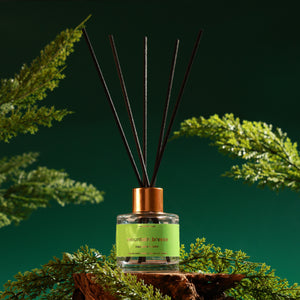
 Mountain Breeze₹849The oily aerosol is heavier than the vapour and it does not stay up. It settles onto whatever it meets — curtains, sofa fabric, cushion covers, the backs of dining chairs, the tops of picture frames, and the wall above and around the hob. Once there, it re-releases slowly into the room's air for hours. This is why a house smells of cooking again an hour after it was aired: nothing came back in through the window, the room is simply being re-supplied from its own surfaces. Ventilation cannot reach a fraction that is no longer airborne. Only washing, wiping and airing the surfaces themselves reduces it, and in a home that cooks twice a day it is a routine rather than a one-off.
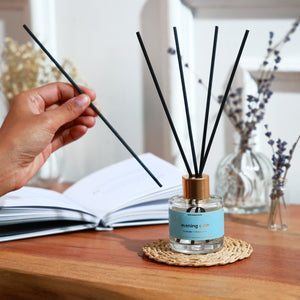
 Evening Calm₹799Olfactory receptors stop reporting a stimulus that does not change, and they do it within minutes. If you have been at home through the cooking you are adapted to it and you will underestimate what a visitor walks into; if you come home at seven to a flat that cooked at six you will overestimate it, because you arrive un-adapted from outside. Neither reading is the truth. The only reliable test is to leave the flat for a quarter of an hour and walk back in, or to notice what a guest says in their first two seconds. This matters practically: households routinely over-dose fragrance because they cannot smell their own room, and then guests find the living room heavy.
Why the smell comes back an hour after you aired the room
This is the question underneath your question, and it deserves a plain answer. An hour after airing, the air in your living room is largely new air; the surfaces are the old surfaces. Cooking deposits an oily film so thin you will never see it on a curtain, and that film behaves like a slow reservoir — it holds odour-active material and lets it go gradually, at a rate that depends on how warm the room is and how much air is moving over it. Open the windows and you accelerate the release while also removing what is released; close them and the room refills quietly from its own walls and textiles. Nothing has gone wrong. You are watching a two-speed system behave exactly as two-speed systems do.
Twice a day makes this cumulative rather than episodic. A household that fries once a week gets a spike and a long recovery; a household that tempers at eight in the morning and again at eight at night never gets the recovery. The film is topped up before the previous layer has finished releasing, which is why the flat develops a steady background character that the family stops noticing and every visitor registers. It is also why frequency of fabric care matters more here than in almost any other Indian home. Curtains in a twice-a-day kitchen-adjacent living room are not decoration; they are the largest piece of absorbent surface in the room and they should be treated as consumable in the way bedlinen is.
And this is the point at which I have to be direct about what we sell. Fragrance does not remove a smell. Adding a pleasant odour to an unpleasant one produces a mixture, and the brain now has two things to track rather than one — which is why a heavily scented room that still carries yesterday's frying is more unpleasant than either component alone. SOSA does not make an odour eliminator, an air purifier or a dehumidifier, and I am not going to gesture at one. What a reed diffuser does is give an already-aired room a consistent character. That is a real and worthwhile job. It is simply not the job of removing the tadka, and a page that blurred the two would be selling you something that does not exist.
What each step is actually worth, honestly ranked
Five interventions, in the order of how much they change the problem in a household cooking tadka twice a day. The last row is the one we sell, and it is last for a reason. If you can only do one thing this week, do the first row and ignore everything else on this page.
| Step | What it addresses | How much it changes | Effort | Cost |
|---|---|---|---|---|
| 1. Extraction, on early and off late | The plume before it ever leaves the kitchen | The largest single change available to you | A habit, once learned | Nothing |
| 2. Kitchen door closed while cooking | Stops the flat becoming one channel with the hob upstream | Very large in an open-plan or corridor layout | A habit | Nothing |
| 3. Cross-ventilation, two openings | The airborne fraction, in minutes | Complete for that fraction, none for the other | Ten to fifteen minutes | Nothing |
| 4. Curtains, covers and hard surfaces on a rota | The deposited fraction — the one that keeps returning | The step that changes the flat's baseline character | Real, recurring, unglamorous | Washing |
| 5. A reed diffuser, once the room is aired | Gives the cleared room its own character between meals | Meaningful for how the room reads, nil for odour removal | Flip the reeds every few days | ₹749–₹1,349 |
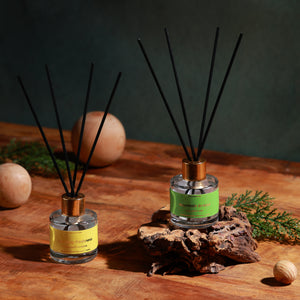
Bright · Morning Freshness₹749Shop → 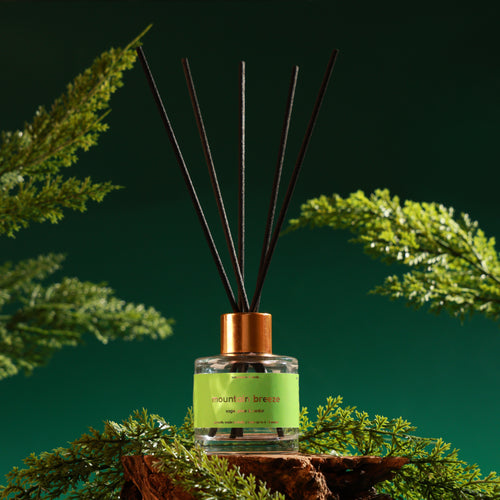 Dry woody · Mountain Breeze₹849Shop →
 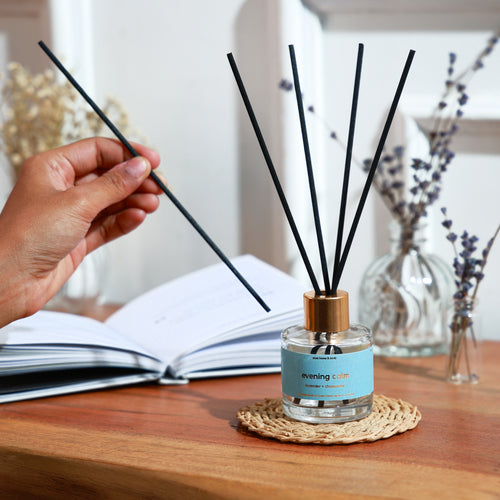 Softest · Evening Calm₹799Shop →
Placement, dose and the twice-a-day rhythm
Where you put the bottle matters more in this house than in most, because your flat has a prevailing direction of travel and you already know what it is: from the hob, through the doorway, into the living room. Put the diffuser at the far end of that path, not on it. A reed diffuser has no fan and relies on the room's own air movement, so it wants to be in the room's natural circulation but not in a draught line and never in the corridor between kitchen and sofa, where it will be stripped by every cooking session and will also be the first thing that mingles with the plume. A side table at the living-room end, at or slightly below nose height, away from direct sun and well away from any flame, is the right place.
Dose second, and dose down rather than up. The instinct in a house that cooks twice a day is to reach for six reeds and the largest bottle on the assumption that more fragrance will hold the line against more cooking. It does not work that way, because the two are not in competition; a stronger fragrance simply gives you a stronger mixture. Six fibre reeds is full projection for a living room above 150 sq ft; three is a soft level and roughly doubles how long the bottle lasts. In a flat where the living room is modest, start at three or four and add one if a returning visitor genuinely does not notice it. People who describe a home fragrance as cloying are usually describing over-dosing rather than the composition, and the correction is free.
Sizing follows the room and not the problem. A 50ml at ₹749 is built for up to about 150 sq ft and runs 6–8 weeks; a 130ml at ₹1,249 is for above that and runs 14–18 weeks. Cost works out at roughly ₹13 a day for Morning Freshness on the 50ml, which is a fairer way to think about it than the sticker price. As for timing: flip the reeds every three to five days, and if you want the flip to earn its keep, do it in the evening after the second cooking and after the room has been aired — flipping releases a burst of projection, and you want that burst landing in a room that has just been cleared rather than one that is about to be filled.
What to buy, in order — and what is not worth buying
In buying order for a household that tempers twice a day and wants the living room to have a character of its own between meals. I have put the honest gap at the bottom, because it is the row that saves people money: there is no SOSA product, and to my knowledge no product of any kind that I would recommend, which removes a cooking odour from a room. If that is what you are shopping for, the extraction fan and the washing machine are your budget, not this page.
| Buy | What it is | When it is the right answer | Price |
|---|---|---|---|
| 1. Morning Freshness 50ml ★ | Malabar lemon, peppermint, eucalyptus — bright citrus, 9.0 | The default for a kitchen-adjacent living room up to ~150 sq ft | ₹749 |
| 2. Morning Freshness 130ml | The same composition, sized for above 150 sq ft, 14–18 weeks | Open-plan living rooms and larger flats | ₹1,249 |
| 3. Mountain Breeze 50ml | Himalayan pine, sage, Indian cedar — dry and resinous, 9.4 | If citrus reads as too close to a cleaning product for you | ₹849 |
| 4. Fresh & Grounded duo | Bright and woody together, two 50ml bottles | If you are scenting a living room and a bedroom rather than one room | ₹1,548 |
| The honest gap: nothing here removes a cooking smell | SOSA makes no odour eliminator, no air purifier and no dehumidifier, and there is no room spray in the range — every SOSA spray is a car perfume | Said plainly. Extraction, airing and washing do that work; fragrance follows them | — |
Versailles
I grew up in a house where the tadka happened twice a day and nobody ever discussed it, and I have spent a good part of my working life explaining to people that the thing they are trying to buy their way out of is largely a fabric problem. The smell you cannot shift is not in the air. It is in the curtains. That is not a sales line; it is the reason ventilation appears to work and then appears to stop working, and once you have seen it you cannot unsee it.
So the order matters more than the product, and I would rather write that down than pretend a bottle changes it. Extraction on before the oil. The connecting door shut for the fifteen minutes that matter. Two openings, not one. Curtains and covers washed on a rota that would look excessive to a household that eats out. Only then a diffuser, and placed at the far end of the room from all of that.
What the diffuser then does is worth having, and I want to describe it accurately rather than grandly. It gives the room a consistent character in the hours between meals, so that the living room has an identity of its own rather than being defined by whatever was last cooked. Morning Freshness at ₹749 is what I use for that, and the eucalyptus base underneath the lemon is the unglamorous engineering that keeps a citrus alive for six to eight weeks instead of the ten to fourteen days an ordinary lemon reed manages. Everything is made in Pune, and a part of every order funds a girl's classroom through Nanhi Kali.
Frequently asked questions
- A 1BHK that smells of breakfast until lunch — why small volumes concentrate everything.
- Frying fish in a 2BHK — the highest-deposition case, and what to do before any fragrance.
- The chimney works but masala still reaches the sofa — fabric as the reservoir.
- Should you avoid sweet fragrances if you cook nightly? — largely yes, and why.
- Citrus, floral or woody after heavy cooking — the four registers scored.
- One AC across kitchen and living room — one air volume, one decision.
- A reed with the kitchen a few feet away — yes, with one caveat.
- Cooking at 7, guests at 8 — the hour you actually have.
- Sukoon or a reed when you need fragrance quickly — speed against continuity.
- Brand: the SOSA founder story.
SOSA reed diffusers — facts verified August 2026: Five scents, all alcohol-free, on a heat-stable CCT (caprylic/capric triglyceride) base rather than DPG, phthalate-free, paraben-free, IFRA-compliant, 0 ppm formaldehyde, six fibre reeds in a refillable glass bottle, composed and made in Pune, India. Morning Freshness (Malabar lemon · peppermint · eucalyptus globulus) 50ml ₹749 · 130ml ₹1,249 · 9.0 on the SOSA strength scale. Evening Calm (Kashmir lavender · chamomile · soft musk) 50ml ₹799 · 130ml ₹1,299 · 8.9, the softest in the range. Garden Bloom (British rose · night-blooming jasmine) 50ml ₹799 · 130ml ₹1,299 · 8.9. Mountain Breeze (Himalayan pine · sage · Indian cedar) 50ml ₹849 · 130ml ₹1,349 · 9.4. Fresh Brew (Coorg coffee · Kerala vanilla · soft caramel) 50ml ₹849 · 130ml ₹1,349 · 9.5, the deepest in the range. Longevity 6–8 weeks on 50ml and 14–18 weeks on 130ml; 50ml suits rooms up to about 150 sq ft and 130ml above that. Six reeds give full projection and three give roughly double the life. Climate-tested through 45°C heat and 85% RH monsoon humidity. The reed line contains no oud, sandalwood, vetiver or amber; the Smoked Oudh and Sandalwood ₹449 jar candles are separate products. Reed oil and the water-based Hotel Collection are not interchangeable and there is no hotel-inspired reed diffuser. Fragrance oil is flammable — keep diffusers away from diyas, agarbatti and open flame. Free shipping above ₹499. A portion of every order supports girl-child education through Nanhi Kali. SOSA is an independent Indian fragrance house and is not affiliated with or endorsed by any hotel brand. Prices subject to change — see the live product pages.