



Choose the continuous background if the fragrance is mostly for you, you occupy the room for many hours a day, and you would rather a home felt consistently pleasant than occasionally dramatic. Accept in advance that you will stop noticing it within minutes and that this is the setup working correctly.
The tension in one line: the arrival effect needs a low side. Scenting everything evenly removes it.
The only honest way to have both: zoning plus intermittency — different registers in different rooms, and a device that runs in windows rather than continuously, because sensitivity recovers in the gaps. Safar ₹3,999 has three speeds and a 1/2/3-hour auto-off; Vaayu ₹11,999 schedules 1h/4h/8h/24h windows. A reed can do neither — it cannot be switched off.
The honest gap: no single product does both well, and between Safar at personal scale and Vaayu at 1000 m³ — roughly 2,000–3,000 sq ft — SOSA has no mid-sized waterless bedroom nebuliser.
2. Understand that the arrival effect is a gradient rather than a strength. What produces the moment is a difference between two concentrations either side of a threshold, met by a nose that has been somewhere else. That means it has two halves, and the half everybody forgets is the low one. A closed room accumulates; an unscented corridor stays low; the step between them is the whole event. Nothing about this requires an unusually strong fragrance, and raising the fragrance everywhere destroys it, because you have raised both sides of the step equally.
3. Understand that the background is a level, and that you will stop noticing it. That is not a failure of the setup; it is the setup working. Olfactory receptors stop reporting a constant, unchanging stimulus within minutes, so a background you can perceive continuously is one that has overshot the room — and the people arriving at your door will find it heavy while you find it correct. If you want a continuous background, buy it and then deliberately stop auditing it. Judge it by whether guests ever describe the house as pleasant, not by whether you can smell it at nine on a Tuesday.
4. Then look at your hours and your doors, because those decide what is even possible. A room you occupy for ten hours a day cannot give you an arrival effect — you are adapted to it by the second hour, every day. A room you leave and return to can. A room with a door can hold a concentration; an open-plan floor cannot hold one without a machine sized for the whole volume. If you have no doors and no absences, the honest answer is that the background setup is the only one on the table, and you should build that one well rather than chase the other.
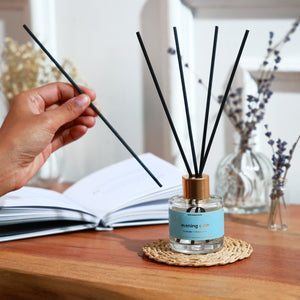
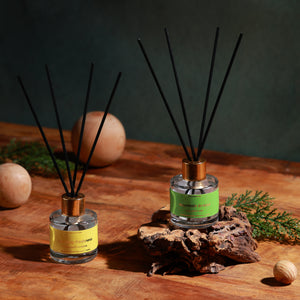
5. Only then choose the mechanism, and choose it for the shape you picked. Background wants passive capillary: a reed diffuser at three fibre reeds is silent, unpowered, maintenance-free, roughly doubles its life at that reed count, and holds one level for weeks. Arrival wants either concentration in one room — a 130ml with all six reeds in the entry room only — or a device with a clock, because only a machine can be high at eight and quiet at eleven. Sukoon at ₹1,899 covers 270–320 sq ft for 16–18 hours on low; Safar at ₹3,999 nebulises undiluted oil with three speeds and a 1/2/3-hour auto-off, and is named and sold as a car and travel diffuser with no published room-coverage figure.
Alcohol-free, phthalate-free, paraben-free, IFRA-compliant, 0 ppm formaldehyde. Free shipping above ₹499, and a portion of every order supports girl-child education through Nanhi Kali.
Why the two setups are genuinely in tension, and not just different emphases
The clearest way to see it is to draw the concentration across a floor plan. The arrival setup is a tall narrow shape: one room high, everything around it low. The height of that shape is not what produces the moment — the slope is. A guest walking from an unscented landing into a fragranced hallway experiences a change, and a change is the only thing a nose reliably reports. Now flatten the drawing: raise the landing, the corridor and the next two rooms to the same pleasant level. You have not made the effect stronger. You have deleted it, because there is no longer a slope anywhere for anybody to cross, and every person in the building will adapt to the new uniform level within minutes of entering it.
The reverse holds just as firmly. A setup optimised for arrival is, by construction, an uneven home. The entry room is doing something and the back bedroom is doing very little, and if you find that irritating — if what you actually wanted was a house that always feels considered rather than a house with one dramatic doorway — then you did not want the arrival setup at all. It is worth being blunt about this because the two goals are usually held simultaneously and unexamined, and the resulting purchases are contradictory: a large machine bought for reach, then run on its lowest setting because the room became too much, which is to say a lot of money spent to arrive at the reed’s natural behaviour.
There is also a perceptual asymmetry between the two that decides more than most people expect. The arrival effect is experienced by people who are not you. Guests get it; you get it on returning from outside; you never get it from the next room, because by then you are adapted to the whole flat. The background, by contrast, is experienced by nobody consciously, including you — its entire value is that a room feels pleasant without anyone identifying why. So the real question underneath “which setup do I want” is often whose experience am I buying, and once that is settled the rest follows almost mechanically.
 Garden Bloom₹799This is the question that decides the other two, so answer it honestly rather than aspirationally. If you picture somebody stepping in and saying something, you are buying the arrival effect and you are buying it for them — which is a perfectly good reason to buy anything, and it means your money belongs in one room rather than spread across five. If you picture yourself on an ordinary Wednesday evening with nobody visiting, you are buying background, and the correct spend is small, soft and repeated. The commonest expensive mistake in this category is buying the arrival setup and then judging it by the background criterion — concluding that a strong entry room has “stopped working” because you personally cannot smell it after ten minutes at home.
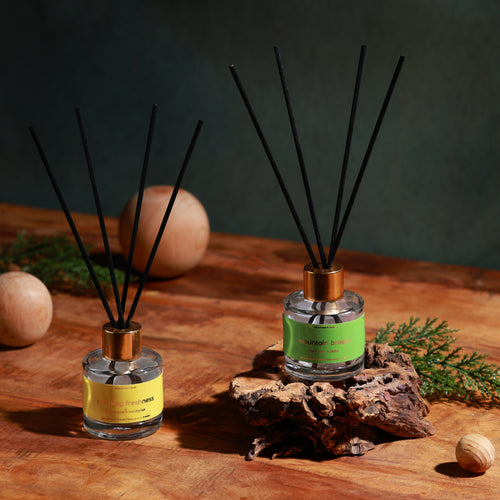
 Mountain Breeze₹849Count the hours before you spend anything. If you work from home in the room in question and are in it ten hours a day, the arrival setup is not available to you in that room at any price, because you are adapted to it from the second hour onward and will stay adapted. Continuous low-level is the only sensible design for a room like that, and it should be pitched low deliberately: something you will be inside all day should never have been set to impress somebody arriving. Conversely, if you leave at nine and return at seven, you have a genuine arrival every single evening, for free, and the setup that exploits it is worth building. Absence is the raw material of the effect — not oil.
 Sukoon₹1,899A closed 100–150 sq ft room reaches a perceptible concentration easily, because the volume is small and the air is not being replaced. An open-plan living-dining does not, because you have asked the same source to fill several times the volume with nothing to hold it. So the cheapest equipment in this entire cluster is a door you already own, and the honest consequence for open-plan homes is that a true arrival effect there is a machine question rather than a bottle question. Sizing matters too and is frequently the real complaint: a 50ml is specified for up to about 150 sq ft and a 130ml above it, so a 50ml in a 300 sq ft room reads as weak while performing precisely to specification.
The one honest way to have a version of both
Having spent the page insisting on the tension, I owe you the resolution, and it is real — it simply is not free and it is not one product. The answer is zoning plus intermittency. Zoning means different registers in different rooms rather than one scent everywhere: a floral where people arrive, a soft herbal where you sleep, something cool and dry where you work. That keeps a step at every doorway while still giving you a home that always smells of something considered. It is the closest thing to having both, and with reeds it costs the price of two bottles — a duo is two 50ml bottles at ₹1,548, not a boxed set and not a discount structure. Its genuine advantage here is that it puts two different things at two thresholds.
Intermittency is the second half and it is the one that acts on perception rather than on the room. Sensitivity recovers during a gap. A device that runs in windows — on for an hour, off for two — produces a room whose concentration rises and falls, and a rising edge is something a nose reports even from inside the house. That is why scheduled machines feel more present than their settings suggest, and why continuous running at a high setting is usually the worst of both worlds: expensive, heavy for guests, and imperceptible to you. Safar at ₹3,999 does this with three speeds and a 1, 2 or 3-hour auto-off — it is named and sold as a car and travel diffuser, SOSA’s own page also names bedside and hotel room among its uses, and no room-coverage figure is published for it, so it is personal and small-space scenting rather than a room machine. Vaayu at ₹11,999 does it properly with app scheduling in 1h, 4h, 8h and 24h windows, under 38 dB — but it is rated to 1000 m³, roughly 2,000–3,000 sq ft, and in one bedroom nine-tenths of it is wasted.
Which leaves the reed doing what the reed is best at, and I want to name it precisely rather than as a consolation. For the continuous background, a reed diffuser is not a compromise — it is the correct instrument, and nothing on this page beats it. It holds one level for six to eight weeks without being asked. It is silent, which matters more in a bedroom than any specification. It needs no power, no water, no charging and no schedule; there is nothing to run dry, descale or forget. It costs roughly ₹13 to ₹15 a day, and it looks like a glass object rather than an appliance. Its single genuine design limitation is precisely the one this page cares about: it cannot be switched off, so it cannot be scheduled and it cannot give you a rising edge. That is a real limit and it is the honest reason a machine exists.
| Decision | Setup A — strong arrival | Setup B — continuous background |
|---|---|---|
| Who experiences it | Guests, and you on returning from outside. Never you from the next room | Nobody consciously, including you. The room simply feels considered |
| The shape you are building | A tall step at one threshold — high inside, low outside | A low flat level across the rooms you occupy |
| Where the fragrance goes | One room only — the first one people enter. Approach deliberately left bare | Every room you use, in the same register or two related ones |
| Dose | All six fibre reeds; the 130ml if the room is above ~150 sq ft | Three fibre reeds, not six — a soft level, and roughly double the life |
| Doors | Essential. Containment is what allows a step to exist | Irrelevant. Evenness is the goal, so open plan is fine |
| Mechanism that suits it | Concentration in one room, or an active diffuser with a schedule — Sukoon ₹1,899 at 270–320 sq ft, or Safar ₹3,999 with a 1/2/3-hour timer | Passive capillary. A reed at ₹749–₹849, silent, unpowered, ₹13–₹15 a day, and genuinely the best tool for the job |
| How you judge it | Ask an arriving guest where they first noticed anything and whether it was too much | Do not audit it. If you can perceive it continuously, it has overshot |
| The honest gap: no single product does both well, which is why this page makes you choose. And the mechanism that suits a scheduled bedroom arrival best — waterless nebulising with an off period — exists at SOSA only as Safar, named and sold as a car and travel diffuser with no published room-coverage figure, and as Vaayu at 1000 m³, which is the wrong purchase for one bedroom. There is no mid-sized waterless bedroom nebuliser between them. Megh ₹3,499 is not it either — about 215 sq ft, less than the ₹1,899 Sukoon, and a runtime and humidity machine. | ||
 Arrival room · Garden Bloom₹799Shop → Background · Evening Calm₹799Shop →
  Scheduled · Sukoon₹1,899Shop →
The mistake both setups share, and how to avoid it
Whichever you choose, the same error waits at the end of it: judging the result with your own nose, from inside your own home. Olfactory receptors stop reporting a constant, unchanging stimulus within minutes — the molecules keep arriving and the brain stops forwarding the signal, because something unchanged is not news. You will therefore lose track of both setups within a fortnight, and the temptation at that point is identical in both cases: add reeds, buy a larger bottle, run the machine higher. You will adapt to each new level too. Meanwhile the people walking through your door are experiencing a room you have no way of assessing, and in the small, well-sealed, air-conditioned rooms most of these questions concern, overshoot is far more common than under-dosing.
So build in a measurement before you build the setup. Leave the flat for fifteen minutes and walk back in with the door shut behind you, and read the room from the threshold rather than from beside the bottle. Better, ask an arriving guest two questions: where did you first notice anything, and was it too much. Those two answers give you the distance at which the fragrance becomes perceptible and whether you have gone too far, which between them are the only numbers either setup needs. And if guests remark on it and you cannot detect a thing, nothing is wrong: sensitivity to individual materials varies enormously between people, and you carry the extra handicap of living there. The diffuser is working for everybody but you, which is the ordinary condition of owning one.
The second shared mistake is expecting either setup to do a job neither can do. Fragrance does not remove a smell. Adding a pleasant odour to an unpleasant one produces a mixture rather than a cancellation, and the mixture is frequently worse because the brain now tracks two things — which, incidentally, is exactly what a guest is registering when they walk into a room and think something has just been sprayed. Source, then ventilation, then fragrance. Air the room before people come rather than scenting over it, and remember that cooking aerosols condense onto curtains and upholstery and re-release for hours after the airborne fraction has cleared. That is a ventilation and cleaning question with an odour symptom, and no setup on this page is the answer to it.
What to buy for each — and the rung that does not exist
Two shopping lists rather than one, because that is the honest structure of the question. The free rows are genuinely first in both. The last row is the gap in our own range, said plainly, because the hybrid is the setup our catalogue serves least well.
| Buy | What it is | Which setup, and when | Price |
|---|---|---|---|
| 1. The free build ★ | For arrival: shut the room, leave the approach unscented, all six reeds, bottle a metre inside and out of the draught. For background: three reeds instead of six, the same register in every room you use, and stop auditing it | Both. Most readers who arrive here are one free adjustment away from the setup they wanted | ₹0 |
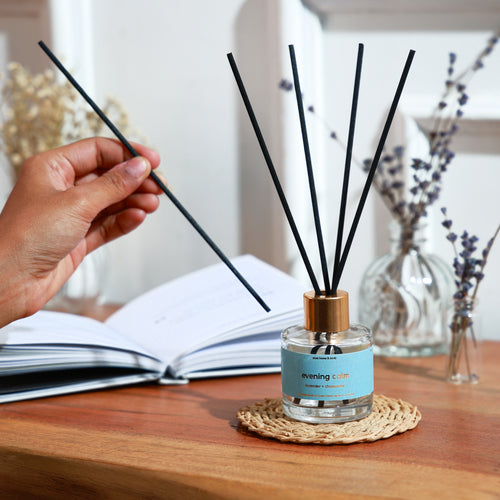
| 2. Evening Calm 50ml, three reeds | Passive capillary. 8.9 on the SOSA strength scale, the softest we make. Roughly double the life at three reeds | Setup B. The correct instrument for a continuous background, not a compromise | ₹799 |
| 3. Garden Bloom 130ml, six reeds, one room | Passive capillary at full dose in the entry room only, with the approach left bare. 14–18 weeks, for rooms above ~150 sq ft | Setup A, done passively. It will not give you a peak on cue, but it gives a real step at a threshold | ₹1,299 |
| 4. A duo — two 50ml bottles | Two registers in two rooms. Not a boxed set, not a hamper, not a discount structure — the advantage is that it puts a change at each doorway | The hybrid. The cheapest honest way to keep a step while still having a home that always smells of something | ₹1,498–₹1,598 |
| 5. Sukoon — the schedule, with water | Ultrasonic water mist. 500ml, 270–320 sq ft, 16–18 hours on low, three 15ml Hotel Collection scents included. Run it in windows rather than continuously | Setup A with a clock, and the best value for it. Accept dilution, refilling, added humidity and possible white dust in hard water | ₹1,899 |
| 6. Safar — undiluted, with an off switch | Waterless cold-air nebulising. 20ml, 2000 mAh Type-C, up to 10 hours continuous or ~30 intermittent, 3 speeds, 1/2/3-hour auto-off, 6.9 cm. Named and sold as a car and travel diffuser, with bedside and hotel room among its stated uses | When intermittency matters and you want no added water. No published room-coverage figure; personal scenting, and it needs recharging | ₹3,999 |
| Only for a large space: Vaayu | 1000 m³ — roughly 2,000–3,000 sq ft — 400ml lasting about 90+ days, Bluetooth scheduling in 1h/4h/8h/24h windows, under 38 dB | Genuinely the best hybrid device made, and the wrong purchase for one bedroom. It earns its price on a whole floor, an open-plan living-dining, a villa, a clinic or a reception | ₹11,999 |
| The honest gap | No single product does both setups well, and no mid-sized waterless bedroom nebuliser exists at SOSA between Safar at personal scale and Vaayu at building scale | Said plainly. If you want a scheduled, waterless, room-sized machine for one bedroom, we do not make one | — |
Versailles
I wrote this page because I kept answering two questions as though they were one, and giving worse advice for it. Somebody would write asking how to make their home more noticeable, and I would talk about mechanism and coverage; then it would emerge three messages later that what they actually wanted was for the flat to feel calm on a Tuesday evening with nobody visiting. Those are opposite briefs, and the products that serve them well are different products at different prices.
The part that surprises people is that the low side of the step is equipment. If you want a doorway to mean something, the corridor outside it has to smell of less, and that means deliberately leaving parts of your home unscented — which feels like under-buying and is in fact the whole design. I have talked more people out of a second and third bottle on that basis than I have sold, and I would still do it, because a home fragranced identically everywhere stops registering within a week and then the owner concludes the product was weak.
And if you want the background instead, buy small and then leave it alone. Three reeds rather than six, the softest thing in the range, and no auditing. You will stop perceiving it within minutes, every day, and that is the setup succeeding rather than failing. The only person who cannot review your home is you. If you want both, the honest route is two registers in two rooms, and — if you can afford it and the space justifies it — a machine that runs in windows rather than continuously, because sensitivity recovers in the gaps. Just know before you spend that our small waterless device is named and sold as a car diffuser with no published room coverage, and that the machine above it is built for a whole floor. There is nothing in between, and that gap is ours rather than yours. Everything is composed in Pune, and part of every order funds a girl’s classroom through Nanhi Kali.
Frequently asked questions
- How hotels do it in seconds — threshold concentration and a scent held constant for years.
- The “wow, your home smells amazing” effect — one scent, one room, ventilate before.
- Guests noticing before they sit down — placement inside the entrance, out of the draught.
- An arrival moment at the bedroom door — why a closed door is the cheapest tool you own.
- Nice once you sit inside, but no immediate impact — the concentration gradient explained.
- Reed, spray or active diffusion — three shapes over time, honestly compared.
- A signature scent at your own bedroom door — and the honest limit on getting it yourself.
- Why you notice a lobby and not your own home — adaptation in full, and the fifteen-minute test.
- Stronger fragrance or better diffusion? — the pillar, and the one free exception.
- Brand: the SOSA founder story.
Facts verified August 2026: Three diffusion mechanisms are described — passive capillary (reed diffusers), ultrasonic water mist (Boond ₹899, 300ml, up to ~150 sq ft, ~6 hours, USB, night light; Sukoon ₹1,899, 500ml, 270–320 sq ft, 16–18 hours on low, three 15ml Hotel Collection scents included; Megh ₹3,499, 6L tank, ~100 hours runtime, ~215 sq ft, which is less coverage than Sukoon and never a coverage upgrade) and waterless cold-air nebulising (Safar ₹3,999, 20ml bottle, 2000 mAh Type-C battery, up to 10 hours continuous or around 30 hours intermittent, 3 speeds, 1/2/3-hour auto-off timer, 6.9 cm, named and sold as a car and travel diffuser with car, handbag, desk, bedside and hotel room among its stated uses, no published room-coverage figure; Vaayu ₹11,999, coverage up to 1000 m³ or roughly 2,000–3,000 sq ft, 400ml refillable tank lasting up to about 90+ days, Bluetooth app and onboard buttons, 1h/4h/8h/24h run windows, adjustable intensity, key-lock, under 38 dB, freestanding or wall/HVAC mount, 5W, CE, RoHS, SGS). SOSA reed diffusers: five scents, 50ml ₹749–₹849 lasting 6–8 weeks and suiting rooms up to ~150 sq ft, 130ml ₹1,249–₹1,349 lasting 14–18 weeks and suiting above 150 sq ft, six fibre reeds included and flipped every 3–5 days, six reeds for full projection and three for a soft bedside level, about ₹13–₹15 a day, heat-stable CCT carrier rather than DPG, alcohol-free, phthalate-free, paraben-free, IFRA-compliant, 0 ppm formaldehyde, refillable glass bottle, climate-tested at 45°C and 85% RH, composed in Pune. SOSA strength scale: Evening Calm 8.9 (softest), Garden Bloom 8.9, Morning Freshness 9.0, Mountain Breeze 9.4, Fresh Brew 9.5 (deepest). Duos are two 50ml bottles at ₹1,498–₹1,598; 130ml duos ₹2,498–₹2,598; refills 300ml ₹2,399 and 500ml ₹3,499, oil only and never a first purchase. Hotel Collection fragrance oils are water-based and ultrasonic-only at 15ml ₹299 (a refill), 100ml ₹999, 300ml ₹1,799 and a pack of seven at ₹1,799; they cannot be used in reed diffusers and reed oil cannot be used in ultrasonic machines, so no hotel-inspired reed diffuser exists. Free shipping above ₹499. A portion of every order supports girl-child education through Nanhi Kali. SOSA is an independent Indian fragrance house; the Hotel Collection scents referenced here are SOSA’s own interpretations inspired by the world’s finest hotels, and SOSA is not affiliated with, endorsed by or a supplier to any hotel brand. Prices subject to change — see the live product pages.