
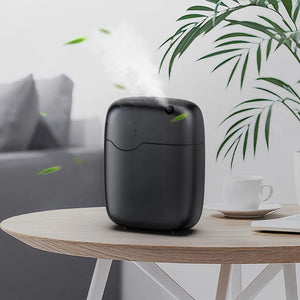




The free ladder: flip every reed weekly → move sources out of dead corners and away from AC jets → place at waist to chest height in the traffic path → close the space for an hour before it matters → add reeds. Only then spend.
The three product bands: under ~250m³, reed diffusers from ₹749 or a Sukoon at ₹1,899. Roughly 250–1000m³ connected, the Vaayu at ₹11,999. Beyond that, ducted commercial systems.
The gap: no separate Vaayu refill oil is sold at present. 400ml ships in the box, 90+ days a fill at a mid setting. Ask SOSA about supply before buying.
- The straight answer
- Part one — the principle behind all nine problems
- Part two — every villa symptom, diagnosed
- Part three — the free ladder for a large house
- Part four — the whole range against a villa
- Part five — measuring your own villa
- Part six — where the Vaayu stops, and the refill gap
- A note from Sonal
- FAQs
2. Spend the free ladder first. Flip all six reeds in every bottle, weekly, with gloves. Move sources out of alcoves and cabinets and several feet clear of AC jets and direct sun. Place at waist to chest height in the path people walk. Close a space for an hour before it matters. Add reeds if you accept a shorter bottle. A large share of villa complaints end here.
3. Add sources rather than strength. Output per bottle is fixed, so the only way to raise the total entering a space is another release point. Two 50ml at opposite ends of an open living-dining beat a single 130ml anywhere in it. A 130ml at ₹1,249–₹1,349 buys 14–18 weeks against 6–8 — duration, never reach.
4. Treat each floor and each closed door as its own problem. Fragrance does not climb stairs reliably; what arrives upstairs is a thin, late remainder. Closed bedroom doors need their own bottles regardless of what is running downstairs.
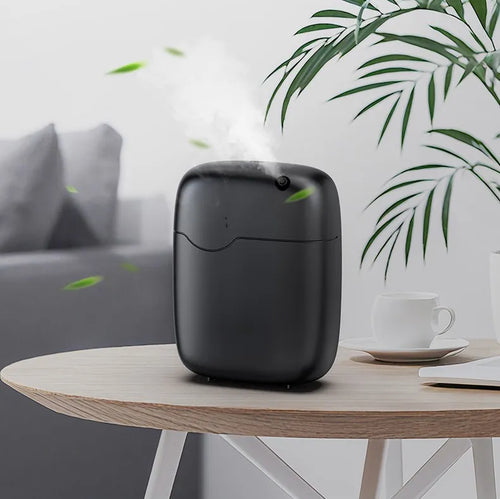
5. Change category, not size, when the volume is genuinely large. Above roughly 250 to 300 cubic metres of connected space, no passive format and no water-based machine will cover it. The Vaayu at ₹11,999 nebulises undiluted oil into a dry nano-mist and is rated up to 1000m³, about 2,000–3,000 sq ft depending on your ceilings.
6. Do not buy the 6L Megh as a coverage step. At ₹3,499 it runs about 100 hours a fill but covers only around 215 sq ft — less than the ₹1,899 Sukoon. It is a runtime and humidity machine and it will not solve a villa.
7. Expect to run a hybrid. Most large villas that end up with a Vaayu also keep reed diffusers behind the bedroom doors. One machine for the connected volume, bottles for the closed rooms, is the arrangement that actually works.
8. Ask about supply before you commit. SOSA does not currently sell a separate Vaayu refill oil; the 400ml in the box — four cold-air fragrances at 100ml each — is the supply available today. Confirm the current position with SOSA before purchasing if long-term supply matters to you.
The reed range is composed and handmade in small batches in Pune, the Vaayu is made in India, and a portion of every order supports girl-child education through Nanhi Kali.
Part one — the principle behind all nine problems
Home fragrance is a quantity per unit of air, and every product has a fixed rate at which it can add to that quantity. A reed diffuser's rate is set by its composition and the reed surface exposed; an ultrasonic machine's by its mist output and the dilution in the water; a cold-air nebuliser's by the pressure and intensity setting. None of these rates changes when you move the product into a larger house. What changes is the denominator — the volume of air the same output has to colour — and in a villa that denominator is not marginally larger, it is several times larger, and it is also being replaced faster. Everything the nine guides in this cluster describe follows from that, and the three cards below are the three shapes the problem takes.
 Mountain Breeze₹849 · 9.4/10Warm air rises, and in a house with vertical connection that becomes an organised column up the stairwell — free ventilation for the building, and a one-way conveyor for your fragrance. The ground floor exports scented air all day while fresh air replaces it at the doors; the top floor receives everything, including whatever came off the hob, and holds it if it is not cross-ventilated. Alongside that, villas simply exchange more air than flats: bigger glazing, doors to gardens and decks, ceiling fans, extractors. A space that changes its air twice an hour is discarding most of what a passive source released in that hour. Airflow has two opposite failure modes and villas manage to produce both at once — dead pockets behind sofas and in alcoves where nothing distributes, and jets from split units and open doors that strip a reed's surface so the room reads faint while the bottle empties weeks early.
Part two — every villa symptom, diagnosed
The seven complaints that arrive most often, each with what is actually happening, the free correction to try first and the paid one if the free one fails. Work down the free column before you read the paid one.
| What you notice | What is actually happening | Free correction | Paid correction, if needed | From |
|---|---|---|---|---|
| Only smell it standing next to the bottle ★ | Dead air — the space is not distributing what is released | Move to a console in the traffic path, waist to chest height | A second source at the opposite edge | ₹1,498 duo |
| Ground floor smells of nothing by evening | The stack effect is exporting the air upward as fast as it is scented | Close the stairwell door for an hour; move the source away from the stair | Your loudest composition, or a machine on that level | ₹849 |
| Top floor smells of everything, including dinner | Terminal floor with poor cross-ventilation, receiving the whole column | Open a window ten minutes; run four reeds instead of six | Switch to the quietest composition you own | ₹799 |
| Great room swallows a good bottle | An open volume dilutes rather than accumulates; nothing reaches a noticeable concentration | Sources at the edges rather than the centre; close it for an hour before guests | Two to three sources, or a format with propulsion | ₹1,899 |
| Tall hall reads empty at head height | Height multiplied the volume; scented air is collecting above the occupied zone | Ceiling fan on its lowest setting for twenty minutes; release low | Wall-mount a machine into the traffic route | ₹11,999 |
| Bottle empties weeks early and the room is still faint | A draught — AC jet, open door, direct sun — stripping the reed surface | Move several feet clear of the airstream and out of the sun | Nothing. This one is free to fix, always | Free |
| Four rooms, four different smells | Multiplicity — separate sources with no shared note and no shared schedule | Pair scents that share a note; standardise the rooms that connect | One machine across the connected volume | ₹11,999 |
| The honest caveat that applies to all seven: your own nose is the least reliable instrument in the house. Olfactory adaptation means you stop registering a constant background within minutes, and you adapt hardest in your own home — so "it stopped working" is very often "I stopped noticing." Before diagnosing anything, leave the house for fifteen minutes, go somewhere with its own smell, and attend to the first three seconds when you come back. Guests are better witnesses than owners, and it costs nothing to ask one. | ||||
Vaayu · up to 1000m³₹11,999Shop →  Sukoon · 270–320 sq ft₹1,899Shop →
  Reed oil refill · many bottles₹2,399Shop →
Part three — the free ladder for a large house
Five rungs, none of which costs anything, worked in this order. I put them before the product tables deliberately, because in a villa the free corrections have more headroom than they do in a flat — there is simply more that can be wrong with placement when there are twenty possible surfaces to choose from. Rung one is the doorway test, and it decides whether you have a problem at all: leave the house for fifteen minutes, go somewhere with its own smell — a garden, a car, a neighbour's porch — then come back in and attend only to the first three seconds. Your nose reports change, not constants, and it adapts fastest to your own home. A great many villa owners discover at this rung that the house smells exactly as intended and they had simply stopped hearing it.
Rung two is the weekly flip, and in a large house it is the rung most often skipped because there are six or eight bottles rather than one. Over a few weeks the exposed end of a reed accumulates the heavier, slower part of the composition while the lighter molecules leave; the reed is still full and has simply stopped moving much. Flipping restores the release rate the bottle was designed for, within hours. All six reeds, once a week, gloves on, bottle standing on a tray because the oil marks wood and stone. Rung three is placement, which in a villa means three separate corrections: out of alcoves, cabinets and the space behind a sofa where fragrance pools within a foot of the glass; several feet clear of split AC units, fans, open doors and direct sun, all of which strip the reeds and empty the bottle early; and onto a console or low shelf at waist to chest height in the path people actually walk, where incidental movement distributes for you. Off the stair landing rather than on it, for the reasons in Part one.
Rung four is closing the space, which villa owners underuse. A large connected volume behaves briefly like a small room if you shut it for an hour — doors closed, fans off, extractor off — and that is often all you need before people arrive. Rung five is reed count, the only true volume control a passive format has, and it is not free in the way the others are: it costs bottle life roughly in proportion. Six fibre reeds is the count every SOSA composition is dosed for. Nine gets you an audibly fuller space and roughly five weeks instead of eight on a 50ml; ten is as far as I would go and gives four to five. You can stage it — six on ordinary days, nine before a weekend of guests, back to six on Monday — which is what I do at home and costs almost nothing in bottle life. Only when all five rungs are worked and the space is still not what you pictured is it worth reading the next two tables, and at that point you are no longer guessing.
Part four — the whole SOSA range, judged against a villa
Every product we make, with the villa job it genuinely does and the honest limit that comes with it. Read the limit column as carefully as the price column; it is the more useful of the two.
| Product | Price | Coverage or life | The villa job it does | The honest limit |
|---|---|---|---|---|
| Reed diffuser 50ml ★ | ₹749–₹849 | 6–8 weeks | Bedrooms, baths, studies — every room behind a door that stays shut | A point source with no propulsion. It cannot cross an open volume |
| Reed diffuser 130ml | ₹1,249–₹1,349 | 14–18 weeks | The same rooms, refilled three times less often | Duration only. At six reeds it projects like the 50ml |
| Duo sets | ₹1,498–₹1,598 · ₹2,498–₹2,598 | 2 × 50ml or 2 × 130ml | Two sources at opposite edges of an open living-dining, sharing a note | Still passive. Two point sources, not a distribution system |
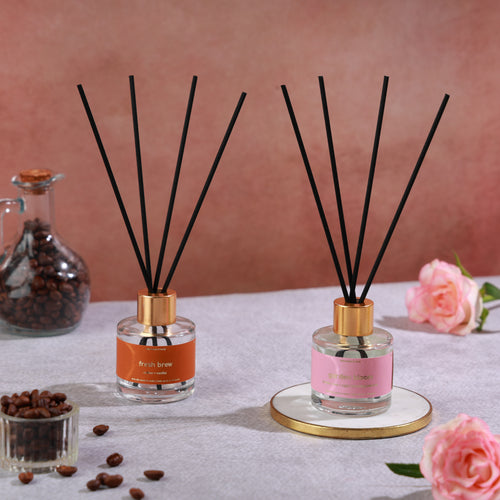
| Reed oil refill | ₹2,399 / 300ml · ₹3,499 / 500ml | 8–11 and 14–18 months | Makes running six or eight bottles across a villa affordable | Oil only — reeds are not sold separately; refresh them every few months |
| Boond | ₹899 | ~150 sq ft · ~6 hrs a fill | A study, a dressing room, a bathroom — small and on demand | 300ml tank, USB. Too small for any main villa space |
| Sukoon | ₹1,899 | 270–320 sq ft · 16–18 hrs on low | The single room that matters — drawing room, entrance hall, family lounge | Water-carried mist: short throw, and it adds humidity |
| Megh | ₹3,499 | ~215 sq ft · ~100 hrs runtime | Runtime and humidity in one room, unattended for days | Covers less than the Sukoon. Never a coverage upgrade for a villa |
| Vaayu | ₹11,999 | Up to 1000m³ · 2,000–3,000 sq ft | A whole connected floor or open-plan villa, on a schedule, locked | No separate refill oil sold at present — 400ml in the box is the supply |
| Commercial tiers | ₹25,999 · ₹38,500 | 8,000–10,000 · 12,000–18,000 sq ft | Aangan and Meenar — ducted scenting for hotels, showrooms and offices | Not house products. Mentioned so you know where the range ends |
Part five — measuring your own villa, with worked examples
Take a tape to the two or three largest connected spaces and note their ceiling heights. Add together only what is genuinely open to what — a room whose door is normally shut is a separate, much easier problem, and counting it in will push you toward a machine you do not need. Five real villa shapes below, converted with the same arithmetic, so you can find the row nearest your house before you decide anything.
| Villa shape | Connected footprint | Ceilings | Connected volume | Honest answer |
|---|---|---|---|---|
| Duplex, closed plan, doors mostly shut ★ | Living 350 sq ft is the largest single space | 10 ft | ≈ 99 m³ | Reed diffusers room by room, from ₹749. No machine needed |
| Two floors, open living-dining | 650 sq ft connected | 10 ft | ≈ 184 m³ | Two reed sources at the edges, or a Sukoon at ₹1,899 |
| Open living-dining-kitchen, single level | 1,100 sq ft connected | 11 ft (3.35 m) | ≈ 342 m³ | Past passive. A Vaayu is now a reasonable conversation |
| Great room with mezzanine, double height | 800 sq ft connected | 18 ft (5.49 m) | ≈ 408 m³ | Vaayu, wall-mounted low into the traffic route |
| Three floors around an open atrium | 2,400 sq ft connected | 12 ft (3.66 m) average | ≈ 816 m³ | Vaayu at the top of its range, plus reeds behind closed doors |
| Beyond the range | 4,000 sq ft+ connected | 12 ft+ | 1,360 m³+ | Past 1000m³. Ask SOSA about Aangan (₹25,999) or Meenar (₹38,500) |
| The honest caveat: these are conversions using 1 sq ft = 0.0929 m², shown so you can repeat them on your own rooms — they are arithmetic, not measurements of any real house and not a prediction of how yours will smell. Real coverage moves with ventilation, glazing, air-conditioning, furnishing, intensity setting and season, and a space that exchanges its air frequently behaves like a larger one. Use the numbers to rule options in and out, then use the free ladder to make whatever you buy work properly. | ||||
Part six — where the Vaayu stops, and the refill gap
Three limits are worth stating before anyone spends ₹11,999, and I would rather set them out here than have you find them yourself. The first is the volume ceiling. Up to 1000m³ is the specification, and past that the honest answer is not a second Vaayu placed hopefully at the other end of the house but a ducted commercial system — Aangan at ₹25,999 for roughly 8,000–10,000 sq ft, or Meenar at ₹38,500 for 12,000–18,000 sq ft. Those are products for hotels, showrooms and offices, and if your house genuinely needs one, that is a conversation to have with us directly rather than a checkout decision. The second is the door. No machine reaches through a closed bedroom door, however powerful, which is why the arrangement that actually works in large villas is a hybrid: one machine across the connected volume, reed diffusers from ₹749 behind every door that stays shut. Anyone selling you one machine for a whole villa without mentioning the doors is selling you a disappointment.
The third is supply, and it is ours to own. SOSA does not currently sell a separate refill oil for the Vaayu. The machine arrives with 400ml — four SOSA Hotel Collection cold-air fragrances at 100ml each, in whichever of the three combos you pick at checkout — and it is rated at 90+ days per fill at a mid intensity setting. That works out at roughly 4.4ml a day as arithmetic on the specification, and real consumption will differ with intensity, run hours and the volume being scented. When the 400ml is gone, there is at present nothing in our catalogue to replace it with, and the water-based Hotel Collection sold for ultrasonic machines at ₹299, ₹999 and ₹1,799 is not a substitute at any price — it is a different formulation for a different mechanism, and it must not go in a Vaayu even though the scent names match. This is exactly the same species of gap as our missing replacement reeds, and it is named for the same reason: so that a buyer can decide with it instead of discovering it. If knowing your resupply is settled is part of how you buy, write and ask us where the refill position stands before you pay.
While we are among the honest numbers, the running cost splits cleanly in two and only one half is knowable. The electricity is trivial and computable: at 5W, eight hours a day is 0.04 kWh a day and about 1.2 kWh a month, which even at ₹8 a unit is under ₹10 a month; twenty-four hours a day is 0.12 kWh a day, about 3.6 kWh a month, still under ₹30 at that tariff. Those are arithmetic on the published 5W rating, tariffs vary by state and I am not quoting anybody's bill. The fragrance is the real cost and, today, the open question. And one last boundary that matters more than any of them: a scent diffuser adds fragrance to air and does nothing else. It does not clean air, remove smells, kill anything or change how anyone feels, and no claim on this page should be read that way. In a villa, the sequence is always ventilate first, scent second — extractor on and windows open for ten minutes after cooking, then close up, then wait half an hour before any fragrance goes near it. Fragrance layered onto a smell you have not cleared makes a third smell nobody designed.
Versailles
Nine guides in this cluster and I have spent most of them telling villa owners not to buy the expensive thing. That is an odd way for a founder to write about her own range, and I would defend it on the simplest commercial grounds: the customer who was talked out of a ₹11,999 machine and sold ₹4,000 of the right products stays with us, and the one who was sold the machine for a two-bedroom duplex does not. Most of the letters I answer about large houses are solved by moving a bottle and flipping some reeds.
What changed how I think about villas was learning to ask for ceiling height and door count before anything else. Those two numbers turn a conversation about adjectives — strong, weak, not enough — into arithmetic that anyone can do on paper in ten minutes. And the arithmetic goes both ways: about as many people find out their dramatic house is a modest volume as find out their modest-looking house is a large one.
Where the volume genuinely is large, I will not pretend a passive format stretches to cover it. It does not, and stretching it is how people end up with six bottles, a house that smells of four different things and a quiet suspicion that they were sold something. The honest move there is a change of category, and that is what the Vaayu is: undiluted oil pushed out dry, up to 1000m³, on a schedule you set and a lock nobody else can undo. I will also keep saying the unfinished part out loud. There is no separate cold-air refill oil today. Four hundred millilitres arrives with the machine and that is the supply. Ask us where it stands before you commit, and if the answer is not good enough for you yet, buy the ₹1,899 machine and the reed diffusers and wait. Everything in the reed range is composed and handmade in small batches in Pune, the Vaayu is made in India, and a part of every order funds a girl's classroom through Nanhi Kali.
Frequently asked questions
- Why can't I smell my diffuser across my villa? — the diagnostic and the volume arithmetic that starts everything.
- Why is my reed diffuser too weak for my villa? and why isn't my ultrasonic scenting the whole villa? — the two format ceilings, stated as specifications.
- Consistent fragrance across a large villa and scenting the junctions, not the rooms — hot spots, dead zones and where to place.
- Multiple floors, large open spaces and high ceilings — the three shapes a villa takes.
- Should villa owners upgrade to cold-air? — four yeses, three noes, and the questions to ask us before spending ₹11,999.
- Brand: the SOSA founder story.
SOSA Vaayu specifications (verified from the live product page, August 2026): ₹11,999 (the product page displays a rounded ₹12,000). Waterless cold-air nebulisation — pressurised air atomises undiluted fragrance oil into a dry nano-mist; no water, no heat, residue-free. Coverage up to 1000m³, about 2,000–3,000 sq ft. 400ml refillable tank, 90+ days per fill at a mid intensity setting. Bluetooth app plus onboard buttons, 1h / 4h / 8h / 24h timers, adjustable mist intensity, auto-stop and key-lock. Under 38 dB. DC 12V / 1A, 5W. 165 × 80.5 × 215 mm, 0.9 kg, black or white. Freestanding or wall / HVAC mount. CE, RoHS and SGS certified. Ships with four SOSA Hotel Collection fragrances at 100ml each (400ml in total) in one of three combos chosen at checkout. SOSA does not currently sell a separate Vaayu refill oil; the 400ml supplied in the box is the fragrance available at the time of writing, and buyers who need long-term supply should confirm current refill availability with SOSA before purchasing. The cold-air oil supplied with the Vaayu is a different product from the water-based Hotel Collection sold for ultrasonic machines (15ml ₹299 · 100ml ₹999 · 300ml ₹1,799), which must not be used in a Vaayu despite sharing scent names. Other SOSA machines: Boond 300ml ₹899 (~150 sq ft) · Sukoon 500ml ₹1,899 (270–320 sq ft) · Megh 6L ₹3,499 (~215 sq ft — a runtime and humidity machine, not a coverage upgrade) · Aangan ₹25,999 (~8,000–10,000 sq ft) · Meenar ₹38,500 (12,000–18,000 sq ft) · Safar car diffuser ₹3,999. Reed diffusers 50ml ₹749–₹849 (6–8 weeks) · 130ml ₹1,249–₹1,349 (14–18 weeks) · duo sets ₹1,498–₹1,598 · oil-only refills 300ml ₹2,399 / 500ml ₹3,499. Runtime, consumption and coverage figures are manufacturer specifications and vary with intensity setting, run hours, ceiling height, ventilation and season; any per-month or per-day figure in this guide is arithmetic on those specifications, not a measurement. Electricity costs vary by state tariff. No claim is made that scenting affects ratings, reviews, bookings, occupancy, revenue, health, mood or air quality. Free shipping above ₹499. A portion of every order supports girl-child education through Nanhi Kali. Prices subject to change — see the live product pages.