Founder Diaries · The Brokerage Office · Your Own Space
By Sonal Sahani · ISIPCA Versailles 11 min read Updated September 2026
The answer is yes with a correction in it, and the correction is the useful part. Your meeting room should carry the same fragrance as the rest of your office, at a noticeably lower output — not a fragrance of its own. A client walking from your reception into a meeting room should not cross a boundary, and the room itself is a small sealed volume where somebody sits for an hour with the door shut, which makes the same output read considerably stronger than it does outside. Before any of that, though, the room's real problems are not fragrance problems at all, and they are free.
Quick answers — read this first
The answer: the same composition as the rest of the office, at a lower setting. Not a second scent.
Why the same: two fragrances meeting at a doorway reads as two rooms rather than one firm, and the client crosses that threshold with a fresh nose about ninety seconds after arriving.
Why lower: a meeting room is often under 50 m³ against 250 or more for the open floor, the door is shut, and people sit still in it for an hour. It is the room where somebody is most likely to become conscious of a scent.
Do first, for ₹0: open the room between meetings, run the cooling for twenty minutes before, clear cups the moment a meeting ends, cap the markers, and give new upholstery or new MDF several weeks with the door open before you add anything to the air.
The short answer
Short answer: yes — but it should be the same fragrance as the rest of the office, run at a lower level, rather than a signature of its own. One composition across the whole space is what makes a firm read as one firm; the lower level is because a shut meeting room is a small volume holding seated people for an hour.
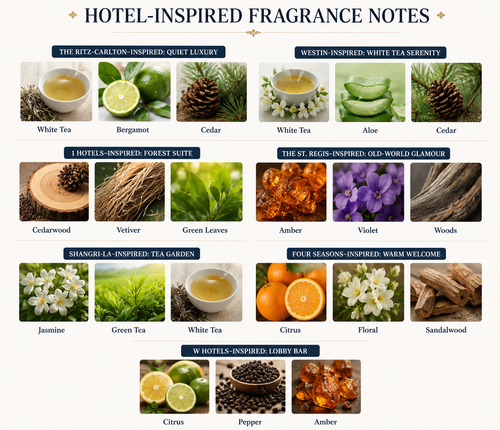
The pick: whatever your office already runs, held constant — the Ritz-Carlton-inspired Quiet Luxury (white tea, bergamot, cedar, ₹299) as the usual default, or the Westin-inspired White Tea Serenity (₹299) as the lightest of the seven if your whole office is small. What you change between rooms is the number on the dial, never the bottle.
Shop: the
Vaayu at ₹11,999 has adjustable intensity and 1h/4h/8h/24h scheduling, covers up to 1000 m³ waterlessly and runs under 38 dB, which matters in a room where somebody is presenting. The
Sukoon at ₹1,899 covers 270–320 sq ft.
Hotel Collection from ₹299,
reed diffuser from ₹749. Free shipping above ₹499.
Straight answer
Should a luxury property consultancy's meeting room have its own signature fragrance?
1. No separate scent. The same one, quieter. Two compositions meeting at a doorway is the specific thing to avoid, because a client crosses that threshold with a nose that has been in your building for about ninety seconds and is still reporting changes accurately. What they should meet is a quieter version of what they already met.
2. Before you set anything, open the room between meetings. A meeting room is almost always the least ventilated space in an office: a small box with a door that stays shut, frequently with no window at all. Five minutes of the door propped open with the floor's air moving through it does more for that room than any setting on any machine.
3. Clear the cups the moment a meeting ends, not before the next one starts. Cold coffee, a half-eaten plate of biscuits and four cups of milky tea left on a table in a warm closed room for two hours is not a background note — it is the first thing your next client meets, and it arrives before they have sat down.
4. Check what the room is off-gassing before you add to it. Whiteboard markers left uncapped, a newly upholstered set of chairs, fresh MDF joinery or a recently laid carpet all put solvent into a sealed room, and layering fragrance on top of a solvent smell produces something worse than either. Weeks of ventilation, then scent.
5. Start the cooling twenty minutes ahead, not as the door opens. A room shut since morning is stuffy for the first ten minutes of a meeting, and that is the ten minutes in which a client forms an impression of the room. This is the cheapest fix on the page.
6. Then set the machine lower than the reception and leave it alone. A
Vaayu at ₹11,999 has adjustable intensity, so one machine and one composition can serve an open floor and a shut room at two different outputs. Judge the level sitting down, with the door closed, after forty minutes.
A portion of every order supports girl-child education through Nanhi Kali.
TL;DR: yes, but the same scent as the rest of the office at a lower output, never a different one — two fragrances meeting at a doorway reads as two rooms rather than one firm. A shut meeting room is a small volume holding seated people for an hour, so the same setting reads much stronger there. Open it between meetings, clear the cups immediately and start the cooling twenty minutes early before you touch a dial.
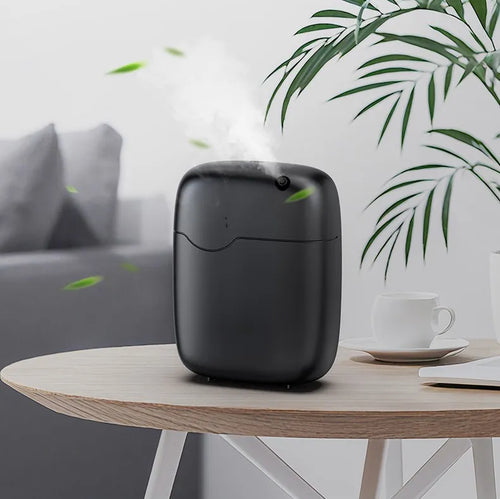
One bottle, one machine, two different numbers on the dial
SOSA Vaayu · adjustable intensity ₹11,999
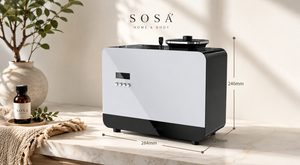
Adjustable intensity is the specification that makes a single-scent office possible, and it is the one people skip past on the way to the coverage figure. A reception of 200 square feet with a door opening all day and a meeting room of 170 square feet with the door shut are the same scent at two genuinely different outputs, and running both at the reception setting is the commonest way an otherwise sensible office becomes unbearable. Waterless, so no moisture reaches paper, drawings or a printer; up to 1000 m³; under 38 dB in a room where somebody is presenting; 1h/4h/8h/24h scheduling; 165 × 80.5 × 215 mm and 0.9 kg.
Why the same scent, and why quieter
Two separate questions get compressed into one here, and they have different answers, which is why the usual advice goes wrong. The question of which scent is a question about your firm, and the answer is that it should be the same one you run everywhere else. The question of how much is a question about physics, and the answer is considerably less than the room next door. Almost every meeting room I am asked about has got the first part wrong for aesthetic reasons and the second part wrong for arithmetic reasons, and the second is the one people actually notice.
1
ONE FIRM, NOT TWO ROOMS
What a client's nose does at a doorway
Start with the threshold, because a doorway is where a nose is at its most alert.
A person's sense of smell is a change detector: it reports differences and discards constants, which is why you stop noticing your own office in a fortnight and why a visitor registers it in four seconds. Every doorway is a change, and a doorway where the composition changes is a very loud one. A client who has been in your reception for three minutes has already adapted to what is there. Walking them into a room carrying a different fragrance re-triggers the whole apparatus, and what it produces is not a pleasant second impression — it is a small unresolved question about why this room is different. In a corridor the two will meet and mix, and mixed compositions are almost always worse than either one alone, because nobody composed them together.
The deeper reason is about what a signature is for. A single scent held across a whole space is one of the ways an organisation reads as an organisation rather than as a set of rooms that were furnished at different times. The moment your meeting room smells of something else, you have told a client that the fragrance is decoration applied room by room rather than a property of the firm — and decoration applied room by room is exactly the impression a consultancy charging serious fees does not want. This is also why I would keep a
reed diffuser out of a meeting room that sits off a scented floor: the reed line is a separate set of alcohol-free scents, so putting one in there is not a quieter version of your office, it is a different fragrance behind a shut door.
2
THE ARITHMETIC OF A SHUT ROOM
A fifth of the volume, four times the exposure
Then the numbers, which settle the level argument without any judgement being required. A meeting room of twelve feet by fourteen at a ten-foot ceiling is about 168 square feet and under 50 cubic metres of air. The reception and open floor it opens off might be 900 square feet and 250 cubic metres or more. The room is roughly a fifth of the volume, and the same output does not produce a fifth of the impression. Then compound it with three things that all point the same way. First, the door is shut, so there is no exchange with the rest of the floor and nothing is being carried away — the reception loses air every time somebody walks through it, and the meeting room loses almost none. Second, the occupants are stationary: a client walks through a reception in eleven seconds and sits in a meeting room for fifty minutes, which is the difference between meeting a scent and living in one. Third, they are seated, so their nose is at table height rather than at standing height, and in a small room that is closer to whatever surfaces have been absorbing fragrance all week. Put those together and the meeting room is the single most likely place in your office for somebody to become consciously aware of the fragrance — which, on the argument this whole cluster runs on, is the outcome you are trying to avoid. So the setting comes down, and it comes down more than feels intuitive. If your open floor is comfortable at a given output, the shut room wants meaningfully less, and the only reliable way to find it is to sit in there with the door closed for forty minutes and notice whether you are still thinking about it at minute thirty-nine.
3
WHAT IS ACTUALLY WRONG WITH THE ROOM
The last meeting, the markers and the missing window
And now the part that matters more than either of the two above, because in most consultancies the meeting room does not have a fragrance problem at all. It has a ventilation problem, and fragrance applied to a ventilation problem produces a room that smells of two things. Four causes, in the order I find them. The first is the previous meeting, still in the air: milky tea going cold, coffee, a plate of biscuits, samosas at four o'clock, and eight people's worth of breath in a sealed box. Cups cleared immediately rather than at the start of the next meeting, food kept to the pantry where you can, and the bin emptied daily. The second is off-gassing, which nobody thinks of as a smell: uncapped whiteboard markers are solvent sitting in an open tray, and new upholstery, fresh MDF joinery and a newly laid carpet all release for weeks. Cap the markers, and if the room has just been refurbished, ventilate it hard for several weeks before you add anything to the air. The third is the air conditioning: a cassette unit that has been pulling that room's air across a mesh for a year is why the first minute after it starts smells flat, and washing the filters on a calendar fixes it. The fourth is the structural one — a great many meeting rooms have no window at all, which means the only fresh air the room ever gets is the air that comes in when the door is open, and the door is only open when nobody is using the room. Prop it open between meetings and the whole problem largely resolves. And if the room smells of damp, of a drain, or of anything with a cause in the building, that is a repair. It is not a setting on a machine, and I would not sell you one to put on top of it.
The forty-minute test, which is the only one that works for this room: sit in the meeting room alone with the door shut and the machine running as usual, and work for forty minutes. If you are aware of the fragrance at minute thirty-nine, it is too high — and so is the setting your client has been sitting in all quarter.
Three spaces, one bottle, three settings
The same composition across an entire office, with the level changed for what each space actually is. The volumes below are a typical 1,500 sq ft brokerage at a ten-foot ceiling. Notice that the only column that changes down the table is the last one — the bottle never does.
One composition, three levels
Reception, open floor and meeting room, sized honestly
| Space |
Typical size |
Air volume |
Doors and traffic |
Setting |
| Meeting room ★ |
~170 sq ft |
About 48 m³ |
Shut for an hour at a time, often no window, occupants seated and still |
The lowest in the office. Judge it seated, door closed, at forty minutes |
| Reception |
~200 sq ft |
About 57 m³ |
Opens to the lift lobby all day; air leaves with every visitor |
The reference setting. This is where you set the level first |
| Open floor |
~700 sq ft |
About 198 m³ |
No doors, constant movement, the largest single volume |
Fed from the reception machine. Whatever reaches it is right |
| Cabins |
3 × ~120 sq ft |
About 102 m³ together |
Doors usually shut, one person inside all day |
Lighter than everywhere else, and that is fine — nobody assesses a cabin |
| Pantry and circulation |
~70 sq ft |
About 20 m³ |
Where food, bins and the strongest smells in the building actually live |
None. This is a lid, a bin routine and an exhaust fan, not a fragrance zone |
| Whole office |
1,500 sq ft |
About 425 m³ |
One Vaayu rated to 1000 m³ covers it without being worked hard |
One machine, one bottle, the dial doing the rest |
Shop this guide
The meeting room, in three products
The SOSA principle
A meeting room is a fifth of the volume and fifty times the exposure. Which is why the answer is the same scent at a lower number, and never a different scent at the same one.
Two compositions meeting at a doorway reads as two rooms. One composition at two levels reads as one firm that thought about it.
The free routine, then the setting
The routine comes first and it costs nothing, which is why it goes at the top rather than in a footnote. Prop the meeting-room door open between appointments and let the floor's air move through it; run the cooling for twenty minutes before somebody arrives rather than as they walk in; clear cups, plates and glasses within a minute of a meeting ending; cap the markers; and empty the room's bin daily even when it looks empty. Those five things, done consistently, change that room more than any machine will. If the room has no window — and a great many do not — then the propped door is the entire ventilation strategy and it needs to be somebody's actual job rather than a good intention. Twice a week, get the building's fresh air into it properly: doors and any openable window on opposite sides of the floor, twenty minutes, early. And put the air-conditioning filter wash in a calendar with a name against it, because the flat, dusty first minute after a cassette unit starts is the thing clients notice in a room that is otherwise spotless.
Then the setting, and there are only three decisions in it. First, the composition: whatever your office already runs, unchanged. If you have not chosen one yet, the Ritz-Carlton-inspired Quiet Luxury at ₹299 — white tea, bergamot and cedar — is the default for a workplace, and the Westin-inspired White Tea Serenity at ₹299 is the lightest of the seven if the whole office is small. Nothing plush, nothing sweet, nothing that reads as somebody's personal perfume in a room where a person is sitting three feet from you for an hour. Second, the level, which comes down from the reception reference: the Vaayu at ₹11,999 has adjustable intensity, so one machine in the entrance zone at one output can serve the open floor while the shut room receives whatever reaches it under the door, which in most 1,500 sq ft offices is the correct amount and requires no second machine at all. If the meeting room is genuinely isolated — down a corridor, behind two doors, or on another floor — then a second unit running the same composition at a lower setting is legitimate, and a Sukoon at ₹1,899 covers 270 to 320 square feet, though it is an ultrasonic and adds 30 to 50 millilitres of water an hour to a sealed room, which is worth thinking about in a monsoon month. Third, the schedule: office hours, on the 1h/4h/8h/24h timers, never started for a particular meeting.
Then the constraints, which in this room bind harder than anywhere else in the building. Your own colleagues sit in that meeting room for hours at a stretch with the door shut, and if any of them reacts to the fragrance — a headache, a pregnancy, asthma, or simply that they cannot concentrate under it — the answer is to stop running it in that room, not to reduce it and hope. That is not a difficult position to hold and it costs a firm almost nothing; a meeting room that smells of clean air and nothing else is a perfectly good meeting room. Ask before you install, and ask again a month later, because the first answer people give their employer is not always the true one. Then the usual habituation trap: within a fortnight nobody in your firm can judge that room any more, so the useful opinion belongs to somebody walking in from outside — and a small enclosed room is precisely where an over-set level goes unnoticed by the people responsible for it. And the two rules that govern this cluster hold here without modification. If the room smells of damp, a drain or anything with a cause, find it, fix it or disclose it and do not put a machine on top of it. And nothing on this page suggests that the air in your meeting room affects what a client decides, what they offer or whether you win a mandate — it is presentation, in the same category as the chairs and the lighting, and that is a sufficient reason to get it right.
A client should walk from your reception into your meeting room without crossing a boundary. Two scents meeting at a door is two rooms; one scent at two levels is one firm.
— Sonal Sahani, SOSA
The SOSA edit
In the order the work should be done, which puts four free items above anything with a price on it. The last row is the purchase this page is most often asked to endorse and will not.
The SOSA edit
A consultancy meeting room, in order of work
| Do |
What it is |
When |
Cost |
| 1. Prop the door open between meetings ★ |
The room's only real ventilation, especially if it has no window |
First. Needs to be somebody's job rather than a good intention |
₹0 |
| 2. Clear cups within a minute; cooling twenty minutes early |
Cold tea, coffee and a biscuit plate in a warm sealed box, and a stuffy first ten minutes |
The two things clients meet before they sit down, and the two cheapest to fix |
₹0 |
| 3. Cap the markers; ventilate new furniture for weeks |
Solvent from an open marker tray, new upholstery, fresh MDF and new carpet |
Before any fragrance goes in. Scent over solvent is worse than either alone |
₹0 |
| 4. Wash the air-conditioning filters, on a calendar |
The flat, dusty minute after a cassette unit starts in an otherwise spotless room |
Quarterly, with a name against it. The most-skipped free item in an office |
₹0 |
| 5. The same scent, at a lower setting |
One Vaayu at ₹11,999 in the entrance zone, adjustable intensity, office-hours schedule |
After all four above. Set the reception first, then judge the shut room seated at forty minutes |
₹11,999 |
| 6. A second unit, only if the room is isolated |
A Sukoon at ₹1,899 for 270–320 sq ft, running the same composition lower |
Only for a meeting room down a corridor or on another floor. Ultrasonic, so it adds water to the air |
₹1,899 |
| Not recommended: a second, different fragrance |
A signature scent for the meeting room alone, or a reed diffuser from the separate reed line in there |
Two compositions meeting at a doorway reads as two rooms rather than one firm |
— |
Honest notes for buyers: fragrance is the last step in preparing a property, never the first, and it must never be used to cover a defect. Damp, a leak, drains, smoke or anything structural is a material fact about a property: find it, fix it or disclose it. Scent a listing that is genuinely sound. On the machines: the
Vaayu at ₹11,999 is waterless cold-air nebulisation — no water, no heat and no dampness — covering up to 1000m³ or roughly 2,000–3,000 sq ft, with a 400ml tank lasting about 75 days, Bluetooth app control, 1h/4h/8h/24h timers, under-38dB running, auto-stop and a key-lock, at 0.9 kg and smaller than a shoebox, so one machine can serve a whole portfolio. The
Aangan at ₹25,999 covers up to 3,000m³ for sales galleries and clubhouses. The ultrasonic
Sukoon,
Boond and
Megh are water-based and add 30–50 ml of water an hour to the air, which makes them the wrong choice for a closed or humid vacant property. A
reed diffuser needs 24–72 hours to establish, so it suits a listing shown over months rather than a viewing tomorrow. A candle must be attended and put out, which rules it out of an unoccupied property. SOSA does not make a room spray for the home; the sprays in the range are car perfumes. The Hotel Collection scents are SOSA's own interpretations inspired by the world's finest hotels; SOSA is an independent Indian fragrance house, not affiliated with or endorsed by any hotel brand. A portion of every order supports girl-child education through Nanhi Kali.
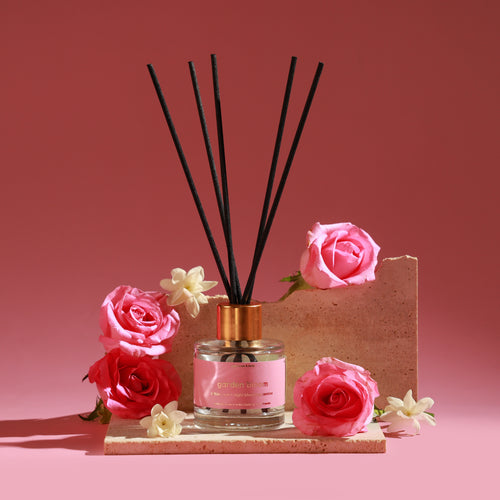
The product I would keep out of this particular room
SOSA alcohol-free reed diffusers from ₹749
A reed on a meeting-room credenza looks correct and I would still not put one there while the rest of the office runs a different composition.
The reed line has its own alcohol-free scents — Morning Freshness at ₹749, Mountain Breeze at ₹849, Evening Calm at ₹799 — which means a reed in the meeting room is a second fragrance meeting the first at the doorway, and two scents at one threshold is exactly the impression this page is trying to avoid. Reeds earn their place in a small waiting area or a one-room office where they are the only scent in the building. In a room off a scented corridor, quieter is better than different.
A note from Sonal
The meeting room is the room I get asked about most and it is the room where I most often say no to something. Somebody has usually decided that because it is where the important conversation happens, it deserves its own scent — and that instinct, which is a generous one, produces the single worst arrangement available. I have walked down a corridor in a very good consultancy where a citrus reception met a woody meeting room halfway along, and what was in that corridor belonged to nobody. Neither scent was bad. The pair of them, mixing in a space that had not been considered, was.
The other half of it is that meeting rooms are almost always over-scented, and for a reason that is easy to sympathise with: the person who sets the level does it standing in the doorway for thirty seconds with the door open. Your client experiences that room sitting down, with the door shut, for fifty minutes, in about a fifth of the air. So sit in it. Shut the door. Work for forty minutes and see whether you are still aware of it. If you are, come down a step, and come down another one in July when the room is warmer. A meeting room that smells faintly of a clean building is doing its job. A meeting room that smells of a fragrance is competing with the conversation you are having in it.
Everything is made and supported from Pune, and a part of every order funds girl-child education through Nanhi Kali. You get a space that smells like somewhere considered; a girl gets a classroom. That equation has always felt right to me.
Frequently asked questions
Should a meeting room have a different signature scent from the rest of the office?
No. It should carry the same composition at a lower output. Two fragrances meeting at a doorway reads as two rooms rather than one firm, and in the corridor between them they mix into something nobody composed. Change the number on the dial, never the bottle.
Why does the same setting smell stronger in a meeting room?
Volume and exposure. A 170 sq ft meeting room is about 48 m³ against 250 m³ or more for the reception and open floor, the door is shut so nothing is carried away, and a client sits still in it for fifty minutes rather than walking through in eleven seconds.
What should I do about the smell of the previous meeting?
Clear the cups, glasses and plates within a minute of it ending rather than before the next meeting starts, empty the room's bin daily, prop the door open in between, and start the cooling twenty minutes ahead. Cold milky tea in a warm sealed room is the first thing your next client meets.
My meeting room has no window. Does that change anything?
It changes everything, and it is common. With no window the only fresh air that room ever gets arrives when the door is open, and the door is only open when nobody is using it. Propping it open between appointments becomes the ventilation strategy, and it has to be somebody's actual job.
Do I need a second machine for the meeting room?
Usually not. In a 1,500 sq ft office a single
Vaayu at ₹11,999 in the entrance zone, rated to 1000 m³ against about 425 m³ of air, gives the shut room whatever reaches it under the door — which is generally the right amount. A second unit is only for a room down a corridor or on another floor.
The room where the number gets discussed
The same scent — at a lower number on the dial
The Vaayu is ₹11,999: waterless cold-air nebulisation with adjustable intensity, coverage up to 1000 m³ against the roughly 425 m³ of a 1,500 sq ft office, a 400ml tank lasting about 75 days, Bluetooth 1h/4h/8h/24h scheduling, under 38 dB in a room where somebody is presenting, auto-stop and a key-lock. The Sukoon is ₹1,899 for an isolated room of 270–320 sq ft. Hotel Collection from ₹299. Free shipping above ₹499. A portion of every order supports girl-child education through Nanhi Kali.
See the Vaayu · ₹11,999 Shop the Hotel Collection →
Continue the read
More from SOSA
Editorial standards & sources
About this guide: Written by Sonal Sahani, ISIPCA Versailles-trained founder and perfumer at SOSA Home & Body, on why a consultancy meeting room should carry the same fragrance as the rest of the office at a lower output rather than a signature of its own, what a nose does at a doorway where the composition changes, why a shut room of under 50 cubic metres reads far stronger than the floor it opens off, and the free ventilation routine that fixes most meeting rooms before any machine is bought.
Facts verified August 2026: Product facts used in this guide. SOSA Vaayu ₹11,999: waterless cold-air nebulising diffuser, atomises undiluted fragrance oil to a dry residue-free nano-mist, coverage up to 1000m³ (approximately 2,000–3,000 sq ft), 400ml refillable tank lasting up to about 75 days per fill, Bluetooth app plus onboard control, 1h/4h/8h/24h timer scheduling, adjustable intensity, under 38 dB, DC 12V/1A at 5W, 165 × 80.5 × 215 mm and 0.9 kg, freestanding or wall/HVAC mounted, auto-stop and key-lock, CE, RoHS and SGS certified, supplied with four hotel-inspired fragrances. SOSA Aangan ₹25,999: HVAC-connected or standalone commercial nebulising diffuser, coverage up to 3,000m³ (roughly 8,000–10,000 sq ft), 800ml reservoir, metal body, programmable schedules, under 42 dB. Ultrasonic machines are water-based and consume 30–50 ml of water an hour: Sukoon ₹1,899 (500ml, 270–320 sq ft, 16–18 hours on low, 3–6 drops per tank, steady/2H/4H timers, three 15ml Hotel Collection scents included), Boond ₹899 (300ml), Megh ₹3,499 (6 litres). Hotel Collection water-based fragrance 15ml ₹299, 100ml ₹999, 300ml ₹1,799, Pack of 7 at 15ml ₹1,799 against ₹2,093 bought singly; the Vaayu and Aangan take their own undiluted oil rather than these water-based bottles. Reed diffusers (separate alcohol-free line) from ₹749, requiring 24–72 hours to reach their working level. Scented candles from ₹379, scenting a room in roughly 15–20 minutes but requiring attendance. Free shipping above ₹499. Timings: a nebulising diffuser reaches a working level within minutes and a stated viewing level well inside two hours. This guide makes no claim that fragrance affects a property's price, offer level or time on market; it is presentation, in the same category as photography, styling and lighting. Fragrance must never be used to conceal a material defect. SOSA is not affiliated with or endorsed by any hotel brand. Prices subject to change — see the live product pages.




 One scent · both rooms₹299Shop →