

The surprise in those numbers: both sizes drink at about the same weekly rate, because both carry six fibre reeds. The 130ml simply started with more.
When you will actually see it: around week four on a 50ml, when you should be at or a little past the halfway mark. On a 130ml, closer to week six or seven.
The free test: a strip of tape on the glass at today's level with the date pencilled on it. Read it a fortnight later, not tomorrow.
2. Both bottle sizes drink at nearly the same weekly rate. A 130ml over 14–18 weeks works out at roughly seven to nine millilitres a week. That is the clearest possible demonstration of the rule that size buys duration and not reach: the same six reeds release at the same rate whether they stand in 50ml or 130ml of oil. The larger bottle lasts longer because it started with more, not because it works harder.
3. Week four is the honest checkpoint. On a 50ml with six reeds, you should be at or a little past halfway by then. On a 130ml you will be nearer a quarter down, which is why 130ml owners are the ones who most often write to ask whether their bottle is defective. It is not; it is three times the reservoir at the same rate of use.
4. Measure it properly or do not measure it. A strip of masking tape stuck to the glass at today's level with the date written on it costs nothing and settles the question in a fortnight. Judging by memory across a week is not a measurement, and it is where almost every false alarm begins.
5. A level that visibly falls week on week is a warning, not a boast. Direct sun, an AC draught, a west-facing shelf in May or nine reeds instead of six will all make the drop conspicuous — and will empty the bottle weeks before it should. Fast is not the same as good.
6. If the level has genuinely not moved by week four, that is when to act — and the first three actions are free. Lift a reed and read the wet line, flip all six, and move the bottle into gentle passing air. Only after those three would I consider anything else.
Composed and handmade in small batches in Pune, and a portion of every order supports girl-child education through Nanhi Kali.

Part one — the arithmetic of an ordinary week
There is no mystery in this and no measurement equipment required. Take the volume of oil, divide it by the number of weeks the bottle is rated for, and you have the weekly figure the design is aiming at. A 50ml bottle rated at six to eight weeks is spending between about six and eight millilitres every seven days; a 130ml rated at fourteen to eighteen weeks is spending between about seven and nine. Those are averages across the whole life of the bottle rather than a promise about any particular week, and they are SOSA's own working guidance rather than a laboratory figure — but they are close enough to plan by, and they explain nearly everything people find confusing about the glass.
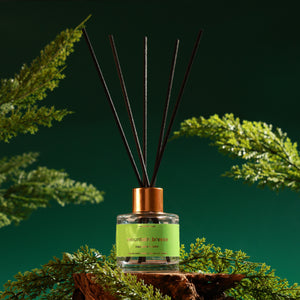
 Mountain Breeze₹849 · 9.4/10Here is the result that surprises people. The 130ml lasts fourteen to eighteen weeks against six to eight, so you might reasonably expect it to sip more slowly. It does not. Divide it out and the weekly consumption is broadly the same, because the release rate is set by six fibre reeds and the air around them, not by how much oil is standing underneath. The 130ml lasts two to three times as long for the simple reason that it started with two and a half times the oil. This is the clearest evidence I can give you that a bigger bottle buys duration and not reach — the reeds do not know how deep the reservoir is. It is also why the 130ml looks static for so much longer: the same weekly loss is a smaller fraction of a larger, wider bottle.
Part two — what a normal week looks like, by bottle and by setting
This is the table I wish shipped in every box. It sets out the average weekly consumption for each configuration, what that amounts to in the glass, and the week at which the change stops being a matter of opinion. Treat the millilitre figures as arithmetic from the stated bottle life rather than as a measurement — they are SOSA working guidance, and a hot May in Nagpur will beat any of them.
| Configuration | Stated life | Average weekly drop | In the glass after 7 days | First week you can be sure |
|---|---|---|---|---|
| 50ml · six reeds ★ | 6–8 weeks | ≈ 6–8 ml | A fingertip's band — easily missed | Week four, at or past halfway |
| 50ml · four reeds | Beyond 8 weeks | Under ≈ 6 ml | Effectively invisible | Week five or six |
| 50ml · eight reeds | 5–6 weeks | ≈ 8–10 ml | A visible step for a careful eye | Week three |
| 50ml · ten reeds | 4–5 weeks | ≈ 10–12 ml | Obvious week on week | Week two |
| 130ml · six reeds | 14–18 weeks | ≈ 7–9 ml | A smaller fraction of a wider bottle | Week six or seven |
| Any bottle in sun or a draught | Weeks early | Well above the figures above | Conspicuous — and not a good sign | Week two, unhappily |
| The honest caveat: these are averages derived by dividing the bottle by its stated weeks, not per-week measurements. Real consumption is faster in the first fortnight than in the last, because the lighter, more volatile part of the composition leaves first and because dry reeds absorb several millilitres before they reach equilibrium. A bottle that is slightly ahead of schedule at week two and slightly behind at week seven is behaving exactly as designed. | ||||
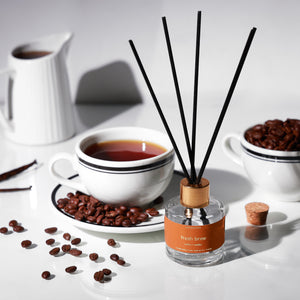
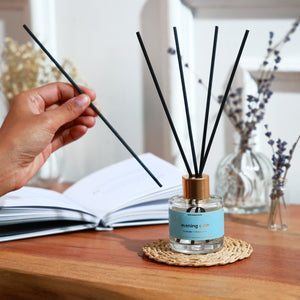
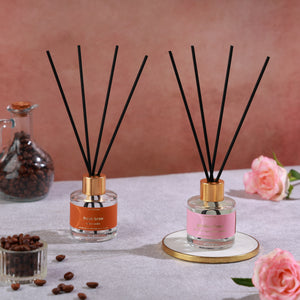
Morning Freshness · 50mlfrom ₹749Shop → 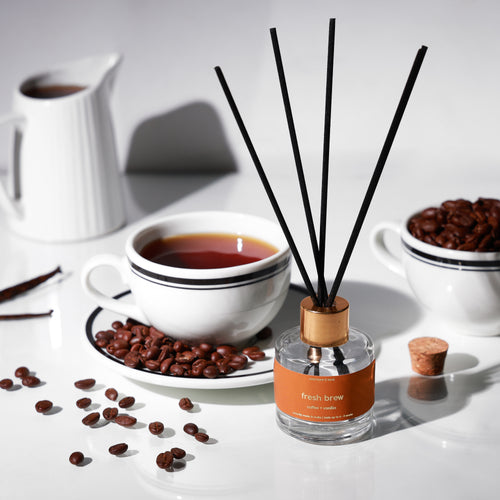 Fresh Brew · 130ml 14–18 weeks₹1,349Shop →
 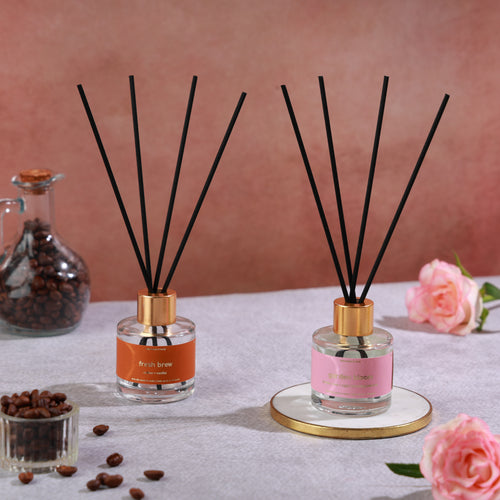 Oil refill · 300ml₹2,399Shop →
Part three — why the first fortnight looks like nothing at all
Three separate things conspire in weeks one and two, and each of them is normal. The first is geometry. Bottle shoulders curve, labels sit across the middle of the glass, and the oil is coloured — so the boundary you are trying to read is neither sharp nor conveniently placed. Six millilitres removed from a wide bottle is a shallower band than six millilitres removed from a narrow one, which is why two people with the same weekly consumption can have completely different impressions of whether anything is happening. The second is that the reeds themselves take up several millilitres on the way to equilibrium. When you first stand six dry fibre reeds in a fresh bottle they wick hard for a day or two; a portion of what leaves the reservoir in the first week is not in the room at all but held inside the fibre, and it stays there for the life of the bottle. That loss happens once, at the start, and never repeats.
The third is the one nobody warns you about: your memory of last week's level is not evidence. I have watched people argue confidently about a boundary they last looked at nine days earlier, in different light, from a different height, having in the interim developed an expectation. This is not a failure of attention; it is simply what human comparison is like at the scale of two or three millimetres. Which is why the recommendation on this page is so unglamorous. Stick a strip of masking tape to the glass so its lower edge sits exactly at the surface, write the date on it in pencil, and then leave it alone for a fortnight. Fourteen days of consumption is roughly a quarter of a 50ml — that is a gap you cannot argue with, and it takes the question out of the realm of impression entirely.
There is a corollary worth stating plainly, because it runs against instinct. A level that drops conspicuously every week is not a bottle performing well; it is usually a bottle in trouble. Direct sunlight warms the oil and thins it, an AC vent or fan blowing across the reeds strips them continuously, and either will produce a satisfying visible drop while delivering less to the room than a calm bottle at a steadier rate. The same is true of running nine or ten reeds — a legitimate choice for a festive fortnight, an expensive habit year-round. When someone tells me their level is falling nicely and their room still smells of very little, my first two questions are about the window and the air conditioner, in that order. On our heat-stable coconut-derived CCT base the composition itself holds through 45°C rather than turning acrid, but nothing protects a bottle from the arithmetic of standing in a draught.
Part four — the expectation calendar, week by week
Here is what to expect and when, for a 50ml with its standard six fibre reeds in an ordinary Indian room, flipped weekly. Read the row for the week you are in before you conclude anything. The 130ml runs the same shape stretched across roughly two and a half times the calendar.
| Week | Where the level should sit | What the room should be doing | Action |
|---|---|---|---|
| Week 1 ★ | A visible dip as the dry reeds fill, then apparent stillness | The days-1–3 spike, then a settle — both normal | Tape the glass, write the date, do nothing else |
| Week 2 | Roughly a quarter down — but hard to read | Quieter than day one; this is the settle, not a fault | Flip all six reeds with gloves. Still do not judge the level |
| Week 3 | Around a third down; the tape starts to earn its place | The plateau begins — steady, low, constant | Flip. Ask someone who has been out for a few hours |
| Week 4 | At or a little past halfway | The plateau. Your own nose has largely stopped reporting it | Now judge. If the tape shows no gap, run the wet-line test |
| Week 6 | Two-thirds to three-quarters down | Unchanged from week four if the bottle is healthy | Consider ordering a refill so you are not caught out |
| Week 8 | At or near the bottom of the stated window | Tailing off as the last few millilitres go | Refill to the neck, return the reeds, flip once |
| Nothing has moved by week 4 | The tape shows no gap you can see | Room reads flat even to a visitor | Wet line first, then flip, then move the bottle — all free |
Versailles
The first month a bottle spends in someone's home is the month I have the least influence over and the most correspondence about. Nothing in the product has gone wrong — the composition is doing precisely what it was dosed at six reeds to do — but the customer has no instrument, and the only dial visible to them is a level in a glass that moves too slowly to read.
So I have come round to giving people arithmetic instead of reassurance. Fifty millilitres over seven weeks is seven millilitres a week. Once someone has that number they stop asking whether the bottle is faulty and start asking the better question, which is whether the room is receiving what the bottle is releasing. Those are different problems with different fixes, and confusing them costs people money they did not need to spend.
The thing I would most like to retire is the second purchase made in week two — a bigger bottle, bought in the belief that the first one was defective, which then behaves identically because it is the same six reeds standing in more oil. Tape, a pencil and a fortnight will save you that. Everything is composed and handmade in small batches in Pune, and a part of every order funds a girl's classroom through Nanhi Kali.
Frequently asked questions
- Why is my reed diffuser oil not going down? — the three states a static level can mean, told apart in thirty seconds.
- How do you know it is actually working? — three tests, none of which is your own nose in your own room.
- Why is my reed diffuser barely evaporating? — the cold, sealed, still room where slow is genuinely correct.
- Lasting too long but not smelling — the complete guide, plus why can't I smell my reed diffuser?
- Brand: the SOSA founder story.
SOSA reed diffuser range & prices (verified August 2026): alcohol-free, phthalate-free, paraben-free and IFRA-compliant compositions on a heat-stable coconut-derived (CCT) carrier, low-VOC, supplied in a refillable glass bottle with six fibre reeds; 50ml lasts 6–8 weeks and 130ml lasts 14–18 weeks. Morning Freshness (Malabar lemon · peppermint · Nilgiri eucalyptus) 50ml ₹749 · 130ml ₹1,249 · 9.0/10; Garden Bloom (British rose · night-blooming jasmine) 50ml ₹799 · 130ml ₹1,299 · 8.9/10; Evening Calm (Kashmir lavender · chamomile) 50ml ₹799 · 130ml ₹1,299 · 8.9/10; Fresh Brew (Coorg coffee · Kerala vanilla) 50ml ₹849 · 130ml ₹1,349 · 9.5/10; Mountain Breeze (Himalayan pine · sage · Indian cedar) 50ml ₹849 · 130ml ₹1,349 · 9.4/10. Reed diffuser refills are oil only — you reuse your own vessel and reeds: 300ml ₹2,399 (roughly 8–11 months) · 500ml ₹3,499 (roughly 14–18 months), about ₹7–8 per ml against ₹15–17 per ml for a 50ml bottle. Duo sets ₹1,498–₹1,598 for 2 × 50ml and ₹2,498–₹2,598 for 2 × 130ml. Strength figures are positions on SOSA’s own internal strength scale, not an industry standard. Replacement reeds are not sold as a separate SKU; SOSA guidance is to refresh reeds every few months. The reed line is separate from the water-based Hotel Collection for ultrasonic machines (15ml ₹299 · 100ml ₹999 · 300ml ₹1,799) and the two are not interchangeable. Diffusers: Boond 300ml ₹899 · Sukoon 500ml ₹1,899 · Megh 6L ₹3,499 · waterless Vaayu ₹11,999. Composed and handmade in small batches in Pune, India; tested through 45°C summer heat and 85% monsoon humidity. Free shipping above ₹499. A portion of every order supports girl-child education through Nanhi Kali. Prices subject to change — see the live product pages.