
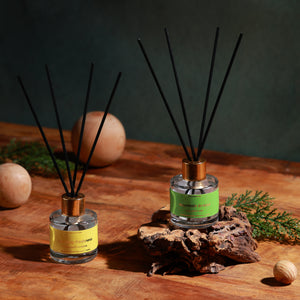
2. Green is the strong second and the better choice for anyone who finds citrus sharp. Dry, resinous pine and cedar read as outdoor air. Mountain Breeze ₹849.
3. Floral is third, and not because it is a lesser fragrance. A floral pushes a room towards sweet and close, which is the direction a damp room already feels. It is a beautiful thing in a dry, aired flat and the wrong tool over damp.
4. Gourmand is last — our own Fresh Brew ₹849 is the scent in this range I would keep out of a damp flat, and I would rather say that than let you find out.
The honest gap: the answer to damp is not in any of these columns. Space the clothes, run a fan across the rack, dry them elsewhere. SOSA makes no dehumidifier, no air purifier and no odour eliminator.
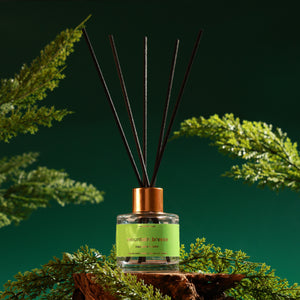
2. Green, a close second, and better for some people. Pine, sage and cedar read as dry — the association is with dry wood and cool outdoor air, and dryness is precisely the quality a damp room lacks. Mountain Breeze at ₹849 is also the answer for anyone who finds bright citrus insistent, and its heavier materials hold up well in a month when projection shortens anyway.
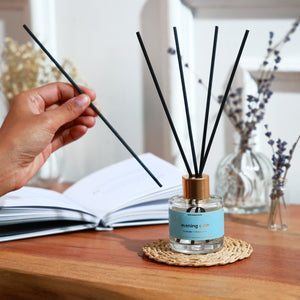
3. Soft herbal is a legitimate third for a bedside. Evening Calm at ₹799 is the softest thing we make at 8.9, and in a wet month that is a genuine risk: a quiet composition in air that carries fragrance poorly can simply disappear. Choose it if you want the room quiet rather than fresh.
4. Floral, third or fourth, and the reasoning is register rather than quality. Florals carry sweetness and weight. A damp note also carries a faint sweetness and a great deal of weight. Putting them together pushes the room further in the direction it is already going, and the result reads as heavy and perfumed rather than as clean.
5. Gourmand, last, and I would keep it out entirely. Coffee, vanilla and caramel are the heaviest and sweetest register there is. Our own Fresh Brew at 9.5 is a lovely bottle in a dry room in January and the wrong bottle in a damp flat in July.
Alcohol-free, phthalate-free, paraben-free, IFRA-compliant, 0 ppm formaldehyde, six fibre reeds in a refillable glass bottle, composed in Pune. Free shipping above ₹499, and a portion of every order supports girl-child education through Nanhi Kali.
What a damp note actually smells of, and why that decides everything
Ask ten people to describe the smell of a damp flat and you get the same four words: heavy, close, musty, low. Those are all descriptions of position rather than of a particular material, and they are more useful than they look. A damp note has weight to it, it sits near the floor and near textiles, and it carries a faint sweetness that almost nobody consciously identifies but everybody responds to. That last part is the key to this whole page, because it explains the mistake people make. When a room smells bad, the instinct is to reach for something warm and comforting. Warm and comforting means sweet. Sweet is the one quality the damp note already has, and adding more of it is how you get a room that reads as perfumed and still wrong.
The mechanism underneath is simple enough to state without any chemistry. Two odours that occupy distant parts of the spectrum are resolved by the nose as two separate things; two that sit close together are resolved as one blended thing. You cannot cancel an odour, but you can choose whether yours is heard as a separate voice or as part of the same one. Bright citrus is a separate voice. Dry resinous green is a separate voice. A heavy floral or a gourmand is close enough to be heard as part of the same chord, and that is what people are describing when they say a fragrance made the damp worse. It did not make the damp worse; it joined it.
There is a second effect that belongs specifically to a wet season, and it stacks on top of the first. Higher humidity slows diffusion and makes a composition feel closer and heavier than the same bottle does in a dry month, while higher temperatures lift the top notes off faster and let the base dominate sooner. So the same Garden Bloom that is elegant in a dry Delhi December can feel like a great deal in a wet Mumbai July, and no formulation prevents that — it is the season doing it, not the bottle. Since floral and gourmand are already the heavy end of the range, they take that penalty from a worse starting position. Citrus and green take it from a better one.
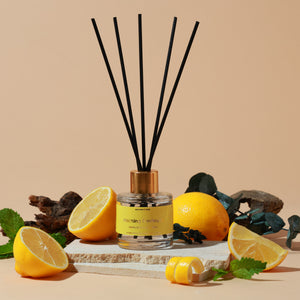
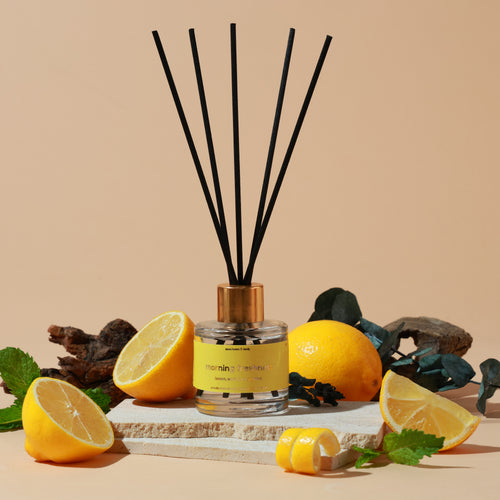
 Morning Freshness₹749Bright, sharp, high and dry — every adjective is the opposite of the room. That distance is the whole reason it works, and it is why a lemon reads as clean to an Indian nose in a way that a rose does not, even though neither of them has cleaned anything. Morning Freshness adds a peppermint heart to that, which brings a cooling impression on top of the lift, and a eucalyptus globulus base, which is the reason the citrus is still present in week six rather than week two. One warning that belongs to this family: a cheap synthetic lemon will not do this job, because your nose met that material in a floor cleaner and files it as cleaning rather than as fragrance, which over a damp note reads as a flat covering it up.
 Mountain Breeze₹849Green does something citrus does not, and for some people it is the better answer. Himalayan pine, real sage and Indian cedar are resinous, dry materials, and dryness is the exact quality the room is missing — so instead of contrasting with the damp by being bright, Mountain Breeze contrasts with it by being arid. It also has a practical advantage in a wet month: its materials are heavier than a citrus top note, so it is less dependent on the air carrying the lightest molecules around the room, and it holds a consistent character when projection shortens. At 9.4 it is the deepest woody we make, so three reeds is plenty in a bedroom.
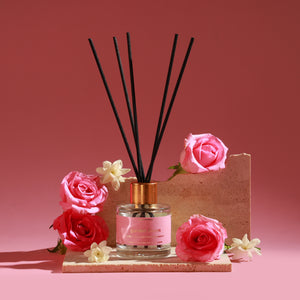
 Garden Bloom₹799This is not a criticism of florals and it is certainly not a criticism of Garden Bloom, which is one of the compositions I am proudest of — British rose with night-blooming jasmine, and the indole held below the threshold where jasmine turns animalic in heat, which is the single most common way a jasmine product goes wrong in an Indian summer. It is a lovely thing in a dry, aired room. Over damp it has the wrong shape: florals carry sweetness and body, the room already has both, and the combination reads as heavy and perfumed rather than as fresh. In a humid month, when everything already feels closer, that effect is amplified rather than softened. Buy it for the flat in December. Not for the flat in July with a rack of washing in the corner.
All five SOSA reed scents, ranked for a room that feels damp
Scored for this one situation. The last row is the scent I would keep out of the room entirely, named rather than quietly left off the list, because a guide that only lists what suits your search is an advertisement.
| Rank | Scent | Register | Strength | Why it lands there | 50ml |
|---|---|---|---|---|---|
| 1st | Morning Freshness ★ | Bright citrus — lemon, peppermint, eucalyptus | 9.0 | Maximum distance from a damp note, so it reads as a separate clean voice rather than a blend. Eucalyptus base keeps it alive 6–8 weeks | ₹749 |
| 2nd | Mountain Breeze | Dry green — pine, sage, cedar | 9.4 | Contrasts by dryness rather than by brightness, and its heavier materials hold their character when humidity shortens projection | ₹849 |
| 3rd | Evening Calm | Soft herbal — lavender, chamomile, soft musk | 8.9 · softest | Correct register and the right choice for a bedside, but the quietest thing we make and a wet month is the one most likely to swallow it | ₹799 |
| 4th | Garden Bloom | Floral — rose, night-blooming jasmine | 8.9 | Shares sweetness and body with the damp note, so it blends rather than contrasts. Excellent in a dry aired room, and this is not that room | ₹799 |
| 5th | Fresh Brew | Warm gourmand — coffee, vanilla, caramel | 9.5 · deepest | The one I would keep out of a damp flat altogether. The heaviest and sweetest register we make, stacking with exactly what is already there | ₹849 |
1st · Morning Freshness₹749Shop → 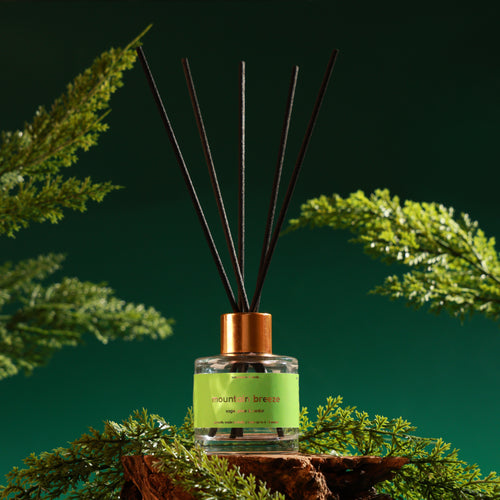 2nd · Mountain Breeze₹849Shop →
 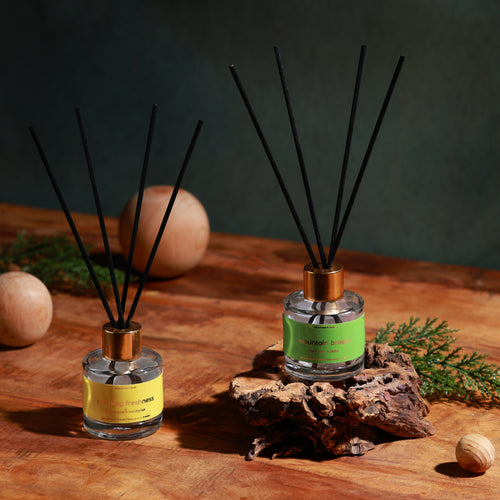 Both · Fresh & Grounded₹1,548Shop →
Why the dose decides this as much as the family does
Here is the part that would improve most people’s results more than switching scent families at all. Almost any composition read at too high a concentration flattens into a single sweet or sharp impression — the nose stops resolving the separate materials and reports one thing, and that one thing is what people mean when they call a fragrance an air freshener. The same oil at a lower dose reads as layered, because there is room to hear the parts. Over a damp note this matters twice as much, because a flattened fragrance is much more likely to merge with the room than a legible one is.
The practical version: three reeds, not six. Six is full projection and belongs in a living room in a dry month. Three is a soft level and roughly doubles how long the bottle lasts, and in a damp flat it is very often the difference between a room that reads as fresh and a room that reads as heavily perfumed on top of something else. If you have already bought something floral or sweet and are stuck with it this season, halving the reed count is the single most useful thing you can do with it. Restraint is the cheapest luxury signal there is, and it costs nothing to apply.
Placement is the other free adjustment, and it matters more in this season than in any other. Saturated air carries fragrance molecules less readily, so projection shortens and the scent hangs closer to the bottle. Move the diffuser into the room’s natural airflow path — near a doorway, at the mouth of a corridor, in the line the fan is pushing — rather than tucking it into a corner. That is worth more than adding reeds, which in a wet month mostly buys a faster-emptying bottle. And whichever register you choose, the sequence underneath is unchanged: fix the moisture, move the air, then add the fragrance. A fragrance is an addition and never a subtraction, and readers can always tell when a page has pretended otherwise.
What to buy, and what to keep out of the room
The ranking as a purchase order, with the honest gap at the bottom. That gap matters more on this page than on most, because the register people actually want around damp laundry is clean cotton, and there is no clean-cotton accord in this range at all.
| Buy | What it is | When it is the right answer | Price |
|---|---|---|---|
| 1. Morning Freshness 50ml ★ | Bright citrus — the maximum contrast available in this range | First, for almost anyone whose flat feels damp. Three reeds in a bedroom, four in a living room | ₹749 |
| 2. Mountain Breeze 50ml | Dry green — contrast by aridity rather than by brightness | If citrus reads as sharp, or you want the room settled rather than woken | ₹849 |
| 3. Evening Calm 50ml | Soft herbal at 8.9, the quietest thing we make | A bedside where you want quiet rather than fresh — accepting that a wet month can swallow it | ₹799 |
| 4. Fresh & Grounded duo | Bright and dry green together, 50ml each | If you are scenting two rooms; a flat that smells identical everywhere stops registering | ₹1,548 |
| Keep out of the room: Fresh Brew | Coffee, vanilla, caramel at 9.5 — the heaviest and sweetest thing we make | Genuinely lovely in a dry room in a cold month. Not in a damp flat, and we would rather name it than omit it | ₹849 |
| The honest gap: no clean-linen accord, and no dehumidifier | The reed line has no cotton, clean-linen, aquatic or marine accord — the register most people picture for laundry. SOSA also makes no dehumidifier, air purifier or odour eliminator, and every SOSA spray is a car perfume | Said plainly rather than stretched to fit | — |
Versailles
The instinct that gets people into trouble here is a good instinct in every other context. A room feels unpleasant, so you reach for something warm and enveloping, because warm and enveloping is what comfort smells like. In a cold dry flat that instinct is right and I would sell you Fresh Brew without hesitation. In a damp flat it is the one instinct you have to override, because warmth in perfumery is carried by sweetness and weight, and those are the two properties the room already has too much of.
Ranking my own range publicly is uncomfortable, particularly when the bottle at the bottom is one I like a great deal. But a list that quietly omits the wrong answers is not a list, it is a shop window, and the reader who buys the coffee-and-vanilla reed in July learns the same lesson at their own expense a fortnight later. I would rather they learned it here for nothing.
And if you take one practical thing from this page, take the reed count rather than the ranking. Three instead of six, in the airflow path near the doorway rather than a corner. That single change fixes more complaints about a fragrance being wrong for a room than changing the fragrance ever does — and it is free. Everything is composed in Pune, and a portion of every order funds a girl’s classroom through Nanhi Kali.
Frequently asked questions
- Drying indoors in a Mumbai monsoon — the full sequence for a living room.
- Laundry in the spare bedroom — a closed room with wet fabric is the worst case.
- Why the house smells damp — the mechanism on its own, in full.
- Fresh without being too perfumed — the dose question around a drying rack.
- A 1BHK with no choice — practical sequencing when there is nowhere else.
- What to fix before adding fragrance — the four free steps, in order.
- Best fresh fragrance for a Mumbai flat — why citrus longevity decides it.
- Reed diffuser or Sukoon in monsoon — why we argue against our own machine here.
- A small flat through weeks of rain — the complete method in one place.
- Brand: the SOSA founder story.
SOSA reed diffusers — facts verified August 2026: Five scents, all alcohol-free, on a heat-stable CCT (caprylic/capric triglyceride) base, phthalate-free, paraben-free, IFRA-compliant, 0 ppm formaldehyde, six fibre reeds in a refillable glass bottle, composed and made in Pune, India. Morning Freshness (Malabar lemon · peppermint · eucalyptus globulus) 50ml ₹749 · 130ml ₹1,249 · 9.0 on the SOSA strength scale; the eucalyptus globulus base slows lemon evaporation three to four times. Evening Calm (Kashmir lavender · chamomile · soft musk) 50ml ₹799 · 130ml ₹1,299 · 8.9, the softest in the range. Garden Bloom (British rose · night-blooming jasmine) 50ml ₹799 · 130ml ₹1,299 · 8.9; the indole is held below the threshold at which jasmine reads as animalic above 30°C. Mountain Breeze (Himalayan pine · sage · Indian cedar) 50ml ₹849 · 130ml ₹1,349 · 9.4. Fresh Brew (Coorg coffee · Kerala vanilla · caramel) 50ml ₹849 · 130ml ₹1,349 · 9.5, the deepest in the range. Longevity 6–8 weeks on 50ml and 14–18 weeks on 130ml; six reeds gives full projection and three gives a soft level at roughly double the life. Duos: Day & Night ₹1,498, Fresh & Grounded ₹1,548, Warmth & Bloom ₹1,598 (50ml × 2). Refills 300ml ₹2,399 · 500ml ₹3,499, oil only. Climate-tested through 45°C heat and 85% RH monsoon humidity. The reed line contains no oud, sandalwood, vetiver, amber, aquatic, marine or clean-linen accord. SOSA makes no room spray, air purifier, dehumidifier or odour eliminator; every SOSA spray is a car perfume. Reed diffuser oil and the water-based Hotel Collection are separate systems and are not interchangeable, and there is no hotel-inspired reed diffuser. Free shipping above ₹499. SOSA is an independent Indian fragrance house and is not affiliated with or endorsed by any hotel brand. Prices subject to change — see the live product pages.