



Why: reed oil carries fragrance materials of different molecular weights. The light ones travel up the fibre and evaporate off the top; the heavy ones, plus household dust, accumulate inside the pores. The stick draws more slowly and delivers a duller, heavier version of the scent.
The three signs: the scent has faded while the bottle is still half full; the reeds look darkened or crusted at the top; flipping them no longer produces a noticeable surge for a day or two. Any one of those means new sticks, not more oil.
2. The reason is that reeds clog, and most people have never been told this. The oil carries fragrance materials of different molecular weights up the fibre by capillary action. The light ones reach the top and evaporate. The heavy ones travel more slowly, accumulate along the way, and along with ordinary household dust they silt up the pore structure of the stick.
3. The result is a reed that draws slowly and delivers the wrong half of the fragrance. Less volume overall, and what does come through is the heavy, dull end of the composition rather than the bright top you bought it for. The bottle can still be half full while the room has gone quiet.
4. Flipping is a refresh, not a repair. Turning the reeds brings the saturated end into the air and gives you a genuine lift for a day or two. It does nothing about the blocked fibre, and if the lift no longer arrives at all, that is your clearest signal that the sticks are finished.
5. While you are at it, wipe the neck of the bottle and the surface under it. Reed oil creeps down the outside of the glass and it will mark polished wood and unsealed stone. A coaster or a small tray under every reed diffuser, permanently.
6. If the oil is low too, a 300ml refill is ₹2,399. That is about ₹8 per millilitre against roughly ₹15 at 50ml, and it is better value than a new bottle if the vessel is sound. A portion of every order supports girl-child education through Nanhi Kali.
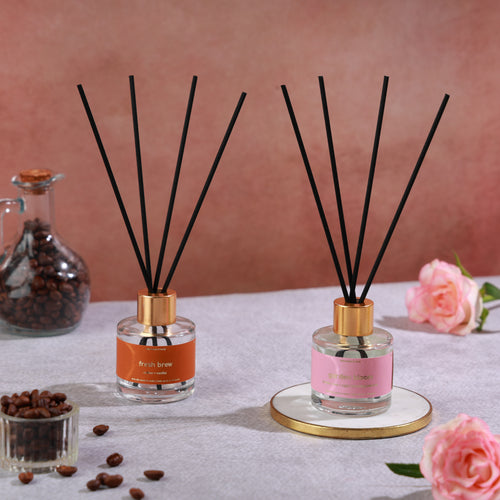
What actually happens inside a reed over three months
A reed diffuser looks like the simplest object in home fragrance and it is quietly the most mechanical. Each stick is a bundle of long fibres with an open pore structure running the full length, and oil climbs it by capillary action — the same physics that moves oil up a lamp wick or water up a paper towel. At the exposed top, the oil evaporates into the room, and that evaporation is what keeps pulling more up from below. The complication is that reed oil is not one substance. It is a composition containing materials of very different molecular weights, and they do not travel at the same speed. The light, volatile top notes move quickly and leave quickly. The heavy base materials move slowly, accumulate along the fibre rather than reaching the top, and never evaporate at anything like the same rate. Over weeks, that difference silts the stick up from the inside.
The three signs, and what to do about each
A short diagnostic table, because the difference between a reed problem and an oil problem decides whether you spend a little or ₹2,399. The first row is the one that settles it on its own. The last two rows are the situations people misread as clogging when they are actually something else entirely, and both have different fixes.
| What you are seeing | What is happening | What to do | Cost |
|---|---|---|---|
| Scent faded, bottle still half full ★ | The fibre has silted up with heavy fragrance residue and dust. The oil is fine; the delivery has failed | New reeds. Do not add oil — a refill poured through blocked sticks changes nothing | A fresh set |
| Reeds darkened or crusted at the top | Accumulated base materials concentrated where evaporation happens, sitting exactly where they block the exit | New reeds, and move the bottle out of direct sun if it is standing in any | A fresh set |
| Flipping no longer produces a surge | The pores can no longer move oil at a useful rate at all. This is the end state | New reeds, and stop flipping the old ones — each flip spends usable fibre | A fresh set |
| Bottle nearly empty, scent gone | Ordinary consumption. A 50ml runs six to ten weeks and a 130ml three to four months at five or six reeds | 300ml refill at ₹2,399 if the vessel is sound, plus new reeds with it | ₹2,399 |
| Oil dropping fast, scent strong then gone | Too many reeds, direct sun, a draught or an air-conditioning vent. Evaporation is outrunning the composition | Remove one or two reeds and move the bottle. Fewer sticks is a longer, steadier life | Free |
| Oily ring on the table under the bottle | Reed oil creeping down the outside of the glass. It marks polished wood and unsealed stone permanently | Wipe the neck and the surface, and put a coaster or small tray under every reed in the house | Free |
300ml refill · about ₹8/ml₹2,399Shop →  A fresh set · 50ml₹749Shop →
 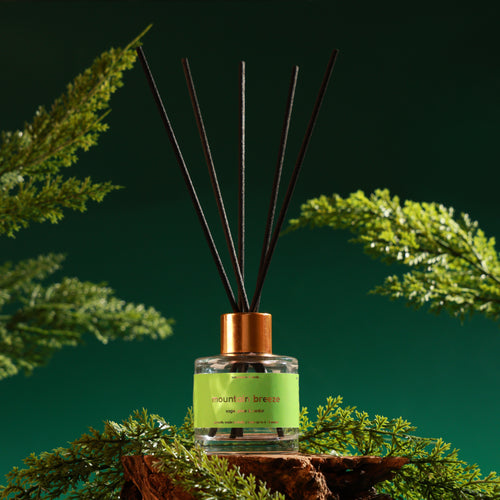 Mountain Breeze · 130ml₹1,349Shop →
The deep-clean routine for reed diffusers, in order
Do this while everything is already off the shelves, because it takes four minutes and you will not do it otherwise. Pull the reeds out and throw them away — all of them, not the worst-looking two. A mixed set of old and new sticks gives you a bottle in which some reeds are drawing properly and some are not, which makes the output unpredictable and makes the next diagnosis impossible. Then wipe the neck and the shoulders of the bottle with a dry cloth or a piece of kitchen paper, because that is where the creeping film of oil sits and where dust bonds to it. Wipe and thoroughly dry the surface underneath before anything goes back, and if that surface is polished wood, unsealed stone or a laminate you care about, this is the moment to put a permanent coaster, saucer or small tray there. Reed oil marks. It does not wash off wood polish and it will leave a matte ring that outlasts the diffuser by years, and I have been shown a good many of them. Then check the level: if the bottle is more than a third full, keep the oil and simply add new reeds. If it is lower than that, this is the moment for the 300ml refill at ₹2,399, which works out at roughly ₹8 per millilitre against about ₹15 at the 50ml size, on the condition that your vessel is sound and its neck is narrow — a wide-mouthed bottle evaporates far faster than it draws and no refill will compensate for that.
Then the reed count and the placement, which you may as well reconsider while the bottle is in your hand. Put back fewer sticks than you took out if the bottle emptied faster than you expected last time, and more if the room was never quite scented. Five or six in a living room, three or four in a bedroom, two or three in a bathroom is the range I would work within, and the number is very nearly linear in output, so one stick is a real adjustment rather than a nominal one. This is also the moment to move the bottle if it was in a bad place: direct sunlight degrades the composition and accelerates evaporation, a draught or an air-conditioning vent strips the light top notes and empties the bottle early, and a closed alcove means nothing carries the scent out. Waist height or above, where air moves gently and constantly. Expect the new set to take 24 to 72 hours to climb from dry — a fresh reed starts empty and has to transport oil the whole length before it does anything, which is exactly the same establishment window as a brand-new diffuser, and it surprises people who assume that because the oil is old the scent should arrive immediately.
Then the economics and the compatibility rules, both of which decide whether this job is cheap or expensive. Reeds are the least expensive component in the system and the one most people never replace, which is an odd inversion when you consider that a 130ml bottle at ₹1,249 to ₹1,349 is running through sticks that cost a fraction of that. A complete new diffuser is ₹749 for Morning Freshness, ₹799 for Garden Bloom and Evening Calm and ₹849 for Fresh Brew and Mountain Breeze at 50ml, with 130ml from ₹1,249 and duos from ₹1,498 — so if the vessel has chipped, or you have decided you want a different scent in that room anyway, buying the whole thing again is a perfectly sensible option rather than a defeat. The refill only wins when you are keeping both the vessel and the scent. On compatibility: SOSA reed diffusers are a separate alcohol-free line with their own scents, so Hotel Collection oil never goes into a reed — it is water-based and composed for an ultrasonic mist — and reed oil never goes into a Sukoon, a Boond or a Megh, where it will clog the 2.4MHz misting plate. Do not top a reed bottle up with a different scent from the one already in it; the two will not layer, they will muddle. And do not try to make old reeds last by adding more oil, which is the single most common thing people do and the one thing on this page that reliably does not work. The principle, if you want one line to remember: the oil is the fragrance and the reeds are the machine, and the machine wears out first.
The SOSA edit
In buying order for somebody standing in front of a reed diffuser that has stopped working, mid-clean, with the shelf already cleared. The first row is the cheapest thing on the page and the one that fixes the actual problem. The last row is the thing people do instead, and it is the only genuinely wasteful option here.
| Do this | What it is | When it earns its place | Price |
|---|---|---|---|
| 1. A fresh set of reeds ★ | New sticks, all of them at once, never a mixed set of old and new | First, and at every major clean — roughly every three to four months. Allow 24 to 72 hours to climb from dry | A fresh set |
| 2. Wipe the neck and the surface | A dry cloth on the bottle shoulders, then the shelf underneath, then a permanent coaster or tray | Immediately. Reed oil marks polished wood and unsealed stone, and the ring does not come out | Free |
| 3. 300ml refill | About ₹8 per millilitre against roughly ₹15 at 50ml, for a vessel you already own and a scent you are keeping | Only if the bottle is under a third full. Buy new reeds with it, not instead of it | ₹2,399 |
| 4. A complete new diffuser | Morning Freshness ₹749, Garden Bloom and Evening Calm ₹799, Fresh Brew and Mountain Breeze ₹849 at 50ml; 130ml from ₹1,249 | If the vessel is chipped, the neck is too wide, or you want a different scent in that room | from ₹749 |
| 5. The 130ml size or a duo | Three to four months per bottle at five or six reeds, or two bottles from ₹1,498 | If you are replacing anyway and the room is above about 200 sq ft, or if you want two zones running | ₹1,249+ / ₹1,498+ |
| Do not: add oil to old reeds | A refill poured through silted-up fibre delivers no more scent than it did the day before | Never. The blockage is inside the pore structure, water will not shift it, and washing swells the fibre shut | — |
Versailles
This is the piece of information I most wish came printed on every reed diffuser box in the country, mine included. Reeds are consumable. Almost nobody knows this, and the consequence is that a great many people conclude that reed diffusers simply stop working after a few months and are not worth buying again. They do stop working after a few months. The bottle has not failed and the perfumer has not let you down; the delivery system has silted up, exactly as a filter does, and it costs very little to put right.
I like attaching it to a deep clean because it is the only schedule anybody keeps. Nobody remembers a date written on a calendar in March, but everybody moves the shelf when they clean properly, and the reed is already in your hand at that point. Take out the old sticks, wipe the neck, dry the surface, put a coaster under it, put new reeds in and walk away for a day. Four minutes, twice or three times a year. The difference between a reed diffuser that people love and one they quietly give up on is almost entirely this, and it has nothing to do with the fragrance in the bottle.
Everything is made and supported from Pune, and a part of every order funds girl-child education through Nanhi Kali. You get a home that smells like somewhere you chose; a girl gets a classroom. That equation has always felt right to me.
Frequently asked questions
- What should I use after Diwali cleaning to keep the house fresh for weeks? — the reed case in full.
- I deep-cleaned my house but it still doesn't smell luxurious — the two missing pieces.
- Is a reed diffuser worth buying after deep-cleaning your home? — whether it earns the money.
- Reed diffuser or Sukoon: which keeps the home feeling fresh longer? — the closing comparison.
- Brand: the SOSA founder story.
Facts verified August 2026: Timings in this guide: a scented candle puts noticeable fragrance into a normal room in roughly 15–20 minutes; a Sukoon ultrasonic diffuser reaches a steady level in about 20 minutes from cold; a reed diffuser needs roughly 24–72 hours for the oil to travel the reeds and the room to settle, so it is not a same-day solution. SOSA products and prices: Sukoon 500ml ultrasonic diffuser ₹1,899 (270–320 sq ft, 16–18h on low, 9–12h high, 30–50 ml/h, 2.4MHz cool mist, 7-colour LED, remote, steady/2H/4H timers, BPA-free, auto shut-off, includes three 15ml Hotel Collection scents of your choice); Boond 300ml ₹899; Megh 6-litre ₹3,499; waterless Vaayu ₹11,999 (up to 1000m³); Aangan ₹25,999; Meenar ₹38,500. Hotel Collection water-based fragrance 15ml ₹299, 100ml ₹999, 300ml ₹1,799, Pack of 7 at 15ml ₹1,799 / 100ml ₹5,999 / 300ml ₹10,799; dose 3–6 drops per tank. Reed diffusers (separate alcohol-free line): Morning Freshness from ₹749, Garden Bloom and Evening Calm from ₹799, Fresh Brew and Mountain Breeze from ₹849; 130ml from ₹1,249; duos from ₹1,498; 300ml refills ₹2,399. Scented candles: Bookshop 80g ₹379 (~15–18 hours), Bookshop + Cozy Corner ₹664 (~30–36 hours), Amber Rose 130g ₹599 (~25–30 hours) and 220g ₹799 (~40–50 hours), ceramic jar candles ₹949, Pure Calm wax melt set ₹854. Free shipping above ₹499. SOSA does not make a room or linen spray for the home — the sprays in the range are car perfumes. The Hotel Collection scents are SOSA's own interpretations; SOSA is not affiliated with or endorsed by any hotel brand. Prices subject to change — see the live product pages.