

Why bottles drift below the rate: the exposed end of a reed slowly accumulates the heavy, slow part of the composition while the light part leaves. The reed stays wet and stops delivering.
What a flip actually does: puts a clean surface into the air and the loaded end back into the oil. The room recovers over a few hours, not instantly.
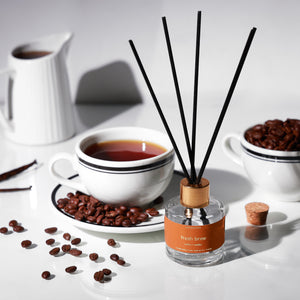
The ceiling: a freshly flipped bottle is at 100% of its designed output. If that is still too quiet, add reeds, move the bottle, or change the composition — Fresh Brew 9.5/10 from ₹849.
2. Expect restoration, not amplification. The correct mental model is a car returning to its proper tyre pressure rather than an engine being tuned. You get back what the bottle was built to give. You do not get more.
3. Most people needed the repair anyway. A bottle at week five that has never been flipped is typically delivering a fraction of its week-one performance, and that shortfall is exactly what "it stopped working" describes. Recovering it feels like an increase because the drift happened slowly enough to go unnoticed.
4. Do not chase the post-flip surge. For a few hours after a flip, freshly wetted fibre releases more than it will settle at. That surge is not the new baseline and it is not something to try to hold with more flipping. The plateau is the product.
5. Give it a few hours before judging. The room does not change the moment you put the reeds back. Judge the next morning, and judge by walking in from outside rather than by standing in the room with an adapted nose.
6. If a fresh flip changes nothing, you have a diagnosis for free. It means the reeds are at full output and the shortfall is elsewhere: dead air or a draught, a room larger than the format handles, or a composition quieter than the space needs.
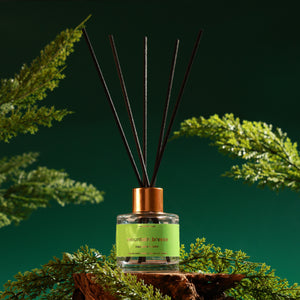
7. Then, and only then, spend. Add reeds, move the bottle, or move up the strength scale — Fresh Brew at 9.5 and Mountain Breeze at 9.4 against 8.9 for the softest in the range.
Composed and handmade in small batches in Pune, and a portion of every order supports girl-child education through Nanhi Kali.
Part one — why a flip is a repair and not a raise
To see why flipping has a ceiling, you have to look at what has actually gone wrong in an unflipped bottle. Nothing has been used up: the oil level may have barely moved, the reeds are still visibly wet, and the fragrance is still perfectly good in the glass. What has changed is the composition of the last centimetre of each reed, which is the only part of the system that talks to your room. Evaporation is selective — it takes the light and volatile parts of a fragrance preferentially and leaves the heavy ones behind — so the exposed tip gradually becomes a concentration of the slowest, least airborne materials in the formula. It is saturated, it is dark, and it is doing very little. Turning the reed over swaps that surface for fresh fibre: it restores, and it has no mechanism for exceeding.
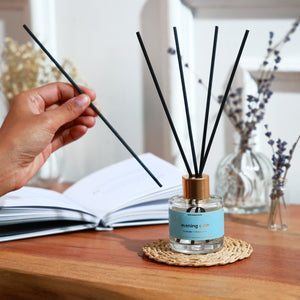
 Morning Freshness₹749 · 9.0/10A clean reed standing in oil releases at a rate set by the fragrance itself — how volatile its materials are, and how readily the carrier lets them go. Our compositions sit on an alcohol-free, phthalate-free CCT base chosen deliberately for a flatter, longer curve. A freshly flipped reed is already at that rate; there is no state above it for a flip to reach. This is why flipping twice a week gives so little over flipping once: the second flip is restoring a surface that had barely begun to drift. It is also where the phthalate trade becomes visible. Solvent-heavy diffusers push fragrance hard off the reed and win the first fortnight convincingly, then degrade in heat and turn acrid by around week six. We chose the smaller opening and the longer plateau, and I would rather say that out loud than let you wonder why week one is not overwhelming.
Part two — what people hope a flip will do, against what it does
Six versions of the same question arrive in my inbox every week. Read down the first column for the one you were thinking, and across for what the mechanism can and cannot deliver.
| What you were hoping for | What flipping actually does | Repair or raise | When you will know |
|---|---|---|---|
| "It has faded — bring it back" ★ | Exactly this. Fresh fibre, designed rate restored | Repair — and the one that works | Within a few hours; settled by the next morning |
| "Make it louder than it ever was" | Nothing. There is no state above the designed rate | Neither — the request has no mechanism | Immediately, and usefully |
| "Fix a bottle sitting in a cabinet" | Raises output into a pocket of air nobody stands in | Repair, wasted on the wrong problem | Next day — the room is unchanged |
| "Rescue a bottle in the AC draught" | Little. Stripped reeds are being over-ventilated, not stalled | Neither — move the bottle instead | Next day, alongside a fast-dropping oil level |
| "Give me a boost before guests arrive" | A few hours of genuine lift, then settling back | Repair with a temporary bonus | Two to three hours after flipping |
| "Make a soft fragrance suit a big room" | Nothing beyond restoring what the soft fragrance gives | Neither — this is a composition question | Next morning, and it is worth knowing |
| The honest caveat: flipping does shorten the bottle slightly, because a working reed consumes oil and a stalled one does not. That is not a drawback — it is the trade being correctly made. A stalled bottle "lasts longer" only in the sense that it has stopped delivering the fragrance you paid for. If you want both a working bottle and a low running cost, the answer is an oil refill at ₹2,399 for 300ml, roughly ₹7–8 per millilitre against ₹15–17 for a 50ml bottle. | |||
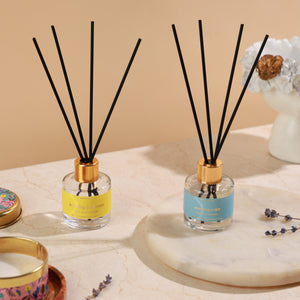
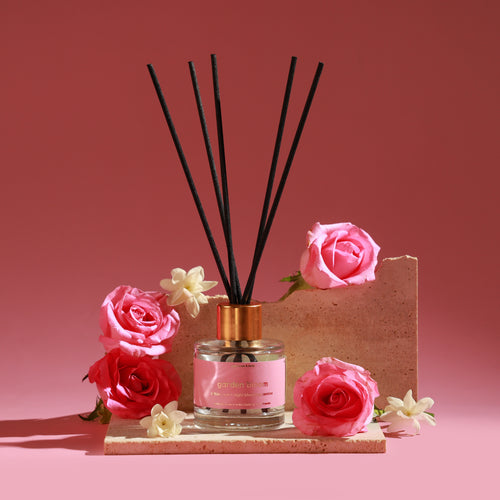 Garden Bloom · 8.9/10from ₹799Shop →
 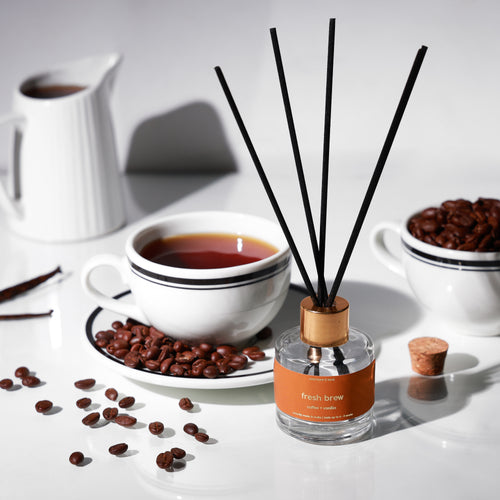 Fresh Brew · 9.5/10from ₹849Shop →
  Oil refill · 300ml₹2,399Shop →
Part three — the morning after a flip, and what it tells you
This is the part of flipping that nobody writes about, and it is the most valuable part. Because a flip has a known ceiling, the result of one is interpretable in a way that almost nothing else about a reed diffuser is. Twelve hours after flipping all six reeds you are looking at your fragrance at one hundred per cent of its designed output, in your actual room, with your actual furniture and ventilation. There is no ambiguity left about whether the reeds were tired. So walk out of the flat for an hour, come back in through the front door, and pay attention to the first three seconds. Those three seconds are worth more than an evening of standing in the room wondering, because your nose reports change and stops reporting constants within minutes.
If those three seconds are good — the room greets you, the fragrance is where you wanted it — then your entire problem was maintenance, your solution is a recurring weekly reminder, and you should spend nothing. If those three seconds are pleasant but thin, the shortfall is real and now it is locatable. Check placement before anything else: a bottle in an alcove, behind a sofa, inside a cabinet or on a low table below the layer of air that people stir when they walk past will underperform at any output level, and moving it to a console near a doorway at waist to chest height costs nothing. Check for the opposite fault too — a bottle within a few feet of a split AC or a fast fan is being stripped rather than distributed, and the giveaway is a room that smells of little while the oil level falls unusually fast.
And if the placement is right and the flip was fresh and the room is still quieter than you want, then you have arrived at a genuine, honest conclusion: this composition, at six reeds, is not enough for this space. That is not a fault and it is not a defeat; it is information you obtained without spending a rupee. Now the paid options make sense in a way they never did before. Add reeds, accepting that nine takes a 50ml to about five weeks from six to eight. Or move up our internal strength scale, which runs from 8.9 for Evening Calm and Garden Bloom through 9.0 for Morning Freshness to 9.4 for Mountain Breeze and 9.5 for Fresh Brew — positions on our own scale at six reeds, not an industry standard. Or, if the space is genuinely large or you want scent on demand rather than constantly, accept the format's ceiling and look at a Sukoon at ₹1,899. What you will not be doing is buying blindly, which is the entire point of flipping first.
Part four — reading the reed you have just lifted
While the reed is in your gloved hand, look at it. There is a boundary on every reed between the oil-soaked part and the dry part, and where that line sits tells you which problem you have before you have spent anything.
| What the lifted reed looks like | What it means | What to do | What it costs |
|---|---|---|---|
| Wet line high and the fibre dark ★ | Saturated and stalled — heavy residue has collected at the tip | Flip all six. This is the textbook case | Free |
| Wet line barely above the oil | Not wicking — the reed is not carrying oil up its length | Add reeds, or refresh the whole set if they are months old | Free, or a fresh bottle if the set is spent |
| Wet line normal, room still quiet | The reeds are fine. It is airflow, room size or your own nose | Move the bottle; leave the flat for an hour and return | Free |
| Dry for the top third in a hot room | Evaporation at the tip is outrunning the climb — a hard-drawing room | Out of the sun and off a warm surface; expect a shorter bottle | Free, and it buys weeks back |
| A dusty crust where the reed meets the neck | Dust ingress is blocking the exposed end | Refresh the reeds; keep the bottle out of high-dust corners | Free until reeds need replacing |
| Even amber colour along the whole reed | Normal oxidation and residue. Expected, not a fault | Carry on flipping weekly | Free |
| Oil creeping down the outside of the glass | The neck is overcrowded with reeds | Remove two or three; keep the bottle on a tray | Free, and it saves your furniture |
Versailles
The most common message I receive after somebody flips their reeds for the first time is some version of "I thought it had gone off, and it turns out it was fine all along". I take a certain amount of quiet satisfaction in those messages, but I also read them as a criticism of us. If a product needs a maintenance habit to perform as designed, the brand ought to be teaching that habit as insistently as it advertises the fragrance — and for a long time nobody in this category did.
What I try to be careful about is not overselling the flip in the other direction. It is not a secret trick, it does not double anything, and it will not turn a bedroom fragrance into a hosting one. It restores. That is all it does, and it is enormously worth doing precisely because so many bottles have quietly drifted below where they should be sitting.
The corollary is the honest one. When a customer tells me they flipped everything, moved the bottle into passing air, and the room is still too quiet, I do not ask them to flip harder. I tell them the composition is the limit, and I point them at a 9.4 or a 9.5 — or, if the room is genuinely large, at a machine, because a reed diffuser has a ceiling and I would rather name it than sell around it. Everything is composed and handmade in Pune, and a part of every order funds a girl's classroom through Nanhi Kali.
Frequently asked questions
- Does adding more reeds make it stronger? — the next lever, once flipping has done its work.
- How many reeds for stronger fragrance? — staging a higher count for a weekend.
- How to make a reed diffuser smell stronger and how to increase scent throw.
- The complete guide to stronger performance and why can't I smell my reed diffuser?
- Brand: the SOSA founder story.
SOSA reed diffuser range & prices (verified August 2026): alcohol-free, phthalate-free, paraben-free and IFRA-compliant compositions on a heat-stable coconut-derived (CCT) carrier, low-VOC, supplied in a refillable glass bottle with six fibre reeds; 50ml lasts 6–8 weeks and 130ml lasts 14–18 weeks. Morning Freshness (Malabar lemon · peppermint · Nilgiri eucalyptus) 50ml ₹749 · 130ml ₹1,249 · 9.0/10; Garden Bloom (British rose · night-blooming jasmine) 50ml ₹799 · 130ml ₹1,299 · 8.9/10; Evening Calm (Kashmir lavender · chamomile) 50ml ₹799 · 130ml ₹1,299 · 8.9/10; Fresh Brew (Coorg coffee · Kerala vanilla) 50ml ₹849 · 130ml ₹1,349 · 9.5/10; Mountain Breeze (Himalayan pine · sage · Indian cedar) 50ml ₹849 · 130ml ₹1,349 · 9.4/10. Reed diffuser refills are oil only — you reuse your own vessel and reeds: 300ml ₹2,399 (roughly 8–11 months) · 500ml ₹3,499 (roughly 14–18 months), about ₹7–8 per ml against ₹15–17 per ml for a 50ml bottle. Duo sets ₹1,498–₹1,598 for 2 × 50ml and ₹2,498–₹2,598 for 2 × 130ml. Strength figures are positions on SOSA’s own internal strength scale, not an industry standard. Replacement reeds are not sold as a separate SKU; SOSA guidance is to refresh reeds every few months. The reed line is separate from the water-based Hotel Collection for ultrasonic machines (15ml ₹299 · 100ml ₹999 · 300ml ₹1,799) and the two are not interchangeable. Diffusers: Boond 300ml ₹899 · Sukoon 500ml ₹1,899 · Megh 6L ₹3,499 · waterless Vaayu ₹11,999. Composed and handmade in small batches in Pune, India; tested through 45°C summer heat and 85% monsoon humidity. Free shipping above ₹499. A portion of every order supports girl-child education through Nanhi Kali. Prices subject to change — see the live product pages.