




No, in this sense: a house that smells different every month has no signature, and a signature is what people remember. Constant novelty also means no scent ever reaches the second week, which is when it is honestly judged.
The recommendation: two or three scents on a rhythm with a reason — a day scent and an evening scent, or a warmer bottle for winter and a cooler one for summer. Two 15ml is ₹598.
2. The yes is real: adaptation is specific to what you adapted to. A nose that has stopped reporting amber has not stopped reporting white tea. Switching restores your perception on the day you switch, with no increase in dose — the only free reset there is.
3. Choose two that are not neighbours. Two white teas will not reset each other, because the overlap is too great. A cool tea against a warm amber, or a dry cedar against a soft floral, gives you a genuine change of stimulus rather than a variation on one.
4. The no is also real: a house that changes constantly has no signature. What people remember about a home is that it smells the same way every time they come. That impression takes months of consistency, and it is dismantled by novelty.
5. So change on a rhythm with a reason, not on the feeling that it has faded. A day scent and an evening scent, or a warmer bottle for winter and a cooler one for summer. The feeling that a scent has faded arrives on a fortnightly schedule that has nothing to do with the room.
A portion of every order supports girl-child education through Nanhi Kali.

Why the answer is yes and no at the same time
Both halves of this question are true and they pull in opposite directions, which is why a straight yes or a straight no both produce bad outcomes. Adaptation really is specific, so changing scent really does restore perception. And a signature really is built out of sameness, so changing scent really does cost you something. The resolution is not a compromise between them; it is a structure that gets both, and it turns out to be a small rotation with a reason behind the rhythm rather than an appetite for the next bottle.
Four rotation patterns, and what each one costs
Four ways to arrange a rotation, plus the two failure modes, with what each does for your perception and what it does for the signature. The column that matters most is the fourth one, because keeping a house recognisable is the reason for scenting it in the first place, and it is the thing a novelty habit quietly spends.
| Pattern | How it works | What it does for your nose | What it does for the signature | What it costs |
|---|---|---|---|---|
| Day scent and evening scent ★ | Something cool and clean while the flat is being worked in; something warmer from six or seven, with a minute to rinse the tank | The strongest reset of the four — two changes a day, so neither composition gets a fortnight of uninterrupted exposure | Intact, and arguably improved. A house with a rhythm is still a house with a character | ₹598 for two 15ml |
| Summer bottle and winter bottle | A warmer, plusher scent from about October and a cooler, greener one from March | Two clean resets a year. Modest, but it breaks a twelve-month adaptation twice, which is more than most homes manage | Strong. Seasonal consistency is how a house acquires a remembered smell rather than a current one | ₹598 for two 15ml |
| Weekday and weekend | One scent Monday to Friday, another from Friday evening, on the same machine | Good. A two-day break is enough for meaningful receptor recovery before the weekday scent returns | Intact, provided both stay the same across months rather than being swapped for new ones | ₹598 for two 15ml |
| Three scents on a monthly cycle | Three bottles rotated in a fixed order, each returning every third month | Very good. Three months is long enough for near-complete recovery from any one of them | Weaker. Three signatures is closer to none than to one, unless the three are close relatives | ₹897 for three 15ml |
| A new fragrance every month | The habit most people fall into when a scent stops registering | Works, in the sense that novelty always registers — and it treats the symptom at ₹299 a time | Poor. No scent is ever judged past its first fortnight and the house never becomes anything | ₹299 a month, indefinitely |
| One scent, run forever, dose rising | The default. No rotation, and an extra drop whenever the room goes quiet | Nothing. Adaptation is complete within a fortnight and the only response left is a larger dose | Strong on paper, and gradually too strong in practice for everybody except the household | The ratchet |
Two 15ml · ₹598₹299 eachShop → Pack of 7 · saves ₹294₹1,799Shop → 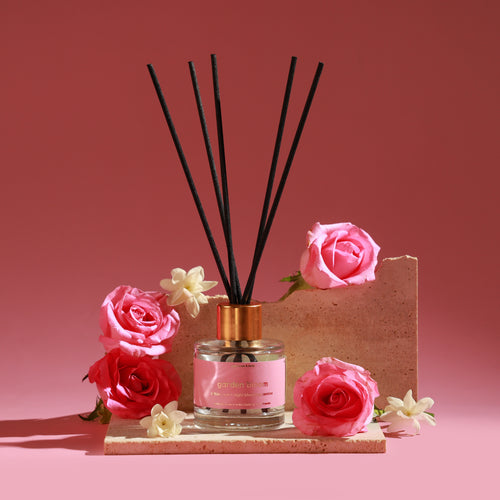 Reeds · one steady levelfrom ₹749Shop →
Rinsing, rhythms, and what to do before you buy a new scent
Start with the mechanics of swapping, because a rotation is only pleasant if changing over takes a minute rather than an evening. Rinse the tank when you change scent — genuinely rinse it, not just tip it out — because a residue of amber under three drops of white tea gives you neither, and it is the commonest reason people conclude that a new bottle was disappointing. Wipe the 2.4MHz misting plate at the same time; a film of old fragrance reduces output and makes a fresh scent seem weaker than it is. Then the dose, which does not change with the scent: the Hotel Collection is composed at three to six drops per tank, and the dose is per tank rather than per litre, so a 300ml Boond at ₹899 takes the same three drops as a 500ml Sukoon at ₹1,899 and a six-litre Megh at ₹3,499 takes the same again. Keep the number constant across the rotation rather than adjusting it for each bottle by feel, or you will have reintroduced the exact judgement the rotation was meant to remove. Three in a bedroom or study, four in a sitting room, written on each bottle with the date. If you would rather not rinse at all, the honest answer is a second machine: a Boond at ₹899 alongside a Sukoon gives you two scents live at once in different rooms, which is a better arrangement than one machine and a swap for anybody whose rotation is daily rather than seasonal.
Then the thing to do before buying any new scent at all, because a surprising share of the urge to change fragrance is not boredom. It is a room that has acquired a competing smell, and a new bottle will not fix it. A composition that used to please and now seems wrong is very often sitting on top of something that has arrived since: a monsoon that has taken indoor humidity to 80 or 90 per cent, where microbial growth accelerates above roughly 60; a bathroom whose U-bend seal has evaporated over two to four weeks of disuse and is now venting into the flat; a sofa or a set of curtains carrying six months of dinners; an air-conditioner filter that has not been washed this season, blowing biofilm off a cold wet coil in the first minute of every start-up. So: two openings on opposite or adjacent walls for twenty minutes, a mug of water down every floor drain, basin and unused shower, the washable fabric through a cycle, and the AC filter out and washed. Then run the same scent for a fortnight and see whether you still want to replace it. This costs nothing and it is the step that decides whether you have a fragrance question or a household one. Fragrance layers onto air that is already clean and moving; it removes no source, and a new bottle over an old problem simply gives you a different combination of two smells. One exception worth naming: if the room is genuinely damp, a cool-mist ultrasonic is the wrong machine entirely, since it adds 30 to 50 millilitres of water an hour to air you are trying to dry. Candles and reeds add none.
Then the buying, which for this reader is unusual enough to be worth stating against our own interest. Two 15ml bottles at ₹598 is a better purchase than one 300ml 300ml refill at ₹1,799, even though the larger bottle is far better value per millilitre — about ₹6 against roughly ₹20 — because a rotation needs variety in the cupboard rather than volume in one bottle. The 300ml is the right buy later, for the one scent that has stopped being a product and become the smell of your house. If you want the rotation to be real rather than theoretical, the Pack of 7 at 15ml is ₹1,799 against ₹2,093 for seven singles, a saving of ₹294, and it is the natural version of this argument: seven bottles is a day scent, an evening scent, a winter one and a summer one with three left to discover, and it removes the friction that makes people run one bottle into the ground — which is that changing requires ordering. The Sukoon at ₹1,899 includes three 15ml scents of your choice, so a three-bottle rotation can arrive with the machine at no extra cost, alongside its 500ml BPA-free tank, 270–320 sq ft coverage, 16–18 hours per fill on low at 30–50 ml/h and steady, 2H and 4H timers. On the constraints: the water-based Hotel Collection runs in the Sukoon, Boond and Megh only. It does not go into a reed diffuser, which is a separate alcohol-free line with its own scents — Morning Freshness from ₹749, Garden Bloom and Evening Calm from ₹799, Fresh Brew and Mountain Breeze from ₹849 — and it does not go into the waterless Vaayu at ₹11,999, which takes its own undiluted oil. SOSA does not make a room or linen spray for the home. And the principle: rotate to keep your perception, and keep the rotation small enough that your home still smells like itself.
The SOSA edit
In buying order for somebody who wants to stop going nose-blind without losing what their home smells like. The free steps come first, as they should on this subject, and the last row is the purchase that usually gets made instead.
| Buy | What it is | When it earns its place | Price |
|---|---|---|---|
| 1. Two 15ml scents that are not neighbours ★ | A cool one against a warm one — a white tea and cedar against an amber and violet, or a dry vetiver against a soft sandalwood | First. Two distant scents alternated give a genuine reset with no increase in dose; two similar ones give almost nothing | ₹598 |
| 2. A rhythm, written down | Day and evening, or summer and winter, decided in advance and noted with the dose on each bottle | Second, and free. A rotation driven by the feeling that a scent has faded is being scheduled by your adaptation | ₹0 |
| 3. Air the room before buying a third scent | Twenty minutes of cross-ventilation, a mug of water down every unused drain, the washable fabric through a cycle | Third. A scent that has started to feel wrong is often a room that has acquired competition since you chose it | ₹0 |
| 4. Sukoon or a second Boond | 500ml with steady/2H/4H timers and three 15ml scents included, or 300ml for a second room | If swapping is daily rather than seasonal, two machines beat one machine and a rinse | ₹1,899 / ₹899 |
| 5. Pack of 7 · 15ml or a reed diffuser | All seven for ₹1,799 against ₹2,093 singly, or one unchanging level for months from ₹749 | The pack if the rotation should be real rather than theoretical; the reed as the constant underneath it | ₹1,799 / from ₹749 |
| Not first: a 300ml refill of one scent | ₹1,799 for 300ml at about ₹6 per millilitre against roughly ₹20 for the 15ml | Excellent value, and the wrong shape for this reader. Buy volume for the scent that has already become the smell of your house | — |
Versailles
I get asked this most often by people who have already answered it in the worst possible way, which is by buying a new fragrance every few weeks and still not being able to smell their home. Changing scent does work, and it works for a real reason — adaptation is specific, so a nose that has gone quiet on one composition is fully awake to a different one. What does not work is treating that as a licence to keep shopping, because the thing you are buying a home fragrance for is not the moment of noticing it. It is the year in which your house quietly becomes somewhere.
So my honest recommendation is smaller than the one that would sell more. Two bottles, or three at the outside, changed on a rhythm you decided rather than on the evening the room goes quiet. A cool one for the day and a warmer one after six is the version I use, and the swap takes a minute at the tap. Buy two 15ml at ₹598 rather than a 300ml at ₹1,799, which is me arguing against the better margin, and take the Pack of 7 at ₹1,799 only if you want the rotation stocked properly. And leave something unchanging somewhere in the house — a reed on a landing, holding one level for months — so that whatever you are doing with the machine, the place still has a smell of its own to be remembered by.
Everything is made and supported from Pune, and a part of every order funds girl-child education through Nanhi Kali. You get a home that smells like somewhere you chose; a girl gets a classroom. That equation has always felt right to me.
Frequently asked questions
- Why you cannot smell your own home — the mechanism that makes a switch work.
- Why you keep adding more drops to your diffuser — the alternative reset, and why it is the expensive one.
- How to find out what your house actually smells like to other people — how to check whether the rotation is landing.
- Nose-blindness at home: the complete guide — the pillar for this group.
- Brand: the SOSA founder story.
Facts verified August 2026: Diagnostic facts used in this guide: a closed room accumulates what it cannot exchange, so cross-ventilation needs two openings rather than one; a drain's U-bend water seal evaporates in roughly two to four weeks of disuse and then admits sewer gas, which is corrected by pouring water down the drain; microbial growth in fabric and on surfaces accelerates above about 60% relative humidity, and Indian monsoon indoor humidity commonly runs 80–95%, which is the one situation where ventilating on a wet day can import moisture rather than remove it; an air-conditioner's cold, wet evaporator coil and filter grow biofilm that is blown into the room on start-up; textiles adsorb cooking aerosol and body oils and re-release them for weeks; and olfactory adaptation makes a constant household smell undetectable to its residents within about a fortnight while visitors still perceive it. Timings: a scented candle scents a normal room in roughly 15–20 minutes, a Sukoon ultrasonic diffuser reaches a steady level in about 20 minutes from cold, and a reed diffuser needs roughly 24–72 hours. SOSA products and prices: Sukoon 500ml ₹1,899 (270–320 sq ft, 16–18h on low, 9–12h high, 30–50 ml/h, 2.4MHz cool mist, remote, steady/2H/4H timers, BPA-free, auto shut-off, includes three 15ml Hotel Collection scents of your choice); Boond 300ml ₹899; Megh 6-litre ₹3,499; waterless Vaayu ₹11,999 (up to 1000m³); Aangan ₹25,999. Hotel Collection water-based fragrance 15ml ₹299, 100ml ₹999, 300ml ₹1,799, Pack of 7 at 15ml ₹1,799; dose 3–6 drops per tank. Reed diffusers (separate alcohol-free line): Morning Freshness from ₹749, Garden Bloom and Evening Calm from ₹799, Fresh Brew and Mountain Breeze from ₹849; 130ml from ₹1,249; duos from ₹1,498; 300ml refills ₹2,399. Scented candles: Bookshop 80g ₹379, Amber Rose 130g ₹599 and 220g ₹799, Smoked Oudh 130g ₹449, ceramic jar candles ₹949, Pure Calm wax melt set ₹854. Free shipping above ₹499. SOSA does not make a room or linen spray for the home. The Hotel Collection scents are SOSA's own interpretations; SOSA is not affiliated with or endorsed by any hotel brand. Prices subject to change — see the live product pages.