



Commissioning a bespoke scent: a perfumer creates something exclusive to your firm. Real development time, real minimum quantities, real cost, and it only makes sense at a scale most firms never reach. SOSA does not offer this service.
What a signature needs to work: repetition, consistency, then time — in that order. There is no shortcut past the third one.
What it does not do: it does not communicate a message about your firm, and most people will never consciously notice it. Both of those are fine. Neither is a failure.
2. For almost everybody, choose rather than commission. A 15ml bottle at ₹299 and the refusal to keep trying new ones gets you every practical benefit a signature has. Nothing about recognition requires exclusivity — it requires sameness.
3. Understand what commissioning involves before you enquire. A brief, several submissions over months, revisions, then a minimum production quantity measured in litres rather than millilitres, plus bottling, labelling and storage of a fragrance nobody else will ever buy. It is a real undertaking and it is priced like one.
4. Then hold it, which is the part that fails. Repetition first, consistency second, time third. A composition changed twice in a year is not a signature, it is a preference, and nobody will ever connect it to you.
5. Run it through something that does not depend on anybody remembering. A Vaayu at ₹11,999 holds an identical level on a schedule across up to 1000 m³, waterless and under 38 dB. A Sukoon at ₹1,899 does one room. The machine is what makes consistency an arrangement rather than a resolution.
6. And know what it will not do. It will not say anything about your firm's values, and most clients will never consciously register it. A signature is a background that becomes familiar, not a message that gets read.
A portion of every order supports girl-child education through Nanhi Kali.

Two questions wearing one sentence
I get this question by email perhaps twice a month and the first thing I do is ask which version of it is being asked, because the two answers point in opposite directions. One version is a choice between compositions that already exist, and its whole difficulty is behavioural: can you use one bottle for three years without getting bored of it. The other version is a procurement decision about having a fragrance manufactured to your own brief, and its whole difficulty is arithmetic. A firm that asks the first question and gets an answer to the second concludes that signature scents are a thing for developers with marketing departments, and drops an idea that would have cost them ₹299. A firm that asks the second and gets an answer to the first ends up mildly insulted. So the distinction is not pedantry. It is the page.
Choosing against commissioning, line by line
The two versions of the question set side by side on the things that actually differ. The last column is the one to read first — it is who each version genuinely suits, rather than who could be persuaded into it. I have left the cost of a bespoke development as a range of magnitude rather than a number, because any specific figure would be invented.
| Choosing an existing composition | Commissioning a bespoke scent | Who it suits | |
|---|---|---|---|
| What you decide ★ | Which of a finished set you will use for years | A brief, then several rounds of submissions and revisions | Choosing suits essentially every brokerage. Start here and stay here |
| Lead time | The delivery time of a ₹299 bottle | Months, because each submission has to be made, sent and lived with | Anybody with a listing to prepare this quarter is choosing, not commissioning |
| Minimum quantity | 15ml, which is weeks of a small machine | A production batch measured in litres, not millilitres | A firm consuming litres a year. A brokerage with two machines is not that firm |
| Exclusivity | None. Somebody else may run the same composition | Genuine — it exists nowhere else | Exclusivity matters to a developer with a hundred premises and to almost nobody else |
| What makes it work | Repetition and refusing to change it | Repetition and refusing to change it. Identical | The mechanism does not care whether the scent is unique, which is the whole point |
| If you change your mind | ₹299 spent, a rinsed tank, move on | A batch with no resale value and no alternative use | The asymmetry of the two mistakes is the real argument |
| Where SOSA sits | A finished range of seven, from ₹299 | Not offered. We do not do bespoke development | Said plainly so you know what this page is and is not selling |
Repetition, consistency, time — and what a signature does not do
Start with what to pick, because the brief for a signature is narrower than most people expect and it is not the brief for a scent you love. You are choosing something that has to be tolerable on its two hundredth exposure, not impressive on its first, and those two requirements pull in opposite directions. The Ritz-Carlton-inspired Quiet Luxury at ₹299 — white tea, bergamot and cedar — is the default for exactly that reason: cool, dry, faintly citric, with no material sticking out of it that anybody can form an opinion about. The Westin-inspired White Tea Serenity at ₹299 is the lightest of the seven and suits a small office or a firm whose clients sit rather than walk. The 1 Hotels-inspired Forest Suite at ₹299 — cedarwood, vetiver and green leaves — is the driest, and it is the one I would choose for a warm office or a floor above a restaurant. What I would avoid as a signature is anything heavily floral or anything a client might recognise as a specific perfume, because a firm whose office smells like a well-known fragrance has borrowed somebody's personality by accident. Buy the 15ml at ₹299 before the 300ml 300ml refill at ₹1,799; the small bottle is a decision and the large one is a supply, and committing to a supply before you have lived with the decision is the wrong order.
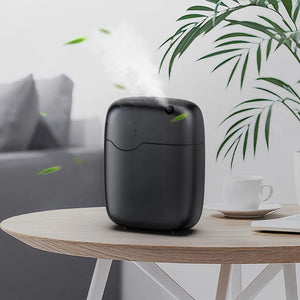
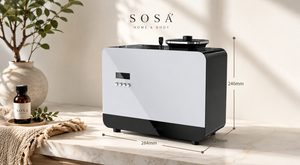
Then the machinery of consistency, which is where a signature is actually won or lost. Consistency cannot rest on anybody remembering to do something, because in a working brokerage it will not survive a busy fortnight. That is the whole argument for a scheduled machine over a bottle somebody sprays or a reed somebody replaces. A Vaayu at ₹11,999 covers up to 1000 m³, holds an intensity setting you chose once, and runs on Bluetooth scheduling with 1h/4h/8h/24h timers, so the office is at the same level at nine on a Tuesday in February as it is at nine on a Thursday in September, without a single person on the team having a task about it. It is waterless cold-air nebulisation, so nothing damp reaches paper or drawings, it runs under 38 dB, it has auto-stop and a key-lock, and at 0.9 kg it goes into a car boot when you want the same composition in a listing. If your office is genuinely one room of 270 to 320 sq ft, the Sukoon at ₹1,899 is the honest machine and it includes three 15ml Hotel Collection scents — but it is an ultrasonic, so it adds 30 to 50 ml of water an hour to the air, which is a consideration in a sealed cabin in August. The Aangan at ₹25,999 covers up to 3,000 m³ and belongs in a sales gallery or a clubhouse, not in a brokerage office, and I would rather say so than sell one.
Then the three things that will make you want to abandon this, so that you recognise them when they arrive. The first is your own nose. Within a fortnight you will not be able to smell your own office, because a nose reports change and discards constants, and the instinct that produces is to turn the machine up or to change the bottle. Resist both. Ask two people who have walked in from outside, ask them to be truthful rather than polite, and act on their answer instead of yours. The second is the anniversary feeling — the sense at about month nine that a scent you have run all year is stale and the firm needs something new. It is stale to you and to nobody else; a client who has visited three times has not had enough exposures for staleness to be possible. The third is a compliment, which sounds like success and is usually the warning. If clients regularly mention the fragrance, the level is too high — a signature is supposed to be the condition of the room, not an item in it. Turn it down and the compliments stop, which is the correct outcome. And underneath all three, the principle this whole cluster runs on and that a branding page has no exemption from: a scent in a property you are showing should leave the buyer noticing the property. A signature is a discipline about your own premises. It is never a reason to make a listing smell of you.
The SOSA edit
In buying order for a firm deciding to hold one composition rather than commission one. The last row is the service this page has been asked about and that we do not provide, printed rather than implied so that nobody enquires and is disappointed.
| Buy | What it is | When it earns its place | Price |
|---|---|---|---|
| 1. One 15ml bottle ★ | The Ritz-Carlton-inspired Quiet Luxury — white tea, bergamot and cedar, the default signature | First, and then for three years. Interesting is what you get tired of | ₹299 |
| 2. Vaayu | Waterless, up to 1000 m³, app scheduling, 1h/4h/8h/24h timers, under 38 dB, key-lock, 0.9 kg | As soon as consistency has to survive a busy fortnight without anybody remembering it | ₹11,999 |
| 3. Sukoon | 500ml ultrasonic for 270–320 sq ft, three 15ml scents included, steady/2H/4H timers | If your office is one room. Water-based, so think twice in a sealed cabin in monsoon | ₹1,899 |
| 4. 300ml refill | The supply size, at about ₹6 per millilitre against roughly ₹20 at 15ml | Second, never first — once the composition has stopped being a decision | ₹1,799 |
| 5. Pack of 7 at 15ml | All seven at ₹1,799 against ₹2,093 bought singly, a saving of ₹294 | Only if you genuinely cannot choose. Buying seven is the opposite of a signature | ₹1,799 |
| Not offered: bespoke development | SOSA does not create house-exclusive compositions for brokerages | Printed rather than implied. There is no brief-and-submission process here to enquire about | — |
Versailles
I trained at ISIPCA and I have written briefs and sat through submissions, so I want to be careful not to make bespoke development sound either glamorous or trivial. It is neither. It is a long, unglamorous, iterative process in which most of the work is deciding what you actually meant by a word like clean, and most of the cost sits in a minimum quantity that has nothing to do with how much fragrance you will use. When a brokerage asks me about it I usually find that what they want is not a molecule nobody else has. It is for their clients to walk into their office and feel that somebody has been running the place carefully for a long time. Those are different projects, and only one of them needs a perfumer.
So my advice is unfashionable and it is what I would tell a friend. Buy one bottle at ₹299, put it on a machine that runs itself, and then be boring about it for three years. The firms whose offices I remember are not the ones with the most distinctive scent — they are the ones where the fourth visit smelled like the first. That is achievable this week, at a cost you will not notice, and it is the entire benefit anybody is really asking for when they use the word signature.
Everything is made and supported from Pune, and a part of every order funds girl-child education through Nanhi Kali. You get a space that smells like somewhere considered; a girl gets a classroom. That equation has always felt right to me.
Frequently asked questions
- Should a premium property consultancy have a signature scent? — the same decision, taken from inside the office rather than from the brand side.
- Can a signature fragrance become part of a personal brand? — what is honestly claimable about recall, and what is not.
- One signature or a different scent per listing? — why varying it by property undoes the only mechanism that works.
- One signature across your office and selected viewings — the practical arrangement, including the part where the property is not yours.
- Brand: the SOSA founder story.
Facts verified August 2026: Product facts used in this guide. SOSA Vaayu ₹11,999: waterless cold-air nebulising diffuser, atomises undiluted fragrance oil to a dry residue-free nano-mist, coverage up to 1000m³ (approximately 2,000–3,000 sq ft), 400ml refillable tank lasting up to about 75 days per fill, Bluetooth app plus onboard control, 1h/4h/8h/24h timer scheduling, adjustable intensity, under 38 dB, DC 12V/1A at 5W, 165 × 80.5 × 215 mm and 0.9 kg, freestanding or wall/HVAC mounted, auto-stop and key-lock, CE, RoHS and SGS certified, supplied with four hotel-inspired fragrances. SOSA Aangan ₹25,999: HVAC-connected or standalone commercial nebulising diffuser, coverage up to 3,000m³ (roughly 8,000–10,000 sq ft), 800ml reservoir, metal body, programmable schedules, under 42 dB. Ultrasonic machines are water-based and consume 30–50 ml of water an hour: Sukoon ₹1,899 (500ml, 270–320 sq ft, 16–18 hours on low, 3–6 drops per tank, steady/2H/4H timers, three 15ml Hotel Collection scents included), Boond ₹899 (300ml), Megh ₹3,499 (6 litres). Hotel Collection water-based fragrance 15ml ₹299, 100ml ₹999, 300ml ₹1,799, Pack of 7 at 15ml ₹1,799 against ₹2,093 bought singly; the Vaayu and Aangan take their own undiluted oil rather than these water-based bottles. Reed diffusers (separate alcohol-free line) from ₹749, requiring 24–72 hours to reach their working level. Scented candles from ₹379, scenting a room in roughly 15–20 minutes but requiring attendance. Free shipping above ₹499. Timings: a nebulising diffuser reaches a working level within minutes and a stated viewing level well inside two hours. This guide makes no claim that fragrance affects a property's price, offer level or time on market; it is presentation, in the same category as photography, styling and lighting. Fragrance must never be used to conceal a material defect. SOSA is not affiliated with or endorsed by any hotel brand. Prices subject to change — see the live product pages.