


- The direct answer
- Why a roastery is the hardest case in this cluster
- The three tests specific to a roasting café
- Every zone in a roasting café, honestly assessed
- Where the three-zone rule tightens further for a roastery
- What to buy — for the two zones that can ever qualify
- A note from Sonal
- Questions from café owners who roast on site
2. Never on the service floor, including the counter and seating, whatever the layout. Roasting aroma and brewing aroma both reach this air, and a roasting café's service floor carries the combined interference risk of both processes at once, not just one, which makes it a stricter case than a brew-only café's counter.
3. Almost never at the entrance, which is the one exception to this cluster's general rule. Most entrances in a roasting café still share air with the roasting process — through the same doorway, the same HVAC zone, or simply because roasting exhaust and residual CO2 travel further than most layouts assume, disqualifying the entrance far more often here than elsewhere in this cluster.
4. Only where a washroom is genuinely sealed from the roasting air can fragrance apply. A real door and a distinct ventilation path — not simply a wall — are the minimum bar, because roasting air moves further through a building than brewing aroma does, and a boundary that would satisfy a brew-only café may not satisfy this one.
5. Only where a retail room has its own separate ventilation, entirely apart from the roaster, is a second zone genuinely available. This means its own air handling, not just a partition or a half-wall — a retail counter that shares HVAC with the roasting area is still, for this purpose, part of the roasting air, whatever the interior design suggests.
Vaayu has a role in a roasting café only in a genuinely separate retail room, never in the roasting area, the service floor, or an entrance that shares air with either.
Why a roastery is the hardest case in this cluster
Every other café format in this cluster is working with a finished product's aroma — brewed coffee, baked bread, tempered chocolate — something with a comparatively stable smell that a genuine boundary can separate a fragrance from. Roasting is different: it's an active process, not a finished product, producing a large volume of aroma that shifts continuously by bean origin, batch size and roast profile across the working day. There's no consistent backdrop here to dose a fragrance against, which means even a café confident it has a real boundary somewhere is working against a moving target on the other side of it. A boundary tested against Monday's roast profile isn't guaranteed to hold against Thursday's.
Roasting aroma also behaves differently in the building than brewing aroma does. Roasting produces exhaust that has to go somewhere — typically through dedicated ducting — and the beans themselves continue releasing carbon dioxide and residual aroma for a period after roasting finishes, not merely while the roaster is actively running. Both of these push roasting aroma further through a building's air than most owners plan for, which is precisely why an entrance that would count as a genuine boundary for a brew-only café often doesn't for a roasting one. A door that closes is still the right first test — it's simply no longer a sufficient one on its own.
None of this is a claim about exhaust sizing, ducting design or kitchen-engineering — those questions belong to your roaster equipment supplier and your ventilation engineer, not to a fragrance guide. What this page can say honestly is where fragrance stops being a reasonable question at all, and for a roasting café that line sits further back than it does for almost any other format in this series. Any judgement here is made on interior and hospitality grounds only, never as a substitute for a proper ventilation assessment.
The three tests specific to a roasting café
 Mountain Breeze₹849Check this at the ducting and HVAC level, not just by walking the floor — a room can feel separated by walls and still share the same air handling as the roasting area.
Every zone in a roasting café, honestly assessed
Most zones in a roasting café fail at least one of the three tests above — that's the honest starting point, not an exception to work around.
| Zone | Passes the roasting-café tests? | Verdict | What it costs |
| Roasting area itself | No | Never — an active, continuously changing aroma process | ₹0 |
| Service floor, counter and seating | No | Never — carries both roasting and brewing interference at once | ₹0 |
| Entrance or vestibule, typical layout | Usually no | Most entrances still share air with roasting exhaust or residual CO2 | ₹0 in most layouts |
| Washroom, genuinely sealed, own ventilation confirmed | Yes, if independently verified | The narrower of the two genuine candidates | Reed ₹749–₹849 or Sukoon ₹1,899 |
| Retail room, own separate ventilation confirmed | Yes, if independently verified | The other genuine candidate, and the only one that scales to Vaayu | Sukoon ₹1,899 or Vaayu ₹11,999 |
| A roasting café should expect to end this exercise with two candidate zones at most, both requiring mechanical verification rather than a walkthrough — this is a narrower result than the general three-zone rule produces for a brew-only café, and that narrowing is specific to what roasting itself does to the building's air. | |||
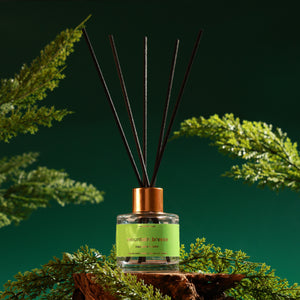
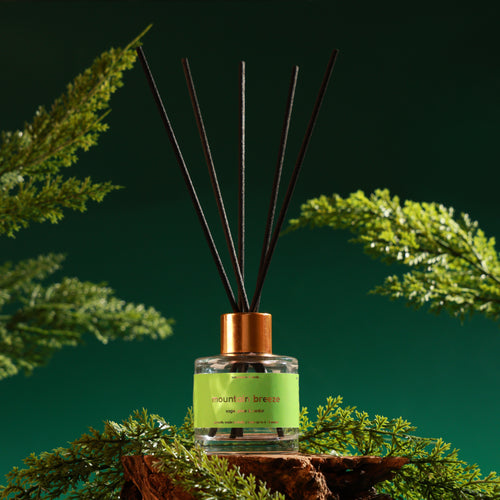
Mountain Breeze · a genuinely sealed washroom₹849Shop →  Sukoon · a retail room on its own ventilation₹1,899Shop →
  Vaayu · a larger separate retail room₹11,999Shop →
Where the three-zone rule tightens further for a roastery
Never scent the roasting area or the service floor — this is not new for a roasting café, but the reasoning is stronger here, since the service floor absorbs interference from both the roasting process and the brewing one at the same time. No exception applies even during hours the roaster itself is switched off, since residual aroma and CO2 persist beyond the active roasting window.
Sometimes, elsewhere in this cluster, a separated entrance is a fair candidate. For a roasting café, that 'sometimes' resolves to almost never — roasting exhaust and residual CO2 typically reach further than a standard entrance boundary accounts for, so treat an entrance in a roasting café as disqualified unless independently verified against the roasting-air test above. Verification means asking the person who designed the ventilation, not judging it by eye from the shopfront.
Usually a washroom or retail room is the opportunity in this cluster — for a roasting café, that 'usually' narrows to 'only if mechanically verified'. A wall or a partition isn't enough; the candidate zone needs its own independent ventilation, confirmed rather than assumed, before any fragrance decision follows. Treat every assumption about a wall as unverified until someone with the ventilation drawings has actually confirmed it.
What to buy — for the two zones that can ever qualify
Every route below assumes independent verification of a real ventilation boundary — none of it applies until that's confirmed.
| Route | Premises | Why | What it costs |
| No fragrance in the roasting area, service floor, or a typical entrance | Every roasting café, regardless of size | None of these zones pass the roasting-air, residual-CO2 or own-ventilation tests | ₹0 |
| Reed diffuser, Mountain Breeze, sealed washroom | Under 300 sq ft, ventilation independently confirmed | A clean register in air genuinely apart from roasting exhaust | ₹749–₹849 |
| Sukoon ultrasonic, separate retail room | 300–750 sq ft, own ventilation confirmed | Holds a steady level in a room with no shared air handling with the roaster | ₹1,899 |
| Vaayu, wall or ceiling-mounted, larger retail room | 750 sq ft and above, own ventilation confirmed | Zoned scheduling for a retail room large enough to need it, still fully apart from the roaster | ₹11,999 |
| Aangan, HVAC-integrated, large separate retail wing | Above roughly 3,000 sq ft, a genuinely independent air-handling zone | Distributes through ducting that has no connection to the roasting system | ₹25,999 |
Roasting cafés are the sites where I ask the most questions before I'll recommend anything, because the answer genuinely depends on the ducting, not on how the floor plan looks. I've walked into more than one that had a beautifully separated retail corner on paper, only to find it shared the same air-handling unit as the roaster once I asked. The owner was usually as surprised as I was.
That's not a criticism of the design — most architects aren't thinking about roasting exhaust when they draw a partition. But it does mean I can't take a wall's word for it, and neither should an owner. If the ventilation engineer can't confirm a zone is genuinely independent, I treat it as part of the roasting air, full stop, however convincing the wall looks from the inside.
I know 'ask your ventilation engineer before you ask me' isn't the answer people expect from a fragrance brand. It's still the honest one for this format, and it's the only way I'd want a roasting café to spend money with SOSA — on a zone that's actually earned it, rather than one that merely looks separated on a drawing I've never seen the ductwork behind.
Questions from café owners who roast on site
- When Should a Café Avoid Ambient Fragrance Completely? — the general version of the 'buy nothing' answer this page narrows further for roasteries.
- Which Areas of a Café Should Be Fragranced — and Which Shouldn't? — the general zone map this page departs from.
- Can a Café Use Professional Scenting Only in Its Washrooms and Entrance? — the same narrow-zone question for a non-roasting café.
- We're Opening a Luxury Café With a Separate Retail Area — Could the Retail Section Have a Signature Scent While the Coffee-Tasting Area Stays Neutral? — a worked example of the retail-room boundary this page depends on.
- Brand: the SOSA founder story.
SOSA products & prices (verified September 2026): Reed diffusers 50ml ₹749–₹849 (to 150 sq ft, 6–8 weeks at six reeds) · 130ml ₹1,249–₹1,349 (above 150 sq ft, 14–18 weeks) · reed refill 300ml ₹2,399. Ultrasonic: Boond ₹899 (~150 sq ft) · Sukoon ₹1,899 (270–320 sq ft, ships with three 15ml Hotel Collection fragrances) · Megh ₹3,499 (6L tank, ~100 hrs runtime, ~215 sq ft — a runtime machine, not a coverage upgrade). Waterless cold-air: Safar ₹3,999 (no published coverage figure) · Vaayu ₹11,999 (up to 1000 m³, roughly 2,000–3,000 sq ft; 400ml tank lasting about 90+ days; app and onboard control, 1h/4h/8h/24h run windows, adjustable intensity, key-lock, under 38 dB, freestanding or wall/HVAC mount, 5W, CE/RoHS/SGS) · Aangan ₹25,999 (8,000–10,000 sq ft). Hotel Collection water-based fragrance 15ml ₹299 · 100ml ₹999 · 300ml ₹1,799 is for ultrasonic machines; reed oil and Hotel Collection are not interchangeable. Reed diffusers are alcohol-free, phthalate-free, paraben-free, IFRA-compliant and low VOC, handmade in small batches in Pune. Every purchase funds a girl's education through Nanhi Kali. Prices and availability subject to change — see the live product pages.