Founder Diaries · Clinics & Medical Centres · Where Fragrance Does Not Belong
By Sonal Sahani · ISIPCA Versailles 11 min read Updated September 2026
No, and of every room in a medical centre this is the one I would argue about least. A blood-collection cubicle is a small, usually windowless, usually internal box in which people are deliberately made to feel unwell — some of them faint, many of them have been fasting since the night before, and a good proportion of them are frightened of needles and have told nobody. Whatever your view of fragrance in a lobby, that air should have nothing added to it. What that room needs is money, and the money should go to a ventilation contractor rather than to me. This page is mostly about how to spend it.
Quick answers — read this first
The answer: no. A blood- or sample-collection room stays fragrance-free. So does the recliner or recovery chair beside it and the sample-processing bench behind it.
Why this one is firm: people faint in collection rooms and a proportion of patients are fasting, needle-phobic or both. Some people also react to fragrance of any kind, and a person in a chair with a tourniquet on is not in a position to leave the room.
Spend the money here instead: a ducted extract or an openable window for the cubicle, a reliable chair the patient can lie back in, and a door that closes. Roughly ₹4,000 to ₹9,000 for an installed inline extract fan, against ₹0 that you should spend with us for that room.
The short answer
Short answer: no. A blood-collection or sample-collection room should be left fragrance-free and ventilated properly instead. People faint and feel unwell in these rooms, many patients have been fasting, and somebody in a phlebotomy chair with a tourniquet applied cannot choose to leave the room the way a person in a waiting hall can.
The pick: spend on the room rather than in it. A ducted inline extract fan or an openable window for the cubicle, a chair that reclines, a door that shuts, and a sharps and waste routine that runs to a schedule. If you want to scent anything in that department, scent the waiting seats outside with one
Vaayu at ₹11,999 on the lowest useful setting.
Shop: nothing at all for the cubicle, and we will not sell you a discreet version of it. For the pathology waiting seats, the
Vaayu ₹11,999 (waterless with no standing tank, up to 1000 m³, 400ml for about seventy-five days, app plus 1h/4h/8h/24h timers, under 38 dB, key-lock). An alcohol-free
reed diffuser from ₹749 suits the pathology manager's office. Free shipping above ₹499.
Straight answer
Should a blood-collection or sample-collection room be scented?
1. No. Nothing goes into that air, at any setting, in any scent. The collection cubicle, the recliner beside it, the sample-processing bench and the specimen fridge are all fragrance-free. This is the firmest exclusion in the whole zone map and it is not a starting position in a negotiation.
2. People faint in that room, and the staff plan for it. Any phlebotomist will tell you how many she catches in a month. That is why the chair reclines, why there is a couch nearby, and why the department has a routine for it. A room built around the expectation that some people will pass out is not a room you add anything to.
3. Most of the morning list has been fasting since the night before. A fasting-sample clinic runs from seven, and by nine the cubicle has had thirty or forty people through it who have not eaten or drunk anything for twelve hours. Several of them are also frightened of needles and have not mentioned it.
4. Some people react badly to fragrance, and that is a fact about people rather than a claim about a product. In a lobby they can move. In a collection cubicle with a tourniquet on and a needle about to go in, they cannot, and most will say nothing until afterwards.
5. The smell you are trying to cover is information. If that room smells of isopropyl, the question is how many swabs are being used and whether the waste is going out on schedule. If it smells of anything else, the question is the sharps bin, the specimen fridge or a drain trap. Find it and fix it rather than covering it, because covering it removes the signal.
6. Spend the money on air instead. An openable window, or a ducted inline extract fan interlocked with the light and running through collection hours, is roughly ₹4,000 to ₹9,000 installed and it is the single best thing you can do for that room. We will sell you nothing for it, and that is the honest answer rather than a modest one.
A portion of every order supports girl-child education through Nanhi Kali.
TL;DR: no, and this is the firmest no in the cluster. People faint and feel unwell in collection rooms, most of the morning list has been fasting since the night before, and a patient in the chair cannot leave the way a patient in a waiting hall can. Add nothing to that air. Spend roughly ₹4,000 to ₹9,000 on an extract fan or give the room a window, and scent the waiting seats outside if you want to scent anything.
The seats outside, and nothing past the cubicle door
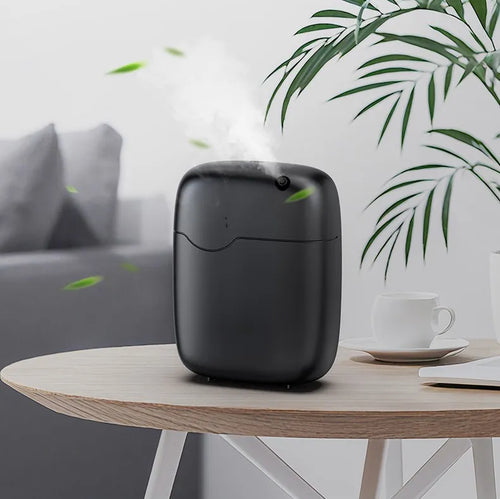
SOSA Vaayu · up to 1000 m³ ₹11,999
A pathology department is two different rooms wearing one name. The waiting seats and the sample-drop counter are public property and can be treated like any other waiting area. The collection cubicle is not, and there is no setting, no scent and no siting distance that makes it acceptable. One unit will usually hold the waiting seats, the counter and the corridor they open onto, at the lowest useful intensity, started thirty minutes before the first fasting patient arrives at seven and stopped by the timer at close. Waterless, no reservoir, up to 1000 m³, 400ml for about seventy-five days, app and onboard 1h/4h/8h/24h timers, under 38 dB, key-lock, CE, RoHS and SGS certified.
What that room actually is at half past seven in the morning
Walk into a pathology collection cubicle in a polyclinic at half past seven on a weekday and describe what you find, honestly, without the floor plan's help. It is six to eight square metres. It is internal, with no window, because windows went to the consultation rooms. It has one door, which is shut for privacy, a split air conditioner recirculating the same air, a chair, a trolley, a sharps bin, a specimen rack and usually three people in it — the phlebotomist, the patient, and a relative who has come along. By nine o'clock forty people will have passed through it, most of them fasting. That room's problem is not that it smells of nothing pleasant. Its problem is that it is small, warm, full and unventilated, and fragrance is the one thing that cannot help with any of those.
1
THE ROOM
Six square metres, no window, one door shut for privacy, and forty people before nine
Take the physical box first, because everything unpleasant about that room follows from it.
A collection cubicle is almost always the smallest room in a clinic and almost always an internal one, since the external wall is worth more to a consultation room or a manager's office. That means no openable window and, in a great many polyclinics I have walked, no mechanical extract either — just a split air conditioner on a wall, recirculating the same air and adding nothing fresh to it. Now put the morning list through it. Three people in six square metres, a door that stays shut because a patient is rolling up a sleeve, a queue outside, and forty of these encounters between seven and nine. The room gets warm, it gets close, and by mid-morning the air in it has been breathed several times over.
A room that is warm, close and airless is a room in which people who were already going to feel unsteady feel worse, and that is a ventilation fact rather than a fragrance one. This is the point at which somebody usually proposes a diffuser, and it is exactly the wrong instinct: you would be adding something to air that is already not being changed often enough. If your collection cubicle has no window and no extract, you do not have a fragrance decision to make. You have a small building-services job to schedule, and
it belongs on the list of things to fix before you spend anything on scent.
2
THE PEOPLE
Fasting, frightened of needles, and unable to leave the chair
Then the people, who are in a more exposed position in this room than anywhere else in your building.
The morning list is fasting. A lipid profile, a fasting glucose, a full panel before a health check — these all mean nothing since the night before, and the clinic that schedules them at seven is being kind, because it means people can eat afterwards. It also means the cubicle spends its busiest two hours full of people who have not eaten in twelve hours. Then the fear, which is far commoner than the number of people who admit to it. Any phlebotomist can tell you how many patients a month go pale, go quiet, or go over, and the department is built around that expectation: the chair reclines, there is a couch, and there is a protocol.
And then the group this cluster keeps returning to, because they deserve a policy rather than a case-by-case apology — the people who react badly to strong smells of any kind. That is a plain fact about people, not a claim about a product, and I would rather state it than pretend it away. In a waiting hall such a person can move seats, stand by the door, or step outside for five minutes. In a collection cubicle she is sitting down with a tourniquet on her arm, in a room with the door shut, being asked to hold still, and she is not going to interrupt the procedure to mention it. She will say nothing, and you will never learn that your building made her morning worse.
The policy for fragrance-sensitive patients starts with rooms like this one.
3
THE SMELL
Isopropyl is not a fragrance problem. It is a usage and waste-schedule reading
Which leaves the question that actually prompts most of these enquiries: the room smells of something, so what do we do about it.
The commonest smell in a collection cubicle is isopropyl from the alcohol swabs, and it is not a defect. It is a reading. A cubicle that smells sharply of spirit at eleven in the morning is telling you either that a lot of swabs have been used in a room with no air change, or that the used ones are sitting in an open bin on the trolley rather than going into a closed clinical-waste receptacle on a schedule. Both of those are answerable, and neither is answerable with fragrance. Beyond that there are three other sources worth checking before anybody says the word diffuser. A sharps or clinical-waste container being changed when it looks full rather than at a fixed point in the day. A specimen fridge with a spill in it, or with a seal that has perished, which is a thing to check at the start of monsoon rather than in August. And a hand-wash basin whose trap has dried out over a long weekend, which costs thirty seconds and a mug of water and
is the single commonest cause of a clinic that smells.
Putting a fragrance over any of those would remove the signal that told your pathology lead something had slipped, and in a department that handles specimens that signal is worth more than a pleasant room. Find it and fix it, and then leave the room alone.
The one-minute check I would run in your own collection cubicle: shut the door, stand in it for four minutes with nobody else in the room, and then step out into the corridor and back in. If the difference is obvious, the room is not being ventilated, and no product on this site is the answer to that.
The pathology department, space by space
A collection suite is not one room, and the answer is different in each part of it. Two of the seven spaces below are ordinary public property and the rest are not. The right-hand column is the useful one, because every exclusion on this page raises the same question: if not fragrance, then what.
Pathology, space by space
Where a sample-collection department can and cannot be scented
| Space |
Who is in it |
Scented? |
What it actually needs |
| Pathology waiting seats ★ |
Fasting patients waiting to be called, often from seven in the morning |
Yes, at a low level |
One Vaayu for the seats and the corridor, lowest useful setting, on the timer |
| Reception and sample-drop counter |
Patients handing in home-collected samples, staff booking tests |
Yes, as part of the same zone |
The same machine usually holds both. Nothing extra needed |
| The collection cubicle |
One patient in a chair, a phlebotomist, sometimes a relative |
No. Firmly, and at any setting |
An extract or a window, a reclining chair, a door that shuts properly |
| The recliner or recovery chair |
Patients who have gone pale, and patients after a longer draw |
No |
Space, air, a glass of water and somebody keeping an eye |
| Sample-processing bench |
Technicians spinning, aliquoting and labelling specimens |
No — this is laboratory air |
Bench extract, and a conversation with your own quality lead before anything is added |
| Specimen fridge and store |
Nobody, most of the time |
No |
Seals checked, spills cleaned, temperature logged. A smell here is a fault |
| Toilet used for urine samples |
A patient, alone, with a sample pot |
No |
A working extract fan and water down the trap. This is where most complaints actually come from |
Shop this guide
The pathology setup, in three products
The SOSA principle
A collection room is the one space in a clinic that is designed around the expectation that somebody will feel unwell in it — which is a complete answer to the question of whether to put something in its air.
The chair reclines for a reason, there is a couch for a reason, and the department has a protocol for a reason. Respect what the furniture is telling you.
What to buy instead, and roughly what it costs
Start with the extract, because it is the answer to this room and it is not expensive. What a windowless collection cubicle needs is air leaving it continuously during collection hours, ducted to outside rather than into the ceiling void, and replaced by air drawn under the door from the corridor. In practice that is a 100 to 150 millimetre inline or axial extract fan, ducted properly, interlocked with the light or on a run-on timer, and in most Indian polyclinics that is a job of roughly ₹4,000 to ₹9,000 installed depending on duct run and whether there is an external wall nearby. Ask your HVAC contractor for the design air-change rate the room was meant to have and then ask him what it actually achieves, because in a surprising number of fit-outs the cubicle was drawn as a store and became a collection room later. Two free things go with it. Leave the door undercut alone — it is the transfer-air path and blocking it for privacy or for draught is how a room ends up with an extract fan pulling against a sealed box. And if there is any openable window at all, even a small high one, use it between patients rather than keeping it shut because the air conditioner is on. If the room genuinely cannot be extracted, the honest answer is to move collection to a room that can be, and in a clinic with six consultation cabins there is usually one that is being used as an office.
Then the routine, which costs nothing and fixes most of what people wanted a diffuser for. Clinical waste and used swabs go into a closed container and out of the room at fixed points in the day rather than when somebody notices the bin is full. Sharps containers get changed at the fill line, not past it. The specimen fridge gets opened, checked and wiped on a named day of the week, and its seal gets looked at before monsoon rather than after. The hand-wash basin gets a mug of water down it on Monday morning if the department has been quiet, because a dry trap is the commonest smell in any clinic and it costs half a minute. The chair covers and the pillow under a patient's arm are laundered on a rota somebody can produce, rather than wiped and hoped for. Every one of those is free, every one of them is a housekeeping item rather than a purchase, and together they are worth more to that room than anything in our catalogue — which is why this page recommends them instead of a product rather than as well as one. Then, and only then, consider whether the department has any public space worth treating, which brings us to the part where we do sell something.
The waiting seats outside are ordinary public property, and a fasting patient at seven in the morning sitting on a metal chair for thirty-five minutes is having a worse time than she needs to. One Vaayu at ₹11,999 will usually hold the pathology waiting seats, the sample-drop counter and the corridor they open onto — waterless, so no tank of standing water sits in a department full of specimens, up to 1000 m³, a 400ml fill lasting about seventy-five days, Bluetooth app plus onboard 1h, 4h, 8h and 24h timers, under 38 dB, auto-stop and a key-lock. Mount it so the plume points along the seating and away from the cubicle doors, keep three metres of clear run from the nearest one, and set the level from inside the closed cubicle rather than from the waiting area — if the phlebotomist can name the fragrance from her chair, come down a step and check again. Run it on the actual opening hours, starting about thirty minutes before the first fasting patient arrives, and stop it with the timer rather than with a person. On the limits, stated rather than buried: the Vaayu runs its own undiluted oil and not the water-based Hotel Collection bottles; the ultrasonic Sukoon at ₹1,899 and Boond at ₹899 hold standing water and have no place in a pathology department, whatever the price difference says; an alcohol-free reed diffuser from ₹749 belongs in the pathology manager's office behind a door and not on the collection trolley; candles are not appropriate in a healthcare facility because an open flame is a fire-safety matter; and SOSA does not make a room spray, so nobody here is going to suggest a morning spritz of the cubicle. The day-care suite reaches the same answer by a different route.
The chair in that room reclines because the clinic already knows what happens in it. Take the furniture at its word and leave the air alone.
— Sonal Sahani, SOSA
The SOSA edit
In spending order for a polyclinic pathology department. The first four rows cost nothing or belong to a ventilation contractor, and only the fifth involves us at all. That is not modesty, it is the correct order of work, and a page that put the machine first would be lying to you about this room.
The SOSA edit
A sample-collection department, in spending order
| Do this |
What it is |
When it earns its place |
Cost |
| 1. Nothing in the cubicle, ever ★ |
No diffuser, no reeds, no plug-in, no spray, at any setting and in any scent, including the recliner and the processing bench |
First and permanently. This is the firmest exclusion in the zone map |
₹0 |
| 2. Get air out of that room |
A 100–150mm ducted inline extract on a run-on timer or light interlock, or an openable window used between patients |
Before anything else. A windowless cubicle with no extract is the whole problem |
₹4,000–₹9,000 |
| 3. Fix the waste and fridge routine |
Closed clinical-waste container emptied at fixed times, sharps changed at the fill line, fridge seals checked before monsoon |
Immediately, and free |
₹0 |
| 4. Water the basin trap weekly |
Thirty seconds and a mug of water, especially after a quiet weekend or a slow week |
Before you conclude anything about a room that smells |
₹0 |
| 5. Vaayu for the waiting seats outside |
Waterless with no standing tank, up to 1000 m³, app and 1h/4h/8h/24h timers, under 38 dB, key-lock, three metres clear of any cubicle door |
Last, and only for the public half of the department |
₹11,999 |
| Not for this room: anything at all |
There is no light enough scent, no low enough setting and no discreet enough machine for a collection cubicle, and we do not pretend otherwise |
We would rather lose the line than sell it |
— |
Honest notes for buyers: fragrance in a medical facility is housekeeping and presentation, never treatment. Nothing on this page claims that a fragrance reduces anxiety, aids recovery, improves sleep, cleans or disinfects air, or has any clinical effect whatsoever, because it does not and a diffuser is not an air purifier. Scenting belongs to the entrance, reception, shared waiting areas, inter-departmental corridors and administrative rooms. Consultation and examination rooms, treatment and procedure rooms, day-care surgery, dressing rooms, blood- and sample-collection rooms, laboratories, pharmacy dispensing, sterile stores, imaging rooms, oncology day-care and paediatric clinical areas should be left fragrance-free. A persistent smell is information about a dry drain trap, a bin, a soiled-linen route or an air-conditioning drain pan: find it and fix it rather than covering it. On the machines: the
Vaayu at ₹11,999 is waterless cold-air nebulisation with no standing water tank, covering up to 1000m³ or roughly 2,000–3,000 sq ft, with a 400ml tank lasting about 75 days, Bluetooth app control, 1h/4h/8h/24h timers, under-38dB running, auto-stop and a key-lock for public areas. The
Aangan at ₹25,999 covers up to 3,000m³ and connects to HVAC for a whole floor or an atrium. The ultrasonic
Sukoon,
Boond and
Megh are water-based, hold standing water and add 30–50 ml of water an hour to the air, which makes them suitable for a single administrative cabin with a named person emptying and drying the tank daily, and unsuitable for public clinical property. An alcohol-free
reed diffuser needs 24–72 hours to establish and suits a small lobby rather than a large waiting hall. Candles are not appropriate in a healthcare facility because an open flame is a fire-safety matter. SOSA does not make a room spray. The Hotel Collection scents are SOSA's own interpretations inspired by the world's finest hotels; SOSA is an independent Indian fragrance house, not affiliated with or endorsed by any hotel brand. A portion of every order supports girl-child education through Nanhi Kali.

Seven scents, and not one of them for this room
SOSA Hotel Collection · the seven from ₹299
White tea, aloe and cedar; white tea, bergamot and cedar; cedarwood, vetiver and green leaves; jasmine, green tea and white tea; citrus, soft florals and sandalwood; amber, violet and woods; citrus, pepper and amber.
The Westin-inspired White Tea Serenity is the lightest composition we make and it still does not belong in a collection cubicle, because the objection is to the room rather than to the bottle. Lightness is not a licence. What these are for is the waiting seats on the other side of the door, where a person who is about to be called in is sitting in ordinary public air. The water-based 15ml at ₹299 is for the ultrasonic machines; the
Vaayu and
Aangan run their own undiluted oil.
A note from Sonal
I lost a sale in Chennai over this room and I have told the story at every clinic meeting since. A pathology desk wanted a small machine in the collection cubicle because patients had described the room as stuffy, and I said no, and then I asked what the room's extract arrangement was. There was no extract arrangement. There was a split air conditioner and a door that stayed shut all morning. They spent about six thousand rupees on a fan and a duct, the complaints stopped, and they bought nothing from me for four months. Then they bought a machine for the waiting seats, which is where it should have gone in the first place.
What has stayed with me is a sentence from the phlebotomist. She said that she catches two or three people a month and that she can usually tell from the doorway which ones it will be, and that the only thing that has ever helped is the room being cool and the air moving. That is not a fragrance brief. It is a building-services brief, and I would rather say so plainly than sell something into a room where the honest answer is a fan. If a vendor offers you a discreet solution for a collection cubicle, what he is offering you is his own convenience.
Everything is made and supported from Pune, and a part of every order funds girl-child education through Nanhi Kali. You get a space that smells like somewhere looked after; a girl gets a classroom. That equation has always felt right to me.
Frequently asked questions
Should a blood-collection or sample-collection room be scented?
No. It stays fragrance-free, along with the recliner beside it, the sample-processing bench and the specimen store. People faint and feel unwell in collection rooms, most of the morning list has been fasting since the night before, and a patient in the chair with a tourniquet on cannot leave the way somebody in a waiting hall can.
Our collection room smells of spirit. Can we use something light to cover it?
No, and the smell is worth reading rather than covering. Sharp isopropyl at mid-morning usually means either a lot of swabs in a room with no air change, or used swabs sitting in an open bin rather than going into a closed clinical-waste container on a schedule. Fix the air and the waste routine, because covering it removes the signal.
What should we spend on that room instead of a diffuser?
Air. A 100 to 150 millimetre ducted inline extract fan on a light interlock or run-on timer is roughly ₹4,000 to ₹9,000 installed in most polyclinics, and it is the single most useful thing you can do for a windowless cubicle. Leave the door undercut clear so replacement air can get in, and use any openable window between patients.
Can we scent the pathology waiting seats if the cubicle stays clear?
Yes. The waiting seats, the sample-drop counter and the corridor are ordinary public property. One
Vaayu at ₹11,999 on the lowest useful setting will usually hold all three. Keep three metres of clear run from the nearest cubicle door and set the level from inside that closed cubicle rather than from the waiting area.
Some of our patients say strong smells affect them. Does that change the answer?
It confirms it. Some people do react to fragrance, which is a fact about people rather than a claim about a product, and the correct response is zoning rather than a different bottle. Clinical rooms stay clear, the public level stays low, and a patient who asks can have it switched off.
The decision framework sets out who in the building gets to make that call.
The room we will not sell into
Nothing in the cubicle — and about ₹6,000 on a fan instead
For the waiting seats outside, the Vaayu is ₹11,999: waterless cold-air nebulisation with no standing water tank, up to 1000 m³ or roughly 2,000 to 3,000 sq ft, a 400ml tank lasting about seventy-five days, Bluetooth app with 1h/4h/8h/24h timers, under 38 dB, auto-stop and a key-lock, supplied with four hotel-inspired fragrances. Free shipping above ₹499, and a portion of every order supports girl-child education through Nanhi Kali.
See the Vaayu · ₹11,999 The seven scents · from ₹299
Continue the read
More from SOSA
Editorial standards & sources
About this guide: Written by Sonal Sahani, ISIPCA Versailles-trained founder and perfumer at SOSA Home & Body, on why a blood- and sample-collection room inside a clinic should be left fragrance-free, what that room physically is at half past seven on a fasting-sample morning, why isopropyl and waste smells in it are information rather than a fragrance gap, and what a ducted extract fan costs against what a diffuser would cost and why only one of those two belongs in the room.
Facts verified August 2026: Product facts used in this guide. SOSA Vaayu ₹11,999: waterless cold-air nebulising diffuser, atomises undiluted fragrance oil to a dry residue-free nano-mist with no water reservoir, coverage up to 1000m³ (approximately 2,000–3,000 sq ft), 400ml refillable tank lasting up to about 75 days per fill, Bluetooth app plus onboard control, 1h/4h/8h/24h timer scheduling, adjustable intensity, under 38 dB, DC 12V/1A at 5W, 165 × 80.5 × 215 mm and 0.9 kg, freestanding or wall or HVAC mounted, auto-stop and key-lock, CE, RoHS and SGS certified, supplied with four hotel-inspired fragrances. SOSA Aangan ₹25,999: HVAC-connected or standalone commercial nebulising diffuser, coverage up to 3,000m³ (roughly 8,000–10,000 sq ft), 800ml reservoir, metal body, programmable schedules, under 42 dB. Ultrasonic machines are water-based, hold standing water and consume 30–50 ml of water an hour: Sukoon ₹1,899 (500ml, 270–320 sq ft, 16–18 hours on low, 3–6 drops per tank, steady/2H/4H timers, three 15ml Hotel Collection scents included), Boond ₹899 (300ml), Megh ₹3,499 (6 litres). Hotel Collection water-based fragrance 15ml ₹299, 100ml ₹999, 300ml ₹1,799, Pack of 7 at 15ml ₹1,799 against ₹2,093 bought singly; the Vaayu and Aangan take their own undiluted oil rather than these water-based bottles. Alcohol-free reed diffusers from ₹749, requiring 24–72 hours to reach their working level. Free shipping above ₹499. Coverage arithmetic: cubic metres equal floor area in square feet divided by 10.76 and multiplied by ceiling height in metres, counting only the volumes that are actually scented. This guide makes no medical, therapeutic or clinical claim of any kind for fragrance: a diffuser does not purify, disinfect or clean air, and does not treat, calm or affect any patient or condition. Fragrance is housekeeping and presentation. Clinical areas should be left fragrance-free, and a persistent odour should be traced to its source and corrected rather than covered. SOSA is not affiliated with or endorsed by any hotel brand. Prices subject to change — see the live product pages.