
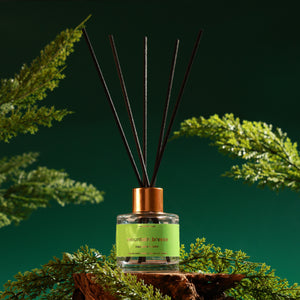
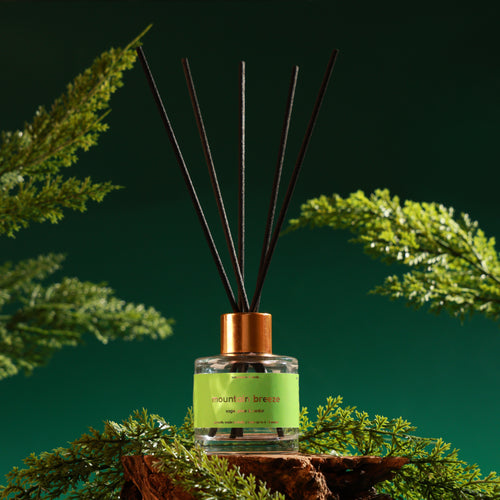
 Mountain Breeze ₹849
 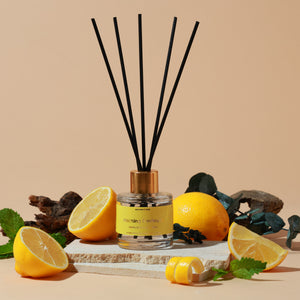 Morning Freshness ₹749
 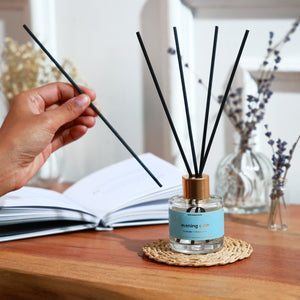 Evening Calm ₹799
  Reed oil refill 300ml ₹2,399
  Sukoon ₹1,899
The falloff is normal, not a defect. Present at the counter, faint at three or four metres, absent across a large waiting bank. That is the shape of passive diffusion in a real room with real air movement.
In a clinic, a bounded zone is the right answer. The arrival point reads considered while the corridor to consultation reads of nothing. Chasing a whole-floor result is chasing the outcome this cluster exists to prevent.
If you truly need a larger volume held, the answer is not a fourth bottle. Past roughly 250–300 sq ft of connected open space, a Sukoon ₹1,899 covering 270–320 sq ft is the honest next step.
2. What that produces is a zone, not a floor. Clearly present within a metre or two of the bottle, detectable at three or four metres in still air, and effectively absent beyond that in a room with any traffic. A large waiting bank is simply outside it.
3. A larger bottle does not reach further. This is the most common expensive mistake in the category. A 50ml lasts 6–8 weeks and a 130ml lasts 14–18, and at the same six reeds they project identically. Size buys duration, never reach.
4. Reed count is the only genuine volume control, and it trades against bottle life. Six is the calibrated position; nine reeds gives roughly five weeks instead of eight on a 50ml, ten gives four to five. It raises output modestly — it does not convert a zone into a floor — and in a clinic the correct move is usually the opposite direction.
5. Two free checks come before any purchase. Lift one reed and find the wet line: dark and high means saturated and stalled, so flip all six with gloves; barely above the oil means the reeds are not wicking and need refreshing. Then check for draught — a bottle under an AC supply, beside an open door or in direct sun is stripped fast, reads weak in the room and empties weeks early.
6. Your own nose is the least reliable instrument in the building. Olfactory adaptation means a constant becomes unreportable within minutes, and it bites hardest where you spend most time. Ask a colleague who has been outside for fifteen minutes to come in through the patient door and say one sentence before anyone speaks to them.
7. In an eye clinic, the bounded zone is the outcome you want. The arrival point reads considered, the seats read of very little, and the corridor to consultation reads of nothing. Reeds are silent, need no power, add no humidity and cannot be turned up by anybody — which is a genuinely good set of properties in a medical waiting room.
8. If you truly need a larger volume held, stop buying bottles. Three sources make three zones and a fourth makes four. Past roughly 250–300 sq ft of connected open space the honest step is one machine: a Sukoon ₹1,899 for 270–320 sq ft, or above about 320 sq ft on one air path a Vaayu ₹11,999 — freestanding in reception, never in shared HVAC, and confirm current refill availability with SOSA before committing. Composed and made in small batches in Pune; a portion of every order supports girl-child education through Nanhi Kali.
Part one — what a reed actually does, and where it stops
Three facts explain every version of this complaint, and none of them is about quality. The output is fixed, the distribution is done by the room, and the only real control is the number of reeds — which trades directly against how long the bottle lasts.
 Reed oil refill₹2,399 / 300ml · oil onlyWhatever leaves the reeds is then moved — or not moved — by the room, and both extremes fail in ways that look identical from a distance. In dead air, the fragrance pools around the bottle: lean over it and it is obviously working, stand three metres away and there is nothing. In a draught, the reeds are stripped continuously, so the room still reads thin while the bottle empties weeks ahead of schedule. The second is far commoner in clinics than people expect, because reception counters are exactly where the AC supply, the entrance door and the ceiling fan all converge. I have seen 50ml bottles finish in under four weeks at six reeds, in reception areas nobody described as draughty, purely from a supply grille two feet above them. The correct condition is in between and rather undramatic: gentle incidental traffic, near a doorway but not in the door, waist to chest height, clear space around the bottle, out of direct sunlight, and not under a grille. The clinic-specific instruction is the extra one. Set it well back from the corridor to consultation and away from any return grille, because a return will take your zone and deliver it somewhere you have spent this entire cluster protecting. If moving the bottle two metres changes what the room reads at four in the afternoon, that was your answer and it cost nothing.
Part two — what you expected against what the mechanism delivers
Almost every reed complaint is a collision between the product's design and an expectation borrowed from a different category. Here they are side by side, with the honest cost of closing each gap — and in three rows the answer is that it cannot be closed at all.
| What you expected | What passive capillary diffusion delivers | Why | What would actually change it, and the cost |
|---|---|---|---|
| Noticeable across the whole waiting area ★ | A zone around the bottle, falling away past two or three metres | Fixed output, no fan, no pressure — the room does the moving | A machine. Sukoon ₹1,899 for 270–320 sq ft |
| A bigger bottle to cover more ground | Identical projection, longer life: 14–18 weeks against 6–8 | Volume is a reservoir; reed surface sets the rate | Nothing. This gap cannot be closed with bottle size |
| A stronger scent to push further | A denser zone of the same size | Composition changes character, not distribution | Nothing useful — and in a clinic it is the wrong direction |
| More reeds for more coverage | More output, same zone, shorter bottle life | Nine reeds ≈ 5 weeks on a 50ml instead of 8 | Free, reversible, modest — and rarely right in a clinic |
| A second bottle to extend the reach | A second zone, plus an overlap between them | Sources add where they meet; they do not join up | ₹749–₹1,349, and it makes the floor less even, not more |
| Consistent strength week to week | A days 1–3 spike, a 1–2 week settle, then a long plateau | Dry reeds and departing top notes at the start | Nothing — the plateau is the product, not the decline |
| It to be noticeable to you, all day | Unreportable to you within minutes | Olfactory adaptation, strongest where you spend most time | A colleague, in from outside, one sentence. Free |
| Fragrance in the corridor and consultation rooms too | Nothing there, deliberately | The clinical pathway stays fragrance-free | Not available at any price, and not a gap to close |
| The honest caveat: bottle-life figures are for six reeds in ordinary conditions and vary with temperature, humidity, air movement and how often the reeds are flipped; no bottle-life figure is published below six reeds, and replacement reeds are not sold separately. Strength positions are on SOSA's own internal scale at six reeds, not an industry standard, a concentration or a quality ranking. Nothing on this page is medical, clinical, ventilation, air-handling, infection-control, accreditation or regulatory advice — those belong to your own clinicians and licensed contractors. No SOSA product or setting is described as safe or unsafe for any patient or staff group, and no claim is made about how any person perceives or responds to fragrance beyond the plain fact that some people are sensitive to it, which is why the clinical pathway stays fragrance-free and why a fragrance-free seat must genuinely exist somewhere a patient would ordinarily sit. Fragrance adds a scent alongside what is already in the air; it removes, neutralises, masks or purifies nothing. | |||
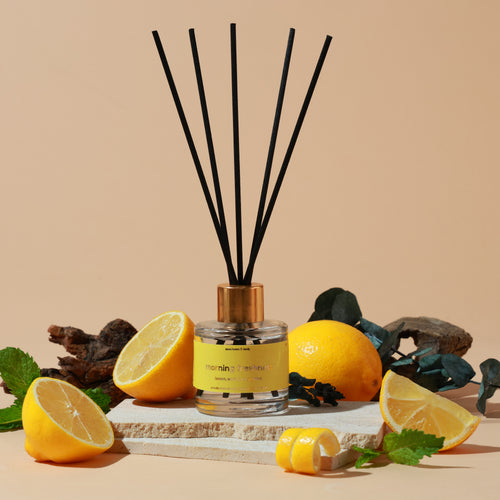 Morning Freshness · bright, dry, two of six reeds₹749Shop →
  Oil refill · 300ml, reuse your own vessel₹2,399Shop →
  Sukoon · 270–320 sq ft, scheduled₹1,899Shop →
Part three — why a bounded zone is the right shape in a clinic
Turn the complaint over and look at what it actually reports. Fragrance is present at the point where a patient arrives, hands over a file and speaks to somebody, and it is absent everywhere else — including the corridor that leads to your consultation cabins. If you had written a specification for scenting an eye practice from first principles, that is close to what you would have asked for. The arrival moment is where an impression is formed and where a small amount of considered ambience does its work; the seats, where somebody may sit for forty minutes with dilated pupils, receive very little; and the clinical pathway receives nothing, which is the boundary the entire subject rests on. A reed diffuser cannot violate that boundary even by accident, because it has no capacity to project and no setting to raise. It is silent, which matters more in an eye clinic than in almost any other commercial building, since patients wait a long time with little to occupy them and a machine they can hear is an irritation with nothing on the other side of the ledger. It uses no power. It adds no humidity, unlike every ultrasonic machine. And nobody on your staff can turn it up on a slow afternoon, which removes the single most common cause of drift in scented buildings.
There is a version of this where the bounded zone is genuinely not enough, and it deserves a fair hearing. If your arrival zone is a large open reception — say 300 sq ft or more of connected floor with a bank of twenty chairs — and the practice wants the whole of it to read the same, no arrangement of bottles will deliver that. Three sources make three zones and three overlaps; a fourth makes four. What you would be buying is unevenness at increasing cost, and I would rather you did not. At that point the honest ladder is short. Past roughly 250–300 sq ft of connected open volume, one Sukoon at ₹1,899 covering 270–320 sq ft replaces the bottles entirely and adds something they cannot offer — a schedule, so the room can be unscented during the cleaning shift and overnight. Past about 320 sq ft on one unbroken air path, a Vaayu at ₹11,999 earns its price for the specifications a clinic actually needs: under 38 dB, a key-lock so the level cannot drift upward, and 1h/4h/8h/24h run windows with day selection. Freestanding in reception, away from the corridor to consultation — never ducted into shared HVAC, which is precisely how fragrance reaches the clinical pathway. And before committing to a Vaayu, confirm current refill availability with SOSA: there is no separate cold-air refill oil on sale at the time of writing, the 400ml supplied lasts roughly 90+ days, and the water-based Hotel Collection is not a substitute.
The outcome I would push hardest for, though, is the one that costs nothing. Before you conclude the zone is too small, find out what your building actually reads like to somebody who has not been in it — because you cannot, and neither can your staff. Olfactory adaptation removes a constant from conscious awareness within minutes and it adapts hardest in the place you spend most of your day. So the measurement is a colleague who steps outside for fifteen minutes and comes back in through the patient door at four in the afternoon, writing one sentence before speaking to anybody: what did you notice, in order. Do it three times in a fortnight. In a fair number of practices the sentence comes back saying the entrance reads clean and pleasant and nothing else stood out — which is exactly the result you were trying to buy, arrived at by a bottle you had decided was failing. If instead the sentence says the room reads of nothing at all, you have a real gap and the ladder above tells you what it costs to close. Either way you will have spent an afternoon rather than eleven thousand rupees to find out.
Part four — the two free checks, then the decision
Run these in order before spending anything. The first four rows cost nothing and resolve most cases; only the last two involve a purchase, and one of those is a purchase I would talk you out of.
| What you observe | The wet-line reading | Likely cause | What to do | Cost |
|---|---|---|---|---|
| Strong at the counter, nothing at four metres ★ | Normal — a clear line partway up the reed | Nothing is wrong. This is the mechanism | Decide whether a zone is what you want; if yes, stop here | Zero |
| Faint everywhere, including at the bottle | High and dark, reeds heavy | Saturated and stalled | Flip all six reeds with gloves; recheck in 48 hours | Zero |
| Faint everywhere, bottle still fairly full | Barely above the oil line | Reeds no longer wicking | Refresh the reeds — they are the consumable, not the oil | Zero to replace from a spare bottle |
| Weak room but the bottle is emptying fast | Normal, but the oil level drops weekly | Draught — AC supply, doorway or direct sun | Move it two metres, off the airflow, out of the sun | Zero |
| Staff say it stopped; a visitor says it is fine | Normal | Olfactory adaptation, not the product | Use a cold-nose check at four p.m., three times a fortnight | Zero — and never raise the level on your own nose |
| Everything correct, but the open reception is genuinely large | Normal | Past the honest ceiling for reeds, around 250–300 sq ft | Sukoon ₹1,899, 270–320 sq ft, with 2H / 4H windows | ₹1,899, and it adds humidity |
| One connected public path above ~320 sq ft | Normal | A machine problem, not a bottle problem | Vaayu ₹11,999 freestanding — never HVAC-mounted | ₹11,999; confirm refill supply first |
| Tempted by a third or fourth bottle | Normal | Each source adds a zone and an overlap | Do not. Buy one machine instead of a fourth bottle | Saves ₹749–₹1,349 and a season of unevenness |
Versailles
An optometrist wrote to me convinced she had been sent a weak batch. Her bottle was obvious at the counter and, in her words, "does nothing" in the seating area eight metres away. She had already ordered a second one and was asking which stronger composition to switch to.
I asked her to do one thing before opening the second box: send somebody outside for fifteen minutes and have them walk back in through the patient door at four in the afternoon and write one sentence. The sentence came back as, roughly, that the entrance smelled clean and quietly pleasant and that nothing else was noticeable. She had been diagnosing her building with her own nose, which had adapted to a constant within minutes of arriving each morning, and the second bottle would have produced a second zone and an overlap rather than the even floor she was imagining.
What I want practices to take from that exchange is the reframing rather than the saving. In a home, "it only works near the bottle" is a limitation you might reasonably want to design around. In an eye clinic it is the specification — because the far end of the building is where your consultation cabins are, and everything in this cluster exists to keep fragrance out of them. When somebody tells me their reed is noticeable only at reception, my honest first reaction is that their installation is behaving. Composed and made in small batches in Pune, and a part of every order funds a girl's classroom through Nanhi Kali.
Frequently asked questions
- Why three reed diffusers still are not enough — where the bottles stop.
- One machine or several zones and the 1,500 sq ft centre.
- A 300–400 sq ft clinic and a 500 sq ft practice.
- When a clinic genuinely needs a Vaayu — the pillar for this whole family.
- Brand: the SOSA founder story.
SOSA range, specifications and prices used in this guide (verified August 2026): Vaayu ₹11,999 — waterless cold-air nebulisation of undiluted fragrance oil; no water, no heat, no added humidity, no white mineral dust. Coverage up to 1000 m³, about 2,000–3,000 sq ft. 400ml refillable tank lasting roughly 90+ days at a mid setting. Bluetooth app plus onboard controls, 1h / 4h / 8h / 24h run windows, day selection, adjustable intensity, auto-stop and key-lock. Under 38 dB. DC 12V / 1A, 5W. Freestanding or wall / HVAC mount. CE, RoHS and SGS certified. SOSA does not currently sell a separate Vaayu cold-air refill oil; the 400ml supplied in the box is the fragrance available at the time of writing, so a practice planning continuous or multi-site use should confirm current refill availability with SOSA before committing. The water-based Hotel Collection is made for ultrasonic machines and must not be used in a Vaayu. Other machines: Boond 300ml ₹899 (~150 sq ft, ultrasonic) · Sukoon 500ml ₹1,899 (270–320 sq ft, 16–18 hours on low, remote and steady/2H/4H timers, three 15ml fragrances included, ultrasonic) · Megh 6L ₹3,499 (~215 sq ft — a runtime and humidity machine that covers less than a Sukoon, never a coverage upgrade) · Safar ₹3,999 (waterless cold diffusion, cordless, 20ml, about 6.9cm, three speeds, 1/2/3-hour auto-off — sold as a car and travel diffuser, personal-scale only; SOSA publishes no coverage figure for it) · Aangan ₹25,999 (HVAC nebulising, ~8,000–10,000 sq ft) · Meenar ₹38,500 (commercial HVAC, 12,000–18,000 sq ft). Water-based Hotel Collection for ultrasonic machines: 15ml ₹299 · 100ml ₹999 · 300ml ₹1,799 · pack of seven ₹1,799; scents are inspired by the atmosphere of well-known hotels — SOSA is an independent Indian brand and is not affiliated with, endorsed by or supplying any hotel group. Reed diffusers ₹749–₹1,349 (50ml 6–8 weeks, 130ml 14–18 weeks, six fibre reeds, no 100ml size; replacement reeds are not sold separately). Reed oil cannot be used in an ultrasonic machine and Hotel Collection oil cannot be used in reeds. SOSA sells no room spray or home spray — every SOSA spray is a car perfume. Nothing in this guide is medical, clinical or safety advice. A fragrance diffuser adds a scent to the air. It does not clean, purify, filter, sanitise or disinfect air, does not remove or neutralise disinfectant, damp or occupancy smells, and has no effect on comfort, anxiety, waiting time, recovery or any clinical outcome. Some people are sensitive to airborne fragrance, which is why this guide recommends that examination rooms, diagnostic areas, consultation cabins, procedure suites and post-operative areas remain fragrance-free, that a fragrance-free seating option always exist, and that a diffuser is never mounted into shared HVAC in a clinical building. Decisions about clinical policy, ventilation standards, infection control and patient suitability rest entirely with the practice and its clinicians. A persistent stale, damp or disinfectant smell is a ventilation, moisture or cleaning problem — SOSA sells no dehumidifier and no air purifier, and fragrance should never be used to cover one. Coverage, runtime and longevity figures are manufacturer specifications and typical ranges, not guarantees, and vary with room volume, ceiling height, air exchange, occupancy and season. SOSA publishes no commercial or bulk pricing, no corporate account, no annual maintenance contract, no installation service, no stated warranty term and no multi-location programme; warranty length, spare parts, servicing and app platform availability are unconfirmed, and larger or multi-site enquiries should go through the contact page before any commitment. Composed and made in small batches in Pune, India. Free shipping above ₹499. A portion of every order supports girl-child education through Nanhi Kali. Prices subject to change — see the live product pages.