


Fix placement before you buy anything: move the bottle to the far side of the room from the door, off the line between the balcony and any other opening, at or slightly below nose height.
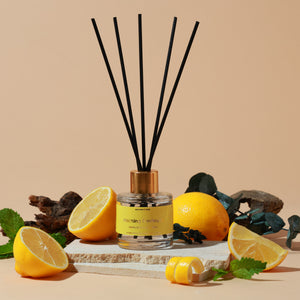
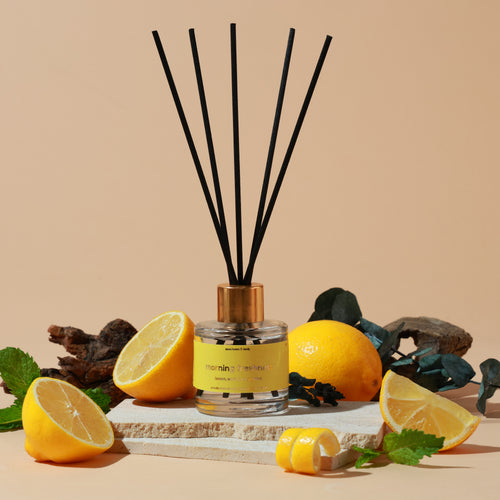
Then buy for the hours the door is shut: Morning Freshness 130ml at ₹1,249 for a living room above 150 sq ft, or Sukoon at ₹1,899 if the room is genuinely only used after the door closes.
The honest bit: if the balcony door is open every waking hour and you want ambient fragrance during those hours, nothing on our shelf will give it to you. A home with the doors open all day is not a home fragrance environment during those hours. It becomes one the moment they close.
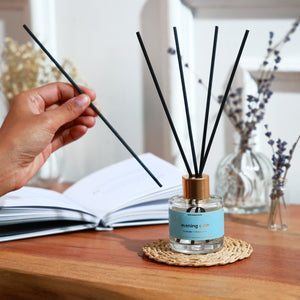
2. Move the bottle before you buy a second one. The single most expensive placement in an Indian flat is a diffuser on or near the balcony threshold, because it sits in the fastest-moving air in the house. Put it on the far side of the room, off the straight line between the balcony door and whatever else is open, out of direct sun, at or slightly below nose height. That change costs nothing and is worth more than an extra bottle.
3. Decide which hours you are actually buying. If the door shuts at seven and the room is yours until midnight, you have a five-hour fragrance environment and it is a good one. If the door is open until you go to bed and the living room is empty after that, you are buying nothing. Being honest about this is the whole of the decision.
4. Size to the room, then use the reeds as the dial. A 50ml at ₹749 to ₹849 suits up to about 150 sq ft; a living room with a balcony is usually larger, which puts it in 130ml territory at ₹1,249 to ₹1,349 and 14–18 weeks. Six reeds is full projection, three is a soft level and roughly doubles how long the bottle lasts. In an airy room you will want six for the closed hours — and you may well want three during the open ones.
5. If the door genuinely never closes while you are home, buy the bathroom bottle instead. A small, enclosed, low-exchange room is where a reed diffuser gives the most fragrance for the least oil, and two or three reeds in a 50 sq ft bathroom can make a 50ml run close to three months. That is a better use of ₹749 than fighting a balcony.
Alcohol-free, phthalate-free, IFRA-compliant, composed in Pune. A portion of every order supports girl-child education through Nanhi Kali.
Why a balcony door is not simply a big window
People reason about openings as though they were all the same thing in different sizes, and for most purposes that is fine. For fragrance it is not, because the three things that decide how much scent stays in a room are the size of the opening, whether there is a second opening for the air to travel towards, and how long the arrangement lasts. A balcony door changes all three at once. That is why the same bottle that seems perfectly good in the bedroom seems to have stopped working in the living room, and why moving it around the living room helps more than most people expect.
 Morning Freshness₹749An open window in a masonry wall is a modest hole in a large surface, and air moves through it in a fairly local way — the corner of the room near the window changes, the far corner takes much longer. A balcony door in a modern flat is often floor to ceiling and takes up a substantial share of one wall. When it is open, the room does not have a ventilated corner; it has an open side. The consequence for fragrance is direct and unglamorous: whatever the reeds have released into the room over the past hour is standing in air that is on its way outside. This is not a fault, an ageing bottle or a bad batch. It is the same physics that makes the room pleasant to sit in.
 Mountain Breeze₹849A single opening moves far less air than two openings on different sides of a room, because air needs somewhere to go as well as somewhere to come from. A balcony door plus a kitchen window, a bedroom window or the main door on the latch turns the living room into a short length of corridor, and anything sitting in that corridor is being scrubbed continuously. This is the part readers can act on. You cannot make the door smaller, but you can decide which square metre of the room the bottle occupies, and the difference between the middle of that path and a sheltered corner off it is very large. Mountain Breeze at 9.4, the deepest woody in the range, holds its own in an airy room better than the softer compositions do, and I would choose it over a delicate floral here.
 Evening Calm₹799The airflow is real, and so is the second thing happening, which is that you live here. Receptors adapt to a steady, unchanging smell within minutes; the signal keeps arriving and the brain stops reporting it because nothing about it has changed. This is why you notice other people's homes and never your own. In a room with a balcony door, the two effects compound in a confusing way — the concentration genuinely drops during the open hours, and then when the door closes and the level climbs again, you are the one person in the house least able to tell. The test is not to sniff harder. Leave the flat for fifteen minutes and walk back in, or ask the next person who visits. A visitor is a better instrument than you are.
Where the bottle should actually stand in a living room with a balcony
Placement in an airy room is worth more than an upgrade, and it is the part of this that is free. Put the diffuser on the far side of the room from the balcony door — the wall behind the sofa, a side table, a shelf in the corner that the air reaches last rather than first. Keep it off the direct line between the balcony and any other opening, because that line is where the air is moving quickest. Keep it out of direct sun, which will heat the oil and accelerate evaporation for no return. Keep it at or slightly below nose height when you are seated, since that is where you will actually meet it. And keep it away from any flame — fragrance oil is flammable, so a diya, an agarbatti or a lit candle should never share a surface with a diffuser, and in a room with a breeze that caution matters more, not less.
The instinct that gets this wrong is a good one badly applied: people put the bottle near the balcony because that is where the room feels alive, and because they imagine the incoming breeze will carry the fragrance inward. Sometimes it does, for a few minutes a day when the pressure happens to run that way. The rest of the time it is doing the opposite, and doing it efficiently. A reed diffuser has no reservoir it holds back — every millilitre eventually leaves the bottle through the reeds — so the only real waste in this product category is oil evaporating into a room nobody is in, or straight out of a door. Placement is how you avoid the second. Occupancy is how you avoid the first.
One more practical note, because it comes up constantly with balconies. If the room is used by everybody all day and the door is open all day, the correct answer may be that the living room is not where your ₹749 should go at all. Fragrance the space people occupy in the hours it is closed, not the space that happens to be biggest. A bedroom that shuts at ten, or a bathroom that is enclosed by definition, will give you far more perceived fragrance per rupee than the airiest room in the flat ever will. There is no cleverness in this, only arithmetic.
| Arrangement | What happens to the room's air | What you will notice | What to do |
|---|---|---|---|
| Balcony door open, plus another opening | The room sits in a path; air moves through continuously | Almost nothing, at any dose | Do not chase it. Place off the path and wait for the closed hours |
| Balcony door open, everything else shut | Bulk exchange at one very large opening | Faint, and only close to the bottle | Bottle on the far wall; three reeds is enough for now |
| Balcony door on a narrow gap | Much reduced, though still the largest opening in the room | Noticeable on arrival, fades as you sit | Six reeds, and judge it when you walk in rather than from the sofa |
| Door closed, room occupied | Low exchange; the room holds what it is given | This is the fragrance you paid for | Six reeds, 130ml if the room is above 150 sq ft |
| Door closed, room empty | Low exchange, nobody there | Nothing, by definition | The one case where three reeds saves real money |
Bright · Morning Freshness 130ml₹1,249Shop → 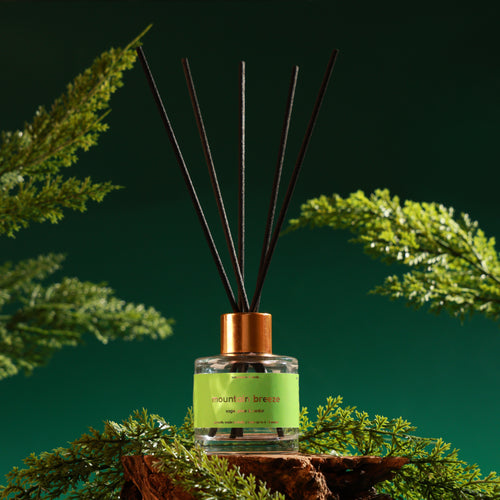 Deepest woody · Mountain Breeze₹849Shop →
  Controllable · Sukoon₹1,899Shop →
Buying for the hours the door is closed
This is the part of the conversation I would rather have early than late. A living room with the balcony door open most of the day is not a home fragrance environment during those hours, and it becomes one the moment the door closes. That sentence is not a disclaimer, it is the buying instruction. Work out honestly when the door is shut and you are in the room — for most households that is the evening, and often only two or three hours of it. Then buy for those hours, and stop expecting the product to perform outside them.
Once you have that number, the reed-versus-machine question answers itself in a way it cannot in the abstract. A reed diffuser is continuous and has no off switch: it runs while the door is open, while you are out, and while everybody is asleep. That is a real limitation and it is exactly the limitation this room exposes. Against it, a reed asks nothing of you — no power, no water, no filling, no switch, nothing beyond flipping the reeds every three to five days — and it costs roughly ₹13 to ₹15 a day for a 50ml. Sukoon at ₹1,899 solves the timing problem instead: a 500ml tank, 270–320 sq ft of coverage, 16–18 hours on low, and the ability to run only in the hours that matter. It also fills a room quickly, which is why it wins when people are arriving. What it does not do is defeat an open door. A machine misting into a room with the balcony open wastes water and oil the same way a reed wastes oil — the advantage is control, not immunity. There is a whole page on that trade in this family and it is worth reading before you spend ₹1,899.
One thing not to do: do not read the price list upward hoping for more coverage. Our own range is easy to misread here. The Sukoon at ₹1,899 covers 270–320 sq ft; the Megh at ₹3,499 has a six-litre tank and around a hundred hours of runtime but only about 215 sq ft of coverage, which is less. Megh is a runtime and humidity machine, and buying it for a large airy living room is the wrong purchase. I would rather say so on our own page than have you find out at home.
What to buy for a living room with a balcony door — and what not to
In the order I would actually spend the money, assuming the room is above 150 sq ft and the door closes at some point in the evening. If it never closes while anybody is home, skip straight to the last row, which is the honest one.
| Buy | What it is | When it is the right answer | Price |
|---|---|---|---|
| 1. Morning Freshness 130ml ★ | Malabar lemon, peppermint, eucalyptus — bright, 9.0, 14–18 weeks | The default for a living room above 150 sq ft with evening closed hours | ₹1,249 |
| 2. Mountain Breeze 130ml | Himalayan pine, sage, Indian cedar — 9.4, the deepest woody we make | If you want more presence in an airy room than a light floral will give | ₹1,349 |
| 3. Sukoon | 500ml tank, 270–320 sq ft, 16–18h on low, three 15ml scents included | If the room is used strictly in the closed hours and you want an off switch | ₹1,899 |
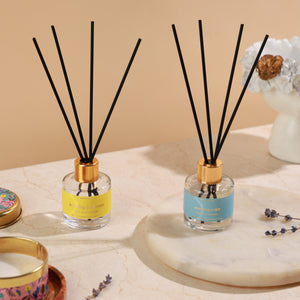
| 4. Evening Calm 50ml | Kashmir lavender and chamomile, 8.9 — the softest thing we make | For the bedroom or bathroom instead, which is often the better ₹799 | ₹799 |
| The honest gap: nothing scents an open room | No reed, no machine and no size in this range holds fragrance in a living room whose balcony door is open all the hours you are in it. Megh at ₹3,499 is not the fix either — around 215 sq ft, less coverage than the Sukoon | If that is your flat, buy the bathroom or bedroom bottle and keep the living room free | ₹0 |
Versailles
The balcony question arrives at our inbox more often than almost any other, and it nearly always arrives with an apology in it — the reader assumes they have done something wrong, or bought the wrong thing. They have not. They have bought a product that works on the air in a room, and then given the air somewhere better to be.
What I would like people to take from this page is that the fix is a decision about hours rather than a decision about scent. I have watched households spend a second ₹1,349 trying to overpower a door that is two metres wide, and I have watched the same households solve it completely by moving the bottle to the far wall and buying a small one for the bedroom. The second solution is cheaper and it works, and the only reason it feels unsatisfying is that it involves admitting the afternoon is not ours.
The other thing worth saying is about your own nose. In an airy flat you will be the last person to know whether the diffuser is working, because you are adapted to your home and because the level in the room genuinely rises and falls through the day. Do not judge it from the sofa. Judge it as you come in through the door, and believe your guests over yourself. Everything we make is composed in Pune, and a part of every order funds a girl's classroom through Nanhi Kali.
Frequently asked questions
- Windows open all day — is a reed diffuser a waste of money? — the honest answer, given first.
- Why can't I smell it with the bedroom window open? — air exchange and adaptation, separated.
- I won't close my windows for fragrance — the rooms and hours that are already closed.
- Excellent cross-ventilation and near or away from the window — the two placement pages.
- Is Sukoon better for a ventilated flat? — a qualified yes, with the qualification stated.
- Without wasting oil and should I use more reeds? — the dose pages.
- A high floor with constant breeze — the whole method in one page.
- Brand: the SOSA founder story.
SOSA facts verified August 2026: Five reed scents, all alcohol-free, on a heat-stable CCT (caprylic/capric triglyceride) carrier, phthalate-free, paraben-free, IFRA-compliant, 0 ppm formaldehyde, six fibre reeds in a refillable glass bottle, composed in Pune, India. Morning Freshness 50ml ₹749 · 130ml ₹1,249 · 9.0. Evening Calm 50ml ₹799 · 130ml ₹1,299 · 8.9, the softest in the range. Garden Bloom 50ml ₹799 · 130ml ₹1,299 · 8.9. Mountain Breeze 50ml ₹849 · 130ml ₹1,349 · 9.4. Fresh Brew 50ml ₹849 · 130ml ₹1,349 · 9.5, the deepest. 50ml suits rooms up to about 150 sq ft and lasts 6–8 weeks; 130ml suits rooms above that and lasts 14–18 weeks. Six reeds give full projection, three give a soft level and roughly double the life. Cost per day approximately ₹13–₹15 on a 50ml. Refills 300ml ₹2,399 · 500ml ₹3,499, oil only and not a first purchase. Machines: Boond ₹899 (300ml, up to about 150 sq ft, around 6 hours), Sukoon ₹1,899 (500ml, 270–320 sq ft, 16–18 hours on low, three 15ml scents included), Megh ₹3,499 (six-litre tank, around 100 hours of runtime, about 215 sq ft — a runtime and humidity machine, never a coverage upgrade). Reed oil and the water-based Hotel Collection are not interchangeable in either direction and there is no hotel-inspired reed diffuser. SOSA sells no room spray, air purifier, dehumidifier or odour eliminator; every SOSA spray is a car perfume. Free shipping above ₹499. A portion of every order supports girl-child education through Nanhi Kali. SOSA is an independent Indian fragrance house and is not affiliated with or endorsed by any hotel brand. Prices subject to change — see the live product pages.