



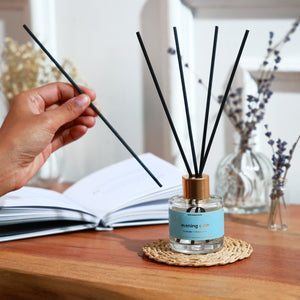
Step two: come back and take three readings — nose about a hand’s width above the reeds, then standing one metre away, then standing in the doorway with the door closed behind you.
How to read it: strong / present / faint is a normal, healthy passive diffuser doing exactly what a reed does. Strong / faint / nothing is a transport problem — the oil is fine and nothing is moving the air. Weak at the bottle too is the only result that points at the liquid, and even then the usual cause is a bottle in a room far larger than its specification rather than a bad batch.
The fourth reading, and the most reliable one: ask somebody who does not live in your house what they notice from the doorway. They are a better instrument than you are, for free.
The honest gap: if the verdict is transport, the range’s answers are Sukoon ₹1,899 at 270–320 sq ft with the oil diluted in water, or Safar ₹3,999, which is named and sold as a car and travel diffuser and has no published room coverage. Between Safar and the 2,000–3,000 sq ft Vaayu at ₹11,999 there is no mid-sized waterless bedroom nebuliser.
2. Reading one, at the bottle. Come back and put your nose about a hand’s width above the reeds. Is it clear, full and recognisably the fragrance you bought? If yes, the oil is not weak. That single observation eliminates a bad batch, a degraded bottle and a composition that was never strong enough. Note whether it smells right as well as strong — flat, sour or oddly sharp is a different signal from simply quiet.
3. Reading two, at one metre. Stand a normal pace away, at head height, and breathe normally rather than sniffing hard. You are looking for “present but softer”. If there is a cliff between the bottle and one metre, the room is not carrying anything and the gradient is very steep.
4. Reading three, at the door, with the door closed. Stand in the doorway of the closed room. This is the reading that answers your actual question, because it is the reading a guest takes. Anything at all here means the room is scented. Nothing here, with a strong reading at the bottle, is a transport failure and nothing else.
5. Then take the fourth reading, which is not yours. Ask somebody who has just come in from outside what they notice. Sensitivity to individual materials varies enormously between people, and you are adapted on top of that. A meaningful share of readers convinced their diffuser has failed have homes that are perfectly obvious to every visitor.
Alcohol-free, phthalate-free, IFRA-compliant, 0 ppm formaldehyde. Free shipping above ₹499, and a portion of every order supports girl-child education through Nanhi Kali.
The three readings, and exactly what each one is measuring
Each reading isolates a different variable, which is why taking all three is worth four minutes and taking only one is worth nothing. Read them in order and write down a single word for each — strong, present, faint or nothing. Four words on the back of an envelope will tell you more about your situation than any amount of browsing.
 Fresh Brew₹849Nose a hand’s width above the reeds, one normal breath. You are asking two questions: is it full, and is it correct. Full but different from week one is usually not a fault at all — the first days of any reed run hot while the sticks saturate and the lightest, most volatile materials leave first, so week three is the heavier heart and base doing the work. That is the composition settling into what it was designed to be, and flipping the reeds restores the lift without opening a new bottle. Thin at the bottle, on the other hand, is the one result that genuinely implicates the liquid — and before assuming a bad batch, check the sizing, because a 50ml is specified for up to about 150 sq ft and a 130ml above that, and an under-specified bottle reads weak while performing exactly as intended.
 Evening Calm₹799Stand one normal pace back, at head height, and breathe rather than sniff — sniffing hard recruits a different sampling behaviour and flatters the result. A healthy passive diffuser gives you present but softer here. A cliff between the bottle and one metre tells you the room has almost no air movement, and that is a placement finding rather than a product one. Try the same reading with a fan on low, or with the air conditioner running in a closed room, and see whether it changes. If it does — and it usually does — you have just proved that the missing ingredient is moved air rather than more oil, which is exactly what a machine sells you and exactly what a second bottle does not.
 Sukoon₹1,899Close the room’s door, stand in the doorway, and take one breath. This is the only reading that describes what other people experience, and it is the one that separates “a fragrant zone” from “a fragranced room”. Anything perceptible here means the room is genuinely scented and your problem was largely adaptation. Nothing here, with a strong reading at the bottle, is a clean transport failure. The doorway is also the hardest place in a home to hold a smell, because it is the most turbulent point — air exchanges every time the door moves — which is why putting a diffuser on the threshold usually works worse than putting it slightly inside, out of the draught.
How to run the test fairly, so the result is worth acting on
Three conditions make the difference between a measurement and a guess. First, the fifteen minutes out of the room, every time. Adaptation is fast and complete, and a reading taken from your armchair tells you about your receptors rather than about the air. If you can arrange to take the readings when you come in from outside — from work, from a walk — that is better still, because that is the state a hotel guest is in when the lobby impresses them. Second, take all three readings within the same few minutes, so temperature, humidity and airflow are the same for each. Comparing a bottle-reading from this morning against a door-reading from tonight compares two different rooms.
Third, do not run it in the wrong conditions. Not while something is cooking, not while the windows have been open all afternoon, and not within an hour of incense or a puja — incense is combustion and far louder than any diffuser, and during and just after it your diffuser is simply not in the conversation. If the room has a smell of its own that you are trying to cover, stop and deal with that first: fragrance does not remove an odour, and adding a pleasant smell to an unpleasant one produces a mixture rather than a cancellation. Source, then ventilation, then fragrance, in that order and never rearranged.
Two seasonal caveats worth knowing before you interpret a poor result. Humidity flattens the middle and far readings — saturated monsoon air carries fragrance molecules less readily, so projection shortens and the scent hangs close to the source; that is the season when moving the bottle into the airflow beats adding reeds. Heat empties the bottle without extending the reach — a 40°C room evaporates faster, which shortens the life rather than filling the space. Neither of these means anything is wrong. They mean the same bottle honestly performs differently in June and January, and a test run in one month should not be used to condemn a product bought in another.
| At the bottle | At one metre | At the door | The diagnosis | What to do |
|---|---|---|---|---|
| Strong | Present | Faint but there | A healthy passive diffuser doing exactly what a reed does | Nothing. Your room is scented and you have adapted to it. Confirm with a visitor |
| Strong | Faint | Nothing | A transport failure. The oil is intact and nothing is carrying it | Free first: six reeds, better placement, closed door. Then Sukoon ₹1,899 or Safar ₹3,999 |
| Faint | Nothing | Nothing | Under-dosed for the volume — usually a 50ml in a room built for a 130ml, or three reeds instead of six | Six reeds, and match the size: 50ml up to ~150 sq ft, 130ml above it. This is the cheapest fix in the guide |
| Faint and smells wrong | Nothing | Nothing | The only result that genuinely implicates the liquid — flat, sour or sharp rather than merely quiet | Check where it has been standing: direct sun or the blast of a split AC will strip the top notes within days |
| Do not buy Megh at ₹3,499 for any of these. Six-litre tank, around 100 hours of runtime, about 215 sq ft of coverage — less than the ₹1,899 Sukoon. It solves refilling, not reach. | ||||
Passive · Morning Freshness₹749Shop →  Ultrasonic · Sukoon₹1,899Shop →
  The oils · Hotel Collection₹999Shop →
What to do with each verdict
If the verdict is adaptation — strong, present, faint at the door, and a visitor confirms the room smells lovely — then nothing is wrong and there is nothing to buy. What you are experiencing is that you cannot smell your own home, which is universal and permanent, and the pleasure of the fragrance will come to you on the way in from outside rather than while you sit in it. A diffuser you can smell continuously in your own house is in fact set too strong for the room, so the ambition to notice it all evening is worth reconsidering rather than funding.
If the verdict is dose or placement — faint at the bottle as well — the fixes are free and they are in this order. Six reeds rather than three, which is close to a doubling of output; the bottle moved out of a dead corner and into the path air already takes, and away from the direct blast of a split AC; and the room’s door closed. Then check the sizing honestly. A 50ml is built for up to about 150 sq ft and a 130ml for above that, and a 50ml being asked to hold a 300 sq ft open-plan room will read as weak for as long as it is asked to do so. That is arithmetic rather than quality.
If the verdict is transport — strong at the bottle, nothing at the door, and the free fixes have already been tried — then a machine is the honest recommendation and the choice is a real trade-off rather than a ladder. Sukoon at ₹1,899 gives you genuine coverage of 270 to 320 sq ft, a 500ml tank, 16 to 18 hours on low and three 15ml Hotel Collection scents in the box; you accept oil diluted in water, added humidity, refilling and possible white mineral dust in a hard-water city. Safar at ₹3,999 gives you the hotel mechanism itself — pressurised air, undiluted oil, a dry mist, no water at all — with a 20ml bottle, a 2000 mAh Type-C battery running up to ten hours continuous or around thirty intermittent, three speeds and a one, two or three-hour auto-off. It is named and sold as a car perfume diffuser, and although SOSA’s own product page lists bedside and hotel room among its uses, no room-coverage figure has been published for it, so treat it as personal scenting rather than a room machine. And Vaayu at ₹11,999, rated to 2,000–3,000 sq ft, is the wrong purchase for a bedroom and the right one for a whole floor, a villa, a clinic or a showroom. Between those two there is no mid-sized waterless bedroom nebuliser in the range, and that gap is the reason this decision is a trade-off at all.
What to buy, in order — and the rung that does not exist
Sorted by what the test told you rather than by price. The last row is the honest gap in the range, and it is the row I would want to read first if I were the one buying.
| Verdict | What it is | When it is the right answer | Price |
|---|---|---|---|
| 1. Adaptation, or dose and placement ★ | Six reeds instead of three, out of the dead corner and the AC blast, door closed, and a visitor’s verdict | The commonest verdict of all, and it costs nothing. Try it before anything else | ₹0 |
| 2. Under-specified bottle | The right size of reed — 50ml up to ~150 sq ft, 130ml above it, six fibre reeds, refillable glass, about ₹13–₹15 a day | When the reading is faint at the bottle too and the room is simply larger than the bottle’s specification | ₹749–₹1,349 |
| 3. Transport, water acceptable | Sukoon — ultrasonic water mist, 500ml, 270–320 sq ft, 16–18 hours on low, three 15ml Hotel Collection scents included | The value answer for a bedroom, accepting dilution, humidity and refilling | ₹1,899 |
| 4. Transport, no water at all | Safar — waterless cold-air nebulising, undiluted oil, 20ml, 2000 mAh, 3 speeds, 1/2/3-hour auto-off. Named and sold as a car and travel diffuser, with bedside and hotel room among its stated uses | When water is the deal-breaker and you want the hotel mechanism at personal scale. No published room coverage | ₹3,999 |
| Never for reach: Megh | 6L tank, around 100 hours of runtime, about 215 sq ft of coverage | Less coverage than the ₹1,899 Sukoon. It solves refilling and humidity, never distance | ₹3,499 |
| The honest gap | No mid-sized waterless bedroom nebuliser exists at SOSA — nothing between Safar and the 2,000–3,000 sq ft Vaayu at ₹11,999, which is nine-tenths wasted in one bedroom | Said plainly, because it is why a transport verdict does not have one automatic answer | — |
Versailles
This is the test I ask people to run before I answer their message, and it is the closest thing I have to a diagnostic tool that does not require them to spend anything. In the overwhelming majority of replies, the reading at the bottle comes back strong. That result is a relief for both of us: it means the composition is intact, nobody has been sold a bad batch, and the remaining conversation is about air rather than about taste.
The reading people find hardest to accept is the first one, because leaving the room for fifteen minutes feels like a formality and it is not. Adaptation is complete and it is fast, and it is the reason a person can be genuinely convinced their house smells of nothing while every visitor comments on it in the hallway. I have had a customer write to withdraw a complaint after asking her sister to walk in.
And when the verdict really is transport, I would rather you knew what you were buying and what you were giving up. A machine buys you reach and control, and it costs you silence, power, filling and something that looks like an appliance on the table. The reed gives up reach and gives you everything else — no plug, no water, no charging, no schedule, about ₹13 to ₹15 a day, and an object rather than a device. Neither of those is the better product. They are answers to two different questions, and the test tells you which question you were asking. Everything is composed in Pune, and part of every order funds a girl’s classroom through Nanhi Kali.
Frequently asked questions
- I bought a hotel-inspired reed diffuser and my room is not a hotel — the premise, corrected.
- Right up close, wrong across the room — the most diagnostic sentence in this family.
- The right fragrance, no experience — composition quality against delivered concentration.
- Why it is not as powerful as the hotel — you are competing with a building.
- Lovely in the bottle, absent across the room — headspace against room concentration.
- Hotel-inspired scent vs hotel-style scenting and why the same notes do not give the same room.
- Oil or diffusion technology? — which decides presence and which decides preference.
- Before blaming the oil — the family pillar.
- Brand: the SOSA founder story.
Facts verified August 2026: Three diffusion mechanisms are described — passive capillary (reed diffusers), ultrasonic water mist (Boond ₹899, 300ml, up to ~150 sq ft, ~6 hours; Sukoon ₹1,899, 500ml, 270–320 sq ft, 16–18 hours on low, three 15ml Hotel Collection scents included; Megh ₹3,499, 6L tank, ~100 hours runtime, ~215 sq ft, which is less coverage than Sukoon) and waterless cold-air nebulising (Safar ₹3,999, 20ml bottle, 2000 mAh Type-C battery, up to 10 hours continuous or around 30 hours intermittent, 3 speeds, 1/2/3-hour auto-off timer, 6.9 cm, named and sold as a car and travel diffuser with car, handbag, desk, bedside and hotel room among its stated uses, no published room-coverage figure; Vaayu ₹11,999, coverage up to 1000 m³ or roughly 2,000–3,000 sq ft, 400ml refillable tank lasting up to about 90+ days, Bluetooth app and onboard buttons, 1h/4h/8h/24h run windows, adjustable intensity, key-lock, under 38 dB, freestanding or wall/HVAC mount, 5W, CE, RoHS, SGS). SOSA reed diffusers: five scents, 50ml ₹749–₹849 lasting 6–8 weeks and suiting rooms up to ~150 sq ft, 130ml ₹1,249–₹1,349 lasting 14–18 weeks and suiting above 150 sq ft, six fibre reeds included and flipped every 3–5 days, about ₹13–₹15 a day, heat-stable CCT carrier rather than DPG, alcohol-free, phthalate-free, paraben-free, IFRA-compliant, 0 ppm formaldehyde, refillable glass bottle, climate-tested at 45°C and 85% RH, composed in Pune. Duos are two 50ml bottles at ₹1,498–₹1,598. SOSA strength scale: Evening Calm 8.9, Garden Bloom 8.9, Morning Freshness 9.0, Mountain Breeze 9.4, Fresh Brew 9.5. Hotel Collection fragrance oils are water-based and ultrasonic-only at 15ml ₹299 (a refill), 100ml ₹999 and 300ml ₹1,799; they cannot be used in reed diffusers and reed oil cannot be used in ultrasonic machines, so no hotel-inspired reed diffuser exists. No health, air-quality, allergy or antimicrobial claims are made, and fragrance does not remove a smell — source, then ventilation, then fragrance. Free shipping above ₹499. A portion of every order supports girl-child education through Nanhi Kali. SOSA is an independent Indian fragrance house; the Hotel Collection scents referenced here are SOSA’s own interpretations inspired by the world’s finest hotels, and SOSA is not affiliated with, endorsed by or a supplier to any hotel brand. Prices subject to change — see the live product pages.