
- The direct answer
- What bergamot actually does in a composition
- Three things that shape how bergamot reads in Adaa
- Bergamot across SOSA's range, and in oil versus alcohol
- Wearing Adaa so the bergamot reads clearly
- What to buy for a bergamot-led taste
- A note from Sonal
- Questions about bergamot in attar
2. Bergamot's role in perfumery is bigger than "citrus opening." It's a cool, slightly bitter, faintly green citrus that shows up as the top note in a huge range of compositions, including many that don't read as "fresh" overall — it's less a genre and more a structural building block.
3. In Adaa, it's paired with green cardamom, not the more conventional lavender. A classic cologne or fougère often puts bergamot next to lavender; Adaa pairs it with cardamom instead, which keeps the opening cooler and more rounded rather than adding the herbal sharpness lavender brings.
4. Bergamot behaves differently in oil than in alcohol. In a spray, it flashes off fast as an opening burst because alcohol evaporates quickly. In oil, it releases slowly, so the bergamot in Adaa reads present for longer rather than peaking early and disappearing.
5. Try it at 3 ml to hear bergamot on a different timeline than you're used to. ₹379 is a low-cost way to hear the same note you already love, released differently than any spray version of it.
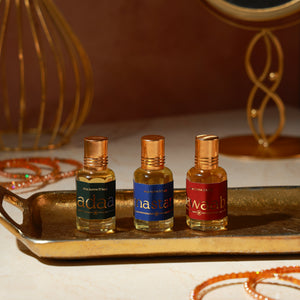
If bergamot itself is what you love, this range only offers it one way — inside Adaa, paired with cardamom, and carried in oil rather than alcohol.
What bergamot actually does in a composition
Bergamot is one of the most widely used materials in perfumery, and its reputation as "just a citrus note" undersells what it actually does. It's cooler and more bitter-green than orange or lemon, with a slightly floral undertone that makes it far more versatile than a straightforward sweet citrus — it's the top note in a huge share of colognes, but it also shows up in compositions that read as woody, floral or even warm overall, doing quiet structural work at the opening before handing off to whatever the rest of the fragrance is actually about. Loving bergamot specifically, rather than "fresh" in general, is a more particular taste than it sounds, and it's usually a sign of a nose that's already paying close attention to what a top note is actually built from, rather than just noting that a fragrance opens bright. Part of what makes it so useful to a perfumer is exactly that versatility — on its own, it can smell almost bitter, closer to the peel of the fruit than to its juice, with a faintly floral, faintly tea-like quality that lemon and orange don't really share, which is why the same material can sit convincingly at the top of a woody composition, a floral one or a genuinely fresh one, changing character far more than most citrus notes do depending on what it's paired with.
In Adaa, bergamot isn't paired the way it usually is. The classic pairing, going back to the earliest colognes and through most modern fougères, is bergamot and lavender — the two together define an entire, recognisable genre of fragrance. Adaa pairs bergamot with green cardamom instead, and the difference is more than cosmetic. Lavender brings an herbal sharpness, almost medicinal at times; green cardamom brings a coolness without that edge, reading more rounded and less austere. It's a deliberate departure from the pairing bergamot is usually known for, and it's the single decision that gives Adaa's opening a different character from almost any citrus fragrance most people have already worn.
The other reason bergamot deserves this kind of close look on its own is the format itself. Bergamot is one of the more volatile materials used in perfumery, which is exactly why it's so effective as an alcohol-based spray's opening note — it evaporates fast and travels with the alcohol, giving that characteristic fast lift. Suspended in oil instead, it has nothing to evaporate with; it releases gradually as the oil warms against skin. The note is the same. Its whole relationship with time is not.
Three things that shape how bergamot reads in Adaa
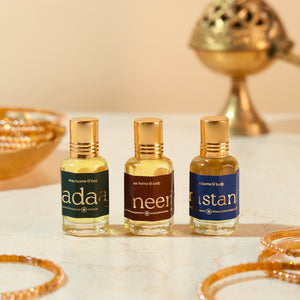
 Adaa₹379Bergamot has a specific, slightly bitter, faintly floral-green character that's different from lemon, orange or grapefruit. If it's bergamot specifically, Adaa is the direct answer. If it's citrus more broadly, Adaa is still the only route to any citrus note in this range at all.
Bergamot across SOSA's range, and in oil versus alcohol
Two comparisons matter here: which attars actually contain bergamot, and how bergamot itself behaves differently once it's suspended in oil rather than alcohol — both are worth seeing laid out plainly rather than taken on trust.
| Attar | Contains bergamot? | What it's paired with instead | Fit for a bergamot lover |
| Adaa | Yes | Green cardamom, jasmine sambac, white musk | The only match in the range |
| Ameeri | No | Taif rose, Indian sandalwood, Persian saffron, soft oudh | No bergamot present at all |
| Nawaab | No | White royal oud, Mysore sandalwood, Kashmir saffron | No bergamot present at all |
| Mastani | No | Night-blooming jasmine, Damask rose, oudh | No bergamot present at all |
| Bergamot in alcohol (a typical spray cologne) | — | Often lavender, in a classic fougère structure | Fast, fizzy opening burst; fades within the first stage of wear |
| Bergamot in oil (Adaa) | — | Green cardamom, not lavender | Slower to arrive, but often perceptible for longer across a full wear |
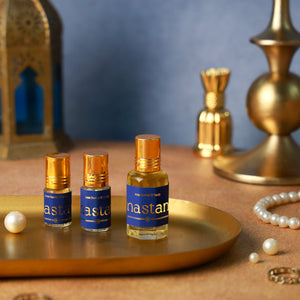
Adaa · 3 ml — hear bergamot on a slower timeline₹379Shop → Adaa · 6 ml — once the cardamom pairing has won you over₹669Shop → Adaa · 12 ml — for daily wear, confirmed₹1,149Shop →
Wearing Adaa so the bergamot reads clearly
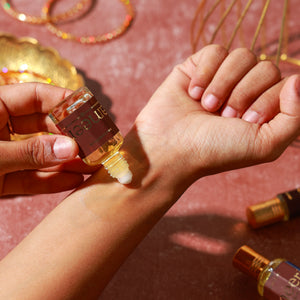
Apply to a pulse point and wait before judging. Bergamot in oil takes longer to become fully perceptible than it does in a spray, because it has to warm against skin rather than flash off with evaporating alcohol — checking in the first sixty seconds will usually undersell it, and will make Adaa seem quieter than it actually turns out to be once it's had time to settle.
Notice it again a few hours later, not only at application. Because the release is gradual rather than concentrated in an opening burst, bergamot's presence in Adaa is often easier to catch partway through the day than in the very first minutes — the opposite pattern from a spray cologne, where the citrus is usually loudest exactly when it's freshest.
If you're used to reapplying a citrus spray through the day, expect to reapply Adaa less often for the same reason — the slower release means the note has more staying power per application, even though it never arrives with the same initial intensity. Think of it as trading a strong first impression for a longer, quieter one, rather than trading strength for weakness outright.
What to buy for a bergamot-led taste
There's only one route to bergamot in this range, so the real decision is size and how curious you are about where a bergamot taste might eventually lead — not which attar to pick, since that part of the decision is already settled.
| Route | Best for | Why | What it costs |
| Adaa, 3 ml | Hearing bergamot released slowly, on oil's timeline, for the first time | The only bergamot in the range, priced to test without commitment | ₹379 |
| Adaa, 6 ml | Confirmed the cardamom pairing and the slower release both work for you | Same formula, sized for regular wear | ₹669 |
| Adaa, 12 ml | A confirmed daily bergamot attar | The honest size once it's not a test anymore | ₹1,149 |
| Nawaab, 3 ml (later, not instead) | A bergamot taste that also runs toward oud-adjacent fragrances | No bergamot here, but a reasonable next direction once Adaa is a known quantity | ₹399 |
| Do nothing yet | Expecting bergamot to open with the same burst a spray gives | Worth reading how oil changes bergamot's timeline before deciding the format disappoints you | No purchase |

Bergamot is one of my favourite materials to work with, and it's also one of the most misunderstood — people assume it's simple because it's common, when really its role changes completely depending on what you put next to it. I wanted Adaa's opening to say something different about bergamot than the classic cologne pairing already has, rather than simply repeating a structure most people who love this note have already smelled dozens of times.
Choosing green cardamom over lavender was the decision I spent the most time on. Lavender and bergamot is a genuinely wonderful, time-tested pairing, but it's also an extremely familiar one, and it carries a herbal sharpness that I didn't want at the top of this particular composition. Cardamom gave me the coolness without the sharpness — a different kind of freshness than the one most bergamot fragrances reach for, and I tried several other spices before settling on it, because most of them either fought with the bergamot or pulled the opening toward something sweeter than I wanted.
The thing I find myself explaining most, though, isn't the pairing — it's the timeline. People who love bergamot from spray colognes often expect that same fast lift, and when it doesn't arrive the same way in Adaa, the instinct is to think the bergamot is weaker. It isn't. It's simply keeping a different schedule, one that oil sets rather than alcohol, and it usually rewards someone who gives it the time to prove that. I'd rather a bergamot lover know that going in than assume, after one quick sniff from the bottle, that the note simply isn't there.
Questions about bergamot in attar
- I Love Fresh Perfumes — Which Attar Should I Try First? — the full entry-level case for Adaa, beyond just bergamot.
- I Usually Wear Fresh Citrus Perfumes — Which Perfume Oil Would Suit Me? — the same oil-versus-alcohol question, from a habitual citrus wearer's angle.
- I Like Fresh Perfumes but Don't Want My Attar to Smell Like Aftershave — What Should I Choose? — why cardamom, the note paired with bergamot here, also avoids a sharper register.
- Which Attar Should I Try If I Like Clean, Crisp and Airy Perfumes? — how the composition stays transparent well past the bergamot opening.
- Brand: the SOSA founder story.
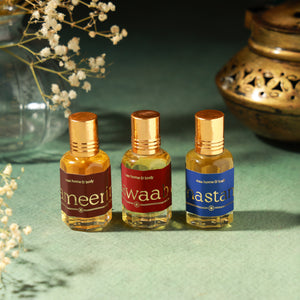
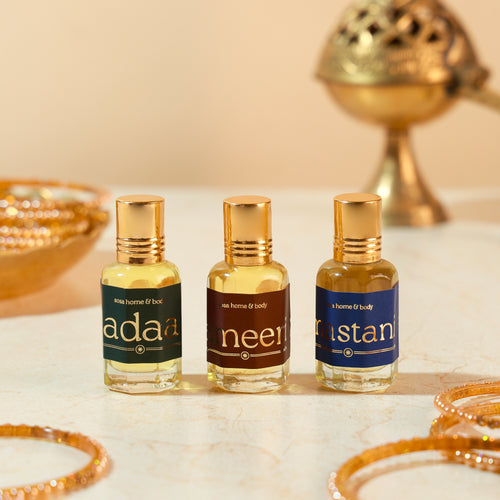
SOSA attars & prices (verified September 2026): All four are alcohol-free roll-on attars in 3 ml, 6 ml and 12 ml. Adaa (bergamot, green cardamom, jasmine sambac, white musk) ₹379 · ₹669 · ₹1,149. Ameeri (Taif rose, Indian sandalwood, Persian saffron, soft oudh) ₹385 · ₹679 · ₹1,165. Mastani (night-blooming jasmine, Damask rose, oudh) ₹389 · ₹685 · ₹1,179. Nawaab (white royal oud, Mysore sandalwood, Kashmir saffron) ₹399 · ₹699 · ₹1,199. The Ameeri + Nawaab + Mastani trio is ₹1,055 · ₹1,859 · ₹3,189. Prices are the live store prices at the time of writing.