



I Just Returned to My Mumbai Flat After Three Weeks Away During Monsoon and It Smells Damp — What Should I Fix Before Using a Reed Diffuser?

I Just Returned to My Mumbai Flat After Three Weeks Away During Monsoon and It Smells Damp — What Should I Fix Before Using a Reed Diffuser?

★ ★ Tell us the whole situation · budget, square footage, who is coming and whenCandle ₹379 · reed ₹749 · Boond ₹899 · Sukoon ₹1,899 · free shipping above ₹499A portion funds girl-child education
★ SOSA · when people are coming over
Most home fragrance advice ignores the constraints that actually decide the answer — your deadline, your budget and whether your kitchen opens into the room
★ ★ ★ ★ ★
★★★★★
"I gave the whole messy situation — in-laws tomorrow, open kitchen, ₹1,000 — and got a plan with times in it rather than a product list."
Shweta R. ₹1,000, in-laws
A plan, not a list
★★★★★
"Eight friends, 200 sq ft living room, hate sweet scents. Got one specific answer and the reason. Bought it, worked."
Aman P. 8 friends, Mumbai
One specific answer
★★★★★
"₹700 and my parents coming to my first Bengaluru flat. Was told what to buy and, more usefully, what to do that costs nothing."
Nikita S. ₹700, first rental
Free steps first
★★★★★
"Three weeks away, monsoon, Mumbai, flat smells damp. Told me clearly not to buy fragrance yet and to fix the damp. Nobody else says that."
Farhan K. Monsoon damp
Told not to buy yet
★★★★★
"Spare room closed three months, guests in four days, ₹500. Got a realistic answer including that a room spray is not something SOSA makes."
Divya M. ₹500, spare room
Honest on the gap
★★★★★
"₹2,000, 900 sq ft, guests this weekend, owning nothing. One purchase, one reason, one order to do things in. That was all I needed."
Arvind T. ₹2,000 from scratch
One purchase
★★★★★
"I gave the whole messy situation — in-laws tomorrow, open kitchen, ₹1,000 — and got a plan with times in it rather than a product list."
Shweta R. ₹1,000, in-laws
A plan, not a list
★★★★★
"Eight friends, 200 sq ft living room, hate sweet scents. Got one specific answer and the reason. Bought it, worked."
Aman P. 8 friends, Mumbai
One specific answer
★★★★★
"₹700 and my parents coming to my first Bengaluru flat. Was told what to buy and, more usefully, what to do that costs nothing."
Nikita S. ₹700, first rental
Free steps first
★★★★★
"Three weeks away, monsoon, Mumbai, flat smells damp. Told me clearly not to buy fragrance yet and to fix the damp. Nobody else says that."
Farhan K. Monsoon damp
Told not to buy yet
★★★★★
"Spare room closed three months, guests in four days, ₹500. Got a realistic answer including that a room spray is not something SOSA makes."
Divya M. ₹500, spare room
Honest on the gap
★★★★★
"₹2,000, 900 sq ft, guests this weekend, owning nothing. One purchase, one reason, one order to do things in. That was all I needed."
Arvind T. ₹2,000 from scratch
One purchase
✓ Candle: scent in the room in 15–20 minutes · Sukoon: about 20 minutes from cold ✓ A reed diffuser needs 24–72 hours — the wrong buy when guests arrive tonight ✓ Ventilate first · fragrance is the finishing layer, never the cover-up


Founder Diaries · Home Fragrance · Your Exact Situation
By Sonal Sahani · ISIPCA Versailles 11 min read Updated August 2026
I am going to spend most of this page talking you out of buying something, and then tell you precisely what to buy at the end of it. Damp is not a smell. It is a source — water somewhere it should not be, and a population of mould and bacteria living off it — and fragrance laid over a source does not improve the source, it produces a second smell on top of the first one that the nose reads as unmistakably worse. Three weeks shut during a Mumbai monsoon is a very specific set of conditions, and there is a fix order for it. Work through that order, get the flat genuinely dry, and then a reed diffuser from ₹749 is the right product for you — while a cool-mist ultrasonic, for reasons I will explain, is actively the wrong one.
Quick answers — read this first
Do not fragrance it yet. Damp is a source. Scent over damp is a worse smell than damp, and it also hides the thing you need to find.

Fix order: 1) find and stop the water — external or bathroom wall seepage, a leaking joint, standing water in a trap or a bucket. 2) Fans on, internal doors open, a dehumidifier if you own one. 3) Ventilate on the driest hours of the day rather than continuously — in a monsoon, an open window can import more moisture than it exports. 4) Dry and, if the sun appears, sun the fabrics: mattress, sofa cushions, curtains, everything in the closed wardrobe. 5) Clean the AC filter and run the AC on dry mode. 6) Wash anything actually mildewed.

Then, and only then: a reed diffuser from ₹749 — alcohol-free, no water, no electricity, steady for months. Not a cool-mist ultrasonic. A Sukoon puts 30–50 ml of water an hour into the air, which is the last thing a damp Mumbai flat needs. Buy one for the dry season, not for now.
The short answer
Short answer: fix the water before you buy any fragrance. Find the source, run fans, ventilate during the driest part of the day rather than continuously, dry and sun the fabrics, clean the AC filter and wash anything mildewed. Fragrance over damp is a worse smell than damp, and it masks the evidence you need in order to find the leak.
The pick, once the flat is dry: a reed diffuser from ₹749 — alcohol-free, no water, no electricity, and it holds a hall or a bathroom for months without attention. Mountain Breeze at ₹849 (Himalayan pine, sage and cedar) is the driest of the five and the one I would put into a flat recovering from monsoon. What I would not sell you right now is an ultrasonic diffuser, because it works by adding water vapour to the room.
Shop and prices: reed diffusers Morning Freshness from ₹749, Garden Bloom and Evening Calm from ₹799, Fresh Brew and Mountain Breeze from ₹849; 130ml from ₹1,249; 300ml reed refills ₹2,399. Bookshop candle ₹379 for roughly 15–18 hours. The Sukoon is ₹1,899 with three 15ml Hotel Collection scents included — a good purchase in October, a poor one in August. Free shipping above ₹499.
Straight answer
My Mumbai flat has been shut for three weeks in the monsoon and smells damp — what do I fix before I use a reed diffuser?
1. Find the water. Nothing else matters until you have. Walk the flat with your hand and your nose rather than your eyes. Press the wall behind the bed, the wall the bathroom shares with the neighbour's, the external wall on the weather side, the ceiling under the flat above. Cold, soft, slightly yielding plaster, a chalky bloom, a bubble in the paint or a tide mark half a metre up means seepage, and seepage is a building problem rather than a housekeeping one. Photograph it and raise it with the society or the landlord today, because monsoon seepage does not wait.

2. Deal with the standing water you left behind. Three weeks closed means every floor trap and every basin trap has partially dried, and a dry trap is an open pipe to the drain. Run every tap for a minute and pour a mug of water into every floor drain. Open the washing machine, take out whatever is in the drum, and leave the door and the detergent drawer open — a front-loader shut for three weeks in a monsoon is one of the most reliable sources of that smell in Indian flats. Empty the fridge drip tray and the AC drain pan. Check for a bucket, a mop and a plant saucer left with water in them.

3. Move the air mechanically before you move it through the windows. Every ceiling fan on, every internal door open, wardrobe and cupboard doors open, the exhaust fans in bathrooms and kitchen running. Air that is moving does not deposit moisture on surfaces, and this costs you nothing but electricity. If you own a dehumidifier, this is its day; run it in the worst room with the door shut.

4. Ventilate on the driest hours, not continuously — this is the monsoon exception. Everywhere else in this cluster I tell people to open two windows on opposite walls and leave them. In Mumbai in August, outdoor air at ninety-plus per cent relative humidity will deposit moisture inside your flat rather than remove it. Open up in the driest part of the day — usually early afternoon on a day it is not actually raining — for half an hour of proper cross-draught, and close up again. On a heavily raining day, keep the windows shut and run the AC on dry mode instead, which dehumidifies rather than merely cools.

5. Dry the fabrics, because they are usually what you are smelling. Mattress, sofa cushions, curtains, rugs, towels, and everything in a wardrobe that has been closed for three weeks. Fabric holds moisture long after the air has dried and it is the substrate mildew actually grows on. If the sun appears for two hours, put the mattress and the cushions in it. Wash anything with visible spotting at sixty degrees or in the hottest wash it will take, and dry it completely before it goes back — half-dry laundry put away in a monsoon is how the whole cycle starts again. Clean or replace the AC filter, which is a felt pad that has been holding damp dust in the dark for three weeks.

6. Only when the flat is genuinely dry, add fragrance — and choose the right kind. A reed diffuser from ₹749 is alcohol-free, needs no water and no power, and holds a hall or bathroom for months. That is the product for you. An ultrasonic diffuser is not, and I would rather lose the larger sale than make it — a Sukoon works by putting 30–50 millilitres of water an hour into the air as cool mist, which in a flat you are trying to dry out is working directly against you. Buy one in October.

A portion of every order supports girl-child education through Nanhi Kali.

TL;DR: do not fragrance it yet. Find and stop the water, run fans and open the wardrobes, ventilate on the driest hours rather than continuously, dry and sun the fabrics, clean the AC filter, wash anything mildewed. Once the flat is genuinely dry, a reed diffuser from ₹749 is the right product — and a cool-mist ultrasonic is the wrong one, because it adds humidity to a flat that already has too much.
Mountain Breeze reed diffuser
The right product — after the flat is dry, and not before
Mountain Breeze reed diffuser ₹849 / 50ml
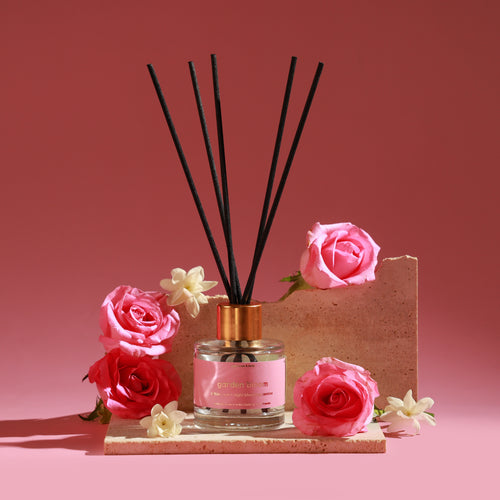
Himalayan pine, sage and cedar. A reed diffuser is the correct category for a monsoon flat for a reason that has nothing to do with the scent: it uses no water and no electricity, so it adds nothing to the humidity load of a room you are working hard to dry. It is also alcohol-free, and it holds a hall, a landing or a bathroom for months with no routine at all — which matters if you travel for three weeks at a time. Of the five reed scents this is the driest and the least sweet, and dry resinous woods are what a flat recovering from damp actually wants. Allow it 24–72 hours to reach its level. ₹849 for 50ml, ₹1,349 for 130ml, with 300ml refills at ₹2,399.

Why fragrance over damp is worse than damp

I want to be plain about this before anything else, because it is the reason this page exists. The smell you are describing is a biological process reporting itself. Mould and bacteria metabolising in a damp substrate release volatile compounds — that is the earthy, cellar, wet-cardboard note — and those compounds keep being produced for as long as the water is there. Adding a fragrance does not stop the production. It gives your nose two things to process instead of one, and because the damp note is low, wide and persistent while a fragrance sits over it, the brain reads the combination as a smell being covered rather than as a nice smell. Everybody who walks in knows. Worse, the mask removes your best diagnostic instrument: the way you find seepage in a Mumbai flat is by walking around it and smelling for where the note gets stronger, and you cannot do that in a room with a reed diffuser in it.

1
THE FOUR CANDIDATES
Wall, fabric, machine, or standing water — find out which before you spend anything
Damp in a closed Mumbai flat is almost always one of four things, and they need completely different responses. First, a wall. Seepage through an external wall on the weather side, from a shared bathroom wall where the neighbour's waterproofing has gone, or from the slab above. The signs are physical: paint blistering, a chalky white efflorescence, a tide mark, plaster that feels cold and soft under the palm. This is the one you cannot fix with a fan, it is the one that gets worse every year it is ignored, and it is a conversation with the society or the landlord rather than a purchase. Second, fabric. A mattress, a sofa, curtains, a rug, or — most often — the contents of a wardrobe that has been shut in the dark for three weeks at eighty-five per cent humidity. Fabric damp smells sourer and more personal than wall damp, it is strongest with your nose an inch from the material, and it responds completely to heat, air and washing. Third, a machine. The AC filter, which is a felt pad that has been holding wet dust in a dark box; the AC drain pan; the fridge drip tray; and above all the washing machine drum and its rubber gasket, which in a front-loader shut for three weeks produces a smell people routinely mistake for the whole flat. Fourth, standing water and dry traps. A dried floor trap is an open connection to the building drain and it does not smell of damp so much as of something worse; a mug of water in each one solves it in thirty seconds. Walk the flat and identify which of the four you have, because three of them are free to fix and the fourth is somebody else's budget.
2
THE MONSOON EXCEPTION
The one situation where opening the windows can make it worse
Every other page I have written about a closed flat says the same thing: open two windows on opposite walls and let the air exchange for twenty minutes. Mumbai in a monsoon is the single exception, and it is worth understanding why rather than just being told. Ventilation dries a room only when the air coming in holds less moisture than the air going out. In August the outdoor relative humidity in Mumbai sits in the eighties and nineties for days at a stretch, and during actual rain it is effectively saturated. Open the flat wide on a day like that and you are not exporting moisture, you are importing it — and it will condense on the coolest surfaces you own, which are the tiled floor, the outer walls and the inside of the wardrobe. People do this in good faith and then cannot understand why a week of open windows has made the flat feel worse. So the rule for you is different: ventilate deliberately rather than continuously. Pick the driest window in the day, usually early afternoon when it is not actively raining, and give the flat thirty minutes of hard cross-draught with fans running to help it. Then close up. On a wet day, keep the windows shut and use the air conditioner on dry or dehumidify mode, which removes water from the air rather than merely cooling it, with the internal doors open so it works on the whole flat. If you own a dehumidifier, it beats every window in the building. What you should never do is leave everything open all week and hope, and what you should always do regardless of the weather is keep the air inside moving, because still air deposits and moving air does not.
3
THE PRODUCT REFUSAL
A cool-mist ultrasonic is the wrong purchase for a damp flat
Here is the part that costs us money, and I would rather print it than have you find out in September. The Sukoon at ₹1,899 is the best single purchase in our range and it is the wrong thing to buy for the problem you have just described. An ultrasonic diffuser works by vibrating a plate at 2.4MHz to break water into a cool mist and pushing that mist into the room — the Sukoon at 30 to 50 millilitres an hour on low, which over a sixteen-hour fill is most of a half-litre of water going into the air of your flat. In a dry Pune winter that is pleasant and does no harm. In a Mumbai flat in monsoon that you are actively trying to dry out, you would be running a small humidifier against your own dehumidifying, and the damp note would come back faster than it otherwise would. The same applies to the 300ml Boond and, at a much larger scale, to the six-litre Megh. The right category for you is the one that adds nothing to the room but scent: a reed diffuser, which is oil wicking up rattan and evaporating, with no water and no power involved at all. It also happens to suit somebody who disappears for three weeks at a time, since there is nothing to switch on, nothing to refill weekly and nothing to leave running. Buy the Sukoon in October if you want one. It will still be ₹1,899 and it will still include three 15ml Hotel Collection scents, and by then your flat will be the sort of room it is good in.
The rule I would give any reader in a coastal Indian city: in the months you are running a dehumidifier or the AC on dry mode, scent the house with reeds and candles. In the months you are not, an ultrasonic is the better instrument. The product should match the season, not just the room.

Four kinds of damp, and what each one actually needs

Work down the first column until you recognise your flat. The fourth column is the one that matters for this page: it is what happens if you put fragrance on top of that source instead of fixing it, and in every single row the answer is that it gets worse rather than better.

Diagnose before you buy
Where the smell is coming from, how to confirm it, and what it costs to fix
What it is How you confirm it What it needs, and what that costs What fragrance does to it
Fabric — mattress, sofa, curtains, closed wardrobe ★ Sourer and more personal than wall damp; strongest with your nose an inch from the material; clothes feel cool and slightly heavy Fans and open wardrobe doors, two hours of sun if it appears, hot wash for anything spotted, dry completely before putting away. Free Fragrance sits on top of it and the fabric carries on releasing. The commonest and most fixable of the four
A wall — external, shared bathroom, or the slab above Blistered paint, chalky white bloom, a tide mark, plaster cold and soft under the palm, note strongest at one specific place Not yours to fix. Photograph it, report it to the society or landlord today. Dehumidify and keep air moving meanwhile Actively harmful — the mask removes the only diagnostic you have, and monsoon seepage worsens every week it is ignored
A machine — washing machine drum, AC filter, drip trays Note is strongest with the appliance door open; the front-loader gasket and the AC filter are the two usual culprits after three weeks shut Leave the drum and detergent drawer open, run a hot empty cycle, wash or replace the AC filter, empty the fridge and AC trays. Free to about ₹500 Pointless — the appliance keeps producing it, and you will be adding drops every week wondering why
Standing water and dried drain traps Not really damp at all — sharper, more drainy. Three weeks with no water run means every trap has partly evaporated A mug of water down every floor drain, every tap run for a minute. Thirty seconds and free Fragrance over a drain smell is the single worst combination in the house. Never mask this one
Genuinely dry flat, faint closed smell remaining No cold spots, no spotting, fabrics dry to the hand, note is flat and neutral rather than earthy Air exchange on the driest hours, wash the soft furnishings you can, then fragrance This is the only row where a reed diffuser from ₹749 is the right next step
A cool-mist ultrasonic diffuser, bought now — — Not recommended in a damp monsoon flat. A Sukoon puts 30–50 ml of water an hour into the air. Buy it in October instead
Shop this guide
What belongs in a monsoon flat, once it is dry
The SOSA principle
Damp is a source, and a source is not a smell problem. Scent laid over it does not produce a better smell — it produces a second smell, and the nose reads the pair as concealment.
It also takes away your best instrument. You find seepage by walking the flat and smelling for where the note gets stronger, and you cannot do that in a room that has been fragranced.

The fix order, in the order it actually works

Do these in sequence, because each step makes the next one work better and doing them out of order wastes effort. Water first, air second, fabric third, appliances fourth, fragrance fifth and only if the first four are done. Water first means walking the whole flat within an hour of getting home, palm flat on every external and bathroom-adjacent wall, looking at the ceiling under the neighbour's bathroom, and emptying anything holding standing water — the AC drain pan, the fridge tray, a bucket, a plant saucer, the washing machine drum. Pour a mug of water into every floor trap. Air second means mechanical air before outdoor air: every fan on, every internal door open, wardrobes and cupboards open, both exhaust fans running. Then the deliberate ventilation window — thirty minutes of cross-draught during the driest part of the day, and the windows shut again afterwards, rather than a week of everything open which in this city imports more moisture than it removes. If you have a dehumidifier or an AC with a dry mode, that is your primary tool and the windows are secondary. Expect two to four days of this before a three-week monsoon closure genuinely clears, not two hours, and do not judge the flat until then.

Fabric third, and this is where most of the smell in most flats is actually stored. Air holds moisture briefly. Fabric holds it for days, and fabric is what mould grows on. Strip the bed entirely and wash everything at the hottest temperature the label allows. Stand the mattress on its side against a wall with a fan on it for a day, and if Mumbai gives you two hours of sun, take it and the sofa cushions out. Open every wardrobe, take the clothes out of the back where the air never moves, and hang anything that smells rather than washing it if it is otherwise clean — an hour in moving air fixes most of it. Curtains hold more than anybody expects, take them down. Rugs the same. Anything with actual visible spotting needs washing at sixty degrees or the hottest wash it takes, and it must go back completely dry, because half-dry linen returned to a cupboard in August restarts the whole cycle within a week. Appliances fourth: run the washing machine empty on its hottest cycle, wipe inside the rubber gasket where water sits, leave the door and drawer open permanently from now on, and take the AC filter out, wash it, dry it fully and put it back — a filter is a felt pad that has spent three weeks holding wet dust in the dark, and cleaning it changes the smell of a room more than most people believe.

Fragrance fifth, and now the recommendation, since I promised one. Once the flat is genuinely dry — no cold soft plaster, no spotting, fabrics dry to the hand, and the earthy note gone rather than quieter — a reed diffuser is the right product and I would put it in the hall and the bathroom rather than the bedroom. Mountain Breeze at ₹849 is Himalayan pine, sage and cedar, dry and resinous, and dry resinous woods are the register that reads as clean in a coastal flat; Morning Freshness at ₹749 is Malabar lemon, peppermint and eucalyptus if you want something brighter; both come in 130ml from ₹1,249 and take 300ml refills at ₹2,399. Give a reed 24 to 72 hours before you judge it, use fewer reeds in a small bathroom and more in a hall, and flip them once a fortnight rather than weekly. Do not buy an ultrasonic diffuser this month. The Sukoon at ₹1,899 is genuinely the best value in our range — 500ml, 270–320 sq ft, 16–18 hours a fill, steady, 2H and 4H timers, three 15ml Hotel Collection scents included — and it produces its scent by putting cool water mist into the room at 30 to 50 millilitres an hour, which is exactly the wrong direction for your flat right now. Buy it in October, when the air is dry and the humidity it adds is a benefit rather than a problem. That is the same advice I would give my own sister, and she lives in Bandra.

You find seepage by walking the flat and smelling for where the note gets stronger. A reed diffuser in the hall takes that instrument away from you at exactly the moment you need it.
— Sonal Sahani, SOSA

The SOSA edit

In order, for a flat that has just come out of three weeks shut in a monsoon. Note that the first three rows cost nothing, and that two of the rows exist to tell you what not to buy — which in this particular situation is more useful than anything on the list.

The SOSA edit
A Mumbai monsoon flat, in the order things should happen
Step What it is Why it comes where it does Cost
1. Find and stop the water ★ Walls, traps, drip trays, washing machine drum, anything left standing Nothing else on this list works while a source is still producing. Seepage is the landlord's or the society's problem and it should be raised today Free
2. Fans, open doors, deliberate ventilation Every fan on, wardrobes open, thirty minutes of cross-draught in the driest hours, AC on dry mode when it is raining In a Mumbai monsoon, continuous open windows import moisture. Ventilate on purpose rather than constantly, and keep indoor air moving all day Free
3. Dry, sun and wash the fabrics Mattress, sofa cushions, curtains, rugs, the contents of the closed wardrobe Fabric is where the smell is stored and what mould grows on. Two to four days, and nothing goes back until it is completely dry Free
4. Bookshop candle for the first evening 80g, roughly 15–18 hours, scent in a room in 15–20 minutes Combustion rather than evaporation, so it adds no water. It makes one dried room feel occupied; it does nothing about damp and I would not claim it does ₹379
5. Mountain Breeze or Morning Freshness, once the flat is dry Alcohol-free reed diffusers — no water, no electricity, steady for months, 24–72 hours to establish The correct category for a coastal flat and for somebody who is away for three weeks at a time. Pine, sage and cedar, or lemon, peppermint and eucalyptus ₹849 / ₹749
Not now: an ultrasonic diffuser Cool mist at 30–50 ml/h — a genuinely good machine in the wrong month It adds humidity to a flat you are trying to dry. This is a sale we would rather not make in August. Buy it in October ₹1,899 — later
Honest notes for buyers: fragrance is the last step, not the first — it layers on air that is already clean and moving, and it will not cover cooking, damp or a room that has been shut for weeks. Timing matters as much as product: a candle scents a room in fifteen to twenty minutes and a Sukoon in about twenty, which is why both work when people are arriving tonight, while a reed diffuser needs a day to three days before it is doing its job properly — it is the wrong buy for a deadline and the right buy for a room you want to hold a steady scent for months. SOSA does not make a room spray for the home; the sprays in the range are formulated and sized for a car. The Hotel Collection is water-based and runs in the Sukoon, Boond and Megh only — not in reeds, and not in the waterless Vaayu. Reed diffusers are a separate alcohol-free line with their own scents. Candles must be attended and put out before guests leave a room unattended. The Hotel Collection scents are SOSA's own interpretations inspired by the world's finest hotels; SOSA is an independent Indian fragrance house, not affiliated with or endorsed by any hotel brand. A portion of every order supports girl-child education through Nanhi Kali.
SOSA Bookshop candle
For the first evening, while everything else is still drying
SOSA Bookshop candle ₹379 / 80g
Roughly 15–18 hours of burn, and noticeable fragrance in a room in fifteen to twenty minutes. A candle is combustion rather than evaporation, so unlike a cool-mist diffuser it puts no meaningful water into the air — which makes it the one same-evening fragrance product that does not fight what you are trying to do to the flat. Use it in a room you have already dried and ventilated, for an hour, attended, and put it out before you leave the room. It will not do anything about damp and I would not pretend otherwise; it will make one room feel occupied again on the evening you get home, which is a real and limited thing.
SS
ISIPCA
Versailles
A note from Sonal

I have had this email in July and August every year since we started, and the version that upsets me is the one where somebody has already bought three reed diffusers, put them around a damp flat, and written to ask why the flat now smells of damp and jasmine. Nothing had gone wrong with the product. The product was simply asked to do a job that no fragrance can do, by somebody who had been told by an advert that it could. Damp is water, and the only thing that removes water is heat, air movement, dehumidification and stopping the leak. Perfumery has nothing to offer that problem and it is dishonest to pretend otherwise.

The part that costs us most to say is the ultrasonic one. A Sukoon is our best product and the machine I recommend more often than anything else in the range, and in a Mumbai flat in the middle of monsoon it is the wrong purchase, because a cool-mist diffuser is a small humidifier that happens to carry scent. I would rather sell you an ₹849 reed in August and have you trust the ₹1,899 recommendation in October than take the larger order now and be quietly wrong. Get the flat dry first. It will take you three or four days and cost you nothing, and the difference when you finally do put something scented in it is the difference between a house that smells good and a house that smells of a good product on top of a bad problem.

Everything is made and supported from Pune, and a part of every order funds girl-child education through Nanhi Kali. You get a home that smells like somewhere you chose; a girl gets a classroom. That equation has always felt right to me.

Frequently asked questions

Will a reed diffuser get rid of the damp smell in my flat?
No, and it will make things worse while the damp is still there. Damp is a source — water, and the mould and bacteria living off it, producing volatile compounds continuously. A fragrance over it gives the nose two smells rather than one, and the pair reads as concealment. Fix the water, dry the fabrics, and then a reed diffuser from ₹749 is a good buy.
Should I leave my windows open all day in Mumbai during the monsoon to dry the flat out?
No. This is the one situation where continuous ventilation can make things worse, because outdoor air at eighty-five to ninety-five per cent humidity deposits moisture inside rather than removing it. Ventilate hard for half an hour in the driest part of the day, then close up, and keep indoor air moving with fans. On a wet day, run the AC on dry mode with the internal doors open instead.
Why shouldn't I buy an ultrasonic diffuser for a damp flat?
Because it works by putting water into the air. The Sukoon outputs 30 to 50 millilitres an hour on low, which over a full tank is most of half a litre of added humidity — the opposite of what a flat recovering from monsoon needs. It is an excellent machine in the dry months. Buy it in October and use reeds and candles until then.
What causes the smell after three weeks with the flat locked up?
Usually four things at once: dried drain traps that have opened a path to the building drain, a front-loading washing machine shut with a damp drum and gasket, an AC filter holding wet dust, and fabric — mattress, curtains and everything in a closed wardrobe — that has been sitting in high humidity with no air movement. All four are free to fix.
How long before the flat is dry enough to use fragrance?
Two to four days of fans, deliberate ventilation and dried fabrics for a normal three-week monsoon closure, and considerably longer if there is wall seepage, which needs fixing rather than drying. The test is physical rather than olfactory: no cold soft plaster, no spotting, fabrics dry to the hand. Then allow the reed its own 24–72 hours.
Fix first, fragrance second
Get the water out — then put something dry and quiet in the hall
Reed diffusers are alcohol-free, need no water and no electricity, and hold a room for months: Morning Freshness from ₹749, Garden Bloom and Evening Calm from ₹799, Fresh Brew and Mountain Breeze from ₹849, 130ml from ₹1,249, 300ml refills ₹2,399. Allow 24–72 hours. The Bookshop candle is ₹379. The Sukoon at ₹1,899 is the right buy once the dry months arrive. Free shipping above ₹499, and a portion of every order supports girl-child education through Nanhi Kali.
Shop reed diffusers → from ₹749 Bookshop candle · ₹379
Editorial standards & sources
About this guide: Written by Sonal Sahani, ISIPCA Versailles-trained founder and perfumer at SOSA Home & Body, as a deliberate refusal page: why damp is a source rather than a smell, why fragrance laid over it reads as concealment and removes the diagnostic you need to find seepage, why continuous ventilation is counter-productive in a Mumbai monsoon, the four places a three-week closure usually stores the smell, and why a cool-mist ultrasonic diffuser — the product SOSA would most like to sell — is the wrong purchase for a flat that is still drying out.

Facts verified August 2026: Timings in this guide: a scented candle puts noticeable fragrance into a normal room in roughly 15–20 minutes; a Sukoon ultrasonic diffuser reaches a steady level in about 20 minutes from cold; a reed diffuser needs roughly 24–72 hours for the oil to travel the reeds and the room to settle, so it is not a same-day solution. SOSA products and prices: Sukoon 500ml ultrasonic diffuser ₹1,899 (270–320 sq ft, 16–18h on low, 9–12h high, 30–50 ml/h, 2.4MHz cool mist, 7-colour LED, remote, steady/2H/4H timers, BPA-free, auto shut-off, includes three 15ml Hotel Collection scents of your choice); Boond 300ml ₹899; Megh 6-litre ₹3,499; waterless Vaayu ₹11,999 (up to 1000m³); Aangan ₹25,999; Meenar ₹38,500. Hotel Collection water-based fragrance 15ml ₹299, 100ml ₹999, 300ml ₹1,799, Pack of 7 at 15ml ₹1,799 / 100ml ₹5,999 / 300ml ₹10,799; dose 3–6 drops per tank. Reed diffusers (separate alcohol-free line): Morning Freshness from ₹749, Garden Bloom and Evening Calm from ₹799, Fresh Brew and Mountain Breeze from ₹849; 130ml from ₹1,249; duos from ₹1,498; 300ml refills ₹2,399. Scented candles: Bookshop 80g ₹379 (~15–18 hours), Bookshop + Cozy Corner ₹664 (~30–36 hours), Amber Rose 130g ₹599 (~25–30 hours) and 220g ₹799 (~40–50 hours), ceramic jar candles ₹949, Pure Calm wax melt set ₹854. Free shipping above ₹499. SOSA does not make a room or linen spray for the home — the sprays in the range are car perfumes. The Hotel Collection scents are SOSA's own interpretations; SOSA is not affiliated with or endorsed by any hotel brand. Prices subject to change — see the live product pages.
Zurück zum Blog