

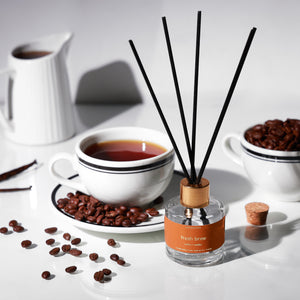
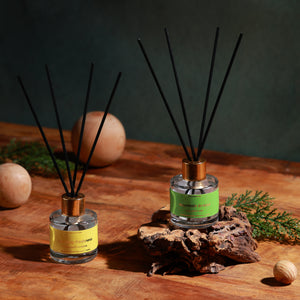
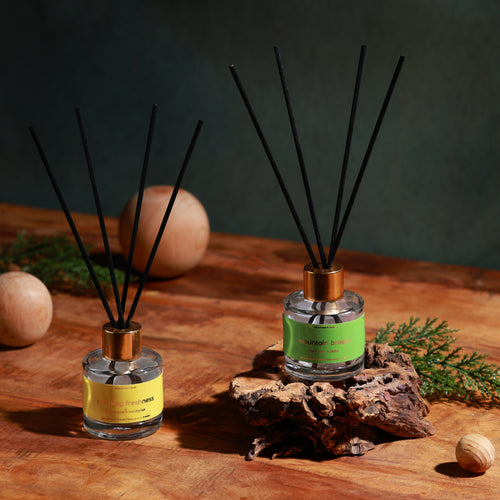
The cheap fix: more sources, not more oil. Two 50ml bottles at opposite ends of an open living-dining beat one 130ml in the middle, every time, and cost from ₹1,498 as a duo set.
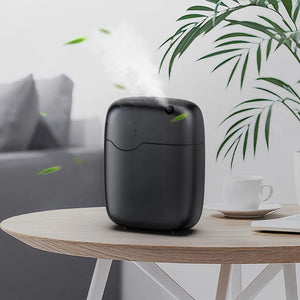
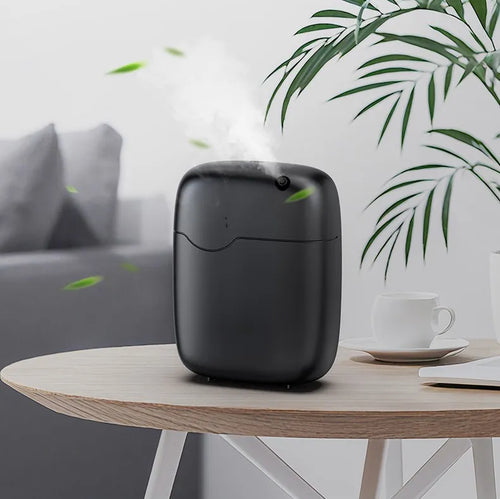
The real fix above roughly 800 sq ft of connected volume: a source with propulsion. Cold-air nebulisation pushes undiluted oil out under pressure instead of waiting for a room to fill.
Two scents in one open volume must share a note or you get a seam where they meet — Mountain Breeze and Morning Freshness meet on green eucalyptus; Fresh Brew and Garden Bloom meet on warmth.
2. Add sources before you add strength. Output per bottle is fixed; the only way to raise the total released into a room is another source. Two 50ml at opposite ends of the volume produce a fuller, more even room than a single 130ml anywhere in it — and cost about the same.
3. If you run two, make them share a note. Two unrelated fragrances in one open volume create a seam you walk through. Mountain Breeze and Morning Freshness meet on green eucalyptus. Fresh Brew and Garden Bloom meet on warmth and soft musk.
4. Fix the airflow before you fix the fragrance. Ceiling fans on high, sliding doors open to a deck all evening and a running kitchen extractor will each defeat any passive source. Run the fragrance when the volume is relatively closed, then open up.
5. Above roughly 800 square feet of genuinely connected open volume, change category rather than quantity. That is where a source with propulsion — waterless cold-air nebulisation, undiluted oil pushed out as a dry nano-mist — starts to be the honest answer rather than a fourth and fifth bottle. The Vaayu at ₹11,999 is rated up to 1000m³, about 2,000–3,000 sq ft.
6. Know the supply position first. The Vaayu ships with 400ml of cold-air fragrance and SOSA does not currently sell a separate refill oil for it; that in-box 400ml is the supply available today. If long-term supply matters to you, confirm availability with SOSA before purchasing.
The reed range is composed and handmade in small batches in Pune, the Vaayu is made in India, and a portion of every order supports girl-child education through Nanhi Kali.
Part one — walls are the container, and you have removed them
Here is the thing nobody says out loud when they sell you a diffuser: a passive source does not project, it releases — and everything you experience as "reach" is actually the room filling up. Oil climbs the reeds, evaporates off the exposed ends at a fixed rate, and joins the air in the room. In a bedroom with the door shut, that air is trapped, so the concentration climbs over an hour or two until it crosses the threshold at which your nose reports it, and then holds. In a great room with a double-height void, a kitchen at one end and eight feet of sliding glass at the other, the same release rate meets a volume several times larger that is also exchanging its air with the outside. It never reaches the threshold. The bottle is behaving exactly as designed; the room simply never fills.
 Fresh Brew₹849 · 9.5/10Open-plan villas are built for light and air, and they get both. Large glazing, doors to a garden or deck, ceiling fans, an extractor over an island hob, and often a stairwell drawing upward: each of those replaces the air in the volume, and every replacement takes your fragrance with it. A room that changes its air twice an hour is throwing away most of what a reed diffuser released in that hour. There is a second, sharper failure mode too — a bottle standing in a direct draught, under a fan or beside an open door, has its exposed reed surface stripped continuously, so the room smells of little and the 50ml finishes weeks before its 6–8 week window. Gentle incidental traffic is what you want; a moving airstream is not.
Part two — the same product in a closed room and an open volume
Rather than a size table, which every guide has, this one sets the two situations side by side on the properties that actually differ. Read it as a diagnosis of why the thing that worked in your last flat does not work in this house.
| Property | Closed 180–250 sq ft room | Open 800–1,500 sq ft volume | What it means for you |
|---|---|---|---|
| Does the room accumulate? ★ | Yes — concentration climbs to a plateau and holds | Barely — dilution roughly matches release | This single difference explains almost every complaint |
| Direction of dilution | Bounded on four sides and above | Three dimensions, often including a void | Place at edges, never in the centre |
| Air changes per hour | Low with the door shut | High — glazing, decks, fans, extractor | Scent while it is closed, then open up |
| Absorbent surface | A bed, a rug, curtains | Large rugs, deep sofas, long drapes | Allow a fortnight before judging |
| What raises the result | Flip the reeds; move into passing air | Another source, or a source with propulsion | Free lever first, then category change |
| What a bigger bottle gives you | 14–18 weeks instead of 6–8 | 14–18 weeks instead of 6–8 | Duration in both cases. Never reach |
| Honest product answer | 50ml from ₹749, or Sukoon ₹1,899 on demand | Two to three sources, or Vaayu ₹11,999 | The jump is a change of format, not of size |
| The honest caveat: the 6L Megh at ₹3,499 looks like the obvious middle step for a big room and is not one. It runs about 100 hours a fill, which is genuinely useful, but it covers only around 215 sq ft — less than the ₹1,899 Sukoon. It is a runtime and humidity machine, not a coverage upgrade, and it will not cross an open plan. Coverage figures throughout are manufacturer specifications and vary with ceiling height, ventilation and season. | |||
 Vaayu · undiluted, nebulised₹11,999Shop → Fresh & Grounded duo₹1,548Shop →
  Sukoon · 270–320 sq ft₹1,899Shop →
Part three — what propulsion actually changes, and who should not buy it
Propulsion is the word that separates the two halves of our own range, and it is worth understanding before spending ₹11,999 on it. An ultrasonic machine such as the Sukoon vibrates a plate in water to throw a visible cool mist, and a small fan pushes it out. That is genuine propulsion, which is why it covers 270–320 sq ft where a reed covers a fraction of it — but the mist is water-carried, so a large part of what leaves the machine is water rather than fragrance, and the throw is short. Cold-air nebulisation removes the water. Pressurised air atomises the oil itself into a dry nano-mist of very fine droplets that stay airborne far longer and carry no dilution at all. That is the entire reason the coverage figure jumps an order of magnitude, to up to 1000m³ — roughly 2,000 to 3,000 sq ft depending on your ceilings — rather than a few hundred square feet.
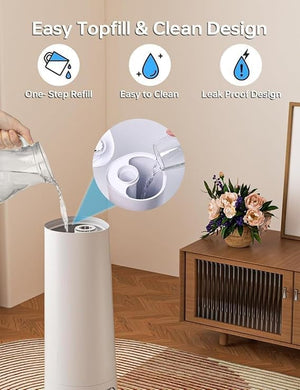
There is a second consequence that matters more in India than the first. A water-based machine adds humidity to the room it scents. In a Goan or Konkan villa in August, or a Kerala house at any time, adding water to the air is the last thing an open living space needs, and a 6L machine running a hundred hours will do it steadily. The Vaayu adds no water and no heat, draws 5W at DC 12V, runs under 38 dB, weighs 0.9 kg and either sits flat on a console or mounts on a wall or an HVAC return. And because it is a machine rather than a passive object, it can be told what to do: 1h / 4h / 8h / 24h timers, adjustable mist intensity, a Bluetooth app plus onboard buttons, auto-stop and a key-lock. For an open volume that is used at particular hours — a great room that matters at seven in the evening and not at eleven in the morning — that is often the real purchase, not the raw reach.
Now the part I would rather you read twice. Most open-plan spaces in Indian homes are not large enough to justify this. An open living-dining of 350 to 450 square feet — which is what most "open plan" flats and smaller villas actually have — is a Sukoon at ₹1,899, or two reed diffusers at opposite ends from ₹1,498 as a duo, and nothing more. Between roughly 450 and 800 square feet, run a Sukoon plus a reed diffuser at the far end and expect a good result. It is above 800 square feet of genuinely connected volume, or where a double-height void is multiplying the cubic metres, that I would start the conversation about a Vaayu at all — and even then, only after you have measured the space rather than estimated it. If you take one figure from this page, take that one: measure the connected volume before you spend, because the number is almost always different from what people guess, in both directions.
Part four — the open-space edit, in buying order
Free corrections first, then the cheapest purchase that could work, then the category change. A good share of readers will solve this at line two or three and never reach the machine.
| Step | What it does in an open volume | What it costs | Price |
|---|---|---|---|
| 1. Move sources to the edges and flip the reeds ★ | Blocks half the dilution and restores the release rate the bottle was built for | Ten minutes | Free |
| 2. Close the volume for an hour before it matters | Lets a big room briefly behave like a small one | Doors and fans off for an hour | Free |
| 3. Add reeds — eight to ten instead of six | Raises release immediately and reversibly | Roughly proportional bottle life: 8 weeks becomes 5 | Free |
| 4. A second source at the opposite edge | Roughly doubles what enters the volume — the real cheap fix | A second bottle, sharing a note with the first | From ₹1,498 as a duo |
| 5. Sukoon for the part of the volume you use | 270–320 sq ft on demand, 16–18 hrs on low, timers and remote | Adds a little humidity; needs water-based oil only | ₹1,899 |
| 6. Vaayu above ~800 sq ft connected | Undiluted oil, dry nano-mist, up to 1000m³, scheduled and lockable | The price, and an open supply question — see the note below | ₹11,999 |
| Not a step: a 130ml instead of a 50ml | 14–18 weeks instead of 6–8 at the same six reeds | Said plainly rather than sold as an upgrade | From ₹1,249 |
Versailles
I trained to build fragrances, not to think about buildings, and the open-plan problem taught me that in home fragrance the two cannot be separated. A composition does not have a reach; a composition in a room has a reach, and the room does most of the work. I have watched the same 130ml bottle be described as overwhelming in a Mumbai bedroom and invisible in a Goa great room within the same month. Neither person was wrong.
What changed how I answer these letters was starting to ask for the ceiling height and the door count before anything else. Once you have those, the arithmetic tells you which of three conversations you are having, and only one of them is about buying something expensive. Most open-plan Indian homes are in the first conversation, where the answer is two bottles instead of one and moving them to the edges, and I would far rather send that reply than a ₹11,999 one.
When the volume genuinely is large, I will not pretend a passive format can be stretched to cover it. It cannot, and stretching it is how people end up with five bottles, a house that smells of four different things and a lingering sense that they were sold something. The honest jump is to a machine that pushes. I will also say plainly what is unfinished at our end: there is no separate refill oil for the Vaayu today. Four hundred millilitres arrives with it and that is the supply. Ask us where that stands before you buy, not after. The reed range is composed and handmade in Pune, the Vaayu is made in India, and a part of every order funds a girl's classroom through Nanhi Kali.
Frequently asked questions
- Why is my reed diffuser too weak for my villa? — the point-source ceiling, stated as a specification rather than a fault.
- Fragrancing a villa with high ceilings — the cubic multiplier that most open plans also carry.
- Consistent fragrance across a large villa and fragrancing a multi-floor villa — hot spots, dead zones and the stairwell.
- The complete large-villa guide — this page and the eight around it, in one place.
- Brand: the SOSA founder story.
SOSA Vaayu specifications (verified from the live product page, August 2026): ₹11,999 (the product page displays a rounded ₹12,000). Waterless cold-air nebulisation — pressurised air atomises undiluted fragrance oil into a dry nano-mist; no water, no heat, residue-free. Coverage up to 1000m³, about 2,000–3,000 sq ft. 400ml refillable tank, 90+ days per fill at a mid intensity setting. Bluetooth app plus onboard buttons, 1h / 4h / 8h / 24h timers, adjustable mist intensity, auto-stop and key-lock. Under 38 dB. DC 12V / 1A, 5W. 165 × 80.5 × 215 mm, 0.9 kg, black or white. Freestanding or wall / HVAC mount. CE, RoHS and SGS certified. Ships with four SOSA Hotel Collection fragrances at 100ml each (400ml in total) in one of three combos chosen at checkout. SOSA does not currently sell a separate Vaayu refill oil; the 400ml supplied in the box is the fragrance available at the time of writing, and buyers who need long-term supply should confirm current refill availability with SOSA before purchasing. The cold-air oil supplied with the Vaayu is a different product from the water-based Hotel Collection sold for ultrasonic machines (15ml ₹299 · 100ml ₹999 · 300ml ₹1,799), which must not be used in a Vaayu despite sharing scent names. Other SOSA machines: Boond 300ml ₹899 (~150 sq ft) · Sukoon 500ml ₹1,899 (270–320 sq ft) · Megh 6L ₹3,499 (~215 sq ft — a runtime and humidity machine, not a coverage upgrade) · Aangan ₹25,999 (~8,000–10,000 sq ft) · Meenar ₹38,500 (12,000–18,000 sq ft) · Safar car diffuser ₹3,999. Reed diffusers 50ml ₹749–₹849 (6–8 weeks) · 130ml ₹1,249–₹1,349 (14–18 weeks) · duo sets ₹1,498–₹1,598 · oil-only refills 300ml ₹2,399 / 500ml ₹3,499. Runtime, consumption and coverage figures are manufacturer specifications and vary with intensity setting, run hours, ceiling height, ventilation and season; any per-month or per-day figure in this guide is arithmetic on those specifications, not a measurement. Electricity costs vary by state tariff. No claim is made that scenting affects ratings, reviews, bookings, occupancy, revenue, health, mood or air quality. Free shipping above ₹499. A portion of every order supports girl-child education through Nanhi Kali. Prices subject to change — see the live product pages.