


2. No fragrance in the service or seating area — including any lounge nook. Unlike a tea lounge, matcha's fragility means even a genuinely separated lounge risks enough trace carry-over, through shared air handling or simply people moving between rooms, to interfere with tasting it cleanly; the safer default is no fragrance anywhere in the front of house.
3. The whisking and preparation station is treated exactly like a tasting area, always. The bowl, the whisk and the moment matcha is prepared deserve the same clean air a tea tasting or a coffee cupping table needs, with no exception for how the space is otherwise used.
4. The entrance can still sometimes be scented — but more conservatively than elsewhere in this cluster. The same genuine-boundary rule applies, and the intensity should sit lower than this cluster's usual floor, given how easily matcha's own aroma is overwhelmed.
5. The washroom keeps its usual allowance, at a lighter dose. A dry, non-edible register is still the right direction, just dosed more conservatively than in a coffee or dessert business.
Matcha doesn't get the tea lounge's exception — it's delicate enough that even a well-separated room is a risk this cluster isn't willing to recommend.
Why matcha can't take the tea lounge's exception
Matcha's aroma sits at the greener, more vegetal and more delicate end of the spectrum this whole block has been describing. It lacks the more assertive body of a brewed black tea, the roast complexity of coffee, or the enveloping sweetness of chocolate, and that faintness is exactly what makes it vulnerable to competition rather than resistant to it. A customer's ability to taste matcha cleanly depends on a quieter background than almost any other product this cluster covers.
The tea lounge exception rested on a specific, narrow condition: a genuinely separated zone, plus a product aroma quiet enough that a restrained register in a different room wouldn't reach across and interfere with tasting nearby. Matcha fails the second half of that test even when the first half is satisfied. Its aroma is faint enough that even air movement between a "separated" lounge and a whisking station, a shared HVAC return, or simply a customer walking from one room to the other, can be enough to compromise it in a way a heartier tea or a rich coffee tolerates without difficulty.
This is why the honest default for a matcha café narrows back to the same three-zone rule the rest of this block opens with, without the tea lounge's carve-out: no fragrance anywhere near where matcha is whisked, poured or tasted, a cautious "sometimes" at a genuinely separated entrance, and the usual washroom allowance at a lower intensity than elsewhere in the cluster — because a customer's nose is being asked to do more delicate work here than in almost any other café concept this cluster covers.
The three decisions that shape the answer
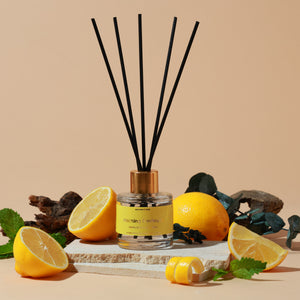
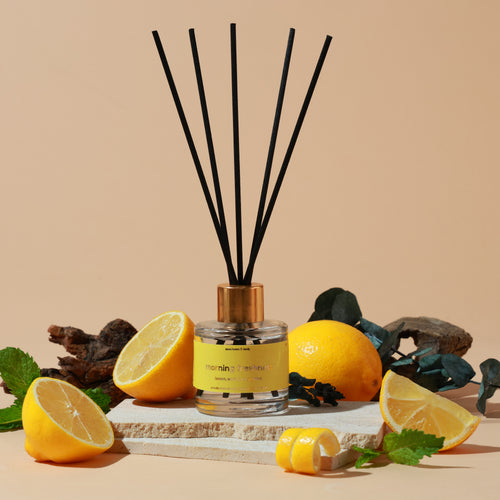
 Morning Freshness₹749The bowl, the whisk and any seating where matcha is tasted should carry nothing beyond what the matcha itself produces, with no exception for a separated corner or a quiet hour.
Which zones of a matcha café can carry fragrance
The zones look identical to a tea lounge's on paper — the difference is that matcha's fragility removes the one exception a tea lounge is allowed.
| Zone | Typical matcha café setup | Verdict | What governs it |
| Matcha whisking, preparation and tasting | The bowl, the whisk and the moment of service | Never scented | The most delicate product aroma in this cluster; treated as a tasting area at all times |
| Dining, seating and any lounge nook, however separated | Where matcha is drunk, even in a genuinely boundaried room | Never scented | Matcha's fragility, not the room layout, is what rules this out — the tea lounge exception doesn't transfer |
| Entrance or vestibule | A genuinely separate lobby with its own door and air volume | Sometimes, at a lower intensity than usual | Same real-boundary rule as elsewhere, dosed more conservatively |
| Washroom | Enclosed, away from matcha service | Usually, at a dry register, dosed lightly | The cluster's usual default allowance, at a reduced dose |
| Retail shelf selling packaged matcha or whisks, kept separate from service | A packaged-goods area rather than a preparation counter | Usually, at the same light dry register | Sells packaged goods rather than prepared matcha |
| A matcha café built inside the same building as a tea lounge concept doesn't inherit the tea lounge's exception — matcha's own fragility, not the room's layout or its neighbour's rules, is what governs the verdict here. | |||
Morning Freshness · light citrus and mint₹749Shop →  Sukoon · for a larger washroom suite₹1,899Shop →
  Vaayu · zoned, for a flagship matcha bar₹11,999Shop →
Why the dose needs to run lower than usual
Never extend the tea lounge's exception to a matcha café's separated seating area, however genuinely boundaried the room is — matcha's own fragility, not the room's layout, is the limiting factor here.
Sometimes a matcha café's washroom is genuinely larger, or part of a bigger flagship with a retail counter and an entrance lobby — in those cases the 130ml reed or Sukoon is the honest step up, still dosed more conservatively than the equivalent room in a coffee or dessert business.
Usually, the correct choice for a single washroom under 150 sq ft is a 50ml reed diffuser in Morning Freshness, run at a lighter dose than this cluster's usual six-reed default — a matcha café's nose is already being asked to do more delicate work than most, and the ambient fragrance around it should ask for correspondingly less attention.
What to buy, and at what scale
Matched first to keeping every scented zone away from matcha's own delicate aroma, and second to the room's actual square footage.
| Route | Premises | Why | What it costs |
| Do nothing | Whisking, preparation, dining, seating and any lounge nook, any size | Matcha's fragility rules out the lounge exception a tea business is otherwise allowed | No purchase |
| Reed diffuser, Morning Freshness, light dose | Washroom under 150 sq ft | A dry, clean register dosed below this cluster's usual floor | ₹749 |
| Reed diffuser, 130ml, Morning Freshness | 150–270 sq ft, a larger washroom or vanity area | Longer runtime and coverage, same conservative dose | ₹1,249–₹1,349 |
| Sukoon ultrasonic, low and steady | 270–320 sq ft, a washroom suite in a bigger matcha flagship | Consistent coverage across a larger shared space | ₹1,899 |
| Vaayu, wall-mounted per washroom | Several washrooms across a flagship matcha bar or small chain | Independent scheduling and a key-lock across multiple rooms | ₹11,999 per unit |
I think about matcha the way I think about the quietest fragrances in my own range — the ones where a heavy hand ruins the point of the thing entirely. Matcha's aroma is genuinely delicate, and I'd rather a café built around it use nothing at all than reach for a register dosed the way I'd dose one for a busier, louder business.
The question I hear most from matcha café owners is whether they can copy what a tea lounge down the street is doing with a separated seating nook. I understand the instinct — the two concepts look similar on a floor plan — but I always come back to the same point: the tea lounge exception exists because tea's own aroma can tolerate a little trace carry-over from a nearby room. Matcha can't, and no amount of clever layout changes that.
Where I do let a matcha café use fragrance, in the washroom or a genuinely separated entrance, I always ask for a lighter hand than I would anywhere else in this cluster — fewer reeds, a lower setting, a register that all but disappears next to the matcha itself.
Questions about scenting a matcha café
- Should a Tea Lounge Have a Signature Scent? — the related concept this page's exception explicitly doesn't extend to.
- Should a Minimal Japanese-Style Café Use Added Fragrance? — a neighbouring aesthetic that argues restraint from a different angle.
- What Should a Premium Dessert Café Smell Like? — a different reason for the same low-intensity, do-less answer.
- Which Areas of a Café Should Be Fragranced — and Which Shouldn't? — the baseline zone rules this page applies more conservatively.
- Brand: the SOSA founder story.
SOSA products & prices (verified September 2026): Reed diffusers 50ml ₹749–₹849 (to 150 sq ft, 6–8 weeks at six reeds) · 130ml ₹1,249–₹1,349 (above 150 sq ft, 14–18 weeks) · reed refill 300ml ₹2,399. Ultrasonic: Boond ₹899 (~150 sq ft) · Sukoon ₹1,899 (270–320 sq ft, ships with three 15ml Hotel Collection fragrances) · Megh ₹3,499 (6L tank, ~100 hrs runtime, ~215 sq ft — a runtime machine, not a coverage upgrade). Waterless cold-air: Safar ₹3,999 (no published coverage figure) · Vaayu ₹11,999 (up to 1000 m³, roughly 2,000–3,000 sq ft; 400ml tank lasting about 90+ days; app and onboard control, 1h/4h/8h/24h run windows, adjustable intensity, key-lock, under 38 dB, freestanding or wall/HVAC mount, 5W, CE/RoHS/SGS) · Aangan ₹25,999 (8,000–10,000 sq ft). Hotel Collection water-based fragrance 15ml ₹299 · 100ml ₹999 · 300ml ₹1,799 is for ultrasonic machines; reed oil and Hotel Collection are not interchangeable. Reed diffusers are alcohol-free, phthalate-free, paraben-free, IFRA-compliant and low VOC, handmade in small batches in Pune. Every purchase funds a girl's education through Nanhi Kali. Prices and availability subject to change — see the live product pages.