


Where it does not: treatment rooms, laser rooms, the peel room, the minor-procedure room, the photography bay and the consultation cabins — all fragrance-free — plus the post-procedure recovery chairs, which need distance rather than a door.
At what level: the lowest usable setting on the machine, set once in the first week and then key-locked. A 340 sq ft waiting area at a three-metre ceiling is about 95 m³, well under a tenth of what the Vaayu at ₹11,999 is rated for, which is exactly why it can sit at the bottom of its range all day. Ask the wing's dermatologists before purchase, not after.
2. Scent the waiting area and the corridor. Nothing else. Treatment rooms, laser rooms, the peel room, the minor-procedure room, the photography bay and the consultation cabins are all fragrance-free, with the doors shut. In a wing where patients are asked to uncover skin in most of those rooms, that list is not a concession and it is not negotiable.
3. Find the recovery chairs and put the machine as far from them as the room allows. Most cosmetology suites park two or three recliners just outside the procedure room, often in the waiting area behind a curtain. A curtain is not a door. If your recovery chairs are in the public room, the public room has a clinical corner in it and the machine belongs at the opposite end, ideally with eight or ten metres and a turn between them.
4. Run it at the lowest usable setting, and accept what that costs you elsewhere. One machine has one intensity. If this wing shares a lobby with the rest of the floor, then the whole lobby runs at the dermatology wing's level rather than the other way round, and your main reception will be a shade quieter than it could have been. That is the correct trade and I would rather state it than hide it.
5. The smells coming out of the rooms are not a fragrance problem. A coal-tar preparation, a sulphur wash, a keratolytic, the plume from a laser or an electrocautery session — these are the smell of medicine being used. They belong behind a shut door with a working extract, and the plume in particular wants an evacuator at the handpiece with a filter that is genuinely changed. Covering any of it in the corridor hides a door being left open.
6. Write the level into the wing's SOP so it cannot drift. Set it once in the first week by walking in cold, key-lock the machine, and record that anyone may lower it and nobody raises it. A wing full of people who are thinking about their skin will not complain twice.
A portion of every order supports girl-child education through Nanhi Kali.
Two populations, one row of chairs
The thing that makes this wing different from every other department in your building is not what happens in the rooms. It is who is sitting outside them. A dermatology and cosmetology waiting area holds two entirely different populations in the same row of chairs: a medical dermatology list — eczema, psoriasis, acne, urticaria, a contact-dermatitis review, a patch-test read — and a cosmetology list of peels, laser sessions, microneedling and threading. The first group is there because their skin is already the subject of a clinical conversation. The second group walks back out into those chairs minutes after a procedure has been performed on the skin of their face. No other department in a polyclinic arranges its waiting area quite like that, and it is the whole reason this page exists.
Room by room through a dermatology and cosmetology wing
Every room in a typical derm and cosmetology suite, what is actually in its air, whether it is scented, and who in your organisation gets to make that call. The last column is the one that matters most: in this department the decision belongs to a clinician far more often than it belongs to facilities, and a page that pretended otherwise would be selling you a problem.
| Room | What is in the air | Scented? | What it actually needs | Who decides |
|---|---|---|---|---|
| 1. The wing's waiting area and reception ★ | People, upholstery, and whatever escapes when a door opens | Yes — at the lowest usable setting on the machine | Ventilation and seating first, then one light scent held steady and key-locked | Dermatologists first, then facilities |
| 2. Treatment, laser and peel rooms | Topical preparations, alcohol wipes, and the plume from a laser or electrocautery session | No. Fragrance-free | A plume evacuator at the handpiece with a filter that is changed, and a working room extract | The clinician. Not negotiable |
| 3. Post-procedure recovery chairs | Nothing, and that is precisely the point | No. Outside the scent field entirely | Distance. The machine at the far end of the room, because a curtain is not a door | The clinician |
| 4. Consultation cabins and the photography bay | A patient who is often asked to uncover skin | No. Fragrance-free | Privacy, a door that closes, and light that is consistent enough to photograph under | The clinician |
| 5. The corridor between the rooms | Whatever leaves a room each time the door swings | Yes, as part of the wing's public volume | Door closers before anything else. A corridor smell means a door is standing open | Facilities |
| 6. The wing's stock room and its own office | Topicals, peels and consumables in one; one member of staff in the other | Stock room no; office yes if the person in it wants it | Shelving and temperature control for stock; an alcohol-free reed at ₹749 for the office | Pharmacist or quality lead |
Vaayu · lowest setting₹11,999Shop →  Reeds · the cabin only₹749Shop →
  The lightest of seven₹299Shop →
Lower, locked, and at the far end of the room
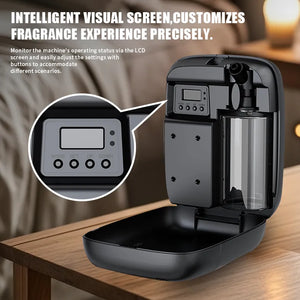
Start with the level, because it is the only decision on this page that cannot be undone by moving something. The setting for a dermatology waiting area is the lowest one at which the room is distinguishable from an unscented room, and the way you find it is not by turning a dial in an empty space — it is by walking in cold, first thing, before the wing fills, on four consecutive mornings with the machine set one step lower each day. You are looking for the morning on which you notice nothing at all. The correct setting is one step above that morning. It takes four days and it is the single most useful piece of commissioning anybody does in this department. Then key-lock it. The Vaayu has adjustable intensity and a physical key-lock, and in this wing the lock is not about the public at all — it is about a member of your own staff on a quiet afternoon deciding the room could do with a little more, which is exactly the decision the whole page is built to prevent. Placement follows: at the far end of the room from the recovery chairs, three or four metres in from any door, above waist height because a cold-air mist falls rather than rises, at the edge of the seating rather than in the walking line, and out of the direct throw of an air-conditioning vent. The Vaayu wall or HVAC mount is worth its fitting cost here because it takes the machine out of the visual field entirely, and in a wing where people are already paying attention to what is being done to them, a visible box that is obviously producing something is its own small problem.
Then the hours, and a specific one that is peculiar to cosmetology. Cosmetology lists run late. A dermatology outpatient clinic finishes when the doctor finishes, but a peel or a laser appointment at seven in the evening is ordinary, and the wing is frequently the last part of a medical centre still occupied. Which means the schedule for this wing is genuinely different from the schedule for the rest of the building, and if the wing shares a machine with the main lobby you will be running the lobby two hours longer than it needs. The Vaayu carries 1h, 4h, 8h and 24h onboard timers plus Bluetooth app scheduling, so the honest configuration is a schedule that matches the wing's own opening hours and stops with the last appointment rather than at the building's nominal closing time — and it does not run overnight into an empty suite, which is both a waste of oil and the one thing that guarantees the first person in on Monday morning walks into a level nobody chose. All day or peak hours only works through the scheduling question in general, and the rule it lands on applies here with particular force: nobody turns the level up because the wing got busy. Busy is an occupancy and air-change problem. A 400ml tank at the low intensity this wing runs at will outlast the seventy-five-day figure comfortably, which makes the refill line in whoever owns refilling and maintenance easier to write than it is anywhere else in the building.
Then the two things I would want written down, and the honest limits of the products. The first is the sentence your front desk says when a client asks — and in this wing they will ask, more often than anywhere else in your centre. Something close to: there is a light fragrance in the waiting area and none at all in any of the treatment rooms, it is switched off on request, and if you would prefer to wait somewhere else we will arrange it. Short, true, no claim of any kind attached, and it ends the conversation well; the full version of that answer is on its own page. The second is the rule about who can change the level, which belongs in the SOP rather than in somebody's memory, because the staff who work in this wing will stop being able to smell it within a fortnight — a nose reports change and discards constants — and the person least able to judge the level is therefore the person most likely to want it raised. On the products, plainly: the Vaayu at ₹11,999 is waterless, holds no standing water and runs its own undiluted oil rather than the water-based Hotel Collection bottles. The ultrasonic Sukoon at ₹1,899 and Boond at ₹899 hold standing water and add 30–50 ml of it to the air every hour, which makes them honest for the wing's own office, with a named person emptying and drying the tank daily, and wrong for the seating. An alcohol-free reed diffuser from ₹749 is genuinely alcohol-free and still belongs behind a door rather than at reach height in a public room. Candles are not appropriate in a healthcare building, because an open flame is a fire-safety matter rather than a fragrance one. And SOSA does not make a room spray, so the morning-spray option this wing sometimes asks about is not one we can supply.
The SOSA edit
In the order I would spend, for a medical centre with a dermatology and cosmetology wing. The first row is a conversation rather than a purchase, which is the correct shape for this department, and the last row prints the thing we do not make rather than leaving you to find out.
| Do this | What it is | When it earns its place | Cost |
|---|---|---|---|
| 1. Ask the wing's dermatologists ★ | A ten-minute conversation with the clinicians who see fragrance materials on a patch-test series as routine work | Before anything is ordered. They are the best-informed people in your building on this and it costs nothing | ₹0 |
| 2. Move the recovery chairs, or move the machine | Eight to ten metres and a turn in the plan between the post-procedure recliners and the diffuser | Second, and before purchase if you can, because it may change where the machine can go at all | ₹0 to a fit-out |
| 3. Plume evacuation and door closers | An evacuator at the laser or cautery handpiece with a filter that is changed, and closers on the treatment room doors | Third. A corridor that smells of a procedure is a door standing open, not a fragrance gap | Equipment supplier |
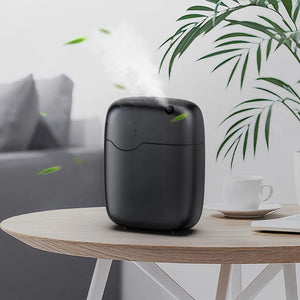
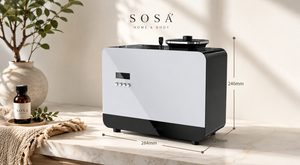
| 4. Vaayu for the wing's public volume | Waterless, up to 1000 m³, adjustable intensity, 400ml lasting about 75 days, app and timers, under 38 dB, key-lock | Fourth. Specified for how low it runs, not how far it reaches — about 95 m³ of actual scented space | ₹11,999 |
| 5. The scent, and only the lightest | Westin-inspired White Tea Serenity — white tea, aloe and cedar. Nothing floral, nothing sweet, nothing nameable | With the machine. If a client can tell you what it is, the level is already wrong for this wing | from ₹299 |
| Not appropriate here: reeds in the seating | SOSA reeds are alcohol-free and cost from ₹749, and they still belong in the wing's office behind a door | An open glass bottle of concentrated oil at reach height in a public room is a spill risk regardless of formula | — |
Versailles
I was asked into a cosmetology suite in Bengaluru by an owner who wanted the reception to feel like a good hotel, and I spent most of the visit doing something she had not asked for, which was counting chairs. There were four recliners behind a linen curtain at the end of the waiting room, three metres from where she wanted the machine, and people sat in them for twenty minutes after a peel. She had not thought of the curtain as a wall and neither, I suspect, had the architect. We moved the machine to the far corner by the entrance, dropped the setting two steps below what I would use in any other reception in the city, and that was the whole of my contribution.
What I have come to think about this wing is that it is the clearest example in the entire cluster of why restraint sells better than ambition. The clients in that room are paying close attention to their own skin, which means they are paying close attention to everything, which means the only version of this that works is one nobody can point at. A patient should not be able to tell you what the fragrance is. In a dermatology waiting area they should barely be able to tell you there is one. And the people whose opinion I would take over my own are the two dermatologists who work in that room every day, which is why the first row of my own buying table is a conversation rather than a product.
Everything is made and supported from Pune, and a part of every order funds girl-child education through Nanhi Kali. You get a space that smells like somewhere looked after; a girl gets a classroom. That equation has always felt right to me.
Frequently asked questions
- Which departments in a multi-speciality clinic should be scented and which should not? — the department map in full.
- How should a multi-speciality clinic handle patients who are sensitive to fragrance? — zoning and level, rather than a different bottle.
- Asthma, allergies and fragrance sensitivity: how should a medical centre decide where to scent? — the decision framework.
- Can a medical centre smell too strongly of fragrance? — what too strong actually looks like.
- Brand: the SOSA founder story.
Facts verified August 2026: Product facts used in this guide. SOSA Vaayu ₹11,999: waterless cold-air nebulising diffuser, atomises undiluted fragrance oil to a dry residue-free nano-mist with no water reservoir, coverage up to 1000m³ (approximately 2,000–3,000 sq ft), 400ml refillable tank lasting up to about 75 days per fill, Bluetooth app plus onboard control, 1h/4h/8h/24h timer scheduling, adjustable intensity, under 38 dB, DC 12V/1A at 5W, 165 × 80.5 × 215 mm and 0.9 kg, freestanding or wall or HVAC mounted, auto-stop and key-lock, CE, RoHS and SGS certified, supplied with four hotel-inspired fragrances. SOSA Aangan ₹25,999: HVAC-connected or standalone commercial nebulising diffuser, coverage up to 3,000m³ (roughly 8,000–10,000 sq ft), 800ml reservoir, metal body, programmable schedules, under 42 dB. Ultrasonic machines are water-based, hold standing water and consume 30–50 ml of water an hour: Sukoon ₹1,899 (500ml, 270–320 sq ft, 16–18 hours on low, 3–6 drops per tank, steady/2H/4H timers, three 15ml Hotel Collection scents included), Boond ₹899 (300ml), Megh ₹3,499 (6 litres). Hotel Collection water-based fragrance 15ml ₹299, 100ml ₹999, 300ml ₹1,799, Pack of 7 at 15ml ₹1,799 against ₹2,093 bought singly; the Vaayu and Aangan take their own undiluted oil rather than these water-based bottles. Alcohol-free reed diffusers from ₹749, requiring 24–72 hours to reach their working level. Free shipping above ₹499. Coverage arithmetic: cubic metres equal floor area in square feet divided by 10.76 and multiplied by ceiling height in metres, counting only the volumes that are actually scented. This guide makes no medical, therapeutic or clinical claim of any kind for fragrance: a diffuser does not purify, disinfect or clean air, and does not treat, calm or affect any patient or condition. Fragrance is housekeeping and presentation. Clinical areas should be left fragrance-free, and a persistent odour should be traced to its source and corrected rather than covered. SOSA is not affiliated with or endorsed by any hotel brand. Prices subject to change — see the live product pages.