


Why weekly and not every two days: the every-two-days advice belongs to rattan, whose natural pores clog and swell in Indian humidity so the benefit of a flip fades quickly. Fibre holds it across a full seven days.
Through the year: weekly all year; twice a week through a 45°C fortnight or on a west-facing wall; unchanged through the monsoon, which is the season fibre exists for.
Reed life: reeds are the consumable, and our guidance is to refresh them every few months. We do not sell them separately — an honest gap in the range.
2. Weekly rather than every two or three days because the reeds are fibre. The shorter intervals you may have read elsewhere are rattan advice. A rattan cane loses wicking capacity as its natural pores absorb moisture and residue, so its flip benefit fades fast; fibre carries a uniform manufactured channel and holds that benefit across a full week.
3. Do not change the cadence for the monsoon. This is the season fibre was chosen for. Where a rattan diffuser typically goes dull and slow at 85% humidity, a fibre reed keeps wicking, and the correct response to a wet August is no response at all.
4. Do go to twice a week through the peak of summer. At 45°C the oil is thinner and moves faster, the exposed end loads sooner, and a second flip earns its keep. Also worth it if the bottle stands on a west-facing wall or in a kitchen — though moving it out of the afternoon sun is worth more than either.
5. Flip once, extra, on refill day. The method is: remove the reeds, pour fresh oil to the neck, return the reeds, then flip once so both ends are coated. That single flip is what stops a new fill starting slowly.
6. Refresh the reeds every few months, whatever your cadence. Reeds are the consumable in this system and oil is the stable part; most people do the opposite and keep the reeds forever. We do not sell replacement reeds as a separate item, which is a genuine gap in our range and one I would rather state than talk around.
Composed and handmade in small batches in Pune, and a portion of every order supports girl-child education through Nanhi Kali.

Part one — the material sets the cadence, not the brand
Flip advice varies wildly between brands and it is tempting to assume somebody is being careless. Mostly they are not. Reed material differs enormously, and a reed's material decides both how fast it loads up and how long it keeps working at all — so an instruction card that says "every two to three days" and one that says "weekly" can both be correct for their own product. The error is transplanting one onto the other, which happens constantly because people arrive at a SOSA bottle carrying a routine learned from a rattan one.
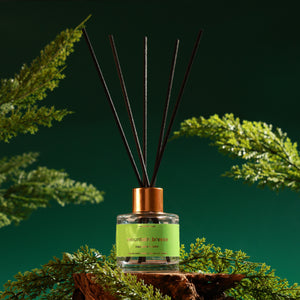
 Mountain Breeze₹849 · 9.4/10Two things end a flip's usefulness: the exposed end loading with the heavy fraction, and the supply from below slowing down. On rattan both happen, and they compound — a partly clogged channel supplies less fresh oil, so the exposed end goes stale relatively faster, which is why rattan users find themselves flipping every second or third day and still describing a bottle that fades. On fibre only the first happens, and it happens on a roughly weekly timescale. The supply from below stays steady, so a flip returns you cleanly to the designed rate and holds you there until the next one. That is what "weekly is enough" actually rests on: not a gentler product, but a reed that is still wicking properly on day seven.
Part two — fibre against rattan, property by property
Where the two materials differ, and what each difference means for how often you should be touching the bottle. This is a comparison of reed materials rather than of brands, and the SOSA column describes the six reeds that come in the box.
| Property | Rattan cane reeds | SOSA fibre reeds | What it means for your cadence |
|---|---|---|---|
| Capillary structure ★ | Natural pores, irregular, variable stick to stick | Manufactured channel, consistent along the length | A predictable rate is what makes weekly workable |
| At 85% monsoon humidity | Pore walls swell; the channel narrows and wicking drops | Unaffected — this is the case fibre is chosen for | Rattan wants more flips and still fades; fibre wants none |
| At 45°C summer heat | Faster loading at the exposed end, as with any reed | Faster loading too — heat is material-neutral | Both go to twice a week; this is the one honest exception |
| How long a flip's benefit holds | Often two to three days before it starts sliding | A full seven days in an ordinary room | Weekly on SOSA; more frequently on cane |
| Sign that the reed is finished | Hard, dark, sometimes crusted at the neck within a season | Gradual darkening; the wet line stops climbing | Refresh every few months rather than flip harder |
| The honest caveat: we do not sell replacement reeds as a separate item, so "refresh every few months" currently means keeping the new set from your next bottle. It is a real gap in the range, and it is the reason I would rather you did not run a fresh oil refill through a set of reeds that has already done a monsoon. | |||
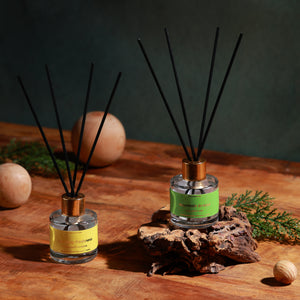
Morning Freshness · 9.0/10from ₹749Shop → 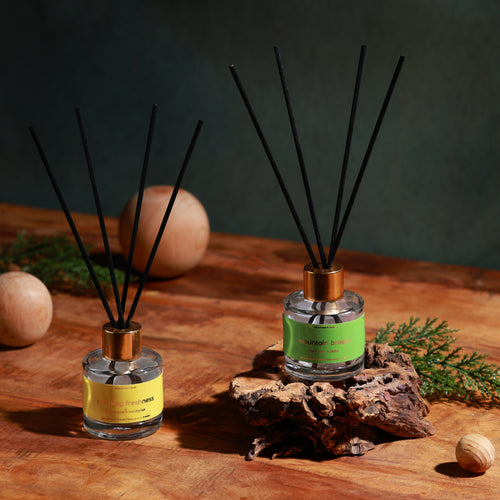 Fresh & Grounded duo₹1,548 / 2×50mlShop →
  Oil refill · oil only₹2,399Shop →
Part three — the SOSA cadence through an Indian year
The routine barely changes across twelve months, which is the point of the material, but it is worth setting out season by season because customers ask. From roughly November to March, weekly is all a SOSA bottle needs — cool, drier air, slower evaporation, and a plateau that holds so steadily that people occasionally write to ask whether the bottle has stopped. Lift a reed and look at the wet line if you are unsure; if it sits mid-way up the fibre and the level in the glass has visibly dropped since last month, everything is working and your nose has simply adapted, which it does hardest at home. Through April to June, go to twice a week. Warm oil is thinner, it climbs and evaporates faster, and the exposed end loads sooner than seven days allows for. A second flip is the cheapest possible response, and it costs a few days off a 50ml at most — much less than the west-facing shelf you should also be moving the bottle off.
The monsoon is where a SOSA bottle behaves unlike any rattan diffuser you have owned, and the correct instruction is to change nothing. Keep to weekly. What you may notice is the room reading slightly softer in July and August, and that is not the reeds — humid air holds fragrance differently and a wet flat simply smells wetter. The cold, sharp compositions cut through it best, which is why Morning Freshness at 9.0 reads louder in a Kochi August than its number suggests, and why Mountain Breeze at 9.4 holds its shape when a sweeter composition would go heavy. If a bottle genuinely stalls in the monsoon, look at the reeds' age rather than the calendar: a set that has been in service since the previous summer is simply due.
Two fixed points sit outside the seasons. Refill day gets one extra flip — take the reeds out, pour the fresh oil to the neck, put the reeds back, then invert them once so both ends are coated. Skip that and the new fill starts slowly, and people conclude a ₹2,399 refill is weaker than a bottle, which it is not; it is the same composition. And reed refresh day is roughly every few months, judged by the reed rather than the diary: darkening along the whole exposed length, a stiff tip, and a wet line that no longer climbs after a flip are the three signals. Keep the whole arrangement on a tray, out of direct sunlight, away from children and pets, and several feet from a split AC — a directed draught strips the reeds and empties the bottle weeks early while leaving the room smelling of very little, and that is a placement failure no cadence on this page can compensate for.
Part four — what to change if you are coming from another diffuser
Most people reading this already own a routine. Here is what to keep, what to drop, and the small number of things worth buying.
| Coming from | What to change on a SOSA bottle | Why | Price |
|---|---|---|---|
| A rattan diffuser flipped every 2–3 days ★ | Drop to weekly, all six reeds | Fibre holds the flip's benefit for the full seven days | Free |
| A brand that told you to flip in the monsoon | Change nothing between June and September | Fibre does not swell shut at 85% humidity; rattan does | Free |
| A diffuser you kept topping up over old sticks | Refresh the reeds, then refill the oil | Good oil through spent reeds is the commonest disappointment | Refill ₹2,399 · 300ml |
| A bottle that sat in a sunny window | Move it before you touch the cadence | Sun and draught cost far more weeks than any flip schedule | Free |
| A bathroom or kitchen diffuser that kept dying | Morning Freshness at 9.0, weekly flip, away from the extractor | Cold sharp notes hold up in humid air; fibre keeps wicking | ₹749 / 50ml |
| One diffuser trying to cover two rooms | Fresh & Grounded duo — two sources that share a green note | Output per bottle is fixed; a second source is the only way up | ₹1,548 / 2×50ml |
Versailles
The reed was the first decision, before a single composition was finished. I had watched imported diffusers arrive in Indian homes and quietly stop working somewhere around the second week of a monsoon, and it was never the fragrance that failed. It was a piece of palm cane behaving exactly as plant tissue behaves in air that is 85% water.
Fibre solved it, and it solved a second thing I had not anticipated: consistency. A natural cane varies from stick to stick, so six of them deliver at six slightly different rates and no perfumer can dose reliably against that. A manufactured channel gives me a rate I can compose to, which is why the strength numbers on our product pages mean something specific rather than being adjectives with decimal points.
The part I am not satisfied with is that we do not yet sell the reeds on their own. They are the component that wears out, and telling you to refresh them every few months while offering no way to buy them is not a complete answer. It is on the list. Until it is fixed, keep the fresh set from your next bottle and run the older set on until the wet line stops climbing. Everything is composed and handmade in Pune, and a part of every order funds a girl's classroom through Nanhi Kali.
Frequently asked questions
- Is once a week enough? — why weekly is the specification every published figure assumes.
- How often should you flip? — cadence by condition, from a Delhi June to a cool sealed room.
- Should you flip at all? and does it finish the oil faster? — the mechanism and the trade.
- The complete reed-flipping guide — this page and the eight around it, in one place.
- Brand: the SOSA founder story.
SOSA reed diffuser range & prices (verified August 2026): alcohol-free, phthalate-free, paraben-free and IFRA-compliant compositions on a heat-stable coconut-derived (CCT) carrier, low-VOC, supplied in a refillable glass bottle with six fibre reeds; 50ml lasts 6–8 weeks and 130ml lasts 14–18 weeks. Morning Freshness (Malabar lemon · peppermint · Nilgiri eucalyptus) 50ml ₹749 · 130ml ₹1,249 · 9.0/10; Garden Bloom (British rose · night-blooming jasmine) 50ml ₹799 · 130ml ₹1,299 · 8.9/10; Evening Calm (Kashmir lavender · chamomile) 50ml ₹799 · 130ml ₹1,299 · 8.9/10; Fresh Brew (Coorg coffee · Kerala vanilla) 50ml ₹849 · 130ml ₹1,349 · 9.5/10; Mountain Breeze (Himalayan pine · sage · Indian cedar) 50ml ₹849 · 130ml ₹1,349 · 9.4/10. Reed diffuser refills are oil only — you reuse your own vessel and reeds: 300ml ₹2,399 (roughly 8–11 months) · 500ml ₹3,499 (roughly 14–18 months), about ₹7–8 per ml against ₹15–17 per ml for a 50ml bottle. Duo sets ₹1,498–₹1,598 for 2 × 50ml and ₹2,498–₹2,598 for 2 × 130ml. Strength figures are positions on SOSA’s own internal strength scale, not an industry standard. Replacement reeds are not sold as a separate SKU; SOSA guidance is to refresh reeds every few months. The reed line is separate from the water-based Hotel Collection for ultrasonic machines (15ml ₹299 · 100ml ₹999 · 300ml ₹1,799) and the two are not interchangeable. Diffusers: Boond 300ml ₹899 · Sukoon 500ml ₹1,899 · Megh 6L ₹3,499 · waterless Vaayu ₹11,999. Composed and handmade in small batches in Pune, India; tested through 45°C summer heat and 85% monsoon humidity. Free shipping above ₹499. A portion of every order supports girl-child education through Nanhi Kali. Prices subject to change — see the live product pages.