



The hosting number: nine, added about two hours before people arrive so the room has time to fill.
The festive number: ten, for a week rather than a season. Expect a 50ml to run 4–5 weeks if you leave it there.
The cost of staging: two days at nine reeds instead of six consumes, very roughly, the oil of an extra day. Two months at nine costs you two or three weeks.
2. Stage to nine when you want the room to feel occupied. Three extra reeds is the step that reads as a genuinely fuller room. Add them roughly two hours before guests, not as the doorbell goes — the room needs time to fill, and the change is gradual rather than instant.
3. Take them out again. This is the part people forget, and it is the part that makes the whole technique cheap. Pull the extra reeds on Sunday morning, stand them upright in a small glass beside the bottle, and the release rate settles back within a day.
4. Ten is a festive week, not a lifestyle. For Diwali, a house full of relatives, or a long weekend of entertaining, ten reeds is reasonable. Left in permanently it takes a 50ml to roughly 4–5 weeks from 6–8.
5. Never stage a bedroom or a nursery. Those rooms want fewer reeds, not more — four is a deliberate, gentle configuration that also outlasts the stated window. Evening Calm at 8.9 is built quiet on purpose.
6. Handle the spare reeds properly. Gloves on, and stand them in a glass rather than laying them on a surface. Reed oil marks wood and stone, and the bottle itself should live on a tray.
7. Free moves first, as always. Flip all six and check the bottle is in gently passing air before you stage anything. Staging into dead air raises the concentration in a pocket nobody stands in.
Composed and handmade in small batches in Pune, and a portion of every order supports girl-child education through Nanhi Kali.
Part one — how to stage a reed count properly
Staging is a small technique with three details that decide whether it works, and all three are about timing rather than quantity. A reed diffuser is a slow instrument; it responds to a change in count over hours, not minutes, because the newly added reeds have to draw oil up their length before they contribute anything at all. The commonest way to be disappointed by staging is to do it too late — pushing three reeds into the bottle as the first guest takes their shoes off, then concluding that reed count does not do very much. It does. It simply does it on its own schedule, and the whole art is in working backwards from when you want the room to be at its best.
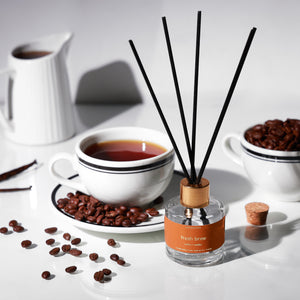
 Fresh Brew₹849 · 9.5/10Six to nine is the step worth taking, and it is worth taking in one move rather than creeping up a reed at a time over an afternoon. The room reads clearly fuller and the bottle stays mechanically comfortable — the neck is not crowded, every reed still wicks evenly, and nothing creeps down the outside of the glass onto your furniture. Going straight to twelve for a party is the mistake that turns a warm room into a heavy one, particularly with the richer compositions in a flat with the windows shut. If you are hosting in a small living room, nine is plenty; ten if the space is genuinely large or opens onto a dining area. And remember what staging cannot do: it cannot make a fragrance louder than the composition was built to be. Evening Calm at nine reeds is a slightly fuller sleep fragrance, not a hosting one.
Part two — a staged week, hour by hour
This is my own household routine written out, using a 50ml bottle of a hosting fragrance in a living room. The counts are the whole system; nothing else changes across the week.
| When | Reeds in the bottle | What you do | What the room is like |
|---|---|---|---|
| Friday, mid-afternoon ★ | Six to nine | Add three reeds, gloves on, and leave the room alone | Building. Noticeably fuller by early evening |
| Monday to Thursday | Six | Nothing at all | The everyday level the composition was dosed for |
| Sunday evening, weekly | Six | Flip all six reeds, the standing maintenance job | Recovers over a few hours to full designed rate |
| Friday evening, guests | Nine | Close the room an hour before, if you can | Full and immediately obvious on entering |
| Saturday, all day | Nine | Nothing — let it run | Holds. This is the plateau at a higher count |
| Sunday morning | Nine back to six | Remove three reeds, stand them upright in a glass | Settles back over the course of the day |
| The honest caveat: staging changes how much fragrance the bottle releases; it does not change where that fragrance goes. If the bottle sits in an alcove, behind a sofa or inside a cabinet, nine reeds will produce a stronger pocket of air in exactly the place nobody stands. Get the bottle onto a console or open shelf near a doorway at waist to chest height first, several feet clear of an AC vent, and out of direct sun. Placement is free and it multiplies everything a reed count does. | |||
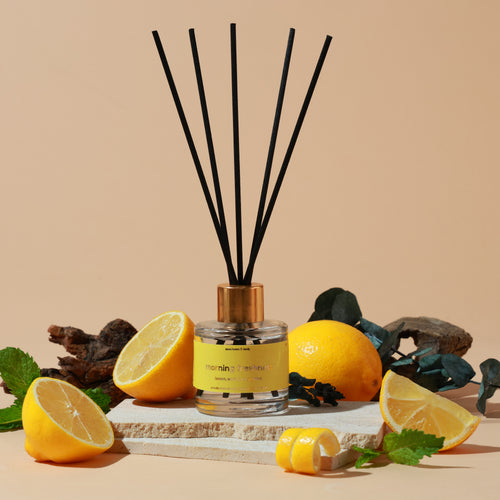 Morning Freshness · 9.0/10from ₹749Shop →
 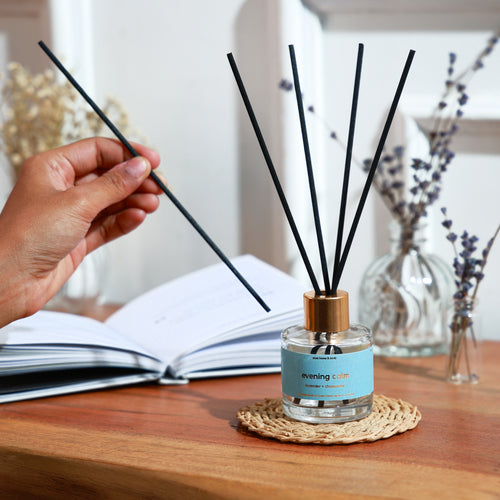 Evening Calm · 8.9/10from ₹799Shop →
 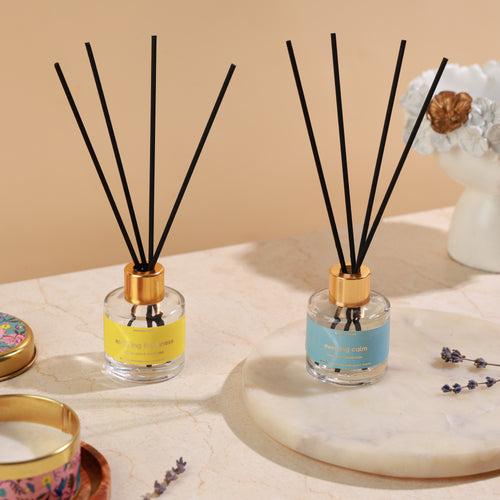 Day & Night duo₹1,498Shop →
Part three — when a high count should simply become permanent
Staging is the right answer when the strength you want is occasional. Sometimes it is not, and then the honest thing is to stop pretending and settle at a higher standing count with your eyes open. If you have found that eight reeds is what your living room needs on a Tuesday as much as a Saturday, run eight reeds and plan for a 50ml to last something like five to six weeks rather than six to eight. There is nothing wrong with a permanently high count as long as you are not surprised by the reorder date — the disappointment people report is almost never about the fragrance and almost always about a bottle finishing sooner than the label led them to expect, having quietly added four reeds two months earlier and forgotten.
If a permanent high count is where you have landed, two things change. The first is maintenance: more fibre means more total surface accumulating the heavy end of the composition, so the weekly flip stops being optional. A ten-reed bottle that is never flipped can end up delivering less than a well-flipped six-reed one while consuming oil at ten-reed speed, which is the worst of both. The second is running cost. Halving a bottle's life roughly doubles what the habit costs per month, and the sensible response is to change the price of a millilitre rather than to accept it: an oil refill is ₹2,399 for 300ml, which works out at roughly ₹7–8 per millilitre against ₹15–17 for a 50ml bottle, and lasts about 8–11 months in ordinary use. You reuse your own vessel and reeds — the refill is oil only, with no reeds in the box, and we do not sell reeds separately, which I would rather tell you here than have you discover on delivery.
The other direction is worth naming too, because "how many reeds for stronger fragrance" is sometimes asked by somebody who should be asking the opposite question. Bedrooms, nurseries, small sealed rooms and homes with anyone sensitive to fragrance want four reeds, not nine. Four in a 50ml is a deliberate configuration rather than a compromise: gentler in the room, and comfortably beyond the stated eight weeks. Running Evening Calm at four reeds beside a bed is one of the nicest things this format does, and staging it upward would defeat the entire point of the composition. Two rooms in the same flat can perfectly well run different counts of different scents; if they share air, choose two that meet on a note — Morning Freshness and Mountain Breeze meet on green eucalyptus.
Part four — staging plans by occasion
Common situations, with when to add, what to add to, and when to take them out again. The final row is the one people ask about most and it is the one where staging is not the answer.
| Occasion | Stage up to | Add them | Return to six | Roughly what it costs |
|---|---|---|---|---|
| Dinner for six ★ | Nine reeds | Mid-afternoon, same day | Next morning | Well under a day of bottle life |
| Weekend house guests | Nine reeds | Friday afternoon | Sunday morning | On the order of a day |
| Diwali or a festive week | Ten reeds | The day before it begins | When the week ends | A few days — worth it once a year |
| A flat viewing or a photo shoot | Nine reeds | The night before | Straight afterwards | Under a day |
| A muggy monsoon evening indoors | Eight reeds | Late afternoon | The following day | Negligible |
| Your living room every day | Settle at eight permanently | Once, and leave them | Not applicable | 5–6 weeks on a 50ml instead of 6–8 |
| A bedroom or nursery | Do not stage — go down to four | Not applicable | Not applicable | Gentler, and beyond the stated eight weeks |

Versailles
I learned staging by accident, in my own flat, the week I had too many people coming and not enough time to do anything about the house. I pushed three spare reeds into the living room bottle at four in the afternoon because it was the only thing I could think of that took ten seconds. By seven the room was exactly what I had wanted and could not have bought at short notice. On Sunday I pulled them out again, and the bottle finished more or less on schedule.
Since then it has become the thing I tell people first when they ask about reed count, because it reframes the question. The number is not a verdict on your room or your taste. It is a dial, it moves in both directions, and the only reason most people never move it is that nobody has said out loud that you are allowed to.
The one discipline it requires is remembering to turn it back down. A reed diffuser is a quiet object and it is easy to forget what you did to it a month ago; if a bottle finishes early and you cannot think why, count the reeds. Everything is composed and handmade in Pune, and a part of every order funds a girl's classroom through Nanhi Kali.
Frequently asked questions
- Does adding more reeds make it stronger? — where the gain curve flattens and the cost does not.
- Should I flip the sticks to make it stronger? — the free move to make before staging anything.
- How to make a reed diffuser smell stronger and how to increase scent throw.
- The complete guide to stronger performance — this page and the eight around it, in one place.
- Brand: the SOSA founder story.
SOSA reed diffuser range & prices (verified August 2026): alcohol-free, phthalate-free, paraben-free and IFRA-compliant compositions on a heat-stable coconut-derived (CCT) carrier, low-VOC, supplied in a refillable glass bottle with six fibre reeds; 50ml lasts 6–8 weeks and 130ml lasts 14–18 weeks. Morning Freshness (Malabar lemon · peppermint · Nilgiri eucalyptus) 50ml ₹749 · 130ml ₹1,249 · 9.0/10; Garden Bloom (British rose · night-blooming jasmine) 50ml ₹799 · 130ml ₹1,299 · 8.9/10; Evening Calm (Kashmir lavender · chamomile) 50ml ₹799 · 130ml ₹1,299 · 8.9/10; Fresh Brew (Coorg coffee · Kerala vanilla) 50ml ₹849 · 130ml ₹1,349 · 9.5/10; Mountain Breeze (Himalayan pine · sage · Indian cedar) 50ml ₹849 · 130ml ₹1,349 · 9.4/10. Reed diffuser refills are oil only — you reuse your own vessel and reeds: 300ml ₹2,399 (roughly 8–11 months) · 500ml ₹3,499 (roughly 14–18 months), about ₹7–8 per ml against ₹15–17 per ml for a 50ml bottle. Duo sets ₹1,498–₹1,598 for 2 × 50ml and ₹2,498–₹2,598 for 2 × 130ml. Strength figures are positions on SOSA’s own internal strength scale, not an industry standard. Replacement reeds are not sold as a separate SKU; SOSA guidance is to refresh reeds every few months. The reed line is separate from the water-based Hotel Collection for ultrasonic machines (15ml ₹299 · 100ml ₹999 · 300ml ₹1,799) and the two are not interchangeable. Diffusers: Boond 300ml ₹899 · Sukoon 500ml ₹1,899 · Megh 6L ₹3,499 · waterless Vaayu ₹11,999. Composed and handmade in small batches in Pune, India; tested through 45°C summer heat and 85% monsoon humidity. Free shipping above ₹499. A portion of every order supports girl-child education through Nanhi Kali. Prices subject to change — see the live product pages.