

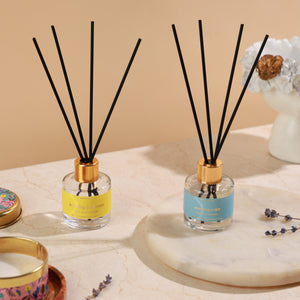



What that costs: ₹1,249 + ₹749 + ₹1,299 + ₹799 = ₹4,096.
What gets nothing: the stairwell, the landing and the kitchen. Buy for the lower floor first — scent travels up the stair, never down it.
2. Count each floor separately, then account for the stair once. The mistake is to treat a duplex as one large flat and reach for a bigger bottle. There is no bottle size that reaches from a ground-floor sofa to a first-floor bedroom. Each floor is its own set of enclosures and has to be counted as one, exactly as you would count two separate flats — and then you make a single adjustment for the fact that they are joined by an open shaft.
3. That adjustment goes one way only: upward. Warm air rises, and the stairwell is the path it takes. A reed diffuser in the lower living room contributes something to the upper landing and to whatever rooms open off it with their doors ajar. The reverse never happens. Scenting the upper floor and hoping it drifts down is the single commonest waste of money in a duplex. Buy downstairs first.
4. The stairwell and the landing get nothing. A stairwell is a moving column of air — that is what a chimney is — and a passive evaporative source cannot build a steady concentration in air that is being replaced continuously. A bottle placed on a stair windowsill or a landing console will empty at the usual rate and produce almost nothing you can detect. If the top of your stairs smells pleasant, that is the living room's bottle arriving, not the landing's. Do not buy a second one to explain a smell you are already getting free.
5. Two bottles is a legitimate duplex, if the budget says so. One 130ml in the lower living-dining and one 130ml in the master bedroom — ₹1,249 + ₹1,299 = ₹2,548 — puts a bottle in the main room of each floor and lets the stair do the rest. It is a noticeably better outcome than four 50ml bottles spread thinly across four rooms for ₹3,096, because two of those four would be in spaces nobody occupies.
Made in India, composed by an ISIPCA Versailles-trained perfumer — and a portion of every order supports girl-child education through Nanhi Kali.
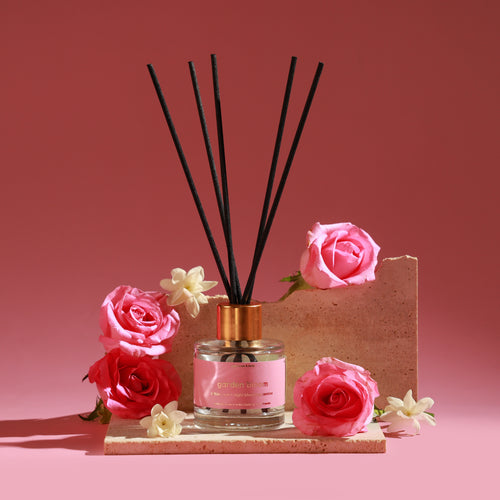
Two volumes and a chimney between them
The coverage figure for a reed diffuser — up to about 150 sq ft on six reeds — assumes a closed room with still air. A duplex breaks that assumption in a specific and predictable way. The stairwell is a permanent vertical opening between two floors, and because warm air is less dense than cool air, it rises through that opening continuously. In practice the lower floor is always feeding the upper one: cooking, incense, the living room diffuser, all of it drifts up. This is why the top of a duplex staircase so often smells better than anywhere else in the house — it is standing in the flow, receiving the accumulated output of the entire floor below. It is also why nobody should buy a bottle for it.
The consequence for counting is straightforward. Each floor is a set of enclosures — living-dining, kitchen, bedrooms, bathrooms — and within a floor the ordinary rules apply: a closed door is a boundary, a room over about 150 sq ft of still air needs more than one source, a room nobody uses needs none. Between floors there is one asymmetric link. The lower floor subsidises the upper; the upper subsidises nothing. Two further points follow. First, ventilation is stronger in a duplex than in a single-floor flat of the same area, because the stack effect keeps air moving even with the windows shut, so expect every bottle to read slightly lighter than it would in a flat. Second, a double-height void over the living room is not covered by the floor-area sum at all — 280 sq ft under an eighteen-foot ceiling is close to 5,000 cubic feet, roughly twice the air a standard room of that size contains, and coverage is a cubic quantity that we quote in square feet only out of habit.
The three decisions for a two-floor home
 Four bottles₹4,096Walk each floor as if it were its own flat and count the enclosures you actually occupy. Downstairs that is usually the living-dining and a powder room; upstairs it is the bedrooms. Two bottles per floor is the answer in most duplexes, and it holds whether the home is 1,200 sq ft or 1,700, because what changes with area is room size — which sets the bottle you buy — and not the number of enclosed spaces anybody uses.
Sizing by space — a two-floor home, floor by floor
The standard 1,400 sq ft duplex, space by space. Two rows come to ₹0, and one of them is the surface you were probably planning to use.
| Space | What it needs | How many | Cost |
|---|---|---|---|
| Lower floor living-dining, about 280 sq ft, stair opening off it ★ | One 130ml on six reeds, placed near the seating and not at the foot of the stairs | One | from ₹1,249 |
| Upper floor master bedroom, door closed at night | One 130ml on four reeds — the second purchase, after the lower living room | One | from ₹1,249 |
| Upper floor second bedroom or study, used nightly | One 50ml on three reeds — small, enclosed, and it receives nothing from the stair with its door shut | One | from ₹749 |
| Lower floor powder room or guest washroom | One 50ml on two reeds — the room visitors are most likely to use | One | from ₹749 |
| The stairwell, the landing, and the lower kitchen | Nothing. Air moves through a stairwell all day and the kitchen has its own dominant smell | None | ₹0 |
| A double-height void over the lower living room | Roughly twice the air volume for the same floor plate — add a second source at seating level | Two | ₹2,498 |
| A note on all of the above: the four-bottle list totals ₹1,249 + ₹749 + ₹1,299 + ₹799 = ₹4,096, and the two-bottle version is ₹1,249 + ₹1,299 = ₹2,548. Duplexes ventilate harder than single-floor flats because the stack effect moves air even with the windows shut, so expect every figure here to read slightly lighter than the same bottle would in a flat. | |||
One room · the unitFrom ₹749Shop → 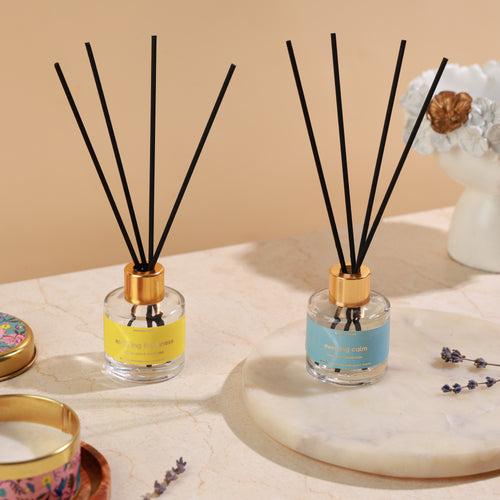 Two rooms · better value₹1,498Shop →
  Large room · a switch₹1,899Shop →
Placement on a stair, reeds and refills
Place the lower bottle away from the stair foot. This is the one placement decision unique to a duplex and it is worth getting right. A reed diffuser needs gentle air movement to distribute, but there is a difference between gentle movement and a one-way flow into a shaft. Set the bottle at the stair foot and the convection current takes a large share of the output upward before the seating area has had any of it — you end up with a landing that smells lovely and a living room that does not, which is precisely backwards. Put it on a console or sideboard near where people sit, ideally across the room from the stairs. Keep it out of direct sunlight, out of the direct path of an AC vent, off polished wood and out of reach of children and pets.
Then set the reeds differently on each floor. Reed count is the only volume control a reed diffuser has, and it is not a free upgrade — more reeds means more presence and faster consumption at the same time. Downstairs, in a living-dining that people arrive into with a fresh nose, six reeds is right. Upstairs, in a bedroom occupied for eight hours at a stretch, four is plenty, and the bottle will run several weeks longer as a result. That difference is useful in a duplex for a reason beyond comfort: it staggers your reordering naturally, so the four bottles do not all empty in the same fortnight. If a room reads quiet, add one reed and wait forty-eight hours before judging — reeds have to saturate along their full length before they throw properly.
Then refill rather than rebuy, and use two scents, not four. A 300ml refill at ₹2,399 fills a 130ml roughly twice, and refilling is the natural moment to fit fresh reeds, since clogged fibre is the usual reason throw drops off after a few months. On scent: because the stair mixes the two floors in one direction, four different blends across a duplex will meet each other on the landing and read as confusion. Use one blend for the whole lower floor and one for the upper. Morning Freshness downstairs and Evening Calm upstairs is the arrangement that survives the stairwell best, because what arrives at the top is a lemon-and-mint trace meeting lavender rather than two florals fighting.
What to buy
The duplex list in buying order — lower floor first — plus what the other formats are genuinely for across two floors.
| Buy | What it covers | Lasts | Price |
|---|---|---|---|
| One 50ml | A single reed diffuser — the powder room downstairs and the second bedroom upstairs — the two small enclosures | 6–8 weeks | from ₹749 |
| One 130ml ★ | The value size — the lower living-dining first, then the upper master bedroom — the two rooms that decide the house | 14–18 weeks | from ₹1,249 |
| The duo | Day & Night duo — one floor solved in a single purchase, with two blends composed to sit beside each other | 6–8 weeks each | ₹1,498 |
| Sukoon | 500ml ultrasonic — a lower living-dining with a double-height void, where you want a switch rather than a permanent source | Runs when you switch it on | ₹1,899 |
| 300ml refill | The running cost — a four-bottle home, where the running cost matters more than the first order did | Roughly 2 × 130ml fills | ₹2,399 |
Versailles
People with duplexes ask me for the biggest bottle we make, and I have to explain that there is no bottle size that climbs a staircase. You have two homes stacked on top of each other with a shaft between them. Count them as two. It sounds like more work and it is actually less, because each floor turns out to need about two bottles and the whole thing resolves in an afternoon.
The landing is where I have to talk people out of a purchase most often. It is a beautiful spot for a bottle — there is usually a console, often a window — and it is the one place in the house where a diffuser will do the least. Air is going past it, not sitting in it. What people are smelling at the top of the stairs is the living room downstairs arriving after a day of quietly climbing. That is free. Do not buy it twice.
So: the lower living room first, ₹1,249. The master bedroom second, ₹1,299. If you stop there at ₹2,548 you have a house that reads as scented on both floors. The powder room and the second bedroom take it to ₹4,096 and are worth adding when you feel like it, not before. A portion of every order funds a girl's classroom through Nanhi Kali.
Frequently asked questions
- How many for a 1,500 sq ft home? — nine doors, five that matter.
- Does a corridor count as a room? — transit space, one exception.
- Rooms or square feet? — the three-step method.
- The complete sizing and quantity guide — every home type, three builds.
- Brand: the SOSA founder story.
SOSA products & prices (verified August 2026): Hotel Collection water-based ultrasonic diffuser fragrance 15ml ₹299 · 100ml ₹999 · 300ml ₹1,799 · Pack of 7 (15ml, all fragrances) ₹1,799; refills 100ml from ₹999. Seven scents: The Ritz-Carlton-inspired (white tea · bergamot · cedar), Westin-inspired (white tea · aloe · cedar), 1 Hotels-inspired (cedarwood · vetiver · green leaves), The St. Regis-inspired (amber · violet · woods), Shangri-La-inspired (jasmine · green tea · white tea), Four Seasons-inspired (citrus · floral · sandalwood), W Hotels-inspired (citrus · pepper · amber). Diffusers: Boond 300ml ₹899 · Sukoon 500ml ₹1,899 · Megh 6L ₹3,499. Water-based, phthalate-free, composed to IFRA standards for home diffusion; 3–6 drops per tank. Made in India, Pune. The Hotel Collection scents are SOSA's own interpretations inspired by the world's finest hotels; all hotel names are trademarks of their respective owners and are used only to describe the scent style — SOSA is an independent Indian fragrance house, not affiliated with or endorsed by any hotel brand. Prices and availability subject to change — see the live product pages.