


2. Expect the far end to be the weakest point, whatever unit is chosen. A single point source is strongest near itself and fades with distance; a rated coverage figure describes total volume, not even distribution along one narrow run, and the far end of a long corridor is structurally the last place to receive a useful result.
3. A duct mount into existing central AC is the strongest single fix, where it is available. Fitted into the corridor's own supply run by the clinic's own AC contractor, a duct mount uses the building's fan to distribute output along the entire length the duct serves, rather than asking one wall-mounted point to cover a run it was never going to reach evenly.
4. Without shared ducting, two units spaced along the run beat one strong unit at either end. Splitting a long corridor into two shorter distribution zones, each served by its own point, produces a more even result across the whole run than concentrating all of the output at one end and hoping it travels the rest of the way.
5. Consulting cabins running off the corridor stay unscented regardless of how the corridor itself is solved. Self-closing doors on each cabin, plus this cluster's standard zoning doctrine, mean the corridor is the zone to fix — the rooms leading off it are not.
Duct-mount into the corridor's own central AC where it exists, or space two units along a genuinely long run where it does not — a single point at one end is rarely enough on its own.
Why the far end of a long corridor is always the weakest point
A long, narrow clinic has one dominant structural feature: nearly all of its air, its foot traffic and its layout run along a single corridor axis rather than spreading across an open floor plate. That makes the corridor the plan's entire distribution system, not one zone among several — reception, the consulting cabins and anywhere else in the clinic are reached only by however far fragrance actually travels down that one run. Get the corridor right and the rest of the plan mostly follows from it; get it wrong and no amount of scenting reception harder will compensate.
A single point source, however well specified, is strongest close to itself and weaker with distance — this is true of every diffusion mechanism in this cluster's range, waterless machines included. A rated coverage figure describes a total volume the unit can fill given moving air and reasonable placement; it does not promise the same intensity at every point along a forty- or fifty-metre corridor. Placed at the entrance, a source will always deliver its strongest result near reception and its weakest result at the far cabin, purely as a function of distance, independent of the unit's quality.
This is why a long, narrow clinic is one of the clearest cases in this cluster for either duct-mounting into existing central AC, which uses the building's own fan to carry output along the whole run rather than relying on the source's own reach, or for spacing more than one point along the corridor. Neither choice is about needing more fragrance overall — both are about solving a distance problem that a single point at one end cannot solve on its own, however strong it is set.
The three decisions a long, narrow plan forces
 Vaayu₹11,999Where central or ducted AC already serves the corridor, duct-mounting into the supply run is the strongest single fix available — the building's own fan solves the distance problem far more evenly than any wall-mounted point can on its own.
Comparing distribution options along a long, narrow plan
Every row compares an option against what it actually does to the far end of the corridor, since that is the point every long, narrow plan has to solve for.
| Option | Effect on the far end | What it points to | What it costs |
| One point at the entrance, no duct access | Strong near reception, fading noticeably by the far cabins | Adequate only for a short run under roughly fifteen metres | ₹11,999 |
| Duct-mounted into the corridor's own central AC | The building's own fan carries output along the entire supply run evenly | The strongest single fix where central AC already exists | ₹11,999 plus contractor fitting |
| Two units, spaced near each half of the run | Each half of the corridor is served by its own nearby source rather than relying on distance from one point | The standard fix for a long run with no shared ducting | ₹23,998 |
| One unit turned up to maximum intensity at the entrance | Reaches slightly further but over-scents reception while still fading before the far end | Not a substitute for correct spacing | ₹11,999, poorly spent |
| A corridor with a turn or a change in ceiling height partway along | Behaves as two distribution zones regardless of total length | Treat each side of the turn as its own placement problem | ₹11,999–₹23,998 depending on ducting |
| Rated coverage figures describe total volume a unit can fill, not even intensity along a single long, narrow run — spacing and ducting decide the far end's result far more than the unit's specification sheet does. | |||
 Vaayu · one duct-mounted, or two spaced₹11,999–₹23,998Shop →
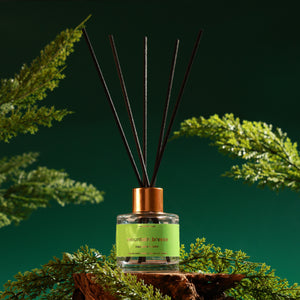
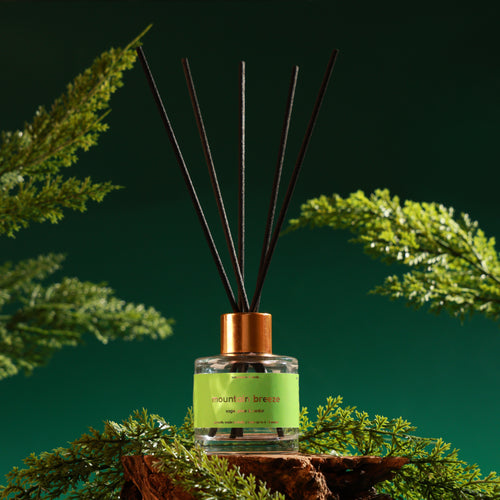
  Sukoon · a short run alternative₹1,899Shop → Mountain Breeze · reception and one cabin only₹849Shop →
Zoning along a long run
The corridor itself, plus reception and any waiting area it connects to, are the zones to scent along a long, narrow plan. Every consulting cabin running off that corridor stays completely unscented, whatever combination of duct mounting or spaced units is used to solve the corridor's own distribution — self-closing doors on each cabin already do most of that work, and this cluster's standard zoning doctrine asks for the rest.
Where two units are used to cover a long run, keep each set to a conservative intensity rather than compensating for distance with strength — the aim across the whole corridor is a result noticed on arrival and forgotten within a minute, the same standard this cluster applies everywhere else, not a stronger presence simply because the run is long. Adjustable intensity on each unit allows the near-reception end and the far end to be set slightly differently if the actual result along the corridor turns out uneven once both are running.
If fragrance is ever noticeable inside a consulting cabin along the run, treat that as a signal to reduce intensity or reposition the nearest corridor unit immediately, not as evidence the corridor finally has enough reach. No part of solving a long corridor's distance problem is a reason to let scent cross into a room that should stay unscented.
What to buy, and how to space it
Every route below follows from the corridor's actual length and whether central AC already runs along it, not from the clinic's total floor area.
| Route | Corridor condition | Why | What it costs |
| Vaayu, duct-mounted into central AC along the corridor | Central or ducted AC already serves the run | The building's own fan distributes output evenly along the whole supply run | ₹11,999 plus contractor fitting |
| Two Vaayu units, spaced near each half of the run | A long corridor with no shared ducting to use | Each half is served by its own nearby source rather than relying on distance from one end | ₹23,998 |
| One Vaayu, wall-mounted near the entrance | A shorter run, under roughly fifteen metres, with no sharp turn | Adequate reach across a genuinely short spine without over-buying | ₹11,999 |
| Sukoon, at reception only | A very short clinic where the corridor is really just a few steps to one nearby cabin | A proportionate answer where there is barely a distance problem to solve | ₹1,899 |
| No fragrance change inside any consulting cabin along the run | Self-closing doors and standard zoning doctrine already keep each cabin unscented | The cabins were never part of the distribution problem | — |
Long, narrow clinics are some of the most straightforward layouts to advise on, once an owner accepts that the corridor is the entire fragrance system, not a hallway attached to one. I ask for the corridor's length and whether it has a turn before I ask almost anything else, because those two facts decide more of the answer than the total square footage does.
The mistake I see most often is one strong unit placed right at the entrance, on the reasonable assumption that stronger output travels further. It does, a little — but a single point's reach has a limit that no amount of intensity meaningfully extends, and the far end of a genuinely long corridor is usually still under-covered, just with an over-scented reception to go with it.
Where a clinic already has central AC running the length of the corridor, I nearly always recommend the duct mount over a second unit — one fitting job, done properly by their own AC contractor, tends to produce a more even result across the whole run than two separately placed points ever quite manage.
Questions clinic owners ask about long, narrow layouts
- Why are multiple reed diffusers still barely noticeable across my large clinic? — the same distance-decay problem, seen with a passive diffusion mechanism.
- Where should I place a scent machine in an orthopaedic clinic? — the mounting-height and supply-side logic behind duct-mounting a corridor run.
- How does central AC affect fragrance distribution in an orthopaedic clinic? — the duct-mounting mechanics this post applies specifically to a long corridor.
- One scent machine vs multiple smaller fragrance points for an orthopaedic clinic — the general case behind this post's two-unit recommendation for a long run.
- Brand: the SOSA founder story.
SOSA products & prices (verified September 2026): Reed diffusers 50ml ₹749–₹849 (to 150 sq ft, 6–8 weeks at six reeds) · 130ml ₹1,249–₹1,349 (above 150 sq ft, 14–18 weeks) · reed refill 300ml ₹2,399. Ultrasonic: Boond ₹899 (~150 sq ft) · Sukoon ₹1,899 (270–320 sq ft, ships with three 15ml Hotel Collection fragrances) · Megh ₹3,499 (6L tank, ~100 hrs runtime, ~215 sq ft — a runtime machine, not a coverage upgrade). Waterless cold-air: Safar ₹3,999 (no published coverage figure) · Vaayu ₹11,999 (up to 1000 m³, roughly 2,000–3,000 sq ft; 400ml tank lasting about 90+ days; app and onboard control, 1h/4h/8h/24h run windows, adjustable intensity, key-lock, under 38 dB, freestanding or wall/HVAC mount, 5W, CE/RoHS/SGS) · Aangan ₹25,999 (8,000–10,000 sq ft). Hotel Collection water-based fragrance 15ml ₹299 · 100ml ₹999 · 300ml ₹1,799 is for ultrasonic machines; reed oil and Hotel Collection are not interchangeable. Reed diffusers are alcohol-free, phthalate-free, paraben-free, IFRA-compliant and low VOC, handmade in small batches in Pune. Every purchase funds a girl's education through Nanhi Kali. Prices and availability subject to change — see the live product pages.