




2. Filter cleaning frequency matters as much as the hood's rated capacity. A correctly sized system with filters overdue for cleaning behaves like an undersized one — grease buildup reduces how much air the hood can actually pull through it, whatever the equipment is rated for.
3. General air movement through the dining room is the second lever, not the first. Once extraction at the source is confirmed adequate, circulation that carries any remaining trace toward an extract point, rather than letting it settle in still corners, meaningfully speeds up how quickly the smell actually clears.
4. Time is a real part of the answer, and it comes after the first two, not instead of them. Residual fried-food odour in the air and in nearby fabric takes a genuine stretch of time to clear even with excellent extraction — expecting an instant result once the fryer is switched off sets an unrealistic bar.
5. Perfume is never a step in this process, at any point. A fragrance introduced over fried-food smell that's still being produced or still clearing doesn't remove it — it combines with it, and the combination reads as an obvious cover-up rather than a resolved problem.
Removing fried-food smell is an extraction, filter and airflow sequence with time built into it — not a fragrance decision, and not one SOSA will sell you a shortcut around.
Why fried-food smell is stubborn, and why perfume makes it worse
Frying produces a genuinely heavy load of airborne particles and vapour — far more than most other cooking methods — and a meaningful share of it is oil-based, which means it doesn't simply dissipate the way a lighter cooking smell might. It clings to grease film on nearby hard surfaces, it gets absorbed into any fabric within reach, and it lingers in still air considerably longer than a quick whiff of coffee or baking would. This is exactly why fried-food smell is so often the specific complaint a café gets, even when every other part of the kitchen smells perfectly reasonable.
An exhaust hood exists specifically to capture that load at the point it's produced, before it spreads into the room at all. When it does its job — correctly sized, correctly positioned, with clean filters actually pulling air through at the rate it's designed for — very little fried-food smell should reach the seating area in the first place. When any part of that chain is weak, particularly clogged filters reducing airflow well below rated capacity, the hood is doing far less than it looks like it's doing, and the dining room absorbs the difference.
Perfume doesn't interact with any part of this mechanism. It doesn't reduce the oil-based particles in the air, it doesn't improve extraction, and it doesn't speed up how quickly fabric releases what it's absorbed. What it does do is combine with the existing fried-food character to form a specific third smell — most people can identify a masked fried-food smell almost immediately, and the inference they draw from it, that the room tried to hide something rather than fix it, tends to be a worse impression than the plain unmasked smell would have left on its own.
The three things that actually remove it
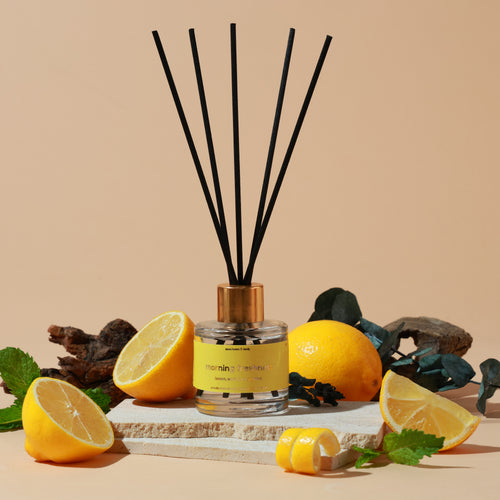
 Morning Freshness₹749A hood that was correctly sized when installed can still under-perform months later if filters are overdue for cleaning or grease has built up in the ductwork, reducing actual airflow well below what the equipment is rated for.
Symptoms, matched to the actual cause
The specific pattern of when and where fried-food smell shows up points fairly reliably at which of the three steps is actually weak.
| What's noticed | Likely cause | What actually fixes it | Where fragrance fits |
| Smell reaches the dining room even while the fryer is running, close to the pass | Hood capacity or filter condition — extraction isn't capturing enough at the source | A kitchen extraction specialist check of hood sizing and filter cleanliness | Not the dining room, at any point |
| Smell clears within the kitchen quickly but lingers in the seating area afterwards | General airflow through the dining room isn't carrying residual odour toward an extract point | Improve circulation in the seating area, particularly toward corners | Not fragrance |
| Smell has been resolved at the source but a faint trace still lingers in nearby fabric | Residual odour absorbed into upholstery or curtains near the kitchen, a separate mechanism | The material and cleaning-cadence question covered elsewhere in this series | Not fragrance |
| Smell is noticeably worse on days with heavier fryer use, otherwise fine | Extraction that's adequate for typical load but under-specified for peak load | A capacity review matched to peak, not average, cooking volume | Not fragrance |
| A washroom or entrance smells fine and unrelated to any of the above | A separate, genuinely distinct zone | Its own extraction and cleaning check, on its own terms | A fragrance decision, made independently |
| Fragrance has already been added to the dining room to deal with any of the above | The combination itself is now part of the complaint, not a solution to it | Remove the fragrance and address extraction, airflow or fabric directly — nothing else resolves this from underneath |
Morning Freshness · a washroom, unrelated to this problem₹749Shop →  Sukoon · a larger washroom suite₹1,899Shop →
  Vaayu · washrooms across a chain₹11,999Shop →
The order that actually works
Never respond to fried-food smell in the dining room by reaching for fragrance, a room spray or a stronger diffuser — none of them touches extraction, airflow or absorbed residue, which are the only three things that actually move this problem.
Sometimes the fix is a single overlooked item — filters that haven't been cleaned on schedule, or a hood that was sized for a smaller menu than the café now runs — and correcting that one thing resolves most of what's being noticed within a service or two.
Usually, the honest sequence for a persistent complaint is a kitchen extraction specialist's check of hood capacity and filter condition first, a look at general dining-room airflow second, and an acceptance that some residual clearing time, particularly after a heavy frying day, is a normal part of the answer rather than a sign anything has failed.
What this costs, in the right order
Almost entirely a kitchen-extraction and airflow decision, not a fragrance purchase — that's the honest shape of the most-asked question in this cluster.
| Route | Premises | Why | What it costs |
| Have a kitchen extraction specialist check hood sizing and filter condition | Any café where fried-food smell reaches the dining room | Addresses the single most common cause directly, at the point it's produced | Assessed by an extraction specialist, not a fragrance purchase |
| Set a filter cleaning schedule matched to actual fryer use, not a generic interval | A hood that's correctly sized but underperforming | Restores airflow the equipment is already rated for but isn't currently achieving | No purchase — a maintenance schedule |
| Improve general air movement through the dining room, toward an extract point | Smell that clears at the source but lingers in the seating area | Carries residual odour out of the room faster than still air allows | A circulation or airflow review, unrelated to fragrance |
| Confirm the washroom or entrance is a genuinely separate zone before considering fragrance | Any zone being considered for scent at all | Establishes the zone is unrelated to the kitchen's extraction question | No purchase — an assessment |
| Reed diffuser, Morning Freshness or Mountain Breeze, for the washroom or entrance only | A genuinely separate washroom or vestibule | The one point in this problem where a modest fragrance is honestly appropriate | ₹749–₹849 |
This is the question I get asked most often in this whole cluster, usually in close to these exact words — how do I get rid of the fried-food smell without just perfuming over it. I take that instinct seriously, because it's the right one, and the honest answer starts somewhere most owners don't expect: the hood and its filters, not the dining room at all.
I've had owners assume their extraction must be fine because it was properly specified when the kitchen was fitted out, only to find filters that hadn't been cleaned in months quietly cutting the airflow the hood was actually capable of. That single fix, on its own, resolves more of these complaints than anything else I can point to.
SOSA doesn't sell a room spray, and this is exactly the situation that decision was made for. A spray reaching for this problem would only ever mask it for a few minutes at a time, repeatedly, without ever touching the extraction, airflow or absorbed fabric underneath — and I'd rather say plainly that the fix sits with a kitchen extraction specialist than sell something that can't actually do the job.
Questions about removing fried-food smell
- Why Do Sofas, Curtains and Upholstery Hold Food Smells in a Café? — what happens to fried-food smell that's already been absorbed into fabric.
- Why Does Kitchen Smell Travel Into My Café Seating Area? — the pressure mechanism that carries kitchen smell outward.
- Can Poor Exhaust Make a Café Smell Bad Even if the Space Is Clean? — a closer look at extraction as the root cause.
- Exhaust, Grease, Drains, Upholstery, HVAC, Humidity or Fragrance: What Should I Fix First if My Café Smells Bad? — the full order-of-operations this diagnosis sits inside.
- Brand: the SOSA founder story.
SOSA products & prices (verified September 2026): Reed diffusers 50ml ₹749–₹849 (to 150 sq ft, 6–8 weeks at six reeds) · 130ml ₹1,249–₹1,349 (above 150 sq ft, 14–18 weeks) · reed refill 300ml ₹2,399. Ultrasonic: Boond ₹899 (~150 sq ft) · Sukoon ₹1,899 (270–320 sq ft, ships with three 15ml Hotel Collection fragrances) · Megh ₹3,499 (6L tank, ~100 hrs runtime, ~215 sq ft — a runtime machine, not a coverage upgrade). Waterless cold-air: Safar ₹3,999 (no published coverage figure) · Vaayu ₹11,999 (up to 1000 m³, roughly 2,000–3,000 sq ft; 400ml tank lasting about 90+ days; app and onboard control, 1h/4h/8h/24h run windows, adjustable intensity, key-lock, under 38 dB, freestanding or wall/HVAC mount, 5W, CE/RoHS/SGS) · Aangan ₹25,999 (8,000–10,000 sq ft). Hotel Collection water-based fragrance 15ml ₹299 · 100ml ₹999 · 300ml ₹1,799 is for ultrasonic machines; reed oil and Hotel Collection are not interchangeable. Reed diffusers are alcohol-free, phthalate-free, paraben-free, IFRA-compliant and low VOC, handmade in small batches in Pune. Every purchase funds a girl's education through Nanhi Kali. Prices and availability subject to change — see the live product pages.