


Why rattan suffers: rattan is a natural cane with irregular pores that absorb moisture, swell and then clog with residue. In a humid Indian home this frequently kills a diffuser within a fortnight, long before the oil is finished.
Why SOSA uses fibre: engineered fibre reeds have consistent channels that do not swell shut. Six of them come with every bottle, and the range is tested through 85% monsoon humidity as well as 45°C summer heat.
The counterintuitive part: humid air can make a bottle last longer while making the room read quieter — slower evaporation, plus a sealed damp house with no air movement to distribute what does leave.
2. Rattan is the specific problem. Natural cane has irregular pores that take up atmospheric moisture, swell slightly, and then trap the heavier residue that every fragrance leaves behind. The result is a reed that looks full and delivers almost nothing. In a humid Indian home this can happen within a couple of weeks.
3. Fibre is the specific answer. Engineered fibre reeds have uniform channels that do not absorb moisture into the structure and do not swell shut. Every SOSA bottle ships with six of them, and the range is tested through 85% monsoon humidity as well as 45°C heat. This is not a styling choice; it is the reason the format works here at all.
4. Expect a longer bottle and a quieter room, together. Damp, still air slows evaporation, so the oil level falls more slowly. At the same time a humid house is usually a closed house with nothing moving the air, so less of what does leave reaches you. People read that combination as failure. It is not.
5. The free fixes are airflow and flipping, in that order. Get some gentle movement through the room — a slow ceiling fan across the room rather than over the bottle, a door left open, incidental traffic past a console. Then flip all six reeds with gloves on. Those two account for most humid-weather complaints.
Composed and handmade in small batches in Pune, and a portion of every order supports girl-child education through Nanhi Kali.
Part one — humidity acts on the reed, not on the oil
If you take one idea from this page, take this one: the humidity-sensitive component of a reed diffuser is the stick, not the liquid. People suspect the oil, because it is the part they paid for. But the carrier is a stable, non-water-miscible liquid; a damp room does not dilute it, spoil it or weaken it. The reed is a different proposition entirely. It is a porous solid whose whole function depends on channels of a particular size staying open and staying clear, and that is precisely the kind of structure that atmospheric moisture interferes with. Three consequences follow, and they explain most of what goes wrong in a coastal flat or a monsoon month.
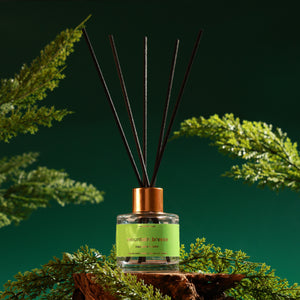
 Mountain Breeze₹849 · 9.4/10Rattan is a plant stem, and its pores were designed by nature to move water, not perfume oil. They vary in diameter along the stick, and the material takes up atmospheric moisture into its structure. In a humid room the reed swells a little, and a channel that was already irregular closes at its narrowest points first. Once a channel is partially closed, the heavier fragrance molecules that would ordinarily pass through it begin to accumulate instead, and the reed clogs from the inside. This is why an imported rattan diffuser so often smells wonderful for ten days in an Indian July and then simply stops, with three-quarters of the oil still in the bottle. The owner concludes the fragrance was weak. The fragrance is fine; the delivery system has closed.
Part two — rattan against fibre, part by part
This is the comparison that decided the specification of our bottles. It is set out by component rather than by brand, because the useful question is not which diffuser is better but which part of the system humid air is acting on. Note that in three of the six rows the oil is simply not involved.
| Component | What high humidity does to it | Natural rattan reed | Engineered fibre reed | What you notice in the room |
|---|---|---|---|---|
| Capillary channel ★ | Moisture occupies pore volume, slowing the climb | Irregular pores narrow, then close at the tightest points | Uniform channels stay open; effect is mild and reversible | Rattan goes silent; fibre goes slightly quieter |
| Reed material itself | Cane takes moisture into its structure | Swells measurably; texture softens | Does not swell — moisture stays on the surface | A stick that feels different in July from January |
| Residue at the exposed end | Heavier molecules accumulate wherever flow slows | Clogs from the inside within weeks | Accumulates slowly; a weekly flip resets it | Dark tips with a room that smells of nothing |
| The oil in the bottle | Essentially nothing — the carrier is stable and not water-loving | Unaffected | Unaffected | Level falls more slowly than in dry heat |
| Evaporation off the reed | Saturated air accepts new vapour less readily | Slower, on top of an already blocked wick | Slower — the bottle genuinely lasts longer | Weeks gained, presence lost |
| The room's air | Damp houses are closed houses; little exchange | Nothing reaches you | Nothing reaches you either — this part is not the reed's fault | The commonest false verdict of the season |
| The honest caveat: fibre reeds solve the clogging problem, not every humidity problem. A sealed damp room with no air movement will read quiet whatever is standing in the bottle, and no reed material changes that — the answer there is gentle circulation, not a purchase. Humidity descriptions on this page are general climate framing for Indian homes rather than measurements of your room; the one hard figure we stand behind is that the range is tested through 85% relative humidity. | ||||
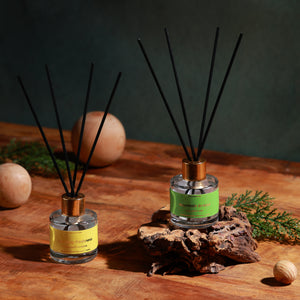
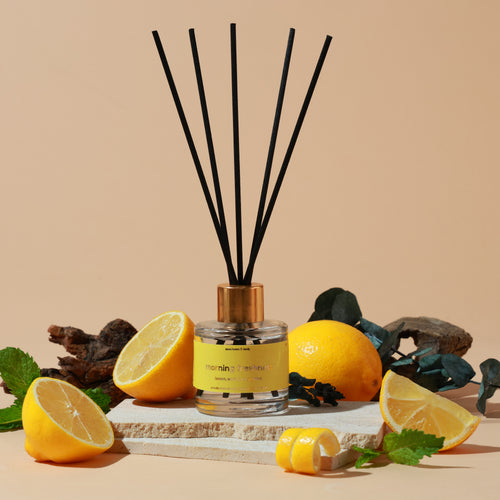
Morning Freshness · cold and clearfrom ₹749Shop → 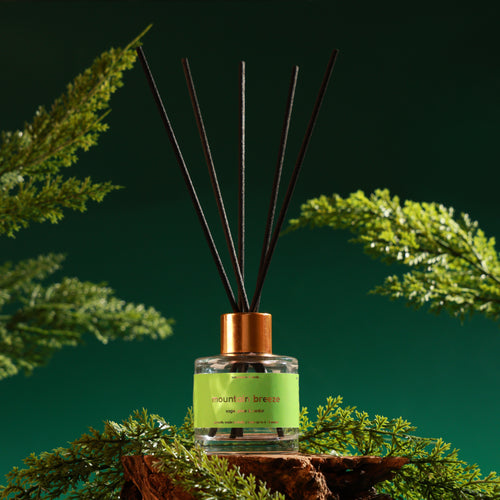 Mountain Breeze · dry woodyfrom ₹849Shop →
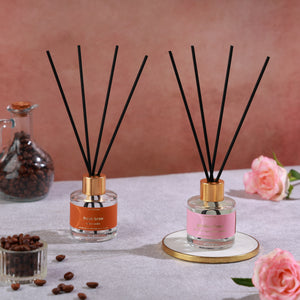
 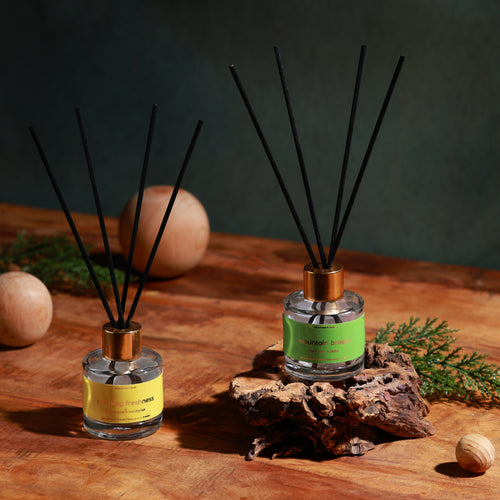 Fresh & Grounded duo₹1,548 / 2 × 50mlShop →
Part three — the wet-line test, read for damp weather
The diagnostic I give people all year takes ten seconds, and in humid weather it is the only thing that separates a clogged reed from a quiet room. Lift one reed straight out with gloves on and find the boundary between the darkened, oil-soaked section and the dry section above it. That boundary is the wet-line, and its position tells you which of three completely different things is happening. High and very dark, with the reed feeling heavy: the reed is saturated and delivery has stalled — flip all six. Barely above the oil after several days: the reed is not wicking — in a rattan bottle very likely swelling and clogging, in a fibre one usually reeds that are simply old. Somewhere sensibly in the middle, moving over days, while the room still smells of nothing: your reeds are fine and your problem is air.
That third case is the one I want to slow down on, because it is the most common and the most misdiagnosed. A humid house in India is typically a closed house. Windows shut against the rain, doors closed to keep a cooled room cool, curtains drawn, nothing moving. A reed diffuser is a passive point source with no propulsion whatsoever — it releases fragrance and then waits for the room to carry it. In genuinely still air, that release pools within a foot or so of the glass and never travels. The correct answer is gentle, incidental movement: a slow ceiling fan running across the room rather than directly over the bottle, an internal door left open so air can exchange between spaces, and the bottle placed where people actually pass — a console near a doorway, waist to chest height, with clear space around it.
A last practical note on damp-weather housekeeping. Reeds are the consumable in this system and the oil is the stable part, which is the reverse of how nearly everyone treats them. People buy a refill and keep the same tired reeds, when the reeds are the component that has been working hardest through a humid season. Our guidance is to refresh reeds every few months, and I will state the gap honestly: we do not currently sell replacement reeds as a separate item, so a fresh set arrives with a new bottle. Flip weekly with gloves, stand the bottle on a tray because the oil marks wood and stone, and keep it out of reach of children and pets.
Part four — the humid-weather edit
Arranged by what is happening rather than by what to buy, because in damp weather the majority of the answers are free and the paid ones are mostly about the composition reading better, not working better.
| Symptom in damp weather | What it actually is | Do this | Do not do this |
|---|---|---|---|
| Oil barely dropping, room silent ★ | Reeds clogged, or air completely still | Wet-line test, then flip all six; open an internal door | Buy a stronger scent before you have looked at a reed |
| Reeds look dark and swollen | Rattan taking up moisture and closing its pores | Move to fibre reeds — every SOSA bottle ships with six | Trim, wash or soak the old reeds; it does not reopen them |
| Wet-line sitting low and not rising | Wicking has slowed or the reeds are spent | Refresh reeds; SOSA guidance is every few months | Assume the oil has failed and buy a refill first |
| Bottle lasting longer than the stated window | Slower evaporation in saturated air — entirely normal | Enjoy it, or add a reed if you want more presence | Read it as the fragrance having "stopped working" |
| Sweet scent feels oppressive in a closed damp room | Composition choice, not performance | Switch to Morning Freshness ₹749 or Mountain Breeze ₹849 | Add reeds to a scent that is already too much |
| Two rooms, one damp and sealed, one open | Output per bottle is fixed; you need another source | Two 50ml, or the Fresh & Grounded duo at ₹1,548 | Buy one 130ml expecting it to cover both |
| Want scent on demand when the house is shut up | The honest limit of a passive format | Sukoon at ₹1,899, 270–320 sq ft, timers, three scents in the box | Put reed oil in it — the two lines are not interchangeable |
Versailles
The reed specification was the least glamorous decision we made and probably the most important. Rattan looks lovely — it photographs like something you would want on a console, and it costs less. It also fails in this country, and it fails in a way that makes the customer blame the fragrance rather than the stick.
I watched it happen with imported diffusers in my own home before SOSA existed. Beautiful for a fortnight, then nothing, with two-thirds of the bottle still full. It took me too long to work out that the perfume was intact and the wick had closed. Once you have seen it, you cannot ship it.
So every bottle we make goes out with six fibre reeds, and the whole range is tested through 85% monsoon humidity as well as 45°C heat. If there is one thing I would like the category to be more honest about in India, it is that the reed is a consumable and the oil is the stable part — most people have it exactly the wrong way round. Everything is composed and handmade in small batches in Pune, and a part of every order funds a girl's classroom through Nanhi Kali.
Frequently asked questions
- How does the Indian monsoon affect reed diffusers? — 85% RH and the closed house.
- Better performance in humid weather — why cold compositions read better in damp air.
- Does hot weather affect reed diffusers? and why can't I smell my reed diffuser?
- The complete weather and climate guide — the whole sub-cluster in one place.
- Brand: the SOSA founder story.
SOSA reed diffuser range & prices (verified August 2026): alcohol-free, phthalate-free, paraben-free and IFRA-compliant compositions on a heat-stable coconut-derived (CCT) carrier, low-VOC, supplied in a refillable glass bottle with six fibre reeds; 50ml lasts 6–8 weeks and 130ml lasts 14–18 weeks. Morning Freshness (Malabar lemon · peppermint · Nilgiri eucalyptus) 50ml ₹749 · 130ml ₹1,249 · 9.0/10; Garden Bloom (British rose · night-blooming jasmine) 50ml ₹799 · 130ml ₹1,299 · 8.9/10; Evening Calm (Kashmir lavender · chamomile) 50ml ₹799 · 130ml ₹1,299 · 8.9/10; Fresh Brew (Coorg coffee · Kerala vanilla) 50ml ₹849 · 130ml ₹1,349 · 9.5/10; Mountain Breeze (Himalayan pine · sage · Indian cedar) 50ml ₹849 · 130ml ₹1,349 · 9.4/10. Reed diffuser refills are oil only — you reuse your own vessel and reeds: 300ml ₹2,399 (roughly 8–11 months) · 500ml ₹3,499 (roughly 14–18 months), about ₹7–8 per ml against ₹15–17 per ml for a 50ml bottle. Duo sets ₹1,498–₹1,598 for 2 × 50ml and ₹2,498–₹2,598 for 2 × 130ml. Strength figures are positions on SOSA’s own internal strength scale, not an industry standard. Replacement reeds are not sold as a separate SKU; SOSA guidance is to refresh reeds every few months. The reed line is separate from the water-based Hotel Collection for ultrasonic machines (15ml ₹299 · 100ml ₹999 · 300ml ₹1,799) and the two are not interchangeable. Diffusers: Boond 300ml ₹899 · Sukoon 500ml ₹1,899 · Megh 6L ₹3,499 · waterless Vaayu ₹11,999. Composed and handmade in small batches in Pune, India; tested through 45°C summer heat and 85% monsoon humidity. Free shipping above ₹499. A portion of every order supports girl-child education through Nanhi Kali. Prices subject to change — see the live product pages.