
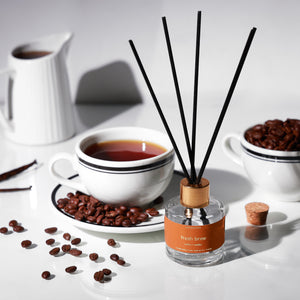


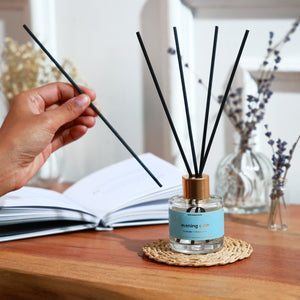
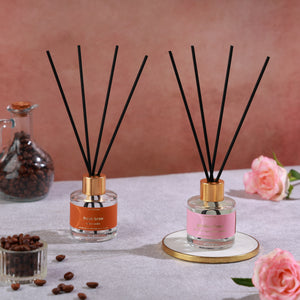
The useful step: six to eight or nine reeds. Clearly fuller room, and a 50ml moves from 6–8 weeks to roughly 5–6 at eight and about 5 at nine.
The wasteful step: past ten. The neck crowds, wicking gets worse rather than better, oil creeps down the outside of the glass, and the room gains very little.
Cheaper first: flip the six you already have, and move the bottle into gently passing air. Reeds cannot fix dead air.
2. The first three extra reeds do most of the work. Six to nine is the step people describe as transforming the room. If you are going to add reeds at all, this is the range worth adding into.
3. The next three do very little. Nine to twelve produces a difference most people cannot reliably identify in a blind comparison in their own home, particularly since their nose has adapted to the fragrance anyway.
4. The cost, however, never tapers. Oil consumption tracks reed count fairly closely throughout. A 50ml rated at 6–8 weeks with six reeds runs roughly 5–6 weeks at eight reeds and about 4–5 at ten. Each reed removes days at a steady rate whether or not you can hear it.
5. Past ten the mechanics turn against you. A crowded neck means reeds touching, uneven wicking, oil creeping down the outside of the glass onto your furniture, and in a small room a genuinely unpleasant density of fragrance.
6. Do the free things first, or you will misread the result. Flip all six reeds and move the bottle into gentle passing air before you add anything. Reeds added into dead air raise the concentration in a pocket nobody stands in.
7. Do not use bottle size as a substitute. A 130ml at ₹1,349 lasts 14–18 weeks against 6–8, but at six reeds it projects about the same. It buys duration, not volume.
Composed and handmade in small batches in Pune, and a portion of every order supports girl-child education through Nanhi Kali.
Part one — why the gain curve flattens and the cost curve does not
Two things happen when you drop an extra reed into the bottle, and only one of them is the thing you wanted. The first is that you have added exposed fibre, which is genuinely more surface for oil to leave from. The second is that you have added it into the same small column of air above the same bottle neck — air that the existing reeds have already loaded with fragrance. Evaporation slows as the air immediately around a surface approaches saturation, so each new reed enters a slightly less hospitable environment than the last one did. Meanwhile the oil does not know any of this. It is drawn up every fibre that is standing in it, and consumption climbs steadily with the count. That asymmetry is the whole story: benefit is subject to a limit, cost is not.
 Oil refill300ml · ₹2,399Capillary action is indifferent to whether you are enjoying the result. Every reed in the bottle wicks, every reed holds oil along its length, and every reed loses some of that oil to the air whether or not the room registers it. Consumption therefore tracks reed count far more faithfully than perception does, which is exactly why the arithmetic in the next section looks the way it does: the weeks fall away on a straight line while the loudness rises on a bending one. There is also a small hidden cost. More reeds means more total fibre accumulating the heavy end of the composition, so a high-count bottle needs its weekly flip without exception — skip it and you can end up with ten reeds delivering less than six well-maintained ones, having paid the oil bill for ten.
Part two — the curve in numbers
Below is the trade for a 50ml bottle, rated 6–8 weeks at its standard six reeds. The weekly cost column is simple arithmetic on a ₹849 bottle divided by the weeks it is likely to last at that count; it is there to make the flattening visible, not to be precise to the rupee. All strength language refers to SOSA's own internal scale at six reeds — our scale, not an industry standard, and not a concentration.
| Reeds in a 50ml | Change you would notice from the previous step | Likely bottle life | Rough cost per week at ₹849 | Flip discipline required |
|---|---|---|---|---|
| 6 → 9 ★ | Large and immediate — the room reads clearly fuller | About 5 weeks, from 6–8 | Roughly ₹170 against ₹110–₹140 | Weekly, without exception |
| 4 → 6 | Clear — this is the step back up to the designed dose | 6–8 weeks, from beyond 8 | Roughly ₹110–₹140 | Weekly |
| 6 → 8 | Obvious, and the gentlest useful increase | 5–6 weeks | Roughly ₹140–₹170 | Weekly |
| 9 → 10 | Small — detectable on the day you do it, less so later | 4–5 weeks | Roughly ₹170–₹210 | Weekly, and watch for creep down the glass |
| 10 → 12 | Very little, and the neck begins to crowd | Shorter again, and less predictable | Rises with no matching gain | Not a configuration I would recommend |
| The honest caveat: these are working figures from our own testing and customer correspondence, not laboratory measurements, and your room will move them. Heat, direct sun and any mechanical draught shorten every row above; a cool, still, sealed room lengthens them. If you want the fuller room without paying in weeks at all, the alternative is to change the composition rather than the count — Fresh Brew at 9.5 or Mountain Breeze at 9.4 against an 8.9, at six reeds and the stated 6–8 weeks. | ||||
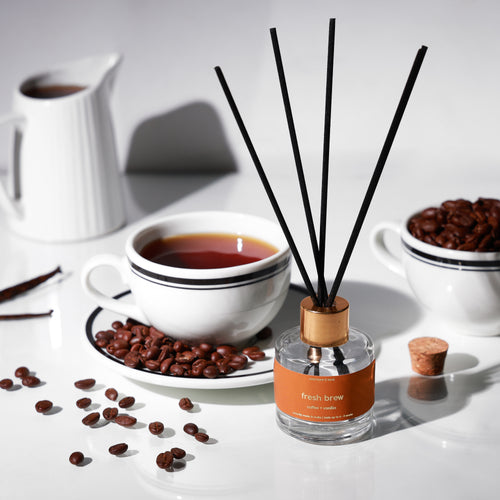 Fresh Brew · 9.5/10from ₹849Shop →
 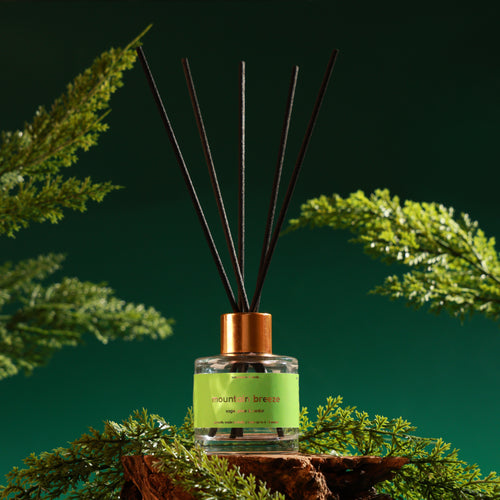 Mountain Breeze · 9.4/10from ₹849Shop →
 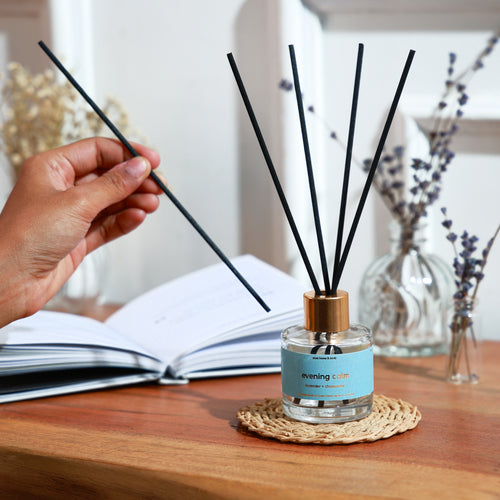 Evening Calm · 8.9/10from ₹799Shop →
Part three — where a sensible person stops
My own answer, for what it is worth, is eight. Eight reeds in a 50ml gives a room that is unmistakably fuller than six without feeling forced, keeps the neck uncrowded enough that every reed wicks properly, and costs something like a fortnight off the bottle rather than a month. Nine is defensible if the room is large or the fragrance is one of the softer ones. Ten is the point at which I would want a specific reason — a festive week, a large gathering, a stubbornly high-ceilinged room — rather than a general wish for more. Past ten I would ask you to stop adding and start asking a different question, because you have hit the flat part of the curve and everything beyond it is bought at full price.
The different question is this: what exactly am I short of? If the answer is the fragrance itself is too soft for this space, the fix is the composition, not the count. Our range runs from 8.9 to 9.5 on our internal scale, and that gap between Evening Calm and Fresh Brew is designed in — the first is a sleep fragrance and is meant to sit low. Eleven reeds of a sleep fragrance in a living room is a workaround for a purchase decision, and it is a workaround that empties a bottle in a month. If the answer is the room is too long, the fix is a second source rather than a fuller single one, because output per bottle is fixed and two bottles at opposite ends genuinely raise the total. And if the answer is I want the room to become fragrant when I decide it should, no reed count achieves that, because a passive diffuser has no on switch by design.
There is one more consideration that people rarely factor in, and it is financial rather than olfactory. Running nine or ten reeds year-round roughly halves the life of every bottle you buy, which changes the economics of the whole habit. That is precisely the situation the oil refill exists for: 300ml at ₹2,399 works out to about ₹7–8 per millilitre against ₹15–17 for a 50ml bottle, and the 500ml at ₹3,499 is a little cheaper again. You reuse your own glass vessel and your own reeds — and I will say plainly that the refill is oil only, with no reeds in the box, because we do not sell reeds separately and I would rather you knew that before ordering than after. Our guidance is to refresh your reeds every few months, and a high count wears them faster.
Part four — reed by reed, is this one worth adding
The same question asked one reed at a time, which is how the decision is actually made in a living room at eight o'clock in the evening.
| The reed you are about to add | What it gives | What it takes | Verdict |
|---|---|---|---|
| The seventh ★ | A clear lift, especially in a living room rather than a small bedroom | A few days off the bottle | Worth it in almost every case |
| The eighth | The room now reads distinctly fuller than standard | Takes a 50ml to roughly 5–6 weeks | The best stopping point for most homes |
| The ninth | A further, smaller lift — still audible | About 5 weeks on a 50ml | Worth it for large or open rooms |
| The tenth | Marginal. Noticeable on the evening you add it | 4–5 weeks, and reeds wear faster | Only with a specific reason, such as hosting |
| The eleventh and beyond | Very little you could identify blind | Crowded neck, uneven wicking, oil creeping down the glass | No. Change the composition instead |
| An extra reed in a bottle you have not flipped | Nothing you could not have had free | Oil, for no reason | Flip the existing six first |
| An extra reed in a bottle sitting in dead air | A stronger pocket of air nobody is standing in | Oil, again for no reason | Move the bottle first — it is free |
Versailles
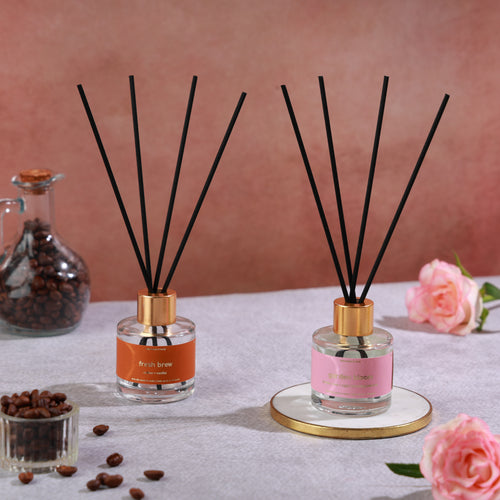
The photographs that sell reed diffusers usually show a generous fan of ten or twelve sticks, because it photographs beautifully. It is also, quietly, a lifespan problem being sold as a styling choice. We put six reeds in the box because six is the number each composition was written for, and the strength rating we publish for every scent describes it at six. If I photographed twelve and rated at six I would be describing a product nobody owns.
What I want people to take from the curve is permission to stop. There is a moment, usually around the eighth or ninth reed, where the room is genuinely what you wanted and the temptation is to keep going because the packet has more in it. Stopping there is not a compromise. It is the point where the format is giving you its best value, and everything after it is paid for at full price for a smaller and smaller return.
And if eight reeds of your current fragrance still is not the room you had imagined, the honest conclusion is usually that you would be happier with a different composition rather than a fuller dose of this one. A 9.5 at six reeds is a different experience from an 8.9 at eleven, and it lasts twice as long. Everything is composed and handmade in Pune, and a part of every order funds a girl's classroom through Nanhi Kali.
Frequently asked questions
- How many reeds should I use for stronger fragrance? — staging a high count for two days rather than a season.
- Should I flip the sticks to make it stronger? — the free move to make before adding anything.
- How to make a reed diffuser smell stronger — the four currencies, ranked by what they cost.
- The complete guide to stronger performance and the full strength guide.
- Brand: the SOSA founder story.
SOSA reed diffuser range & prices (verified August 2026): alcohol-free, phthalate-free, paraben-free and IFRA-compliant compositions on a heat-stable coconut-derived (CCT) carrier, low-VOC, supplied in a refillable glass bottle with six fibre reeds; 50ml lasts 6–8 weeks and 130ml lasts 14–18 weeks. Morning Freshness (Malabar lemon · peppermint · Nilgiri eucalyptus) 50ml ₹749 · 130ml ₹1,249 · 9.0/10; Garden Bloom (British rose · night-blooming jasmine) 50ml ₹799 · 130ml ₹1,299 · 8.9/10; Evening Calm (Kashmir lavender · chamomile) 50ml ₹799 · 130ml ₹1,299 · 8.9/10; Fresh Brew (Coorg coffee · Kerala vanilla) 50ml ₹849 · 130ml ₹1,349 · 9.5/10; Mountain Breeze (Himalayan pine · sage · Indian cedar) 50ml ₹849 · 130ml ₹1,349 · 9.4/10. Reed diffuser refills are oil only — you reuse your own vessel and reeds: 300ml ₹2,399 (roughly 8–11 months) · 500ml ₹3,499 (roughly 14–18 months), about ₹7–8 per ml against ₹15–17 per ml for a 50ml bottle. Duo sets ₹1,498–₹1,598 for 2 × 50ml and ₹2,498–₹2,598 for 2 × 130ml. Strength figures are positions on SOSA’s own internal strength scale, not an industry standard. Replacement reeds are not sold as a separate SKU; SOSA guidance is to refresh reeds every few months. The reed line is separate from the water-based Hotel Collection for ultrasonic machines (15ml ₹299 · 100ml ₹999 · 300ml ₹1,799) and the two are not interchangeable. Diffusers: Boond 300ml ₹899 · Sukoon 500ml ₹1,899 · Megh 6L ₹3,499 · waterless Vaayu ₹11,999. Composed and handmade in small batches in Pune, India; tested through 45°C summer heat and 85% monsoon humidity. Free shipping above ₹499. A portion of every order supports girl-child education through Nanhi Kali. Prices subject to change — see the live product pages.