

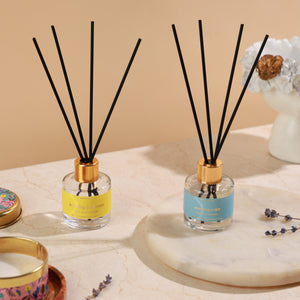



What sets coverage: the evaporating surface — the number of reeds — against the room's air volume and how fast that air is being replaced.
For a room over about 150 sq ft: two sources, not a bigger bottle. Two 130ml at ₹2,498, or a Sukoon at ₹1,899 covering about 270–320 sq ft.
2. Coverage is set by evaporating surface, not by liquid. Fragrance climbs each reed by capillary action and evaporates from the exposed length. The rate at which that happens depends on how much reed surface is exposed, how warm the room is and how much air is moving across it — not on how deep the reservoir is. Adding liquid underneath does not make the tips evaporate faster. It only means they can go on evaporating at the same rate for longer.
3. The machines prove the point better than the bottles do. A Sukoon holds 500ml and covers about 270–320 sq ft. The Megh holds 6 litres — twelve times as much liquid — and covers about 215 sq ft, which is less. Its extra capacity buys runtime and humidity, not area. Anybody who wants more coverage from a machine should buy a second Sukoon at ₹3,798 rather than one Megh at ₹3,499. If reservoir size determined reach, that sentence would be nonsense; it is not.
4. Three dials, three different jobs. Millilitres are the time dial: how many weeks before you reorder. Reed count is the volume dial: six for full strength, four for a bedroom, two or three for a small bathroom, with more reeds meaning stronger and faster at once. The number of locations is the count dial: how many separate air spaces are scented at all. People reach for the first dial to solve problems that belong to the second and third, which is how a 1,200 sq ft flat ends up with one very large bottle in the hall and four bare rooms.
5. For a room genuinely over 150 sq ft, buy a second source or a machine. A 220 sq ft living room takes two 130ml at opposite ends — ₹2,498 — or a Sukoon at ₹1,899, which has a fan and therefore a genuinely wider reach. Shape matters as much as area here: a run longer than about twenty-two feet, an L, a blind leg or a double-height volume all need a second starting point regardless of the floor area. None of those is a bottle-size problem, and no bottle size solves any of them.
Made in India, composed by an ISIPCA Versailles-trained perfumer — and a portion of every order supports girl-child education through Nanhi Kali.

What actually sets coverage
Coverage is an equilibrium, not a projection. A reed diffuser adds fragrance molecules to a room at a steady rate; the room loses them at a steady rate through ventilation, absorption and settling. Where those two rates balance is the concentration you can smell, and the largest room in which that balance lands above the threshold of detection is the coverage figure — up to about 150 sq ft, closed and still, at a standard ceiling height. The input side of that equation is entirely surface and conditions. Six reeds present more evaporating area than three. A warm room evaporates faster than an air-conditioned one. Moving air carries molecules away faster and lowers the equilibrium. The reservoir beneath the reeds never appears in the equation at all — it only decides how long the input side can be maintained before the bottle is dry.
Two consequences follow, and both save money. First, in a room that is too large, the honest fix is more sources rather than more millilitres — two 130ml bottles at opposite ends of a long living room, or an ultrasonic Sukoon at ₹1,899, which uses a fan and so is not a passive source at all and covers about 270–320 sq ft. Second, in a room that is too small, the fix is fewer reeds rather than a smaller bottle. A 130ml on two or three reeds in a bathroom is not too strong; it is a large bottle running quietly, and it will last a very long time. Height counts as size too: 150 sq ft under a nine-foot ceiling is 1,350 cubic feet, and at twelve feet it is 1,800 — a third more air for the same source, with warm air carrying scent above nose height into the bargain. Coverage is a cubic quantity that we quote in square feet only out of habit.
The three dials people confuse
 130ml₹1,24950ml, 6–8 weeks, from ₹749. 130ml, 14–18 weeks, from ₹1,249. That is the whole of what bottle size decides, and it is worth having — the larger bottle works out at about ₹78 a week of use against about ₹105, and it cuts your reorders from roughly seven a year to about three. But it buys weeks, and weeks cannot be spent on square feet. If you are choosing a size, choose it on how often you want to think about the bottle, not on how large the room is.
Sizing by space — when size helps and when it does not
Six situations, and which dial each one actually needs. Two rows cost nothing to fix, and one row is the case where a bigger reservoir genuinely buys you less.
| Space | What it needs | How many | Cost |
|---|---|---|---|
| A 220 sq ft living room that feels thin at the far end ★ | Two sources, not a bigger bottle — two 130ml at opposite ends, or a Sukoon at ₹1,899 covering about 270–320 sq ft | Two, or one machine | ₹2,498 or ₹1,899 |
| A 150 sq ft bedroom, one bottle, working well | Either size holds it. Choose the 130ml for fewer reorders and a lower cost per week, not for reach | One | from ₹749 |
| A 100 sq ft bedroom where the bottle feels too strong | Take two reeds out. Do not buy a smaller bottle — a 130ml on three reeds is quieter and lasts longer | No purchase | ₹0 |
| A room with a ceiling above about eleven feet | A third more air for the same source. Place the bottle lower and add a second source before you consider size | One or two | from ₹1,249 |
| A 300 sq ft open living-dining, wanting one machine to do it | Two Sukoons at ₹3,798 rather than one 6-litre Megh at ₹3,499, which covers only about 215 sq ft — the larger tank buys runtime, not area | Two machines | ₹3,798 |
| A store room, or a bedroom nobody sleeps in | Nothing, in any size. There is no bottle small enough to be worth putting in an empty room | None | ₹0 |
| A note on all of the above: two 130ml is ₹1,249 + ₹1,249 = ₹2,498 and two Sukoons are ₹1,899 + ₹1,899 = ₹3,798. Every coverage figure above assumes a closed room with still air and a standard ceiling; open doors, fans and high ceilings all reduce it, and none of those is fixed by buying more millilitres. | |||
One room · the unitFrom ₹749Shop →  Two rooms · better value₹1,498Shop →
  Large room · a switch₹1,899Shop →
Reeds, placement and when to change technology
Work the free dial first, and give it two days. If a room reads quiet, add a reed rather than planning a purchase — the reeds are already in the box and going from four to six is the commonest successful fix there is. Wait forty-eight hours before judging any change, because a freshly added reed has to saturate along its whole length before it contributes. Then judge from the doorway rather than from the sofa: your nose stops registering a constant, unchanging smell within about twenty minutes, so the person least able to assess your living room is you. Leave the flat for half an hour and read the first breath on returning, or simply ask whoever visits next.
Then placement, which is worth more than a size upgrade. A passive source needs gentle air movement to distribute, so a console near a doorway will outperform the same bottle in a still corner behind a sofa. Avoid direct sunlight, which fades the fragrance and warms the oil; avoid the direct path of an AC vent or a fan, which empties the bottle fast and pushes everything against one wall; and keep it off polished wood, because reed oil marks a finish permanently if the bottle is knocked. In a long room, moving the bottle from the middle to the end you actually sit in often does more than the ₹500 difference between the two sizes ever could.
Then change technology rather than size, if the room genuinely demands it. Past about 150 sq ft of still air, a passive source is being asked to do something it was not built for. Two reed diffusers give you two starting points, which suits long or L-shaped rooms; a Sukoon at ₹1,899 has a fan and covers about 270–320 sq ft, which suits a large open living-dining you want scented on demand rather than continuously. Remember that the Sukoon runs the water-based Hotel Collection from ₹299 and not reed oil — the two liquids are not interchangeable in either direction. And when a 130ml runs dry, a 300ml refill at ₹2,399 fills it roughly twice and is the moment to fit fresh reeds, since clogged fibre is the usual reason throw falls away after a few months.
What to buy
What each format is genuinely for once you have accepted that volume buys weeks rather than square feet.
| Buy | What it covers | Lasts | Price |
|---|---|---|---|
| One 50ml | A single reed diffuser — a short run or a trial — not a small room, since bottle size is not how you size to a room | 6–8 weeks | from ₹749 |
| One 130ml ★ | The value size — any room under about 150 sq ft that you want running continuously, at about ₹78 a week of use | 14–18 weeks | from ₹1,249 |
| The duo | Day & Night duo — two air spaces at once, which is the only thing that scents two rooms — no single bottle does | 6–8 weeks each | ₹1,498 |
| Sukoon | 500ml ultrasonic — a room past about 150 sq ft, where a fan-driven machine covers about 270–320 sq ft and a bottle cannot | Runs when you switch it on | ₹1,899 |
| 300ml refill | The running cost — the running cost of the room you already solved, once you have stopped trying to solve area with volume | Roughly 2 × 130ml fills | ₹2,399 |
Versailles
This is the question behind almost every disappointed message we get. Somebody has a large living room, they bought the biggest bottle, and it did not work. It was never going to. The liquid in a reed diffuser is fuel, not range. You are buying weeks of running time, and weeks do not travel across a room.
The example I use is our own machines, because it is unarguable. The Megh holds six litres and covers about 215 sq ft. The Sukoon holds five hundred millilitres and covers about 270 to 320. Twelve times the liquid, less area. If capacity decided coverage, that could not happen — and if somebody wants a bigger area covered, I tell them to buy a second Sukoon rather than a Megh, which costs us a more expensive sale.
So if your room feels thin: reeds first, because they are free. Placement second, because it is also free. Then a second source, or a machine with a fan in it. The one thing I would ask you not to do is spend ₹500 more on a bigger bottle for a problem that bigger bottles do not touch, and then conclude that reed diffusers do not work. A portion of every order funds a girl's classroom through Nanhi Kali.
Frequently asked questions
- Two 50ml or one 130ml? — the room-count version.
- How big a room can a 130ml handle? — the number and its conditions.
- When to stop adding reeds — the honest crossover point.
- The complete sizing and quantity guide — every home type, three builds.
- Brand: the SOSA founder story.
SOSA products & prices (verified August 2026): Hotel Collection water-based ultrasonic diffuser fragrance 15ml ₹299 · 100ml ₹999 · 300ml ₹1,799 · Pack of 7 (15ml, all fragrances) ₹1,799; refills 100ml from ₹999. Seven scents: The Ritz-Carlton-inspired (white tea · bergamot · cedar), Westin-inspired (white tea · aloe · cedar), 1 Hotels-inspired (cedarwood · vetiver · green leaves), The St. Regis-inspired (amber · violet · woods), Shangri-La-inspired (jasmine · green tea · white tea), Four Seasons-inspired (citrus · floral · sandalwood), W Hotels-inspired (citrus · pepper · amber). Diffusers: Boond 300ml ₹899 · Sukoon 500ml ₹1,899 · Megh 6L ₹3,499. Water-based, phthalate-free, composed to IFRA standards for home diffusion; 3–6 drops per tank. Made in India, Pune. The Hotel Collection scents are SOSA's own interpretations inspired by the world's finest hotels; all hotel names are trademarks of their respective owners and are used only to describe the scent style — SOSA is an independent Indian fragrance house, not affiliated with or endorsed by any hotel brand. Prices and availability subject to change — see the live product pages.