

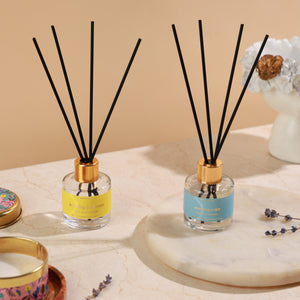



Why a bigger bottle does not help: the problem is not the source, it is the extraction. A 130ml in a draught behaves like a 50ml — and empties like one.
What to do instead: buy for the room you actually close, or accept that the bottle works from the moment the window shuts in the evening. Both are cheaper than the alternative.
2. The problem is extraction, not source strength. People reach for a bigger bottle because the room feels weak, but bottle size buys weeks, not watts. A 130ml and a 50ml evaporate at broadly the same rate on the same number of reeds — the 130ml simply has more liquid behind it. In a ventilated room both produce the same thin result, and the 130ml just does it for longer.
3. It also costs more, not less. Moving air speeds evaporation. A 130ml that runs sixteen weeks in a still room can be finished in ten in a draughty one. That is ₹125 a week instead of ₹78, or roughly ₹6,495 a year against ₹4,059 — about ₹2,436 extra for a worse result in the same room.
4. The one version worth buying for is the evening room. Very few Indian homes are genuinely open twenty-four hours. If the window shuts at six or seven for insects, dust or the air conditioner, then from that moment the room behaves normally and a bottle on four reeds holds it perfectly well overnight. Buy for the closed hours and expect nothing from the open ones.
5. If you must have something during the day, move the money. Put the bottle in the room next door that you do close — usually the bedroom or the bathroom — and let the ventilated room borrow whatever drifts through the doorway. That costs nothing extra and it works, because you are dosing an air space that will hold what you put into it.
Made in India, composed by an ISIPCA Versailles-trained perfumer — and a portion of every order supports girl-child education through Nanhi Kali.
What an open window actually does to a passive diffuser
Air-change rate is the number nobody quotes and the only one that matters here. A closed room with the door shut exchanges roughly 0.2 to 0.5 of its volume an hour through gaps, cracks and ordinary leakage. The same room with a window open and any second opening for the air to leave by — a door on the latch, a second window, a balcony — exchanges three to eight times its volume an hour. Put a number on it. A 150 sq ft room under a nine-foot ceiling contains 1,350 cubic feet of air. Closed, at 0.3 changes an hour, a diffuser is asked to keep 405 cubic feet an hour charged. Open, at six changes an hour, it is asked to keep 8,100 cubic feet an hour charged. That is the same bottle, the same six reeds, and twenty times the work. There is no product in the range that closes a gap of that size, and any brand that tells you otherwise is selling you a bottle rather than an answer.
The second effect is on your money rather than your nose. Evaporation from a reed rises with both heat and airflow, so a ventilated room does not merely fail to hold the fragrance — it pulls it out of the bottle faster while failing to hold it. A 130ml that gives fourteen to eighteen weeks in a still bedroom can be gone in ten weeks standing in a cross-draught. ₹1,249 across ten weeks is about ₹125 a week; across sixteen it is about ₹78. Run that for a year and the ventilated room costs roughly ₹6,495 in liquid against ₹4,059 for the same bottle in a closed one — about ₹2,436 more for a result you can barely detect. This is the shape of the whole problem: worse output, higher running cost, and the instinct to fix it by buying more, which makes both numbers worse again.
The three honest routes for a permanently ventilated room
 Or nothing at all₹0If the window is genuinely open all day and there is a second opening for the air to leave by, this room is not a fragrance problem you can solve with a passive source. Spend ₹0 here and put the bottle somewhere that will hold it. A room that is being ventilated is already doing the thing people usually buy fragrance to achieve — moving stale air out — and the honest position is that you are getting the benefit without paying for it. The rooms worth your money are the ones you shut: the bedroom at night, the bathroom, the entrance hall. Those hold what you put in.
Sizing by space — when ventilation changes the answer
Read down to the ventilation pattern you actually have, not the one you would like. Two of these rows recommend spending nothing, and both are honest recommendations rather than rhetorical ones.
| Space | What it needs | How many | Cost |
|---|---|---|---|
| Window open all day, second opening, air you can feel ★ | Nothing. Air is being replaced three to eight times an hour; a passive source cannot charge it and a bigger bottle only empties faster | None | ₹0 |
| Window open in the day, shut from about six in the evening | A normal closed room for fifteen hours out of twenty-four — buy for those hours | One 130ml, four reeds | from ₹1,249 |
| One window open, door shut, no second opening | Ventilation without a through-path is far weaker; the room still holds a good part of what you put in | One 130ml, six reeds | from ₹1,249 |
| Window open only for an hour of morning airing | Effectively a closed room. Nothing here needs adjusting except when you judge it | One | from ₹749 |
| A ventilated room next to a closed room you already scent | Let it borrow through the doorway. Nothing extra to buy and nothing extra to run | None extra | ₹0 |
| A large open room you genuinely want scented while the windows are open | Not a reed job at all — a Sukoon at ₹1,899 with Hotel Collection from ₹299 is a switch you turn on when you shut up for the evening | One machine | ₹1,899 + ₹299 |
| A note on all of the above: every coverage figure in this range is a steady-state number measured in a closed room with still air and a standard ceiling. Ventilation is the single biggest thing that breaks it, and it breaks it by a factor of ten or twenty rather than by a few per cent. If you remember one line from this page, make it that one. | |||
One room · the unitFrom ₹749Shop → 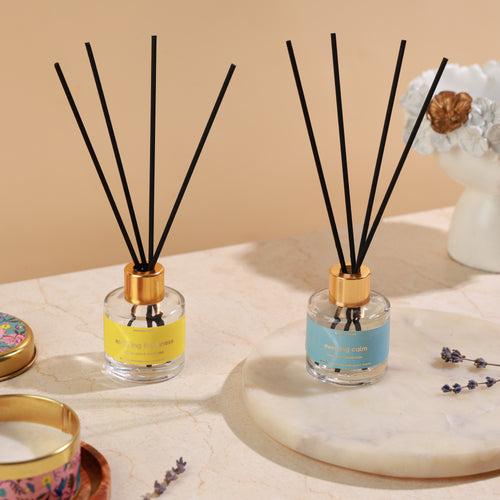 Two rooms · better value₹1,498Shop →
  Large room · a switch₹1,899Shop →
If you buy anyway, buy it properly
Put it out of the flow path, not in it. The instinct is to place the bottle near the window so the incoming air carries the scent inwards. It does the opposite: it puts the reeds in the fastest-moving air in the room, which strips fragrance off the tips and pushes it straight back out of whatever opening the air is leaving by. Place it on the far side of the room from the window, out of the direct line between the two openings, ideally on a low shelf or a chest of drawers where the air is slower. This one change is worth more than the difference between a 50ml and a 130ml, and it is free.
Use four reeds, not six, and judge it after dark. Six reeds in a ventilated room is the most expensive mistake available here: it raises the evaporation rate in exactly the conditions that were already draining the bottle, and the extra output vanishes out of the window before anybody registers it. Four reeds in a 130ml runs towards twenty-one weeks in still air and gives you a real reserve for the daytime losses. Then judge the room at nine in the evening with the window shut, not at three in the afternoon — and judge it from the doorway on the first breath, because olfactory adaptation is essentially complete within about twenty minutes and you are the worst possible judge of a room you have been sitting in.
And do not solve it by adding a second bottle. Two diffusers in a ventilated room give you two sources feeding the same outgoing draught. You would be paying ₹2,498 for two 130ml bottles that between them empty in perhaps ten weeks each, which is roughly ₹250 a week — three times the cost per week of a single bottle in a room that holds. If a ventilated space genuinely has to smell of something while the windows are open, the only honest answer in the range is an active machine: a Sukoon at ₹1,899 running Hotel Collection from ₹299, which you switch on for a period rather than leave running against a draught. Even then, run it once the windows are shut.
What to buy
For a genuinely open room the shopping list is empty. This table is here to show you what the money buys in the rooms that will actually hold it, so you can move the budget rather than lose it.
| Buy | What it covers | Lasts | Price |
|---|---|---|---|
| One 50ml | A single reed diffuser — a bathroom or a small closed room — the spaces that hold what you put in them | 6–8 weeks | from ₹749 |
| One 130ml ★ | The value size — the room you shut in the evening — 14–18 weeks, about ₹78 a week, longer on four reeds | 14–18 weeks | from ₹1,249 |
| The duo | Day & Night duo — one closed bedroom and one closed bathroom solved together, rather than one aired living room | 6–8 weeks each | ₹1,498 |
| Sukoon | 500ml ultrasonic — a large space you want scented on demand, switched on once the windows are shut | Runs when you switch it on | ₹1,899 |
| 300ml refill | The running cost — the running cost once you have settled which rooms are genuinely worth dosing | Roughly 2 × 130ml fills | ₹2,399 |
Versailles
I get asked this most often about kitchens and about living rooms with a balcony door that never shuts, and the answer disappoints people. A reed diffuser is a passive evaporative object. It has no fan. If your room is trading its whole volume of air with the outside six times an hour, the bottle is not losing to a sizing problem, it is losing to the weather, and no amount of my product fixes the weather.
What frustrates me is that the upsell here is so easy and so tempting. Someone says the living room smells of nothing, and the obvious move is to sell them a 130ml instead of a 50ml, then a second bottle, then a machine. Every one of those purchases would fail in the same way, and the customer would conclude that home fragrance does not work. It does work. It just does not work against an open window.
So the advice is boring and it saves you money. Buy for the rooms you close. If the window shuts at six, buy one 130ml, run four reeds, keep it out of the draught line, and judge it at nine in the evening. If the window never shuts, buy nothing for that room and spend the ₹1,249 on the bedroom instead, where it will run four months and you will actually notice it. A portion of every order funds a girl's classroom through Nanhi Kali — including the orders we talk people out of, because those customers come back.
Frequently asked questions
- One diffuser with the balcony door open? — the same problem, one door bigger.
- A home with very strong cross-ventilation — counting rooms that will not hold.
- Should I fragrance rooms nobody uses? — the other room worth skipping.
- The complete sizing and quantity guide — every home type, three builds.
- Brand: the SOSA founder story.
SOSA products & prices (verified August 2026): Hotel Collection water-based ultrasonic diffuser fragrance 15ml ₹299 · 100ml ₹999 · 300ml ₹1,799 · Pack of 7 (15ml, all fragrances) ₹1,799; refills 100ml from ₹999. Seven scents: The Ritz-Carlton-inspired (white tea · bergamot · cedar), Westin-inspired (white tea · aloe · cedar), 1 Hotels-inspired (cedarwood · vetiver · green leaves), The St. Regis-inspired (amber · violet · woods), Shangri-La-inspired (jasmine · green tea · white tea), Four Seasons-inspired (citrus · floral · sandalwood), W Hotels-inspired (citrus · pepper · amber). Diffusers: Boond 300ml ₹899 · Sukoon 500ml ₹1,899 · Megh 6L ₹3,499. Water-based, phthalate-free, composed to IFRA standards for home diffusion; 3–6 drops per tank. Made in India, Pune. The Hotel Collection scents are SOSA's own interpretations inspired by the world's finest hotels; all hotel names are trademarks of their respective owners and are used only to describe the scent style — SOSA is an independent Indian fragrance house, not affiliated with or endorsed by any hotel brand. Prices and availability subject to change — see the live product pages.