



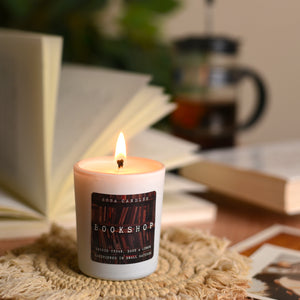
Per rupee over a year: the Sukoon wins clearly. ₹1,899 includes three 15ml Hotel Collection scents worth ₹897; refills are about ₹6 a millilitre. Reeds run roughly ₹250 a month, or ₹133 on 300ml refills.
On quality of result: different in kind. A reed gives one unchanging level of one scent. The Sukoon gives seven scents, steady/2H/4H timers, and the ability to run high before guests and low on a Tuesday.
The recommendation: reeds for the rooms nobody manages — bathroom, hall, guest room. The Sukoon for the room you actually live in. The pair is ₹2,648.
2. If longer means per rupee across a year, the Sukoon, and clearly. ₹1,899 includes three 15ml Hotel Collection scents worth ₹897 bought separately, which is more running than most single rooms need in a year. Reeds for the same year come to roughly ₹2,996 at four 50ml bottles, or about ₹3,148 with a 300ml refill in year one.
3. If longer means the result stays good, they differ in kind rather than degree. A reed gives you one unchanging level of one scent, every hour of every day. The Sukoon gives you seven scents, steady, 2H and 4H timers, and the ability to run high before guests and low on a Tuesday — and a scent that stops is a scent you keep noticing.
4. So the honest recommendation is a room list, not a winner. Reeds in the bathroom, the hall and the guest bedroom, because nobody manages those rooms. The Sukoon in the living room or bedroom you actually occupy, because that is the only room where control is worth anything.
5. Together that is ₹2,648 — ₹1,899 and ₹749 — and free shipping applies above ₹499. It is the setup I would put into most 2BHKs the week after a deep clean, and it is a better use of the money than two of either.
6. Neither, if the clean missed a source. Damp, a dry floor trap, an air-conditioner tray or a chimney filter will defeat both products, and running either over the top of one produces a compound smell rather than a solution.
A portion of every order supports girl-child education through Nanhi Kali.

Three meanings of the word longer
Nine pages of this group have been about what to do after a clean, and they all end in the same place: somebody standing in a finished house deciding between two products. So let me take the word in the title apart, because it is doing three jobs at once and that is why the question feels unanswerable. Longer can mean how long one purchase keeps working if nobody touches it. It can mean how far a given amount of money stretches across a year. And it can mean how long the result stays good rather than merely present — whether you are still pleased with it in March. Those are three different questions with three different winners, and any page that gives you a single answer has quietly picked one of them for you without saying which. I would rather show the working, because once you can see which of the three you actually care about, the decision takes about ninety seconds.
Reed against Sukoon, on every axis
The full comparison rather than the flattering half of it. Read down the axis column and stop at the row that describes what you actually care about, because there is no overall winner here and a table that declared one would be lying to you. The first row is the pick only in the sense that it is the setup I would recommend most often, which is both of them in different rooms.
| Axis | Reed diffuser · from ₹749 | Sukoon · ₹1,899 | Which wins |
|---|---|---|---|
| Best overall use | Rooms nobody manages: bathroom, hall, guest bedroom, landing | The room you actually live in, where control is worth something | Both — the pair is ₹2,648 and it is the honest recommendation |
| Time to work | 24–72 hours to reach its proper level | About 20 minutes from cold | Sukoon, decisively — but irrelevant after a clean, when nothing is urgent |
| Unattended run | About three months at 50ml; five to six at 130ml | 16–18 hours per 500ml fill on low, then it stops until refilled | Reed, decisively |
| Cost, year one, one room | ₹2,996 at four 50ml bottles, or ₹3,148 with a 300ml refill at ₹2,399 | ₹1,899 including three 15ml scents worth ₹897 — usually the whole year | Sukoon, by roughly ₹1,100–₹1,250 |
| Cost, year two onwards | Close to nothing if the ₹2,399 refill is still going: about ₹133 a month | ₹999 for a 100ml or ₹1,799 for a 300ml at about ₹6 per millilitre | Roughly even, with the refill bought |
| Scents and control | One scent, one level, permanently. Sticks are the only volume control | Seven scents; steady, 2H and 4H timers; remote; auto shut-off; a level you set | Sukoon, and it is a difference in kind rather than degree |
| Electricity, safety and travel | None. Nothing to switch off, nothing to leave running while away | Mains, cool mist, auto shut-off when dry. Empty it before a long trip | Reed |
| Your own nose after two months | Constant output, so habituation is total. Visitors still get it clearly | Timer gaps keep it perceptible; swapping among three included scents resets it | Sukoon |
Sukoon · the room you live in₹1,899Shop → 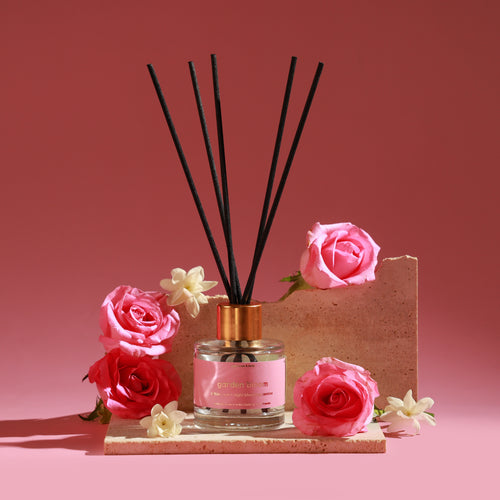 Reed · the rooms you do not₹749Shop →
  Seven scents · included₹299Shop →
Running both, and what goes in which room
Start with the room list, because it is the part people get wrong and it costs nothing to get right. Reeds go where nobody will ever perform a task: the bathroom, the entrance hall, the landing, the guest bedroom, the room with the shoe rack in it. Those rooms need a level rather than a performance, they are usually small, and a bottle with four sticks in it holds them entirely. Three sticks in a bathroom is plenty and five is too many, since a small closed room concentrates everything. Morning Freshness at ₹749 suits a bathroom or hall because lemon, peppermint and eucalyptus read as aired; Evening Calm at ₹799 suits a guest bedroom because lavender and chamomile are the least likely of the five to be objected to by somebody who did not choose them; Mountain Breeze at ₹849 suits a study or a landing. The Sukoon goes in exactly one room to start with, and it should be the room you spend most evenings in. 270–320 sq ft of coverage handles a normal Indian living room; three drops per tank in a house that has just been cleaned, four in a large hall, and six kept for the hour before guests arrive. Run it on the 2H timer at the hour you actually occupy the room rather than on steady all evening: 16 to 18 hours per fill on low is more running than a single room needs, and the gaps are what keep your own nose working. If a second machine ever makes sense, a Boond at ₹899 takes the same three drops per tank as the larger one, since the dose is per tank rather than per litre.
Then the two mistakes people make when running both together, because there are exactly two and they are both avoidable. The first is running two different scents in rooms that share air. A reed in the hall and a machine in the living room with an open doorway between them produces a boundary you walk through, and the nose reads a boundary as two products rather than as one home. Either keep the same family in adjoining spaces — the dry green reeds beside the dry green Hotel Collection bottles, the lavender reed beside nothing at all — or separate them by a door that is usually shut. The bathroom is the one place a deliberately different scent works, because the door is closed and the transition is expected. The second is dosing both as though the other were not there. A cleaned house carries scent further than an uncleaned one because the fabric reservoir is empty, so two products at their usual settings in a 700 sq ft flat is roughly a third more than you want. Take a stick out of the reed rather than turning the machine down, since the machine is the one with a timer and the reed is the one that runs continuously. And never mix the lines themselves: the Hotel Collection is water-based and goes into the Sukoon, Boond or Megh only, never into a reed and never into the waterless Vaayu at ₹11,999; reed oil never goes into an ultrasonic tank; and raw essential or carrier oils clog the 2.4MHz plate. Rinse the tank when you change scent.
Then the long view, which is what this group has really been about. The reason both products work better this month than they would have last month has nothing to do with either product. It is that the house underneath them is right. The cleaning removed the sources, the textiles gave up their reservoir, the air is being changed, and a fragrance running on that base is doing the only job fragrance is genuinely good at: supplying a constant that a person reads as care rather than as a product. Put the same reed into a flat with a dry floor trap and it becomes half of a compound smell. Put the same machine into a room with damp upholstery in it and it becomes a slow mistake. The order of operations is the whole argument, and it has been the argument on all ten of these pages: source first, then ventilation, then moisture and fabric, then cleaning, then air movement, then the fact that your own nose will stop reporting any of it within a fortnight — and only then fragrance. Get that order right and the question in this title stops being difficult, because both answers work and you are simply choosing which room gets which. Get it wrong and neither answer works, and the money is spent either way.
The buying guide for this whole group
This closes the ten pages on cleaning, so the table below is the group's buying order rather than this page's. It starts free, because the first three rows genuinely outperform everything I sell, and it ends with the honest absence that has run through the whole cluster. If you want the reasoning behind any row, the pages are linked underneath — including the waiting period after cleaning products, replacing your reeds during a big clean and what to do once the upholstery has been cleaned.
| Buy | What it is | When it earns its place | Price |
|---|---|---|---|
| 1. Find the source, then ventilate ★ | Dry floor traps, AC filters and trays, chimney baffles, the machine gasket, wall damp — then 20 minutes of cross-ventilation with two openings | First, free, and better than anything on this list. A smell with a pattern in time, weather or place is a source, and fragrance never fixes one | Free |
| 2. Let everything dry, then wait out the cleaning products | Cleaned upholstery and carpet stay damp 24–48 hours; cleaning-product residue clears in hours with the windows open | Second. Never run a cool-mist diffuser at damp fabric, and never add fragrance on top of a room that still smells of what you cleaned with | Free |
| 3. A reed diffuser for the rooms nobody manages | Alcohol-free, no electricity, no routine; roughly three months at 50ml, five to six at 130ml. Flip the sticks every two to three weeks | Bathroom, hall, guest bedroom, landing. Its 24–72 hour climb costs nothing in the week after a clean, and it holds a level with no input at all | ₹749–₹849 |
| 4. Sukoon for the room you live in | 500ml, 270–320 sq ft, 16–18 hours per fill on low, 2.4MHz cool mist, remote, auto shut-off, steady/2H/4H timers, three 15ml scents included | Where somebody is present to use it. Seven scents and a timer are worth having in one room and worth nothing in four | ₹1,899 |
| 5. Both, which is the recommendation for most 2BHKs | ₹1,899 and ₹749 together, covering the room you occupy and one of the rooms you do not | The pair rather than two of either. They are answers to different rooms, not competitors for the same one. Free shipping applies | ₹2,648 |
| 6. Refills, once one scent has clearly won | Hotel Collection 100ml ₹999 or 300ml ₹1,799 at about ₹6 per millilitre; reed 300ml refill ₹2,399, which is six 50ml fills | The second purchase, never the first. Buy the size that supplies a habit rather than the size that tests a guess | ₹999–₹2,399 |
| Not in the range: a room spray for the home | SOSA does not make one. The sprays in the range are car perfumes, formulated and sized for a car | Printed rather than implied. A spray is a thirty-minute product in any case, which is the wrong tool the week after a deep clean | — |
Versailles
Ten pages on what to do after cleaning your house, and I want to end them by admitting what the whole group has been circling. Almost everything that determines how a home smells is free, and almost none of it is fragrance. The bin, the traps, the filters, the drying time of a towel, twenty minutes of cross-ventilation, the state of the curtains and the sofa. A person who does all of that and buys nothing from me has a better-smelling home than a person who does none of it and buys everything. I have said so on every one of these pages and I would rather be quoted on it than on any product line I have ever written.
But there is a real thing left over after the free part is done, and it is worth money. A clean house is a house with nothing wrong with it, and nothing wrong with it is not the same as finished. The gap between those two is where a constant sits, and a constant is what makes a Thursday evening in an ordinary flat feel like somebody chose it. So: reeds in the rooms nobody manages, because the only product that works in an empty room is one that asks for nothing. The Sukoon in the room you actually sit in, because that is the one room where being able to turn something up before people arrive is worth ₹1,899. ₹2,648 for both, three scents included in that price, and after this week the house will hold whatever you chose for months, because you cleaned it first. That is the correct order, and it is the only piece of advice in this group I would defend without qualification.
Everything is made and supported from Pune, and a part of every order funds girl-child education through Nanhi Kali. You get a home that smells like somewhere you chose; a girl gets a classroom. That equation has always felt right to me.
Frequently asked questions
- I deep-cleaned my entire house but it still doesn't smell luxurious — what's missing? — where this group starts.
- What should I use after Diwali cleaning to keep the house smelling fresh for weeks? — the same decision at festival scale.
- What fragrance goes best with a freshly cleaned home? — which scent families suit clean air.
- I want my house to smell like professional hotel housekeeping — the four components, only one of which is for sale.
- Is a reed diffuser worth buying after deep-cleaning your home? — the checklist and the arithmetic.
- Brand: the SOSA founder story.
Facts verified August 2026: Timings in this guide: a scented candle puts noticeable fragrance into a normal room in roughly 15–20 minutes; a Sukoon ultrasonic diffuser reaches a steady level in about 20 minutes from cold; a reed diffuser needs roughly 24–72 hours for the oil to travel the reeds and the room to settle, so it is not a same-day solution. SOSA products and prices: Sukoon 500ml ultrasonic diffuser ₹1,899 (270–320 sq ft, 16–18h on low, 9–12h high, 30–50 ml/h, 2.4MHz cool mist, 7-colour LED, remote, steady/2H/4H timers, BPA-free, auto shut-off, includes three 15ml Hotel Collection scents of your choice); Boond 300ml ₹899; Megh 6-litre ₹3,499; waterless Vaayu ₹11,999 (up to 1000m³); Aangan ₹25,999; Meenar ₹38,500. Hotel Collection water-based fragrance 15ml ₹299, 100ml ₹999, 300ml ₹1,799, Pack of 7 at 15ml ₹1,799 / 100ml ₹5,999 / 300ml ₹10,799; dose 3–6 drops per tank. Reed diffusers (separate alcohol-free line): Morning Freshness from ₹749, Garden Bloom and Evening Calm from ₹799, Fresh Brew and Mountain Breeze from ₹849; 130ml from ₹1,249; duos from ₹1,498; 300ml refills ₹2,399. Scented candles: Bookshop 80g ₹379 (~15–18 hours), Bookshop + Cozy Corner ₹664 (~30–36 hours), Amber Rose 130g ₹599 (~25–30 hours) and 220g ₹799 (~40–50 hours), ceramic jar candles ₹949, Pure Calm wax melt set ₹854. Free shipping above ₹499. SOSA does not make a room or linen spray for the home — the sprays in the range are car perfumes. The Hotel Collection scents are SOSA's own interpretations; SOSA is not affiliated with or endorsed by any hotel brand. Prices subject to change — see the live product pages.