
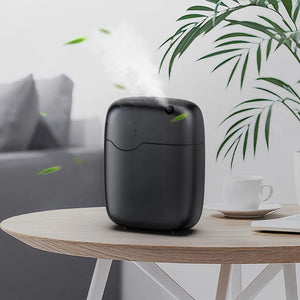


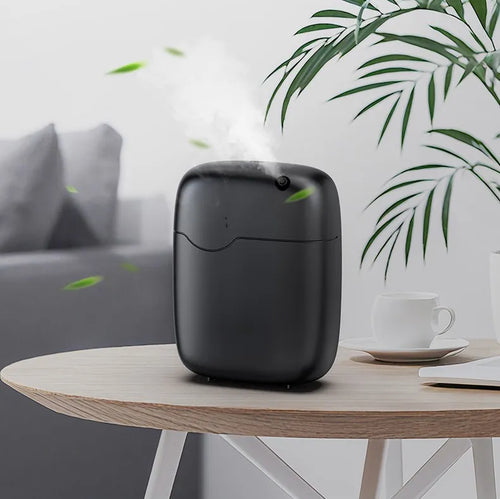
Never mount a machine into your air-conditioning. Ducting delivers fragrance to every room the system serves, which is precisely what a fragrance-free procedure suite is meant to prevent. In a clinic the Vaayu stands freely in reception, and nowhere else.
Verify it, do not assume it. A boundary never walked at the busiest hour is a drawing. Someone who has just come in from the street is a better witness than anyone who works in the building.
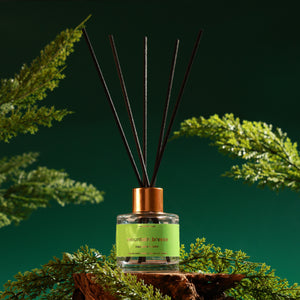
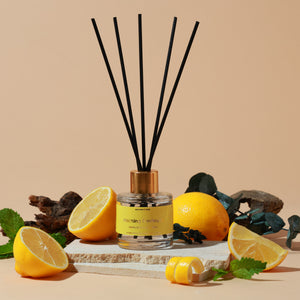
Then size to the arrival zone, not the clinic. Under ~150 sq ft, a reed diffuser from ₹749. From 150 to 320 sq ft, a Sukoon ₹1,899. Past that, a freestanding Vaayu ₹11,999.
2. Condition one: distance, from the source to the mouth of the clinical corridor. Put the bottle or the machine at the far end of the arrival zone, turned into the room rather than towards the opening. It is free, it is the most effective placement decision available, and most practices get it wrong by putting the source on the reception desk — usually the point closest to the corridor.
3. Condition two: a door that closes itself. A doorway is not a boundary and a curtain is not a door. A self-closing hinge costs a few hundred rupees and does more than any change of setting.
4. Condition three: the direction air actually travels. If reception air is drawn down the clinical corridor towards an extract, distance and doors will not save you — and this is the condition practices most often fail without knowing it.
5. Condition four: nothing ducted. Never mount a scent machine into shared air-conditioning in a clinical building. A duct distributes air to every room it serves, so ducting a fragrance source is a decision to put fragrance into the procedure suite. Freestanding in reception is the correct placement.
6. Verify at the worst hour, not the quiet one. Walk the corridor mouth at your busiest session with someone who has come in from the street. Your own nose adapts within minutes and is the least reliable instrument in the building.
7. If a condition fails, fix the building or buy nothing. A lower setting in a building with no boundary is still fragrance on the clinical pathway; it is only fragrance nobody has admitted to.
8. Then size to the arrival zone. Under about 150 sq ft, a reed diffuser from ₹749; 150–320 sq ft, a Sukoon at ₹1,899; past that, a freestanding Vaayu at ₹11,999. Made in small batches in Pune, and a portion of every order supports girl-child education through Nanhi Kali.
Part one — distance, doors and direction
The first three conditions you can settle yourself, without a consultant and mostly without spending anything. Take them in order, because each is cheaper than the next.
 Sukoon₹1,899 · arrival zoneThis is the condition most practices believe they have met and have not. A door counts only if it closes without anybody deciding to close it. In a working clinic, corridor doors are propped open for trolleys, for airflow on a hot afternoon, or because a wedge is easier than a handle forty times a session. A wedged door is an opening, and an opening lets a scented volume and an unscented one become one volume within the hour. The fix is mechanical rather than behavioural, because behaviour does not survive a busy Monday: a self-closing hinge or an overhead closer, fitted once, for a few hundred rupees. Where there is no door at all — an archway from waiting into the corridor, very common in clinics converted from residential floors — you do not have two zones, and the building needs changing before the fragrance question is worth asking.
Part two — the four conditions, and how to verify each
The four in order, with the minimum that counts, the test that proves it, and what to do when your building cannot meet it. Every "if you cannot" answer is an instruction to fix something or to spend nothing — never to lower a setting.
| The condition | The minimum that actually counts | How to verify it in your building | If you cannot meet it |
|---|---|---|---|
| 1 · Distance and placement ★ | Source at the far end of the arrival zone from the corridor mouth, facing into the room | Measure it. If the source is on the desk beside the corridor door, it fails | Move it — this is free and it is the largest single improvement available |
| 2 · A closing door | A door on the clinical corridor that shuts on its own, unwedged | Watch it for one clinic session and count how long it stands open | Fit a self-closing hinge or overhead closer before buying any fragrance |
| 3 · Direction of air travel | Reception air moving towards the front door or an outside wall, not the corridor | Tissue strip or smoke pencil at the corridor mouth, busiest hour, door open and shut | A ventilation question for your facilities engineer and clinicians — buy nothing meanwhile |
| 4 · No shared ducting | Nothing connected to any duct, AHU or cassette return serving both halves | Ask which rooms your air handling serves. If the answer includes a procedure room, it is settled | Freestanding only, in reception. Decline any offer to install into the system |
| Supporting · Split AC position | The indoor unit not blowing from reception towards the corridor opening | Stand under it with the fan on high and follow the throw with your hand | Re-angle the louvres, or move the source out of the throw. Both are free |
| Supporting · Run schedule | Fragrance running only in outpatient hours, never on a procedure list | Compare the machine's programme against the theatre and injection lists | Use a machine with day selection and run windows, or switch it off manually |
| Supporting · Recovery and day-care position | Post-operative seating out of the arrival zone's air path entirely | Walk from the source to the bay. If it is one continuous volume, it fails | Move the seating, not the machine — then re-test the boundary |
| Supporting · Intensity, once all four pass | The lowest level a visitor from the street can register at all | Ask a visitor, not the staff — your own nose adapts within minutes | Reduce reeds or drop a setting; noticeable is already too strong for a clinic |
| The honest caveat: these are ambience placement checks, not ventilation engineering, and nothing here is medical, clinical or regulatory advice. No SOSA product is described as safe or unsuitable for any patient group, procedure or room, and no claim is made that fragrance harms or benefits anyone. Air movement, infection control, theatre ventilation standards and accreditation rest entirely with the practice, its clinicians and its facilities engineers; where a check here conflicts with their advice, follow theirs. | |||
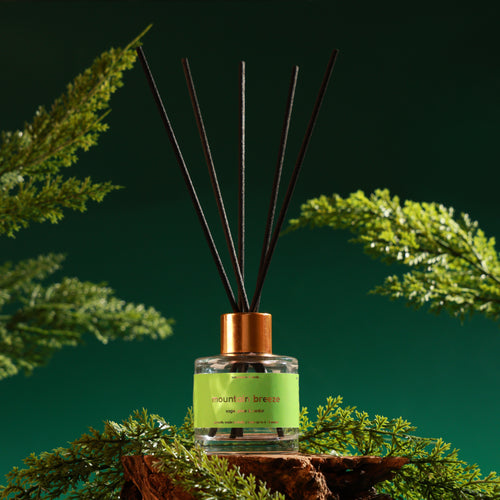 Mountain Breeze · under ~150 sq ft₹849Shop →
  Sukoon · 150–320 sq ft₹1,899Shop → Vaayu · past ~320 sq ft₹11,999Shop →
Part three — the ducting question, and when the answer is no
The fourth condition deserves its own section because it is where the commercial pressure sits. A cold-air nebuliser can be wall-mounted or connected into air handling, and in a hotel or a showroom that is often the neatest installation available. In a clinical building it is the wrong answer, and I will not specify it. A duct exists to deliver air to every room the system serves, so connecting a fragrance source to it is a decision to put fragrance into consultation cabins, diagnostic rooms, the procedure suite and any recovery area on that loop — the exact rooms this cluster exists to keep clear. No setting, schedule or damper arrangement changes that, because distribution is the point of a duct. A supplier offering an in-duct installation for an eye clinic is quoting a hotel brief. Freestanding in reception, away from the corridor, is the correct placement, and being less elegant is not an argument against it.
There is a second placement problem that hides behind a plan: the post-operative or day-care bay. In a great many Indian eye practices, the recovery seating is simply a set of chairs at one end of the waiting hall, screened by a partition or by nothing at all. On the plan it is a separate room with a separate name; in the air it is the same volume as the arrival zone, so anything in reception is also in the bay. The correction is almost never the machine — moving a source rarely produces enough separation inside one hall. It is the seating: put post-operative patients behind the corridor door, then re-run the tissue test. If the layout will not allow that, this practice should not scent its waiting area at all for now.
Three more situations end at no. A reception that is under-ventilated should not be scented — more fragrance in a room whose air is not exchanging reads as heavier, not fresher, and the useful spend is an extract fan rather than a bottle. A practice whose real problem is a smell it can name should fix the source first: fragrance adds a scent alongside what is in the air and removes nothing, so layering it over a cleaning agent or damp produces a third smell worse than either. And a practice whose staff have not been asked should ask them before it buys — the person at the desk is in that air for a full shift, and a single objection from the desk team is a no. In all three cases the correct outcome of reading this page is that you spend nothing this quarter.
Part four — six layouts, and what each one should do
Layouts, not room sizes. The question in every row is whether the four conditions can hold, and only then what to put in the arrival zone.
| Your layout | Do the four conditions hold? | What to do about the building first | Then, for the arrival zone |
|---|---|---|---|
| Procedures on a separate floor from reception ★ | Yes, comfortably — the strongest case there is | Nothing, beyond keeping the stair or lift lobby door shut | Size to the reception alone: reeds from ₹749, or a Sukoon at ₹1,899 |
| Separate wing, two doors between waiting and the suite | Yes, if both doors close themselves | Fit closers if either is wedged; re-test with a tissue strip | Sukoon ₹1,899 for 150–320 sq ft, lowest setting, 2H or 4H timer |
| One corridor, one self-closing door, procedures at the far end | Usually yes — but the direction test decides it | Run the tissue test at the busiest hour before spending anything | Source at the far end of waiting from the corridor mouth, facing into the room |
| Open archway from waiting into the clinical corridor | No — this is one volume, not two | A door, or a partition, or nothing. This is a builder's job first | Buy nothing until the opening is closed; a lower setting is not a fix |
| Ducted or cassette AC serving reception and the suite together | Condition four fails for any in-duct option | Decline in-duct installation. Check where the return grille draws from | Freestanding only, sited out of the return's pull — never mounted in the system |
| Day-care or recovery seating inside the waiting hall | No, while the seating stays there | Move the bay behind the corridor door, then re-run the test | Only after the move, and only at the lowest level a visitor can register |
Versailles
I learned condition three the embarrassing way, in a practice where everything on paper was right. The machine was at the far end of the hall, the corridor door had a closer on it, and the partners had been careful. The surgeon still told me he could tell what the reception held from outside his procedure room.
The building was pulling air from the front door to a toilet extract at the back, and the whole clinical corridor sat on that path. Nothing about the placement was wrong; the airflow simply went the other way from the way we had assumed. We turned the machine off, and I have opened with the tissue test ever since.
What I take from it is that this is not a fragrance problem and I am not the expert on it. I can tell you where to stand a bottle and how quiet a machine is. Where your air goes is a question for the people who look after your building. Made in small batches in Pune, and a part of every order funds a girl's classroom through Nanhi Kali.
Frequently asked questions
- How reception fragrance actually travels — door swing, AC returns and corridor pressure.
- The full zone list for an ophthalmology practice and reception versus the examination room.
- Why diagnostics stay fragrance-free and why examination rooms get nothing.
- Running scent only during certain hours and the most conservative way to introduce fragrance at all.
- Brand: the SOSA founder story.
SOSA range, specifications and prices used in this guide (verified August 2026): Vaayu ₹11,999 — waterless cold-air nebulisation of undiluted fragrance oil; no water, no heat, no added humidity, no white mineral dust. Coverage up to 1000 m³, about 2,000–3,000 sq ft. 400ml refillable tank lasting roughly 90+ days at a mid setting. Bluetooth app plus onboard controls, 1h / 4h / 8h / 24h run windows, day selection, adjustable intensity, auto-stop and key-lock. Under 38 dB. DC 12V / 1A, 5W. Freestanding or wall / HVAC mount. CE, RoHS and SGS certified. SOSA does not currently sell a separate Vaayu cold-air refill oil; the 400ml supplied in the box is the fragrance available at the time of writing, so a practice planning continuous or multi-site use should confirm current refill availability with SOSA before committing. The water-based Hotel Collection is made for ultrasonic machines and must not be used in a Vaayu. Other machines: Boond 300ml ₹899 (~150 sq ft, ultrasonic) · Sukoon 500ml ₹1,899 (270–320 sq ft, 16–18 hours on low, remote and steady/2H/4H timers, three 15ml fragrances included, ultrasonic) · Megh 6L ₹3,499 (~215 sq ft — a runtime and humidity machine that covers less than a Sukoon, never a coverage upgrade) · Safar ₹3,999 (waterless cold diffusion, cordless, 20ml, about 6.9cm, three speeds, 1/2/3-hour auto-off — sold as a car and travel diffuser, personal-scale only; SOSA publishes no coverage figure for it) · Aangan ₹25,999 (HVAC nebulising, ~8,000–10,000 sq ft) · Meenar ₹38,500 (commercial HVAC, 12,000–18,000 sq ft). Water-based Hotel Collection for ultrasonic machines: 15ml ₹299 · 100ml ₹999 · 300ml ₹1,799 · pack of seven ₹1,799; scents are inspired by the atmosphere of well-known hotels — SOSA is an independent Indian brand and is not affiliated with, endorsed by or supplying any hotel group. Reed diffusers ₹749–₹1,349 (50ml 6–8 weeks, 130ml 14–18 weeks, six fibre reeds, no 100ml size; replacement reeds are not sold separately). Reed oil cannot be used in an ultrasonic machine and Hotel Collection oil cannot be used in reeds. SOSA sells no room spray or home spray — every SOSA spray is a car perfume. Nothing in this guide is medical, clinical or safety advice. A fragrance diffuser adds a scent to the air. It does not clean, purify, filter, sanitise or disinfect air, does not remove or neutralise disinfectant, damp or occupancy smells, and has no effect on comfort, anxiety, waiting time, recovery or any clinical outcome. Some people are sensitive to airborne fragrance, which is why this guide recommends that examination rooms, diagnostic areas, consultation cabins, procedure suites and post-operative areas remain fragrance-free, that a fragrance-free seating option always exist, and that a diffuser is never mounted into shared HVAC in a clinical building. Decisions about clinical policy, ventilation standards, infection control and patient suitability rest entirely with the practice and its clinicians. A persistent stale, damp or disinfectant smell is a ventilation, moisture or cleaning problem — SOSA sells no dehumidifier and no air purifier, and fragrance should never be used to cover one. Coverage, runtime and longevity figures are manufacturer specifications and typical ranges, not guarantees, and vary with room volume, ceiling height, air exchange, occupancy and season. SOSA publishes no commercial or bulk pricing, no corporate account, no annual maintenance contract, no installation service, no stated warranty term and no multi-location programme; warranty length, spare parts, servicing and app platform availability are unconfirmed, and larger or multi-site enquiries should go through the contact page before any commitment. Composed and made in small batches in Pune, India. Free shipping above ₹499. A portion of every order supports girl-child education through Nanhi Kali. Prices subject to change — see the live product pages.