



Why sprays fail here: an aerosol peaks within a minute and collapses within fifteen. A guest arriving twenty minutes off your estimate meets the tail of it.
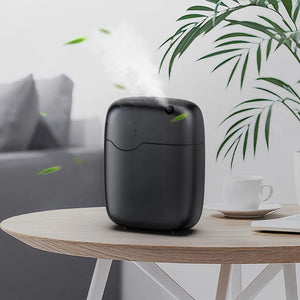
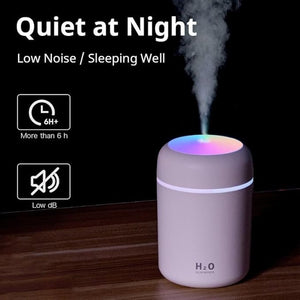
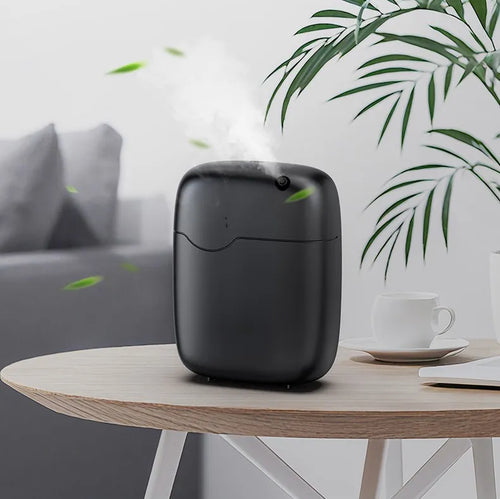
What can actually be scheduled: the Sukoon at ₹1,899 with steady, 2H and 4H timers for one room; the waterless Vaayu at ₹11,999 with 1h / 4h / 8h / 24h timers, app control and a key-lock for up to 1000m³.
The honest limit: this is about the guest's experience of arrival. It is not a ratings, reviews or bookings claim, and nobody can promise you those.
2. Ventilation comes before fragrance, always. Twenty to thirty minutes of cross draught with the cleaning finished, then close the property up. Running a diffuser with the windows open wastes the oil and gives you nothing; running it into a flat that still smells of cleaning gives you two smells.
3. Give a machine sixty to ninety minutes in a shut flat. That is the working window in a normal Indian flat. In a large open-plan property or a double-height room, allow longer — the volume is bigger and the ceiling holds a share of it above head height.
4. If nobody will be there, you need a timer. The Sukoon at ₹1,899 has steady, 2H and 4H settings and a remote. The Vaayu at ₹11,999 has 1h / 4h / 8h / 24h timers, adjustable intensity, Bluetooth app control and a key-lock so a guest cannot alter the setting. Those are the two formats that solve an unattended arrival.
5. If you cannot predict the hour, stop trying. Self check-in windows drift. Flights land late. A passive reed diffuser standing permanently in the entry is immune to all of it, because it was never switched on — Garden Bloom at ₹799 for 50ml or ₹1,299 for 130ml, six fibre reeds, flipped weekly.
6. Choose intensity downward. You cannot smell your own property accurately — your nose adapts to a constant within minutes and adapts hardest in a space you spend time in. Set it lower than feels right and check with someone who has not been inside.
7. Know the boundary. All of this shapes the first ninety seconds of a guest's arrival, which is real. None of it is a promise about ratings, reviews, bookings or occupancy — nobody can make that promise honestly. Composed and handmade in small batches in Pune, and a portion of every order supports girl-child education through Nanhi Kali.
Part one — how a fragrance becomes a room, and why that takes time
A scent in a space is not a switch that is on or off; it is a curve with three phases, and hosts who understand the curve stop buying the wrong things. Production, distribution and absorption each take their own time, and only the first of the three is under your control. A source releases fragrance molecules into the air immediately around it. Air movement then carries them through the volume, which in a still flat happens by slow convection and in a ventilated one happens too fast to accumulate. Finally, soft furnishings — sofas, curtains, bedding, rugs — take up a share and give it back slowly, which is what turns a plume into a room that smells consistent from the door to the balcony. Until that third phase has begun, you have a strong patch near the machine and nothing at the sofa.
 Garden Bloom₹799 · entryway floralThis is the step hosts get backwards. Ventilation and scenting are both necessary and they are sequential, not simultaneous. Air out first with the windows open and the fans on; then close everything and let the fragrance accumulate. A flat with a window open exchanges its entire air volume many times an hour, and no domestic machine can outrun that — you will empty the tank and the room will still read as neutral. Interior doors matter too: a closed bedroom door is a wall as far as fragrance is concerned. If you want the bedrooms to participate, open the internal doors during the run and let a guest close them later. Ceiling fans on low actually help distribution once the windows are shut, because they mix the volume without exhausting it.
Part two — the pre-arrival clock, hour by hour
Here is the sequence written as a clock, counting backwards from the check-in time. Adjust the absolute hours to your turnover; the order never changes. Everything before T-2 is free, and it is the part that does most of the work.
| Time before check-in | What happens | Why it is at this point | Who or what does it |
|---|---|---|---|
| T-4h to T-3h ★ | Clean finishes. Bins out, drains watered, bathroom floors dried | Sources removed before anything is added — fragrance covers nothing | Housekeeping |
| T-3h to T-2h30 | Cross ventilation: opposite windows, ceiling and exhaust fans on | Cleaning products are designed to evaporate; they need moving air to do it | Housekeeping, 20–30 minutes |
| T-2h30 | Close every window. Open internal doors | Nothing accumulates in a ventilated flat. Closed doors are walls | Housekeeping, as they leave |
| T-2h to T-1h30 | Machine starts, at a modest intensity | Production plus distribution plus a little absorption needs this long | Timer or app — no human required |
| T-30m to T-15m | Machine stops | The room settles. A guest should meet a room, not a plume | Auto-stop / 1h or 2H timer |
| T-0 | Guest opens the door. Ninety seconds decide the impression | This is the whole of what you are buying, and it is worth buying | The property |
| The honest caveat: this clock shapes what a guest experiences on arrival. It is not a lever on your ratings, reviews, bookings, occupancy or nightly rate — there is no evidence for any of that and nobody, us included, can promise it. Nor does any of this purify air or remove odours; fragrance adds, which is why the first two rows exist. If your check-in time is a four-hour self-service window rather than an hour, skip the clock entirely and read Part three. | |||
Vaayu · scheduled, whole floor₹11,999Shop →  Sukoon · timed, one room₹1,899Shop →
 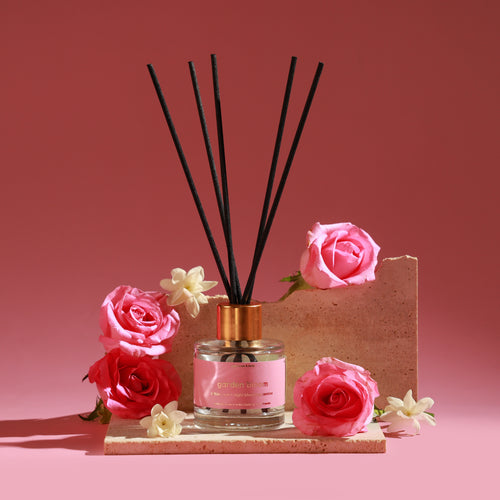 Garden Bloom · always onfrom ₹799Shop →
Part three — when timing is the wrong answer
The clock in Part two assumes you know when your guest will walk in. A great many hosts do not, and for them the entire scheduling approach is a trap. If your listing runs a self check-in window of several hours, or your guests routinely arrive off delayed trains and late flights, do not buy a timer — buy a format that was never switched on. A reed diffuser standing permanently in the entryway is present at two in the afternoon and at two in the morning with no intervention from anyone. It is a constant, deliberately low background rather than an event, and for an unpredictable arrival that is a feature rather than a compromise. Six fibre reeds in the bottle, flipped weekly with gloves; 50ml lasts 6–8 weeks and 130ml 14–18. Put it on a tray, because reed oil marks wood and stone, and keep it away from children and pets.
The second case is a property too small to justify machinery. If the listing is a studio or a 1BHK, a single reed diffuser near the door and possibly a second in the bathroom is the complete correct answer, and it will cost you between ₹749 and ₹1,698 rather than ₹11,999. I would rather say this than sell you the machine and have you conclude the category is a con. The Vaayu is built for up to 1000m³ of connected volume; putting it in 400 sq ft is not a luxury, it is a mismatch, and you will spend the first month turning the intensity down. Below roughly 800 to 1,000 sq ft of connected volume, reeds or a Sukoon is the right ladder rung. And a Megh at ₹3,499 is not the middle step it appears to be — its 6L tank buys about 100 hours of runtime and it covers roughly 215 sq ft, less than the Sukoon. It is a runtime and humidity machine, never a coverage upgrade.
The third case is a supply question rather than a timing one, and it applies specifically to the Vaayu. SOSA does not currently sell a separate Vaayu refill oil. The machine ships with 400ml — four Hotel Collection cold-air fragrances at 100ml each — and at a mid intensity setting that is quoted at 90+ days per fill. That 400ml is the entire supply available from us today. It is a real gap and I would rather name it the way we name the missing replacement reeds in our diffuser range than let you find it in month four. If uninterrupted long-term supply is a condition of your purchase, check current refill availability with SOSA before you buy. And to be explicit, because the two share scent names: the water-based Hotel Collection sold for ultrasonic machines is a different product and must not be used in a Vaayu.
Part four — which formats can actually be scheduled
The practical question underneath all of this is which products can be relied on to do something at a specific hour in a property with nobody in it. This table answers only that. Coverage and price are from the verified August 2026 range.
| Format | Lead time to establish | Can it be timed? | Needs someone on site? | Price |
|---|---|---|---|---|
| Vaayu waterless cold-air ★ | 60–90 min for a large closed floor | Yes — 1h / 4h / 8h / 24h, app, auto-stop, key-lock | No | ₹11,999 |
| Sukoon ultrasonic | 45–90 min for one closed room | Yes — steady / 2H / 4H, with a remote | No, if filled in advance | ₹1,899 |
| Boond ultrasonic | Similar, but only ~150 sq ft and ~6 hrs a fill | Limited — USB powered, small tank | Realistically yes | ₹899 |
| Megh 6L ultrasonic | Long runtime, but only ~215 sq ft of coverage | Runtime, not scheduling — and it adds humidity | No, but it covers less than a Sukoon | ₹3,499 |
| Reed diffusers | Days — but then permanent | No, and it does not need to be | Weekly flip only | From ₹749 |
| Aerosol spray | Under a minute, then gone in fifteen | No | Yes, at the exact right moment | Not sold by us |
| Candles and incense | Irrelevant — never leave a flame in a let property | No | Yes, and continuously | Not sold by us |
Versailles
Perfumery school teaches you to think in phases — top, heart, base — because a fragrance on skin is a thing that unfolds over hours rather than a thing that is simply present. It took me longer than it should have to notice that a room does the same, and that almost every host frustration I hear is really a phase problem. They are meeting their fragrance in the wrong part of its curve, and then buying a bigger bottle of it.
The most useful hour in a turnover is the one where nothing visible is happening. Windows shut, nobody inside, the machine working quietly against a volume of still air. It produces nothing you can photograph and it is the reason the arrival works. I have watched hosts protect the linen budget fiercely and give that hour away without noticing.
If you take one thing from this page, let it be that you should set your intensity lower than your instinct says. You cannot smell your own listing accurately — nobody can smell a space they have been standing in — and the consequence is a fragrance that reads as considered to you and as heavy to a stranger with a suitcase. Ask the cleaner. Ask a neighbour to walk in cold. And remember what this does and does not buy: it shapes ninety seconds of arrival, honestly and describably. It is not a rating, and I will not sell it to you as one.
Frequently asked questions
- How to make your Airbnb smell amazing when guests walk in — the ninety-second window in full.
- Smelling clean without smelling like cleaning products — what has to happen before this clock starts.
- Should you use a fragrance diffuser in an Airbnb? — the unattended-property audit.
- The complete Airbnb arrival scenting guide — this page and the eight around it, in one place.
- Brand: the SOSA founder story.
SOSA Vaayu specifications (verified from the live product page, August 2026): ₹11,999 (the product page displays a rounded ₹12,000). Waterless cold-air nebulisation — pressurised air atomises undiluted fragrance oil into a dry nano-mist; no water, no heat, residue-free. Coverage up to 1000m³, about 2,000–3,000 sq ft. 400ml refillable tank, 90+ days per fill at a mid intensity setting. Bluetooth app plus onboard buttons, 1h / 4h / 8h / 24h timers, adjustable mist intensity, auto-stop and key-lock. Under 38 dB. DC 12V / 1A, 5W. 165 × 80.5 × 215 mm, 0.9 kg, black or white. Freestanding or wall / HVAC mount. CE, RoHS and SGS certified. Ships with four SOSA Hotel Collection fragrances at 100ml each (400ml in total) in one of three combos chosen at checkout. SOSA does not currently sell a separate Vaayu refill oil; the 400ml supplied in the box is the fragrance available at the time of writing, and buyers who need long-term supply should confirm current refill availability with SOSA before purchasing. The cold-air oil supplied with the Vaayu is a different product from the water-based Hotel Collection sold for ultrasonic machines (15ml ₹299 · 100ml ₹999 · 300ml ₹1,799), which must not be used in a Vaayu despite sharing scent names. Other SOSA machines: Boond 300ml ₹899 (~150 sq ft) · Sukoon 500ml ₹1,899 (270–320 sq ft) · Megh 6L ₹3,499 (~215 sq ft — a runtime and humidity machine, not a coverage upgrade) · Aangan ₹25,999 (~8,000–10,000 sq ft) · Meenar ₹38,500 (12,000–18,000 sq ft) · Safar car diffuser ₹3,999. Reed diffusers 50ml ₹749–₹849 (6–8 weeks) · 130ml ₹1,249–₹1,349 (14–18 weeks) · duo sets ₹1,498–₹1,598 · oil-only refills 300ml ₹2,399 / 500ml ₹3,499. Runtime, consumption and coverage figures are manufacturer specifications and vary with intensity setting, run hours, ceiling height, ventilation and season; any per-month or per-day figure in this guide is arithmetic on those specifications, not a measurement. Electricity costs vary by state tariff. No claim is made that scenting affects ratings, reviews, bookings, occupancy, revenue, health, mood or air quality. Free shipping above ₹499. A portion of every order supports girl-child education through Nanhi Kali. Prices subject to change — see the live product pages.