

Why Does the Cooking Smell Always Reach My Bedroom?

Why Does the Cooking Smell Always Reach My Bedroom?

★ Indian cooking, small flats and the smell that is still there at eleven · the order that actually worksCandle ₹379 · reed ₹749 · Boond ₹899 · Sukoon ₹1,899 · free shipping above ₹499A portion funds girl-child education
★ SOSA · find the cause, then scent the room
Extraction while you cook, ten minutes after, a door shut and the air changed — and only then anything with a scent in it
★ ★ ★ ★ ★
★★★★★
"Chimney on only while cooking was my mistake. Ten minutes afterwards was the whole difference, and it cost nothing."
Meghna K. Free fix · extraction
1BHK, Mumbai
★★★★★
"Fish for two days. Learned it was aerosol landing on fabric rather than air, washed what I could, and it went in an afternoon."
Joseph A. Fabric, not air
Kochi
★★★★★
"Asked straight out whether a diffuser would cover tadka. Was told no, and told why. I bought one anyway, for afterwards, and it is the right way round."
Preeti N. Honest answer
Told the truth
★★★★★
"Open kitchen, so containment was never going to work. Switched to a dry scent that sits somewhere completely different from food. That was the trick."
Rahul V. Forest Suite ₹299
Open kitchen
★★★★★
"Bedroom door shut during cooking. One sentence, free, and my clothes stopped smelling of dinner."
Shalini D. Free fix · shut the door
2BHK, Pune
★★★★★
"Sukoon on the 4H timer from six, not at eight when everyone arrives. The flat has already got there by then."
Imran H. Sukoon · 4H timer
₹1,899
★★★★★
"Chimney on only while cooking was my mistake. Ten minutes afterwards was the whole difference, and it cost nothing."
Meghna K. Free fix · extraction
1BHK, Mumbai
★★★★★
"Fish for two days. Learned it was aerosol landing on fabric rather than air, washed what I could, and it went in an afternoon."
Joseph A. Fabric, not air
Kochi
★★★★★
"Asked straight out whether a diffuser would cover tadka. Was told no, and told why. I bought one anyway, for afterwards, and it is the right way round."
Preeti N. Honest answer
Told the truth
★★★★★
"Open kitchen, so containment was never going to work. Switched to a dry scent that sits somewhere completely different from food. That was the trick."
Rahul V. Forest Suite ₹299
Open kitchen
★★★★★
"Bedroom door shut during cooking. One sentence, free, and my clothes stopped smelling of dinner."
Shalini D. Free fix · shut the door
2BHK, Pune
★★★★★
"Sukoon on the 4H timer from six, not at eight when everyone arrives. The flat has already got there by then."
Imran H. Sukoon · 4H timer
₹1,899
Find the source first · two windows for twenty minutes beats any product for a closed smell Fragrance is the finishing layer. It does not remove damp, a dry drain or a loaded sofa Sukoon ₹1,899 · 270–320 sq ft · 16–18 hours per fill · three 15ml scents included
Founder Diaries · Home Fragrance · Why Your Home Smells of Cooking

Why Does the Cooking Smell Always Reach My Bedroom?

By Sonal Sahani · ISIPCA Versailles 11 min read Updated August 2026
Smell does not wander. It goes where the air goes, and air goes where the pressure sends it — and in a flat, pressure is set by four things: what is extracting, what is open, what is blowing and what is shut. Once you can read those four, the route from your kitchen to your pillow stops being a mystery and becomes a diagram you can interrupt. Almost all of the interrupting is free, and one of the steps is simply closing a door at the right moment rather than the wrong one.
Quick answers — read this first
The mechanism: a running chimney removes air, and that air is replaced by air drawn in from everywhere else in the flat — including through the bedroom. Extraction sets up a flow across the whole home toward the kitchen.

Which means two free things matter more than any product: shut the bedroom door before you start cooking, and open a window in or near the kitchen so the extractor takes its replacement air from a near source instead of pulling it through the rest of the flat.

And then the storage problem: whatever reaches the bedroom is held by the mattress, the pillows, the curtains and any clothes hanging in an open wardrobe. Air clears in twenty minutes; fabric does not. Fragrance is for afterwards, never during.
The short answer
Short answer: because your kitchen extraction creates a small negative pressure and the flat replaces that air by pulling it in through every available path, which sets up a current from the rest of the home toward the kitchen — and your bedroom is on that route. When the fan stops, the gradient collapses and whatever is left redistributes by ordinary diffusion.
The free corrections: shut the bedroom door before cooking rather than after; give the extractor a near make-up air path by opening a kitchen window while it runs; switch off any bathroom or bedroom exhaust fan that is quietly pulling air the other way; and shut the wardrobe, which is a fabric store with the door left open.
Afterwards: the Boond is ₹899 for a bedroom at three drops of a Hotel Collection scent at ₹299, and Evening Calm from ₹799 is the unplugged version that holds one level for months — allow 24 to 72 hours before judging a reed. SOSA does not make a room or linen spray for the home. Free shipping above ₹499.
Straight answer
Why does the cooking smell always end up in my bedroom?
1. Because the extraction that clears your kitchen is also moving air across your whole flat. A chimney removes air. That air is replaced, and with the windows shut it is replaced by air pulled in through every gap and doorway in the home. Your bedroom becomes part of the supply route.

2. Shut the bedroom door before you start cooking, not once you notice the smell. A shut internal door is not a seal, but it removes the largest opening on the route and it is the highest-value free action available. Reopen it once the air has been changed.

3. Open a window in or near the kitchen while the extraction runs. Give the fan a near, low-resistance source of replacement air and it stops drawing through the rest of the flat. This is the step that changes the direction of the problem rather than fighting it.

4. Check what else is pulling. A bathroom exhaust fan, a bedroom window fan, an open balcony door on the windward side — any of these can reverse the flow and drive kitchen air straight down the corridor into your room. Switch them off for the hour.

5. Then deal with the storage, because that is why it lasts. The mattress, the pillows, the curtains and the clothes in an open wardrobe hold what the air delivered. Air clears in twenty minutes; fabric takes days. Shut the wardrobe. Wash what is washable.

6. Fragrance afterwards, and at a low level. A Boond at ₹899 with three drops of a Hotel Collection scent at ₹299, or Evening Calm from ₹799 if you would rather have nothing to switch on.

A portion of every order supports girl-child education through Nanhi Kali.
TL;DR: smell follows air and air follows pressure. A running chimney removes air the flat has to replace, so it pulls a current from every other room toward the kitchen, and your bedroom is on that route. Shut the bedroom door before you cook and give the extractor a window near the kitchen to draw from. Both free.
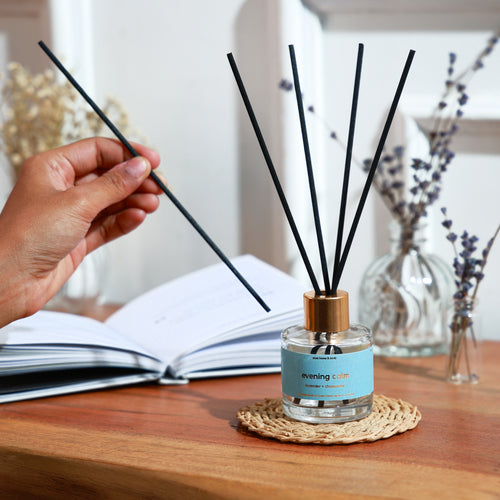
Evening Calm reed diffuser
The bedroom scent, once the door has done the real work
Evening Calm reed diffuser from ₹799
Himalayan lavender and chamomile, alcohol-free, no plug, no tank and nothing to switch on or off. A bedroom in a flat with an Indian kitchen in it wants a low, unchanging level rather than a burst, because the problem this page describes happens at a specific hour and you do not want to be operating a machine in the middle of it. Reeds work by capillary action and ambient evaporation and need 24 to 72 hours before they are doing their job, so this is the buy for a habit rather than for tonight. Start with half the sticks in the liquid. From ₹799, 130ml from ₹1,299, 300ml refills ₹2,399.

Smell follows air, and air follows pressure

Every question in this group eventually reduces to one sentence, and it is worth having it stated plainly before anything else. An odour molecule has no destination. It goes wherever the air it is suspended in goes, and air moves from higher pressure to lower pressure — always, without exception, and over differences far too small for you to feel. In a flat those differences are created by four things and only four: something extracting air out, something open to the outside, something blowing air around, and something shut that would otherwise be open. Learn to read those four and you can predict, before you start cooking, exactly which route the evening's smell will take through your home — and then put something in the way of it.

1
THE PULL
Extraction removes air, and the flat replaces it from everywhere else
So begin with the fan you already own. A kitchen chimney rated at, say, eight hundred cubic metres an hour is not merely cleaning the kitchen; it is removing eight hundred cubic metres an hour from the whole flat, and every one of those cubic metres has to be replaced from outside the building. The replacement air does not politely queue at the kitchen window. It comes in wherever the resistance is lowest: the gap under the front door, the frames of shut windows, the bathroom shaft, the service duct, a balcony door that is not quite sealed, and — most relevantly for this page — any opening in your bedroom. The flat goes very slightly negative in pressure, and every leak in it becomes an inlet. Which means that while the extraction is running, air is moving from your bedroom, through the living space, toward the kitchen — and that direction is actually working for you. The trouble is what happens next. The moment the fan goes off, that gradient collapses. Any smell that escaped the hood is now sitting in the flat's air with nothing driving it anywhere in particular, and from that point it spreads by ordinary diffusion and by whatever gentle convection the fridge, the walls and the evening temperature drop provide. The bedroom is no longer upstream of anything. It is simply part of one volume, and one volume equalises. That is why the answer is not only about direction, it is about how much smell is loose in the flat when the fan stops — which is the argument for leaving the extraction running for ten minutes after you finish rather than switching it off with the hob.
2
THE REVERSE
Something in your flat is often pulling the other way
Then the case people never check, and it accounts for a surprising share of the emails I get on this subject. Your kitchen is not the only extraction in the home. A bathroom exhaust fan is an extractor. A window fan in the bedroom is an extractor. An open window on the leeward side of the building on a breezy evening is an extractor. And whichever of them is winning at a given moment decides which way the air in the corridor is travelling. Run the bathroom fan attached to your bedroom while the kitchen chimney is on and you have created a competing sink at the far end of the flat, which draws air along the corridor — through the kitchen and into your room — rather than away from it. People do this constantly and without noticing, because bathroom fans are switched on for a reason that has nothing to do with cooking and then left running. The same applies to a ceiling fan, which does not extract anything but is extremely good at destroying the orderly separation between rooms. A fan in the living room on high, pointed along the axis of the flat with the bedroom door open, will move kitchen air into that bedroom faster than any pressure gradient. And the third case is wind. On an evening with a breeze on one face of the building, an open window on the pressure side pushes air inward and an open window on the other side takes it out, and if the geometry of your flat puts the kitchen upwind of the bedroom then everything you cook is being delivered directly. None of this costs anything to fix. It costs a minute of paying attention before you start.
3
THE STORAGE
The bedroom holds what the air delivered, and holds it for days
And now the reason it lasts, which has nothing to do with air at all. Air in a bedroom can be completely replaced in twenty minutes with two openings on opposite or adjacent walls. The mattress cannot be replaced at all. Cooking aerosol arrives as fine droplets and as vapour, both of which land on and adsorb into whatever soft material is present, and a bedroom is the most textile-dense room in a flat by a wide margin: a mattress, two or three pillows, a quilt, bedlinen, curtains, a rug and, in most Indian flats, a wardrobe standing open with a week's clothes in it. All of that is a reservoir. It takes the smell in over the course of an evening and releases it slowly for days afterwards, which is exactly why you can air the room thoroughly in the morning and still find it faintly there at night. The wardrobe is the one I would single out, because it is both the worst offender and the easiest correction: a wardrobe left open during cooking is a fabric store with the lid off, and the clothes inside come out smelling of a meal you cooked on Tuesday. Shut it before you start. Then deal with what has already been loaded: bedlinen and pillowcases into the machine, curtains washed if they are washable and hung out if they are not, two hours of direct sun on the mattress if the flat allows it, and a vacuum with the upholstery head over the mattress and the headboard. Fabric holds a smell for far longer than air does, and no amount of ventilating the room addresses a reservoir. Fragrance on top of loaded fabric gives you the loaded fabric and a fragrance.
The thing to remember when you are deciding what to buy: air is the fastest thing in the flat to change and fabric is the slowest, so the smell you notice at bedtime is almost never in the air any more.

The paths, and what is driving each one

Five routes from a kitchen to a bedroom, what is actually pushing the air along each of them, and the correction. Everything in the last column but one costs nothing. Read the first row first, because it is the only one people reliably get wrong by doing the right thing at the wrong moment.

How the smell gets there
Five air paths, what drives them, and what closes them
Path What is driving the air Where it ends up The correction Cost
The open bedroom door ★ Make-up air drawn toward the extraction, then plain diffusion once the fan stops Straight into the most textile-dense room in the flat Shut it before you start cooking, not once you smell something. Reopen once the air has been changed ₹0
No make-up air path A chimney pulling replacement air through every gap in the home because you gave it none Air moving through the whole flat rather than through one window Open a window in or near the kitchen for as long as the extraction runs ₹0
A competing extractor A bathroom or bedroom exhaust fan creating a second sink at the far end of the flat Kitchen air drawn along the corridor toward your room Switch it off for the hour you are cooking. It is doing the opposite of what you want ₹0
A ceiling fan on high Forced mixing, which destroys any orderly separation between rooms Everywhere, quickly and evenly Turn it down or off while the extraction runs, or point it away from the bedroom door ₹0
Fabric already loaded Nothing. This is storage rather than transport, and it releases for days The room smells of dinner long after the air was replaced Bedlinen washed, curtains washed, two hours of sun on the mattress, wardrobe shut ₹0
After all of that A bedroom holding nothing but its own air Now a low, steady level of something you chose has a clean surface to sit on from ₹299
Shop this guide
For the bedroom, once the route is shut
The SOSA principle
Smell has no destination. It goes where the air goes, and air goes where the pressure sends itso the useful question is never what smells, but what in this flat is pulling.
Extraction, an opening, a fan and a shut door are the only four things setting pressure in a home. Three of them are under your hand this evening, and none of the three costs anything.

Shutting the route, and then scenting the room

Start with the door, and start with the timing of the door, because that is where almost everyone loses. A bedroom door shut before you begin cooking is a different object from the same door shut twenty minutes in. By the time you notice the smell, the room already contains it, and closing the door now simply traps what arrived, in the room least able to get rid of it. Shut it while the kitchen is still cold. And be honest about what a shut internal door does: it is not a seal. A standard Indian internal door has a ten to fifteen millimetre gap under it, which is a real opening — but it is a very small opening compared with a doorway, and reducing the aperture by that much reduces the exchange enormously. If a particular evening warrants it, a rolled towel along the base for the forty minutes of active cooking costs nothing and closes most of what is left. Then reopen the door deliberately once the air has been changed rather than leaving the room shut all night, because a bedroom that is never opened develops its own problem — a closed room does not stop producing smell, it stops removing it, and by morning you have traded a cooking note for a stale one. Two openings on opposite or adjacent walls for twenty minutes is an exchange; one window ajar is not. Do that once the kitchen has settled, and the room resets completely.

Then the inlet, which is the correction that works with the physics rather than against it. Open a window in the kitchen, or in the room nearest it, for exactly as long as the extraction is running. You are handing the fan a near, wide, low-resistance source of replacement air, and it will take the easiest path available every time. Given that path, it stops drawing from the far end of the flat, which means the corridor stops being a supply line and your bedroom stops being part of the circuit. Shut the window when the fan goes off, because at that point you no longer want an unmanaged opening. Then survey what else is pulling, which takes about a minute and needs doing once rather than every evening. Walk the flat with the chimney running and hold a strip of tissue paper at each doorway and at the gap under each door. It will lean, and the direction it leans is the direction the air is travelling. That single free test tells you more about your particular flat than anything I can write, because building layouts differ and the shaft in your block may be doing something the shaft in mine does not. If the tissue at your bedroom door leans out of the bedroom while the chimney runs, the extraction is protecting you and the thing to fix is how long you run it for. If it leans in, something else is winning, and it is usually a bathroom fan or an open window on the windward face.

Then fragrance, right at the end, and framed honestly. What you run in a bedroom is not a response to cooking. It is what the room smells of the rest of the time, and it should be chosen and dosed as though the kitchen did not exist. Running a diffuser during dinner to intercept a smell is the one thing I would ask you not to do: you cannot out-run a source, the two notes meet in the corridor, and the result reads to any visitor as something being covered up. Once the door has done its work and the air has been exchanged, a bedroom wants the lowest useful level in the flat, because it is the smallest volume, has the fewest air changes and holds you for eight unbroken hours. Three drops in a 300ml Boond at ₹899 or a 500ml Sukoon at ₹1,899 — the dose is per tank rather than per litre, so the larger machine buys hours and coverage and never intensity — switched on while you are getting ready for bed and off before you are in it, on the 2H timer, placed across the room from the pillow and away from the wardrobe. If you would rather have nothing to operate at all, Evening Calm from ₹799 is alcohol-free, unplugged and silent, and holds one level for months; allow twenty-four to seventy-two hours before you judge it, and start with half the sticks in the liquid. On what does not exist: SOSA makes no room spray and no linen spray for the home, and I would not spray a mattress or a pillow in any case — it adds moisture and a second smell to fabric that is already the problem. And a cool-mist ultrasonic adds thirty to fifty millilitres of water an hour to the air, so in a monsoon month in a room that already feels clammy, a reed or a candle is the better format.

A bedroom door shut before you start cooking is a different object from the same door shut twenty minutes in. By then you are not keeping the smell out, you are keeping it in.
— Sonal Sahani, SOSA

The SOSA edit

In the order the evening actually happens, from before the pan goes on to after the plates have gone. The first five rows are free and they are the page. The last two are for a bedroom that has already been protected, which is the only bedroom worth scenting.

The SOSA edit
Keeping dinner out of the bedroom, in working order
Do What it is Why it is in this position Cost
1. Shut the bedroom door first ★ Before the pan is hot, not once you notice the smell Closing it late traps what has already arrived in the room least able to lose it ₹0
2. Shut the wardrobe The fabric store standing open in the room you are protecting Clothes hanging in an open wardrobe come out smelling of a meal you cooked days ago ₹0
3. A window near the kitchen, open while the fan runs A deliberate make-up air path for the extraction Given a near inlet, the chimney stops drawing replacement air through the whole flat ₹0
4. The tissue-paper walk Hold a strip of paper at each doorway with the chimney running and watch which way it leans Tells you what your particular flat is doing, which no article can. Do it once ₹0
5. Wash the reservoir Bedlinen, pillowcases and curtains in the machine; two hours of sun on the mattress Air changes in twenty minutes and fabric takes days. This is where the smell has been living ₹0
6. Boond or Sukoon 300ml for a bedroom or 500ml with steady/2H/4H timers and three 15ml scents included Afterwards, at three drops on the 2H timer, off before you sleep. Never during cooking ₹899 / ₹1,899
7. Evening Calm reed Himalayan lavender and chamomile, alcohol-free, no plug and nothing to switch off If you would rather hold one quiet level for months. Allow 24 to 72 hours before judging it from ₹799
Honest notes for buyers: fragrance is the last step, never the first. It layers on air that is already clean and moving, and it will not remove a source — not damp, not a dry drain trap, not a loaded sofa, not a filter that needs washing. Deal with the cause, change the air, then scent the room. On timing: a candle puts scent into a room in fifteen to twenty minutes and a Sukoon reaches a steady level in about twenty, while a reed diffuser needs a day to three days before it is doing its job — the wrong buy for a deadline and the right buy for a room you want to hold one level for months. SOSA does not make a room or linen spray for the home; the sprays in the range are car perfumes. A cool-mist ultrasonic adds 30–50 ml of water an hour to the air, so it is the wrong machine for a room you are trying to dry out. The Hotel Collection is water-based and runs in the Sukoon, Boond and Megh only — not in reeds and not in the waterless Vaayu. Reed diffusers are a separate alcohol-free line with their own scents. Candles must be attended and put out. The Hotel Collection scents are SOSA's own interpretations inspired by the world's finest hotels; SOSA is an independent Indian fragrance house, not affiliated with or endorsed by any hotel brand. A portion of every order supports girl-child education through Nanhi Kali.
SOSA Boond
A small machine, in the room you have just spent the evening protecting
SOSA Boond ₹899
A 300ml ultrasonic diffuser taking the same water-based Hotel Collection bottles at the same three to six drops per tank — the dose is per tank and not per litre, since you are scenting the mist rather than the water. A bedroom is the smallest scented volume in a flat, has the fewest air changes and holds you for eight unbroken hours, so it is the room to under-scent rather than over-scent. Three drops, switched on while you get ready for bed and off before you are in it. Across the room from the pillow, away from the wardrobe, and never while the kitchen is still working.
SS
ISIPCA
Versailles
A note from Sonal

This is the question I am asked more than any other about Indian flats, and the answer disappoints people because it has no product in it. The reason dinner reaches your bedroom is that your flat is one connected body of air with a fan at one end of it, and the fan is doing exactly what fans do. I find that genuinely reassuring rather than depressing, because a mechanism you understand is a mechanism you can interrupt, and every interruption on this page is free. A door. A window. A bathroom fan switched off for an hour. A wardrobe shut. Nothing on that list requires a decision more difficult than remembering.

What I will not do is sell you a scent as an answer to it. A diffuser running while a tadka is going produces two smells that meet in the corridor, and every visitor reads that instantly for what it is. The bedroom I want to sell into is a different bedroom: door shut through the cooking, air exchanged afterwards, sheets washed at the weekend, and then a low steady level of lavender and chamomile or three drops of something dry on a two-hour timer. That room smells of a choice. The other one smells of a negotiation, and no amount of fragrance settles a negotiation.

Everything is made and supported from Pune, and a part of every order funds girl-child education through Nanhi Kali. You get a home that smells like somewhere you chose; a girl gets a classroom. That equation has always felt right to me.

Frequently asked questions

Why does the cooking smell reach my bedroom even with the chimney on?
Because extraction removes air the flat has to replace, and with the windows shut it draws that replacement air through every available path, including your bedroom. When the fan stops, the pressure gradient collapses and whatever escaped the hood spreads through the flat by ordinary diffusion.
Does closing the bedroom door actually help?
It is the single most effective free thing you can do, provided you close it before you start cooking rather than once you notice the smell. A shut internal door is not a seal — there is usually a ten to fifteen millimetre gap underneath — but reducing a doorway to a slot reduces the exchange enormously.
Should I open a window in the bedroom or in the kitchen?
In or near the kitchen, while the extraction runs. That gives the fan a near, low-resistance source of replacement air so it stops pulling through the rest of the flat. Air the bedroom separately afterwards, with two openings for twenty minutes, once the kitchen has settled.
Why does my bedroom still smell of food the next day?
Because the smell is no longer in the air. It is in the mattress, the pillows, the curtains and any clothes that were hanging in an open wardrobe, and fabric releases slowly for days. Wash what is washable, put the mattress in the sun for two hours, and shut the wardrobe next time.
Can I run a diffuser during cooking to stop the smell reaching my bedroom?
No, and it is the mistake I would most like to prevent. You cannot out-run a source; the two notes meet in the corridor and the result reads as a cover-up. Run a Boond at ₹899 with three drops afterwards, or use Evening Calm from ₹799 for a level that simply stays.
One flat, one body of air
Shut the route firstthen give the bedroom a level of its own
The door, the wardrobe, the window and the fan cost nothing and come first. Afterwards, the Boond is ₹899 for a bedroom and the Sukoon ₹1,899 for 270–320 sq ft with steady, 2H and 4H timers and three 15ml Hotel Collection scents of your choice included; scents are ₹299 for 15ml and ₹1,799 for 300ml at about ₹6 per millilitre, at three drops per tank. Evening Calm is from ₹799 with 300ml refills at ₹2,399. Free shipping above ₹499, and a portion of every order supports girl-child education through Nanhi Kali.
See the Boond · ₹899 See Evening Calm · ₹799
Continue the read
More from SOSA
Editorial standards & sources
About this guide: Written by Sonal Sahani, ISIPCA Versailles-trained founder and perfumer at SOSA Home & Body, on why odour travels only where air travels, how kitchen extraction puts a flat under slight negative pressure and draws replacement air through every other room, which competing fans and openings reverse that flow, why a bedroom door shut before cooking is worth more than any purchase, how soft furnishings and an open wardrobe store what the air delivers, and why fragrance belongs after the route has been closed rather than during.

Facts verified August 2026: Diagnostic facts used in this guide: a closed room accumulates what it cannot exchange, so cross-ventilation needs two openings rather than one; a drain's U-bend water seal evaporates in roughly two to four weeks of disuse and then admits sewer gas, which is corrected by pouring water down the drain; microbial growth in fabric and on surfaces accelerates above about 60% relative humidity, and Indian monsoon indoor humidity commonly runs 80–95%, which is the one situation where ventilating on a wet day can import moisture rather than remove it; an air-conditioner's cold, wet evaporator coil and filter grow biofilm that is blown into the room on start-up; textiles adsorb cooking aerosol and body oils and re-release them for weeks; and olfactory adaptation makes a constant household smell undetectable to its residents within about a fortnight while visitors still perceive it. Timings: a scented candle scents a normal room in roughly 15–20 minutes, a Sukoon ultrasonic diffuser reaches a steady level in about 20 minutes from cold, and a reed diffuser needs roughly 24–72 hours. SOSA products and prices: Sukoon 500ml ₹1,899 (270–320 sq ft, 16–18h on low, 9–12h high, 30–50 ml/h, 2.4MHz cool mist, remote, steady/2H/4H timers, BPA-free, auto shut-off, includes three 15ml Hotel Collection scents of your choice); Boond 300ml ₹899; Megh 6-litre ₹3,499; waterless Vaayu ₹11,999 (up to 1000m³); Aangan ₹25,999. Hotel Collection water-based fragrance 15ml ₹299, 100ml ₹999, 300ml ₹1,799, Pack of 7 at 15ml ₹1,799; dose 3–6 drops per tank. Reed diffusers (separate alcohol-free line): Morning Freshness from ₹749, Garden Bloom and Evening Calm from ₹799, Fresh Brew and Mountain Breeze from ₹849; 130ml from ₹1,249; duos from ₹1,498; 300ml refills ₹2,399. Scented candles: Bookshop 80g ₹379, Amber Rose 130g ₹599 and 220g ₹799, Smoked Oudh 130g ₹449, ceramic jar candles ₹949, Pure Calm wax melt set ₹854. Free shipping above ₹499. SOSA does not make a room or linen spray for the home. The Hotel Collection scents are SOSA's own interpretations; SOSA is not affiliated with or endorsed by any hotel brand. Prices subject to change — see the live product pages.
Back to blog