




Why Does My Wardrobe Area Smell Damp During Monsoon?
The place to check: the back panel, which usually sits against an external wall and runs colder than the room.
The fix: empty it, dry it, loosen the packing, get air moving through it, and never put anything back that is not completely dry.
2. Because cotton and wool are sponges for water vapour. Natural fibres are hygroscopic: they take moisture directly out of humid air, without any liquid water being involved, and hold a surprising amount of it. A wardrobe of clothes represents an enormous internal surface area. Every garment in there is quietly gaining water for the whole season, and a tightly packed rail has no air moving between the garments to take it back off again.
3. Because the back panel is cold and hidden. Most wardrobes stand flat against a wall, and in a flat that wall is often an external one. External walls run colder than room air; a panel pressed against them gets no airflow on either face. That surface spends hours a day below the dew point of the air touching it, so moisture condenses there and stays. It is also made of particle board or plywood, which mould eats happily. This is where growth starts, nine times out of ten.
4. Because something went in damp. During a wet spell, laundry frequently comes off the line feeling dry and is not. A shirt that is still slightly cool to the touch is still holding water. Put it into a sealed cupboard and it does not dry — it shares its moisture with everything around it and seeds the whole rail. The same is true of anything worn once and hung back, a damp towel, or shoes put away without airing.
5. And fragrance cannot help until all of that is fixed. Scent adds pleasant molecules and removes nothing at all. A sachet in a musty wardrobe gives you musty clothes that also smell of lavender, which is worse than either. Growth on fabric is a laundry matter and a health matter, not an odour to be managed. Empty it, dry it, wash what needs washing — then scent it.
Made in India, composed by an ISIPCA Versailles-trained perfumer — and a portion of every order supports girl-child education through Nanhi Kali.

Why a cupboard is a micro-climate rather than part of the room
It helps to stop thinking of a wardrobe as furniture and start thinking of it as a small, badly ventilated room inside your room. The air in it is exchanged only when you open the doors, which during a monsoon week might be twice a day for twenty seconds. Everything else about it is unfavourable too: no light, because ultraviolet and heat are two of the things that keep surfaces hostile to growth; no air movement, so nothing that gets wet can evaporate; and a temperature slightly below the room's because the back and sides are against cool walls. The interior of a wardrobe is reliably damper than the bedroom it sits in, and the gap widens the longer a wet spell lasts.
Now add what is stored inside. Cotton, linen, wool, silk, leather and paper are all hygroscopic — they exchange water vapour with the air until they reach equilibrium with it, and they can hold several per cent of their own weight in water without feeling wet at all. A full wardrobe presents a very large fibre surface area to that stagnant humid air, and it takes up moisture across the whole season. Packed tight, with garments touching, there is no path for that moisture to leave again. Give it a couple of weeks and the mould and bacteria that are already present as background spores find themselves with water, food and darkness at once. The musty smell is that growth, not the cotton. Which is also why it clings to clothes after they leave the cupboard.
Where the damp starts inside a wardrobe
 Step fourFrom ₹749Empty the wardrobe and look at the inside of the back panel with a torch held almost flat against it. Faint grey shading, dark speckling, or a bloom in the corners is mould, and that is a health matter rather than a smell to be managed. Then pull the whole unit four to six inches off the wall and look behind it as well. A gap that lets air circulate behind the wardrobe is the single most effective permanent change you can make, it costs nothing, and it takes ten minutes.
Symptom to cause: reading a damp wardrobe
The pattern of which clothes smell, and where in the cupboard they were, points straight at the cause. Work through this before you buy sachets or silica packs.
| What you notice | Most likely cause | How to confirm it | What actually fixes it |
|---|---|---|---|
| Everything in the wardrobe smells faintly musty ★ | Ambient humidity inside an enclosed box with no air exchange | Smell the inside after two closed days; compare with the room air | Empty, dry and loosen it; doors open on dry days; a gap behind the unit |
| Only the clothes at the back or bottom smell | Still air and a cold back panel — growth starting on the least ventilated side | Torch the back panel and the base at a raking angle | Move the unit off the wall, lift storage off the floor, clean the interior |
| One garment smells and re-infects the rest after a wash | It went in damp, or it has growth in the fibre rather than on it | Isolate it for a week and see whether the rest improves | Wash hot where the label allows and dry it fully in sun or with a fan |
| Dark speckling on the panel, or on a garment itself | Mould — a health issue, not an odour problem | Nose close to the panel; raking torchlight shows the extent | Remove growth safely, discard heavily colonised porous items, find the water. |
| The wall behind the wardrobe is cool and slightly damp to the touch | Condensation on a cold external wall with furniture flat against it | Check whether it is still damp during a dry week | Damp in dry weather is a building fault. Get it inspected. |
| Smell is worse in the room than inside the cupboard | The source is elsewhere — bedding, curtains, a rug, or the room itself | Close the wardrobe for a day and judge the room on its own | Work the room: dry the bed, wash the curtains, get the humidity down |
| If none of these fit: check the shoes. A shoe cabinet or a stack of footwear at the bottom of a wardrobe holds sweat and street moisture in enclosed leather, and that is a different smell with a different fix — air the shoes individually and never store them still damp. | |||
Reeds · always-on roomsFrom ₹749Shop →
 Sukoon · when you want a switch₹1,899Shop →
 Hotel Collection · the scentFrom ₹299Shop →
Drying out a wardrobe, properly
First, empty it completely. Not partly — completely, including the floor of it and the top shelf. Wipe the interior down and let it dry with the doors wide open for a day, ideally with a fan pointed into it. This is also your inspection: torch the back panel, the base and the corners at a raking angle while it is empty. Anything that smells musty goes into the wash rather than back on the rail, and anything with visible growth on it needs proper treatment or, if it is heavily colonised, discarding. Get the cardboard out permanently; it is both food and sponge.
Second, change the physics of the cupboard rather than its contents. Pull the unit four to six inches off the external wall so air can move behind it. Leave the doors open for an hour or two on every dry day you get — that single habit does more than any product. Loosen the rail so you can slide a hand between garments. Lift shoes, suitcases and boxes off the base. If the room has an AC or a dehumidifier, run it with the wardrobe doors open, since the cupboard interior only dries when it is connected to drier air. Moisture absorbers with calcium chloride are worth having in a genuinely bad cupboard, but they are a supplement to airflow, not a replacement for it.
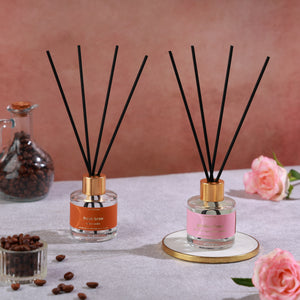
Third, control what goes back in. Nothing damp, ever — finish drying in front of a fan if the line has not managed it, and check by temperature rather than touch. Do not put worn clothes back on the rail during a wet spell; hang them outside the cupboard overnight first. Fourth, and only once the interior is dry and smells of nothing, you can think about scent. A dry cedar block or a fabric sachet is the right thing inside. Keep the reed diffuser from ₹749 outside, on the chest of drawers or a shelf in the room — oil-based fragrance and folded cotton should not share a box, and the room is what you actually want scented. Garden Bloom or Evening Calm suit a bedroom well.
What to do, in order
This is one of the few odour problems where the free fix is close to complete. Emptying, drying and loosening a wardrobe resolves most cases entirely.
| Step | What to do | When | Cost |
|---|---|---|---|
| 1. Remove the source | Empty it completely, wipe and dry the interior, torch the back panel, wash anything that smells musty | Before anything else | ₹0 |
| 2. Move the air | Pull the unit off the wall, open the doors on dry days, run the AC or dehumidifier with the cupboard open | Daily, five to ten minutes | ₹0 |
| 3. Deal with what holds it | Loosen the rail, lift storage off the base, remove cardboard, and never store anything less than fully dry | Weekly to monthly | ₹0 |
| 4. Then the always-on layer ★ | A SOSA reed diffuser — a background scent for the bedroom itself once the cupboard is dry — placed outside the wardrobe, never in it | 50ml 6-8 weeks · 130ml 14-18 | from ₹749 |
| 5. Or the on-demand layer | Sukoon with a Hotel Collection scent — scent on demand in the bedroom for an hour in the evening rather than all night | Run it when you want it | ₹1,899 |
Versailles
People buy scented sachets for a musty wardrobe, and I understand why, but it is the wrong purchase at the wrong time. A sachet in a damp cupboard produces clothes that smell of damp and lavender at the same time, which is a distinctly worse outcome than damp on its own. Empty it and dry it first. That part is free.
The other thing I would say plainly: if you find dark speckling on the back panel or on a garment, that is mould, and mould is a health issue rather than a smell to be managed. Wash what can be washed, be willing to discard a heavily colonised item, and find out why that surface was wet. If the wall behind the wardrobe is damp during dry weather, that is a building fault and it needs someone who does damp for a living.
Once the cupboard is genuinely dry, I would keep fragrance out of it and put it in the room instead. A reed diffuser on a chest of drawers scents the air you move through when you open the doors, without ever putting oil near folded cotton. Four reeds rather than six in a bedroom. And leave the wardrobe doors open for an hour on dry days for the rest of the season — that habit is the actual fix. A portion of every order funds a girl's classroom through Nanhi Kali.
Frequently asked questions
- Musty smell but no visible mould — the seven places to search, in order.
- Why a bedroom smells damp after days of rain — drying rate, and the bed as reservoir.
- Why a shoe cabinet smells worse in monsoon — enclosed leather and trapped sweat.
- After the dampness is fixed — rebuilding the smell of the home.
- Brand: the SOSA founder story.
SOSA products & prices (verified August 2026): Hotel Collection water-based ultrasonic diffuser fragrance 15ml ₹299 · 100ml ₹999 · 300ml ₹1,799 · Pack of 7 (15ml, all fragrances) ₹1,799; refills 100ml from ₹999. Seven scents: The Ritz-Carlton-inspired (white tea · bergamot · cedar), Westin-inspired (white tea · aloe · cedar), 1 Hotels-inspired (cedarwood · vetiver · green leaves), The St. Regis-inspired (amber · violet · woods), Shangri-La-inspired (jasmine · green tea · white tea), Four Seasons-inspired (citrus · floral · sandalwood), W Hotels-inspired (citrus · pepper · amber). Diffusers: Boond 300ml ₹899 · Sukoon 500ml ₹1,899 · Megh 6L ₹3,499. Water-based, phthalate-free, composed to IFRA standards for home diffusion; 3–6 drops per tank. Made in India, Pune. The Hotel Collection scents are SOSA's own interpretations inspired by the world's finest hotels; all hotel names are trademarks of their respective owners and are used only to describe the scent style — SOSA is an independent Indian fragrance house, not affiliated with or endorsed by any hotel brand. Prices and availability subject to change — see the live product pages.