



Why the door moment feels dramatic: opening the door releases a single slug of the day's air past your face. That is the highest concentration you will meet all evening.
What to do in the first two minutes: open two windows on opposite sides before you sit down, before you change, before the kettle. Ten minutes of that undoes most of the nine hours.
2. Because the afternoon is when fabric gives it back fastest. Odour molecules absorbed into curtains, upholstery, mattresses and rugs come back out faster as the material warms. A locked flat in the afternoon is the warmest it gets all day, with no airflow to carry anything away. The reservoir empties into a room nobody is standing in.
3. Because opening the door delivers it as one slug. For nine hours the air inside sat still and layered. Pushing the door open moves a body of that air past your face in about two seconds. That first breath is the most concentrated sample of your home you will get, which is why the effect feels so much stronger at the threshold than in the hallway thirty seconds later.
4. Because your nose is only calibrated for those two minutes. Olfactory adaptation is essentially complete in about twenty minutes. You spent the working day breathing office and street air, so you arrive with a fully reset nose and lose it again before you have finished changing. This is the most useful diagnostic moment you get, and most people spend it taking their shoes off.
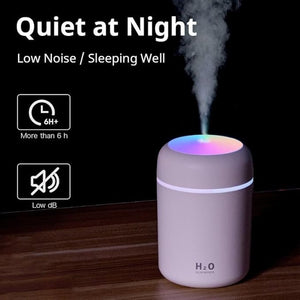
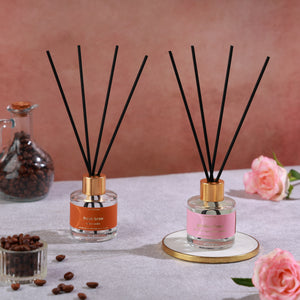
5. And fragrance does not belong in that gap. Switching something on at the door adds a second smell to the first. Move the air, deal with whatever is quietly wet, then add a reed diffuser or a Sukoon as a background that is already in place when you walk in.
Made in India, composed by an ISIPCA Versailles-trained perfumer — and a portion of every order supports girl-child education through Nanhi Kali.

Why the moment you open the door is the only honest reading you get
There is a reason this question is almost always phrased as a contradiction — stale when I come in, fine an hour later. Both halves are true observations and neither is about the flat. Olfactory adaptation is the nose's habit of tuning out any constant, unchanging signal so it can keep detecting new ones. It is essentially complete within about twenty minutes of exposure. That means you have never once smelled your own home under normal conditions. You have only ever smelled the difference between your home and wherever you just were. A commute, a lift lobby, a car park and a corridor add up to a far more thorough reset than the thirty-minute test people are usually told to run.
The other half is physics rather than perception. A shut flat exchanges roughly 0.2 to 0.5 of its internal air volume per hour; two windows open on opposite sides takes that to somewhere between 3 and 8. Over nine hours at the low end, the air in your home has barely been diluted at all — and it has been continuously topped up. Anything wet is still evaporating. Every textile in the flat is still releasing what it absorbed yesterday. The kitchen bin is still working. A dry P-trap in a bathroom nobody used all day is still connected to a drain. Not one of these needs a person in the room to happen; what they need is a person to open a window, and there was nobody there. Nine hours of loading with almost no removal is the entire mechanism.
What actually accumulates in an empty flat
 Step fourFrom ₹749The busiest fifty minutes in an Indian flat are the ones before everyone leaves. Two showers put a large amount of moisture into a small bathroom. Breakfast puts cooking compounds into the air and, more durably, onto surfaces. Towels go onto hooks damp and stay folded. The bin gets its first contribution of the day. Then the door closes on all of it. Give the flat ten minutes of cross-ventilation before you leave, not just when you return — it is the single highest-value habit change here, because it empties the room before the nine hours of stillness rather than after.
Symptom to cause: reading the first breath
The character of the smell at the door tells you a great deal, because you get exactly one uncontaminated sample of it per day. Pay attention to it for a week before you change anything, and match it against the rows below.
| What you notice | Most likely cause | How to confirm it | What actually fixes it |
|---|---|---|---|
| Flat and closed, nothing specific, gone in twenty minutes ★ | Pure air-change rate — nine hours of stagnation, no single source | Cross-ventilate for ten minutes on arrival for three days running and see if the door moment changes | Air the flat before you leave and when you return |
| Faintly like yesterday's dinner even though you cooked nothing today | Cooking residue bonded to soft surfaces and re-released as the flat warms | Smell the curtain nearest the kitchen at close range, then one in the bedroom | Wash curtains and covers; run the chimney longer; ventilate while cooking |
| Sharp, sour or faintly sewer-like at the door only | A dry P-trap in a drain nobody used all day, or a washing-machine gasket | Pour a mug of water down every unused drain, then repeat the door test tomorrow | Weekly water down unused drains; leave the machine door ajar and dry the gasket |
| Warm and slightly sweetish, strongest in the bedroom | Bedding and mattress re-releasing overnight occupancy into a shut room | Strip the bed, open the window for an hour, and judge the door test the next evening | Air the bed before making it; wash bedding weekly; ventilate the bedroom on waking |
| Worse on hot days, much worse in the monsoon | Heat driving faster release, humidity raising how strongly you perceive it | Compare a dry cool day with a wet humid one, same time, same door | Ventilate in dry spells; never leave washing drying in a shut flat all day |
| Earthy or musty, and it does not clear with ventilation | Damp or mould somewhere — this is not an odour problem | Check external walls behind furniture, under the sink, the ceiling in the bathroom | Find the water, stop it, remove the growth. Fragrance is not part of this. |
| If none of these fit: run the door test after a long weekend away. Three days of the same accumulation with a three-day nose reset makes any source far easier to identify than the daily version. | |||
Reeds · always-on roomsFrom ₹749Shop →  Sukoon · when you want a switch₹1,899Shop →
  Hotel Collection · the scentFrom ₹299Shop →
The first ten minutes home, and the ten before you leave
Start with the departure, not the arrival. Most people try to fix this problem at seven in the evening, which is the wrong end. Open two windows on opposite sides of the flat while you are getting ready in the morning, and leave the internal doors open so air has a path. Ten minutes is enough. Close them as you leave. You have now started the nine sealed hours from a much lower baseline, and the difference at the door that evening is usually obvious within three days.
Then use the arrival properly. Before you sit down, before you change, before anything else: open two openings on opposite sides and let the flat exchange. Five to ten minutes of genuine cross-ventilation moves more air than the previous nine hours managed on their own. If one side faces a busy road, or the weather is against you, set a fan in a window blowing outwards — that pulls the flat's air out behind it rather than pushing street air in. While that runs, do the fifteen-minute wet check: unused drains, the washing machine gasket, the bin and its lid, under the sink, every cloth and mop.
Then handle the fabric, which is the part that reloads. Wash bedding weekly, cushion covers monthly, curtains at least seasonally, and vacuum upholstery with the brush attachment rather than only the floor. Air rugs in direct sunlight when you can. Only once all of that is in place does a fragrance layer make sense — and for this particular problem the format matters. A reed diffuser from ₹749 runs the whole time you are out, with no electricity and nothing to operate, so the flat has a settled background already in place when the door opens. A Sukoon at ₹1,899 with a Hotel Collection scent from ₹299 is the opposite tool: nothing while you are away, then an hour of scent when you get in. Neither one removes anything. They give an aired flat a character.
What to do, in order
Three of these four steps are free and they do most of the work. The fourth is the purchase, and for a flat that is empty all day the choice of format matters more than the choice of scent.
| Step | What to do | When | Cost |
|---|---|---|---|
| 1. Remove the source | Fifteen-minute wet check: unused drains, washing-machine gasket, bin and lid, under the sink, every damp cloth | Before anything else | ₹0 |
| 2. Move the air | Cross-ventilate ten minutes before you leave and ten minutes when you get in — two openings, opposite sides | Daily, five to ten minutes | ₹0 |
| 3. Deal with what holds it | Wash bedding weekly and curtains seasonally, vacuum upholstery, do not leave washing drying in a shut flat | Weekly to monthly | ₹0 |
| 4. Then the always-on layer ★ | A SOSA reed diffuser — a background that is already there when the door opens, with nothing to switch on from an empty room | 50ml 6-8 weeks · 130ml 14-18 | from ₹749 |
| 5. Or the on-demand layer | Sukoon with a Hotel Collection scent — an hour of scent after you get in and silence the rest of the time; covers roughly 270–320 sq ft | Run it when you want it | ₹1,899 |
Versailles
I know this one from my own front door. For a long time I assumed the flat was doing something in the afternoon that it was not doing in the morning, and I looked for an afternoon cause. There is not one. The flat is the same at eleven as it is at seven. The variable is me. I had been out, and for about two minutes I could smell my own home like a stranger.
So I stopped treating that as an unpleasant surprise and started treating it as data. Now I do nothing for the first ten seconds after opening the door except notice what it smells of, before I decide anything. It is the only clean reading anyone in the house gets, and it is free. If the answer is flat and closed, it is ventilation. If it has an edge to it, something is wet. If it smells of Tuesday's dinner on a Thursday, it is the curtains.
And I will say the thing that is inconvenient for me to say: for most people reading this, the fix is opening two windows in the morning and it costs nothing. Buy a diffuser when the flat is already aired and you want it to have a character rather than an absence. A reed is the sensible format for a home that is empty all day, because it does not need anyone there. A portion of every order funds a girl's classroom through Nanhi Kali.
Frequently asked questions
- Why does my house smell stale even though I clean it every day? — the general case, in order.
- Cleaned at 9am, stale by 6pm — the half-day decay curve.
- How do I find the source of a stale smell? — the room-by-room method.
- A room nobody used all day still smells closed — why empty is not fresh.
- Brand: the SOSA founder story.
SOSA products & prices (verified August 2026): Hotel Collection water-based ultrasonic diffuser fragrance 15ml ₹299 · 100ml ₹999 · 300ml ₹1,799 · Pack of 7 (15ml, all fragrances) ₹1,799; refills 100ml from ₹999. Seven scents: The Ritz-Carlton-inspired (white tea · bergamot · cedar), Westin-inspired (white tea · aloe · cedar), 1 Hotels-inspired (cedarwood · vetiver · green leaves), The St. Regis-inspired (amber · violet · woods), Shangri-La-inspired (jasmine · green tea · white tea), Four Seasons-inspired (citrus · floral · sandalwood), W Hotels-inspired (citrus · pepper · amber). Diffusers: Boond 300ml ₹899 · Sukoon 500ml ₹1,899 · Megh 6L ₹3,499. Water-based, phthalate-free, composed to IFRA standards for home diffusion; 3–6 drops per tank. Made in India, Pune. The Hotel Collection scents are SOSA's own interpretations inspired by the world's finest hotels; all hotel names are trademarks of their respective owners and are used only to describe the scent style — SOSA is an independent Indian fragrance house, not affiliated with or endorsed by any hotel brand. Prices and availability subject to change — see the live product pages.