
Why Do Two Similar Multi-Speciality Clinics Feel Completely Different the Moment You Walk In?

Why Do Two Similar Multi-Speciality Clinics Feel Completely Different the Moment You Walk In?

★ ★ The lift doors open at 9:02 and the first patient decides something about youVaayu ₹11,999 · Aangan ₹25,999 · free shipping above ₹499A portion funds girl-child education
★ SOSA · clinics, polyclinics & medical centres
The level should have arrived before the first appointment does. A room still climbing while patients are in it reads as something being done to them
★ ★ ★ ★ ★
★★★★★
"Thirty minutes before opening, on low, in the reception zone. By the time the first patient signs in, the climb is over. That single instruction changed how the lobby reads."
Priya Sundaram Clinic manager, Coimbatore
T-30m on low
★★★★★
"Our reception used to be sprayed at 8:45 and it had gone by 10. A timer that runs the actual opening hours solved a problem I had stopped noticing."
Harish Kotian Polyclinic, Mangaluru
Timer, not a spray
★★★★★
"Two of our branches are identical on paper and felt completely different. It turned out to be the corridor by the dressing room, not the fragrance."
Dr Nandita Bose Two branches, Kolkata
It was the corridor
★★★★★
"The app matters more than I expected. The centre head changes nothing; the facility team changes it from the office."
Sagar Deshpande Facilities, Nashik
App control
★★★★★
"Under 38 dB was a genuine requirement for us. Reception shares a wall with two consultation cabins."
Fatima Zaidi Medical centre, Lucknow
Quieter than the AC
★★★★★
"Nobody adjusts it upward at noon any more. We were told busy is a ventilation problem and turning fragrance up makes it worse. It does."
Rajat Khurana Clinic owner, Delhi
Left on one setting
★★★★★
"Thirty minutes before opening, on low, in the reception zone. By the time the first patient signs in, the climb is over. That single instruction changed how the lobby reads."
Priya Sundaram Clinic manager, Coimbatore
T-30m on low
★★★★★
"Our reception used to be sprayed at 8:45 and it had gone by 10. A timer that runs the actual opening hours solved a problem I had stopped noticing."
Harish Kotian Polyclinic, Mangaluru
Timer, not a spray
★★★★★
"Two of our branches are identical on paper and felt completely different. It turned out to be the corridor by the dressing room, not the fragrance."
Dr Nandita Bose Two branches, Kolkata
It was the corridor
★★★★★
"The app matters more than I expected. The centre head changes nothing; the facility team changes it from the office."
Sagar Deshpande Facilities, Nashik
App control
★★★★★
"Under 38 dB was a genuine requirement for us. Reception shares a wall with two consultation cabins."
Fatima Zaidi Medical centre, Lucknow
Quieter than the AC
★★★★★
"Nobody adjusts it upward at noon any more. We were told busy is a ventilation problem and turning fragrance up makes it worse. It does."
Rajat Khurana Clinic owner, Delhi
Left on one setting
✓ Vaayu: waterless cold-air nebulisation · no standing water tank · under 38 dB ✓ 1000 m³ (≈2,000–3,000 sq ft) · 400ml tank ≈75 days · app + 1h/4h/8h/24h timers ✓ Key-lock and auto-stop — safe in a public waiting area the whole day


Founder Diaries · Clinics & Medical Centres · Arrival and the First 60 Seconds
By Sonal Sahani · ISIPCA Versailles 11 min read Updated September 2026
Two polyclinics on the second floors of two commercial buildings four kilometres apart in Pune. The same 4,200 sq ft floor plate from the same developer, the same six specialities, fit-outs eleven months apart by the same contractor, the same seating, the same tariff card at the desk. I have stood in both at twenty to twelve on a Tuesday and they do not read as the same business. What separates them is not the fragrance, the furniture or the frontage. It is four small operational differences, three of which cost nothing at all to correct. Only once those four are dealt with does a machine like the Vaayu at ₹11,999 have anything worth holding steady.
Quick answers — read this first
The short version: two clinics that look identical on paper differ in housekeeping, in one trolley route and in where the air arriving at the registration desk has come from. None of those three is drawn on a floor plan and none of them is a fragrance problem.

The four to check, in order: dry drain traps in the toilets and sinks nobody uses; the dressing-waste and soiled-linen route and the hour it runs; the return-air grille over reception and the two door closers that have stopped working; the extract fan wired to a light switch.

Then, and only then, the fragrance: the Vaayu at ₹11,999 is waterless with no standing water tank, covers up to 1000m³, runs under 38 dB, holds one setting on a timer through the opening hours and locks with a key so nobody in a public hall can alter it. It is presentation and housekeeping. It makes no clinical claim of any kind and a diffuser is not an air purifier.
The short answer
Short answer: because a floor plan does not contain drain traps, bin schedules, trolley routes or airflow, and those four are what a patient meets in the first ten seconds. In almost every pair of clinics I have been asked to compare, the difference has turned out to be housekeeping, one corridor and one grille — not the scent, the sofa or the signage.
The order of work: water down every drain trap at T-60m, every morning, with a named person against the task; move the dressing-waste and soiled-linen route off the public corridor or change the hour it runs; get the return-air path over the registration desk checked by whoever holds the air-conditioning contract; replace the two door closers nobody has noticed. Three of those four are free.
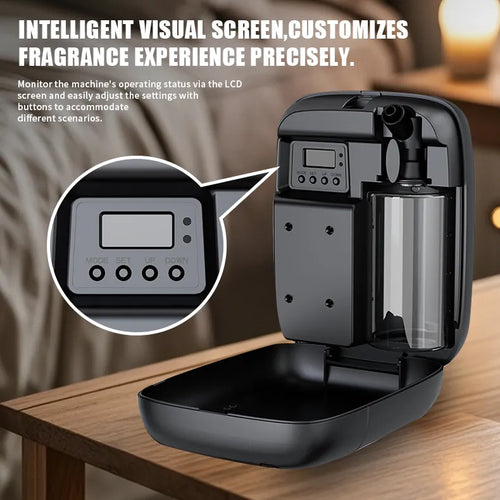
Shop: the Vaayu at ₹11,999 covers up to 1000m³, roughly 2,000–3,000 sq ft of public space, with a 400ml tank lasting about 75 days, app and onboard control, 1h/4h/8h/24h timers, under-38dB running, auto-stop and a key-lock. The Aangan at ₹25,999 covers up to 3,000m³ for a whole floor or an atrium. Alcohol-free reed diffuser from ₹749 suit an administrative cabin. Free shipping above ₹499.
Straight answer
Why do two multi-speciality clinics with the same plan and the same specialities feel completely different at the door?
1. Because the plan is not the building. A drawing contains rooms, seats and door swings. It does not contain a drain trap that has been dry since the monsoon ended, a trolley that crosses the waiting hall at half past twelve, a door closer that stopped working a year ago, or a grille that decides which room's air the registration desk is standing in.

2. Check every drain trap first, including the ones in rooms nobody uses. A U-bend holds water and that water is the only thing between the drainage stack and your lobby. In a staff toilet used three times a week, or a hand basin in a store room, it evaporates in a few weeks and then the smell arrives from below. A mug of water down each one at T-60m every morning costs nothing and it is the single most common cause of a clinic that smells for no visible reason.

3. Walk your own dressing-waste and soiled-linen route at the hour it actually runs. Not on the plan, on the floor, at half past twelve. If it crosses a public corridor or the back of the waiting hall, that is your difference, and it is an event rather than a lingering odour. Fragrance cannot sit on top of an event.

4. Then ask where the air at the registration desk has come from. A return-air grille above the desk pulling corridor air across it, a toilet extract fan wired to the light switch so it stops the moment the door shuts, a fire door propped open — these are the airflow half of the answer, and your air-conditioning contractor can check all three in an afternoon.

5. Only then buy the machine, and buy one rather than three. Clinical rooms are fragrance-free and their doors are shut, so they come out of the coverage sum entirely. On a 4,200 sq ft floor that usually leaves about 2,000 sq ft of public space, which at a three-metre ceiling is roughly 560 m³ — comfortably one Vaayu at ₹11,999 rather than the two the brochure area suggested.

A portion of every order supports girl-child education through Nanhi Kali.
TL;DR: two clinics with the same plan differ in four things a drawing does not show: dry drain traps, the dressing-waste route and its hour, the return-air path over the desk, and two failed door closers. Three of the four are free to correct. Fragrance is the last ten per cent and the Vaayu at ₹11,999 is the machine for it, after the other four and never instead of them.
SOSA Vaayu · waterless cold-air
The part you buy last, and only after the other four
SOSA Vaayu · waterless cold-air ₹11,999
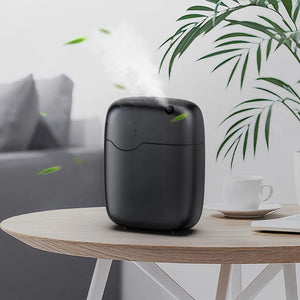
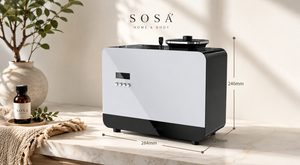
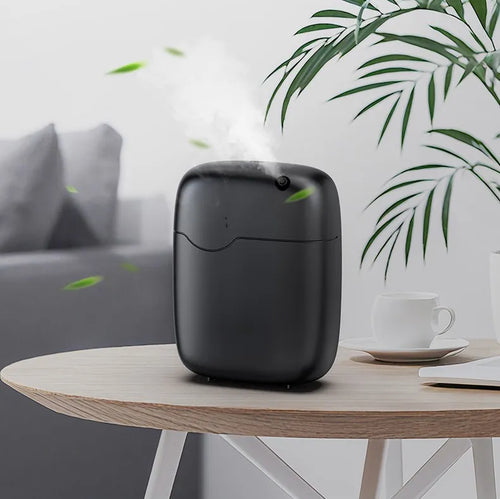
Waterless cold-air nebulisation, so there is no standing water tank anywhere in a building that runs twelve hours a day — which is a housekeeping argument rather than anything more than that. Up to 1000m³, a 400ml tank lasting about 75 days, Bluetooth app and onboard control, 1h/4h/8h/24h timers, adjustable intensity, under 38 dB, auto-stop, key-lock, 0.9 kg and 165 × 80.5 × 215 mm, freestanding or wall or HVAC mounted. The key-lock is the specification that matters in a hall where anyone can reach it, and the timers are the specification that stops it running overnight into an empty building. Ships with four hotel-inspired fragrances.

Same plan, different building

I was asked to look at the pair because the group had convinced itself it had a branding problem. The newer clinic was getting complaints about the waiting area and the older one was not, and somebody had suggested that the newer one needed a signature fragrance to match its sibling. The two floor plans are the same drawing with the north arrow rotated. What is not the same is everything the drawing does not contain. A plan has no drain traps in it. It has no bin schedule, no hour at which a trolley leaves the dressing room, no record of which door closer failed in which month, and no arrows showing where the air standing at the registration desk has come from. Those four omissions are the entire difference a patient meets at the door, and not one of them is on anybody's fit-out budget.

1
THE TRAP
The toilet nobody uses is the one that will cost you
Start underneath the building, because in this country that is where most of these stories end. Every toilet, every floor gully and every hand basin has a U-bend holding a few centimetres of water, and that water is the only barrier between your lobby and the drainage stack. Water evaporates. In a fixture used forty times a day it is replaced forty times a day and you will never think about it. In the staff toilet beside the lobby that three people use, in the hand basin in the dirty utility, in the floor gully of a consultation cabin that has been used as a store since the fit-out, it is not replaced at all, and after a few weeks of dry summer air the seal is gone and the stack has an open route into your building. The newer clinic had two such fixtures. The older one had the same two and a housekeeping checklist that said, in writing, water down every trap before opening. That is the whole of the difference: one had a checklist with a person's name against the line and the other had the word housekeeping. The fix is a mug of water down each one at T-60m, every morning, and it costs nothing whatsoever. I would put it above everything else on this page, including everything I sell, because a smell with a source is information and the correct response to information is to act on it rather than to cover it. If your building smells of drains and you add fragrance, you have not made the lobby better. You have removed the one signal that told your housekeeping lead something was wrong.
2
THE ROUTE
One corridor, twice a day, and the whole hall knows
The second difference is a corridor, and it is the one people find hardest to believe until they stand in it. Both clinics generate the same dressing waste and the same soiled linen. In the older one the trolley leaves the dressing room through a back door onto the service stair. In the newer one the service lift was taken out of the scheme during the fit-out and nobody redrew the route, so the trolley crosses the back of the waiting hall at about half past twelve and again at a quarter to six. It takes eleven seconds. It is not a lingering odour and it will not show up if you walk the building at ten in the morning with a clipboard, which is exactly why it had survived two years of internal audits. It is an event, it recurs twice a day, and it lands on the forty people who happen to be seated at that hour — which over a month is a great many patients. No fragrance addresses an event. A background scent sits at a steady low level underneath whatever else happens in the room; it does not rise to meet a trolley and it should not be asked to. The corrections are ordinary facilities work: change the hour so it runs during the midday gap rather than the peak, fit a lidded trolley, put a self-closing door on the dirty utility, or in the best case find the route that does not cross public space at all. In this building it was the hour and a ₹1,200 door closer. Two years of complaints, corrected in a week, for less than the cost of a week's flowers at the desk.
3
THE GRILLE
Airflow decides which room's air your desk is standing in
The third difference is the one nobody can see and everybody can feel. Air in a conditioned building does not sit still: it is supplied somewhere and returned somewhere, and the return path decides which rooms are upstream of which. In the newer clinic the return-air grille sits directly above the registration desk, at the end of a corridor that serves the dirty utility and two toilets, so the desk is permanently standing in air that has come from the least pleasant end of the floor. The older clinic has the same grille in a different position, four metres away, above the lift lobby, and the corridor air leaves the floor without crossing anybody. Add two more things I found in the newer building and the picture is complete: a toilet extract fan wired to the light switch, so it runs only while somebody is inside and stops the instant the door shuts, and a fire door to the service corridor propped open with an extinguisher because the closer had failed. Every one of those is a job for whoever holds your air-conditioning contract and your maintenance team, and every one of them was fixable in an afternoon. Between the grille, the fan and the door, the difference in what a patient meets on arrival is larger than any fragrance decision either clinic will ever make. If you take one habit from this page, take this one: before you discuss scent with anybody, find out where the air arriving at your front desk has been.
The ten-second test I run at the door of any clinic: stand at the registration desk, and work out where the air at your face has come from. If the honest answer is the corridor that serves the dirty utility, no machine on this site is going to change the sentence a patient is about to form.

The two clinics, line by line

The same audit on both buildings, written out as a patient would meet it rather than as a facilities report would organise it. The fourth column is what actually caused the difference and the fifth is what it cost to correct. Three of the five lines came to nothing at all, which is the reason this page spends most of its length on housekeeping and only its last section on a machine.

Two clinics, same plan
What actually differed between a clinic that reads well and one that does not
What the patient meets The clinic that reads well The clinic that does not The actual cause Cost to fix
A faint drain smell near the lift lobby ★ Absent Present from about eleven, worse in May Two dry U-bends in a staff toilet and a store-room basin nobody runs water into ₹0
A brief unpleasantness twice a day in the seating Never happens 12:30 and 17:45, for about eleven seconds The dressing-waste trolley crosses the back of the waiting hall; the service route was dropped during fit-out ₹0 for the hour, ₹1,200 for a door closer
Stale air at the registration desk Desk sits under a supply, not a return Return-air grille directly above the desk at the end of the utility corridor The return path makes the desk downstream of the worst corridor on the floor An AMC call-out
The toilets smell acceptable at four in the afternoon Extract runs the whole opening period Acceptable at nine, not at four Extract fan wired to the light switch, so it stops the moment the door closes A switch change
The room smells of disinfectant at eleven Mopping finishes before the doors open Public areas mopped at eleven and again at three A cleaning schedule set for the contractor's convenience rather than the clinic's hours ₹0
A low background fragrance in reception and the corridors Present, unnameable, one setting all day Present, stronger, changed daily by whoever felt like it An unlocked machine in a public hall and no written setting Key-lock and one line in the SOP
Shop this guide
What the better-run clinic actually had at the desk
The SOSA principle
A floor plan has no drain traps in it, no bin schedule and no arrows for where the air has been. Almost everything a patient decides in the first ten seconds is made of the things nobody drew.
Two clinics, one drawing, four differences: a dry U-bend, a trolley at half past twelve, a return-air grille in the wrong place and a fan on a light switch. Three of them cost nothing.

Fixing the four, then the last ten per cent

Do the free work first and do it in an order, because the order is what makes it stick. The night before: bins out, dressing waste out of the building, mops dried flat rather than left standing in buckets, which is a smell in its own right by the second morning. At T-60m housekeeping opens up, windows go open where there are windows, and water goes down every drain trap in every toilet and every unused sink — that line belongs on a printed checklist with a named person against it, not in an instruction somebody gave verbally in 2024. At T-45m the air conditioning goes on so the building reaches temperature before the first patient does rather than while they are sitting in it. At T-30m the diffuser goes on, low, in the entrance and reception zone, which gives it comfortably enough time to reach its level. At T-0 the first appointment arrives and the climb is over. Then the midday rule, which is the one most clinics break: nobody turns the fragrance up at lunchtime because the hall got busy. Busy is an occupancy and air-change problem and adding fragrance to it makes the room worse, not better — the waiting area that is fine at nine and unpleasant by six is the same argument in its full form. At close, the timer stops with the last appointment. A machine running overnight into an empty building is wasting oil and telling you nothing.

Then the machine, and the arithmetic that decides how many of them you need. Cubic metres are floor area in square feet divided by 10.76, multiplied by the ceiling height in metres — and the rooms you are not scenting come out of the sum entirely, because they are fragrance-free and their doors are shut. On the 4,200 sq ft floor in this story, six consultation cabins, two procedure rooms, the sample-collection room, the small laboratory and the pharmacy dispensing counter account for a little over 2,100 sq ft. That leaves roughly 2,000 sq ft of entrance, reception, waiting hall, inter-departmental corridor and lift lobby, which at a three-metre slab-to-false-ceiling height is about 560 m³. One Vaayu at ₹11,999, rated to 1000m³, covers that with room to spare — and the group had been quoted for two. Put it in the reception zone rather than in the doorway, where the street and the lift lobby will simply take the output away; wall-mount it if the desk is short of surface, since it is 0.9 kg and 165 × 80.5 × 215 mm; set one intensity and leave it; run the timers to the opening hours; and lock it. The key-lock is not a convenience, it is the reason the machine can sit in a public hall at all, because the alternative is six different people adjusting it over a week and nobody knowing what the setting is. Under 38 dB matters if reception shares a wall with a cabin, which is the noise question in full. The 400ml tank runs about 75 days on a clinic's hours, so procurement is modelling four refills a year per unit and nothing else. For a genuinely large integrated centre or a double-height atrium, the Aangan at ₹25,999 covers up to 3,000m³ and ties into an AHU; for a 4,200 sq ft polyclinic it is more machine than the building deserves and I would not sell it.

Then the discipline that keeps all of this defensible, and the constraints. Scenting belongs to the entrance and lobby, reception and registration, the shared and departmental waiting areas, the corridors between departments, the lift and stair lobbies, the administrative rooms and the café corner. It does not belong in consultation and examination rooms, treatment and procedure rooms, day-care surgery and recovery, dressing rooms, blood- and sample-collection rooms, laboratories, pharmacy dispensing, sterile stores, imaging rooms, oncology day-care or paediatric clinical areas. The full list of what stays fragrance-free is a page of its own and it is longer than the list of what does not. The reasons are practical rather than decorative: a clinician is trained to notice what a room and a patient smell of, people faint in a sample-collection room, and a laboratory lead has a contamination conversation to avoid. On the constraints: the water-based Hotel Collection bottles at ₹299 for 15ml run in the ultrasonic Sukoon, Boond and Megh, never in the Vaayu, which takes its own undiluted oil and arrives with four scents. An alcohol-free reed diffuser from ₹749 needs 24 to 72 hours to reach its working level and is barely noticed past about a metre in a large hall, which makes it right for an administrative cabin and wrong for forty seats. Candles are not appropriate in a healthcare facility at all, because an open flame is a fire-safety and insurance matter rather than a fragrance decision. And SOSA does not make a room spray. The principle underneath the whole page: fragrance is the last ten per cent of how a clinic reads, and it only works as the last ten per cent. Spend it first and it is the ninety per cent that gives you away.

Two clinics, one drawing, four differences — and three of them cost nothing to correct. Fragrance was never the variable; it was only the one somebody wanted to buy.
— Sonal Sahani, SOSA

The SOSA edit

In the order the work should actually happen, which is not the order a vendor would like. The first three rows are free or nearly free and they are where the difference between two similar clinics is almost always found. The machine appears fourth, which is its correct position, and the last row prints something we do not make rather than letting you find out after an order.

The SOSA edit
Two similar clinics, in the order the difference gets closed
Do this What it is When it earns its place Cost
1. Water down every drain trap at T-60m ★ Every toilet, every floor gully, every basin in a room nobody uses First, every morning, with a person's name on the checklist line. The most common cause of a clinic that smells for no visible reason ₹0
2. Walk the dressing-waste and linen route at 12:30 The route on the floor, not the route on the plan Second. If it crosses public space, change the hour, lid the trolley or fit a self-closing door ₹0–₹1,200
3. Ask where the desk's air comes from Return-air grille position, extract fans, the two door closers nobody has noticed Third. An air-conditioning call-out and a maintenance morning. Larger in effect than any fragrance decision An AMC visit
4. SOSA Vaayu Waterless, no standing water tank, up to 1000m³, 400ml ≈75 days, app, 1h/4h/8h/24h timers, under 38 dB, key-lock Fourth, and only fourth. One machine for about 2,000 sq ft of public space at a three-metre ceiling ₹11,999
5. Westin-inspired White Tea Serenity or Aangan The lightest of the seven at ₹299 for 15ml; or up to 3,000m³ and an AHU tie-in for a large integrated centre The scent nobody can name; the Aangan only if the building genuinely justifies it ₹299 / ₹25,999
Not made: a room spray The sprays in the SOSA range are car perfumes, formulated for about three cubic metres of moving air Printed rather than implied. A morning spray is a twenty-minute product in a twelve-hour building —
Honest notes for buyers: fragrance in a medical facility is housekeeping and presentation, never treatment. Nothing on this page claims that a fragrance reduces anxiety, aids recovery, improves sleep, cleans or disinfects air, or has any clinical effect whatsoever, because it does not and a diffuser is not an air purifier. Scenting belongs to the entrance, reception, shared waiting areas, inter-departmental corridors and administrative rooms. Consultation and examination rooms, treatment and procedure rooms, day-care surgery, dressing rooms, blood- and sample-collection rooms, laboratories, pharmacy dispensing, sterile stores, imaging rooms, oncology day-care and paediatric clinical areas should be left fragrance-free. A persistent smell is information about a dry drain trap, a bin, a soiled-linen route or an air-conditioning drain pan: find it and fix it rather than covering it. On the machines: the Vaayu at ₹11,999 is waterless cold-air nebulisation with no standing water tank, covering up to 1000m³ or roughly 2,000–3,000 sq ft, with a 400ml tank lasting about 75 days, Bluetooth app control, 1h/4h/8h/24h timers, under-38dB running, auto-stop and a key-lock for public areas. The Aangan at ₹25,999 covers up to 3,000m³ and connects to HVAC for a whole floor or an atrium. The ultrasonic Sukoon, Boond and Megh are water-based, hold standing water and add 30–50 ml of water an hour to the air, which makes them suitable for a single administrative cabin with a named person emptying and drying the tank daily, and unsuitable for public clinical property. An alcohol-free reed diffuser needs 24–72 hours to establish and suits a small lobby rather than a large waiting hall. Candles are not appropriate in a healthcare facility because an open flame is a fire-safety matter. SOSA does not make a room spray. The Hotel Collection scents are SOSA's own interpretations inspired by the world's finest hotels; SOSA is an independent Indian fragrance house, not affiliated with or endorsed by any hotel brand. A portion of every order supports girl-child education through Nanhi Kali.
Hotel Collection · Westin-inspired White Tea Serenity
The brief is narrow, and narrow is correct here
Hotel Collection · Westin-inspired White Tea Serenity ₹299 / 15ml
White tea, aloe and cedar — the lightest of the seven and the default for a medical facility. The test for a clinic fragrance is not whether anybody likes it. It is whether anybody can name it. A patient should be able to tell you only that the place did not smell of anything unpleasant. The Ritz-Carlton-inspired Quiet Luxury is the slightly more present alternative and the 1 Hotels-inspired Forest Suite is the dry one for a floor where a café corner reaches the seating. Nothing floral, nothing sweet, nothing anyone could describe as a perfume. The water-based bottles run in the ultrasonic machines; the Vaayu and Aangan take their own undiluted oil.
SS
ISIPCA
Versailles
A note from Sonal

I get asked to compare two branches more often than almost anything else in this category, and the request always arrives phrased as a fragrance question. It has never once turned out to be a fragrance question. It has been a dry trap, a bin schedule, a trolley, a propped fire door, a mopping round that happens at eleven in the morning for the cleaning contractor's convenience, and on one memorable occasion a decorative water feature in a lobby that nobody had drained since it was installed. Every one of those is discoverable by a person with no training in perfumery who is willing to walk their own building at the hour the problem happens rather than at the hour it is convenient to walk it.

So the honest sales position is the awkward one. If your two clinics differ, I would rather you spent nothing with me this quarter and closed the gap for free, because a machine installed into an unresolved smell will be blamed for it within a month and you will be right to blame it. Fix the four, then put a low, unnameable background into the entrance, reception and the corridors and leave it on one setting for a year. That is the whole recommendation. It is not a large recommendation and I have stopped apologising for that.

Everything is made and supported from Pune, and a part of every order funds girl-child education through Nanhi Kali. You get a space that smells like somewhere looked after; a girl gets a classroom. That equation has always felt right to me.

Frequently asked questions

Why do two clinics with identical layouts feel so different when you walk in?
Because a layout does not contain drain traps, bin schedules, trolley routes or airflow. In practice the difference is a dry U-bend in a fixture nobody uses, a dressing-waste route crossing public space at a fixed hour, a return-air grille that makes the registration desk downstream of the utility corridor, and a door closer or extract fan that has quietly failed.
Will adding a fragrance make the weaker clinic feel like the better one?
No, and it usually makes it worse. If the weaker clinic has a smell with a source, the smell is information about a dry trap, a bin or a drain pan, and covering it removes the signal that told housekeeping something was wrong. Find it and fix it, and scent only a facility that is already clean.
How much of this can be fixed without spending anything?
Most of it. Watering the traps at T-60m, changing the hour the dressing-waste trolley runs, moving the mopping round to before opening and rewiring a toilet extract fan so it runs through the opening period are all free or close to it. A door closer is about ₹1,200 and an air-conditioning call-out is a service visit you already pay for.
How many diffusers does a 4,200 sq ft polyclinic need?
Usually one. Clinical rooms are fragrance-free and their doors are shut, so they come out of the sum entirely, which on a floor like this removes a little over half the plan area. About 2,000 sq ft of public space at a three-metre ceiling is roughly 560 m³, and one Vaayu at ₹11,999 is rated to 1000m³.
Does a clinic diffuser do anything to the air itself?
No. It adds a very small amount of fragrance to air that is otherwise unchanged. It does not purify, disinfect or clean anything, it is not an air purifier, and it has no clinical effect of any kind. Fragrance in a medical facility is housekeeping and presentation, and that is the only claim worth making for it.
After the traps, the trolley and the grille
Fix the four for almost nothing — then hold the last ten per cent steady
The Vaayu is ₹11,999: waterless with no standing water tank, up to 1000m³ or roughly 2,000–3,000 sq ft of public space, a 400ml tank lasting about 75 days, app and onboard control, 1h/4h/8h/24h timers, under 38 dB, auto-stop and a key-lock for a public hall, supplied with four hotel-inspired scents. The Aangan is ₹25,999 for up to 3,000m³ and an HVAC tie-in. Free shipping above ₹499, and a portion of every order supports girl-child education through Nanhi Kali.
See the Vaayu · ₹11,999 The seven scents · from ₹299
Continue the read
More from SOSA
Editorial standards & sources
About this guide: Written by Sonal Sahani, ISIPCA Versailles-trained founder and perfumer at SOSA Home & Body, on why two multi-speciality clinics built to the same floor plan read completely differently at the door, the four operational differences that account for it — dry drain traps, the dressing-waste route and its hour, the return-air path over the registration desk and two failed door closers — how much of it is free to correct, and where a scent machine honestly belongs in that order of work.

Facts verified August 2026: Product facts used in this guide. SOSA Vaayu ₹11,999: waterless cold-air nebulising diffuser, atomises undiluted fragrance oil to a dry residue-free nano-mist with no water reservoir, coverage up to 1000m³ (approximately 2,000–3,000 sq ft), 400ml refillable tank lasting up to about 75 days per fill, Bluetooth app plus onboard control, 1h/4h/8h/24h timer scheduling, adjustable intensity, under 38 dB, DC 12V/1A at 5W, 165 × 80.5 × 215 mm and 0.9 kg, freestanding or wall or HVAC mounted, auto-stop and key-lock, CE, RoHS and SGS certified, supplied with four hotel-inspired fragrances. SOSA Aangan ₹25,999: HVAC-connected or standalone commercial nebulising diffuser, coverage up to 3,000m³ (roughly 8,000–10,000 sq ft), 800ml reservoir, metal body, programmable schedules, under 42 dB. Ultrasonic machines are water-based, hold standing water and consume 30–50 ml of water an hour: Sukoon ₹1,899 (500ml, 270–320 sq ft, 16–18 hours on low, 3–6 drops per tank, steady/2H/4H timers, three 15ml Hotel Collection scents included), Boond ₹899 (300ml), Megh ₹3,499 (6 litres). Hotel Collection water-based fragrance 15ml ₹299, 100ml ₹999, 300ml ₹1,799, Pack of 7 at 15ml ₹1,799 against ₹2,093 bought singly; the Vaayu and Aangan take their own undiluted oil rather than these water-based bottles. Alcohol-free reed diffusers from ₹749, requiring 24–72 hours to reach their working level. Free shipping above ₹499. Coverage arithmetic: cubic metres equal floor area in square feet divided by 10.76 and multiplied by ceiling height in metres, counting only the volumes that are actually scented. This guide makes no medical, therapeutic or clinical claim of any kind for fragrance: a diffuser does not purify, disinfect or clean air, and does not treat, calm or affect any patient or condition. Fragrance is housekeeping and presentation. Clinical areas should be left fragrance-free, and a persistent odour should be traced to its source and corrected rather than covered. SOSA is not affiliated with or endorsed by any hotel brand. Prices subject to change — see the live product pages.
Back to blog