



The pleasant smell: warm, sweet, vanilla-almond over dry wood. That is lignin yielding vanillin and cellulose yielding aldehydes. It is ageing, not damage.
The other one: sharp, earthy, sour, slightly cellar-like. That is growth on paper or on binding glue, and it is a different problem requiring air and dryness rather than fragrance.
Free fixes: air the shelves, keep books off external walls and out of closed cupboards, run a fan across them, silica gel in a glazed case, and never shelve a book that has been wet without drying it fully first.
2. And because old paper is chemically active rather than finished. Cellulose and lignin break down slowly and continuously — hydrolysis and oxidation — producing volatile aldehydes and organic acids. Lignin yields vanillin, which is why old books smell faintly of vanilla. That reaction is not paused; it is simply slow.
3. Warmth and damp accelerate both processes at once. More compound is being generated per day, and more of what has already been generated leaves the paper per hour. Two multipliers on the same shelf, arriving in the same week of June.
4. So the July shelf is louder than the January one without anything having gone wrong. If the smell is warm, sweet, faintly almond and vanilla over dry wood, that is ageing paper doing what ageing paper does, and a great many people are fond of it.
5. But there is a second smell that is not that. Above roughly seventy per cent humidity, growth can establish on paper itself and on the starch and animal glues in older bindings. That reads sharp, earthy, sour and cellar-like rather than sweet, and it is a different situation entirely.
6. The fixes are free and they are all about air. Take the books off external walls, open closed cupboards, run a fan across the shelves for an hour a day, put silica gel in any glazed case, and never shelve a book that has been wet without drying it fully first. Fragrance is not the answer to a mouldy book.
A portion of every order supports girl-child education through Nanhi Kali.
What a book is actually made of, and why that matters in July
It is worth spending a paragraph on the object itself, because almost every explanation of book smell you will read online skips straight to nostalgia. A book is cellulose fibre, some quantity of lignin depending on how the paper was made, sizing agents, ink, adhesive and board — and every one of those is porous, most of them are hygroscopic, and several are still chemically changing. Cheap twentieth-century paperbacks made from groundwood pulp carry a great deal of lignin and go brown and fragrant quickly. Good rag paper carries almost none and can sit for two centuries doing very little. The glue in a 1960s hardback spine may be animal or starch-based, which is to say edible. None of this is inert, and monsoon is the season it all becomes noticeable at once.
What that composition means practically is that book smell is a product of decay, and the affection people have for it is affection for a controlled and very slow form of it. Nobody minds. A library smells the way it does for precisely this reason and it is one of the pleasanter things a building can do. The important consequence for this page is that the rate is temperature- and humidity-dependent, as chemical rates generally are. Warm damp conditions speed up hydrolysis considerably. A shelf in Pune in January is running the reaction slowly; the same shelf in July, at thirty degrees and eighty-five per cent humidity, is running it appreciably faster and producing more of everything.
The consequence for smell is direct. Water entering the fibre swells it, opens the structure, and displaces volatile compounds that were sitting in it — so a shelf that has been quietly accumulating aldehydes and acids through a dry spring releases a great deal of them in the first genuinely humid week. This is why the change feels sudden rather than gradual. It is not that the chemistry took a holiday and came back; it is that the paper was holding its output and has now let go of it. It is also why simply opening a closed bookcase in July produces a wave of smell that then fades over the following hour: you have released a reservoir, and once released it does not immediately refill. A study of two thousand books contains a genuinely large surface area of paper, and every square centimetre of it is participating.
The distinction, in the plainest terms I can manage: ageing paper is warm, sweet, dry and woody, with a vanilla-almond quality and a faint sourness underneath. Growth is sharp, earthy, cellar-like, mushroomy and slightly sour in a different register — closer to wet soil than to a bakery. If you have to think hard about which one you are smelling, hold a single book close and open it; then hold another. Ageing smell is uniform across a collection because every book is doing it. Growth is patchy — one book, one shelf, one corner, usually the one nearest an external wall or lowest in a cupboard. Look for foxing that has gone fuzzy rather than merely brown, for a cloth case that feels slightly damp to the back of the hand, for a bloom on the fore-edge. And if it is growth: fragrance is not the answer, and nothing on this website is going to fix it. That book needs to come out, be dried thoroughly in moving air away from direct sun, be brushed off outdoors, and go back onto a shelf that is no longer sitting in ninety per cent humidity.
The two smells, side by side
Almost every question I get about books in monsoon is really this question, asked without knowing it. The table separates the benign smell from the one that needs attention, and the last column is deliberately blunt about which of the two a fragrance product has any business being anywhere near.
| Ageing paper | Growth on paper or glue | How to tell | What it needs | |
|---|---|---|---|---|
| The smell ★ | Warm, sweet, vanilla and almond over dry wood, with a faint sour edge | Sharp, earthy, cellar-like, mushroomy — closer to wet soil than to a bakery | Sweet versus earthy is the whole of it, and most people get it right immediately once told the two exist | Nothing. Enjoy it |
| What it is | Vanillin from lignin, aldehydes and organic acids from cellulose breakdown | Volatile metabolites from microbial colonies on paper, sizing, board and starch or animal glue | Chemistry that has been running for decades against biology that started this season | Air, and a lower number |
| Distribution | Uniform. Every book on every shelf is doing it at some rate | Patchy. One shelf, one corner, one book — usually lowest, or nearest an external wall | Compare two shelves. A difference between them is water, not age | Find the wet spot |
| Season | Present all year, much louder from June to September | Appears above roughly 70% RH and disappears when the flat dries | Ageing smell returns every monsoon. Growth smell can be ended permanently | Ventilation and airflow |
| Visible signs | Browning, foxing, brittleness at the edges — all flat and dry | Fuzz, bloom on the fore-edge, cloth that feels cool and slightly damp to the back of the hand | Touch the case. Dry and brittle is age; cool and faintly clammy is not | Remove, dry, brush outdoors |
| Fragrance? | Yes, once you want the room to smell of something else as well | No. Scenting over growth gives you two smells and costs you the warning | This is the only row that matters commercially and it says no on the right-hand side | — |
Bookshop · after the shelf is dry₹379Shop → 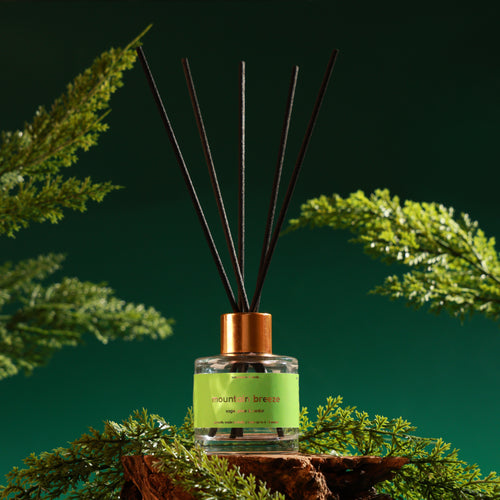 Mountain Breeze · a study₹849Shop →
 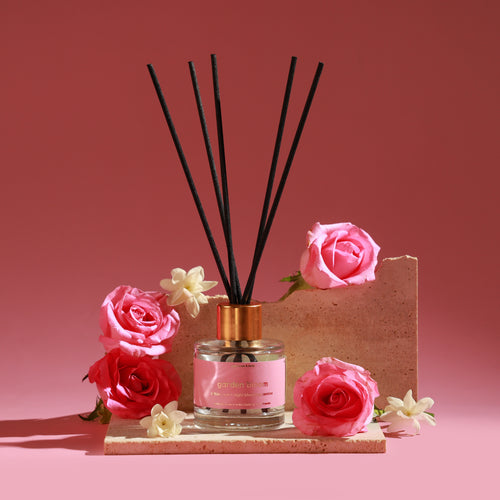 The whole reed linefrom ₹749Shop →
The shelf routine, and where a scent honestly belongs
The whole of the free answer is airflow, and it is worth being specific rather than saying air the room. Pull the bookcase six inches off the external wall, permanently. A wall that is cooler than the room is where condensation forms, and a bookcase pressed flat against it creates a still, cool, unventilated gap of exactly the kind that grows things — you have effectively built a small cupboard between the furniture and the plaster. Six inches restores air movement behind it and costs nothing but a Sunday morning. Then get the books out of closed cupboards for the season, or at minimum leave the doors ajar: a glazed or panelled case in July is a sealed box of damp air with no exchange at all, and it will run several points higher in humidity than the room around it. Then run a pedestal or table fan across the shelves for an hour a day, aimed along the spines rather than at them. This is the single most effective free thing available to a study, and it works because still air at a cool surface is where the trouble starts; moving air does not deposit moisture in the same way. Add silica gel — the reusable kind that changes colour and can be dried in an oven, a few sachets in each glazed case, replaced or dried when they turn. And take twenty minutes in June to open, fan and stand up any book you know has been wet at some point, because a book that was shelved damp is a colony waiting for a warm week.
Then the things not to do, which are where most damage actually comes from. Do not put a cool-mist diffuser in a room of books. It is the worst possible place for one. A cool mist falls, and a bookcase presents several square metres of absorbent horizontal and vertical surface for it to fall onto; a machine emitting 30 to 50 millilitres an hour on a shelf is depositing water into paper for as long as it runs. If you own a Sukoon or a Boond, the study is the room to keep it out of during monsoon and to put it back into in October. Do not seal books into airtight boxes or plastic sleeves for the wet months — you are trapping whatever humidity was in the paper on the day you sealed it, with no way out. Do not dry a wet book in direct sun, which cockles the paper and fades the boards; moving shade does it more slowly and far better. Do not stand books tightly packed if a shelf has had a problem, because a spine-to-spine row is its own unventilated space. And do not put an oil-based product on or immediately above a bookshelf, reed diffuser included — keep the bottle on a separate surface, since oil and paper have never been friends and a knocked reed is an expensive ten seconds.
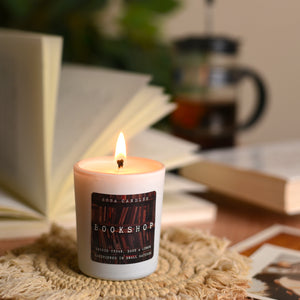
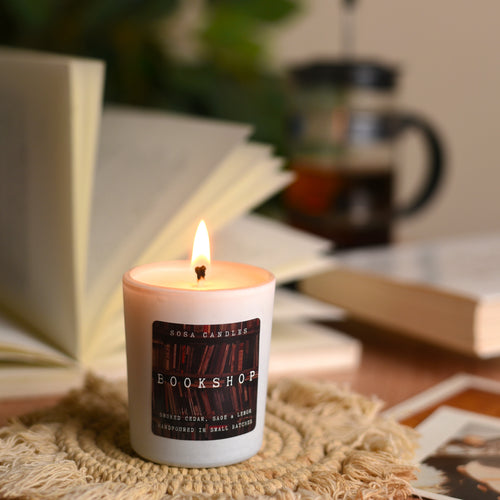
Then the honest position on fragrance, which is where this page has to be careful. If the shelf smells of growth, no product we make will help and I would rather you spent the money on a fan. Scent over a microbial source produces two smells, and in a study the second one arrives already having lost your trust. But once the room is dry and the smell has gone back to being the pleasant one, a study is a genuinely nice room to scent, and there are two sensible ways to do it. The Bookshop candle at ₹379 is the obvious one and I am aware of how that sounds — paper, faint vanilla and dry wood, eighty grams for roughly fifteen to eighteen hours, which at an hour of reading an evening is a fortnight. It is warm, it adds no water, and its plume moves the air above it rather than letting it settle. The alternative for somebody who does not want to think about it is Mountain Breeze at ₹849 in the alcohol-free reed line, Himalayan pine, sage and cedar, which holds one level for months with no socket and nothing to remember. Give a reed 24 to 72 hours before judging it, and expect the slow end of that in a humid month, because the room's air is already carrying close to its capacity and evaporation from the rattan is correspondingly reluctant. Neither product is a treatment. Both are the room's background once the room has earned one.
The SOSA edit
For a study or a room with a lot of paper in it, in the order I would spend. The first three rows are free and do more than the last three, which is the usual shape of an honest answer in this group.
| Do this | What it is | Why it comes here in the order | Cost |
|---|---|---|---|
| 1. Bookcase six inches off the external wall ★ | Restoring air movement in the gap between furniture and cool plaster | First, and free. That gap is a small unventilated cupboard, and it is where a patchy shelf smell almost always starts | ₹0 |
| 2. A fan across the shelves, an hour a day | A pedestal or table fan aimed along the spines rather than at them | Second. Still air at a cool surface is the condition; moving air removes it. The most effective free lever a study has | ₹0 |
| 3. Cupboard doors open, wet books dried | Glazed and panelled cases opened for the season; anything that has been wet stood open in moving shade | Third. A closed case runs several points more humid than the room it stands in, and a book shelved damp is a colony waiting for a warm week | ₹0 |
| 4. Silica gel in the glazed cases | Reusable colour-changing desiccant sachets, dried in an oven and used again | Only where airflow genuinely cannot reach. A desiccant in an open room is a gesture; in a sealed case it is useful | ₹200–₹400 |
| 5. Bookshop candle | Paper, faint vanilla and dry wood — 80g for roughly 15–18 hours, attended and put out | Once the shelf smells of age rather than growth. Adds no water, and 15–20 minutes from lighting | ₹379 |
| 6. Mountain Breeze reed or another reed | Himalayan pine, sage and cedar at ₹849, or from ₹749 across the alcohol-free line | For a level held for months with no socket. Keep the bottle off the shelf itself. 24–72 hours to establish | from ₹749 |
| Not in this room: a cool-mist diffuser | The Sukoon, Boond and Megh emit 30–50 ml of water an hour, and mist falls onto whatever is below it | A bookcase is the worst surface in the flat to deposit water onto. Move the machine to another room until October | — |
Versailles
I have a slightly complicated relationship with this particular smell, because we make a candle named after it. Composing Bookshop meant sitting with the real thing for a long time and working out what it actually is, and what it actually is turns out to be decay — vanillin off lignin, aldehydes off cellulose, a sour thread of acetic acid underneath. That was a genuinely useful thing to learn, because it reframed the whole product for me. We were not bottling nostalgia. We were bottling a very slow chemical reaction that a great many people happen to find beautiful, which is a more interesting brief and a more honest one.
The reason this page exists rather than a straightforward piece about book smell is that the second mechanism gets missed, and it gets missed expensively. Somebody writes to me in August about a study that has gone strange, I ask two questions — is it every shelf or one shelf, and is the smell sweet or earthy — and about a third of the time the answer means a wall behind a bookcase has water in it. A candle is not the response to that, and I would be embarrassed to sell one into that situation. Pull the case away from the wall, put a fan on it, find the water. Then, in a month or two, when the shelf is dry and smelling of vanilla and dust again, light something in the evening because a room full of books deserves it. That is the order, and it is the same order everywhere on this site.
Everything is made and supported from Pune, and a part of every order funds girl-child education through Nanhi Kali. You get a home that smells like somewhere you chose; a girl gets a classroom. That equation has always felt right to me.
Frequently asked questions
- Should I use an ultrasonic diffuser in a room that is already damp — why a bookshelf is the worst place for a cool mist.
- Why my wall smells even though there is no visible water — the wall behind the bookcase, in detail.
- How to dry out a flat without buying a dehumidifier — the seven steps that bring a study back under 60 per cent.
- Why your home smells damp, and why fragrance is the very last step — the pillar guide for this group.
- Brand: the SOSA founder story.
Facts verified August 2026: Diagnostic facts used in this guide: a closed room accumulates what it cannot exchange, so cross-ventilation needs two openings rather than one; a drain's U-bend water seal evaporates in roughly two to four weeks of disuse and then admits sewer gas, which is corrected by pouring water down the drain; microbial growth in fabric and on surfaces accelerates above about 60% relative humidity, and Indian monsoon indoor humidity commonly runs 80–95%, which is the one situation where ventilating on a wet day can import moisture rather than remove it; an air-conditioner's cold, wet evaporator coil and filter grow biofilm that is blown into the room on start-up; textiles adsorb cooking aerosol and body oils and re-release them for weeks; and olfactory adaptation makes a constant household smell undetectable to its residents within about a fortnight while visitors still perceive it. Timings: a scented candle scents a normal room in roughly 15–20 minutes, a Sukoon ultrasonic diffuser reaches a steady level in about 20 minutes from cold, and a reed diffuser needs roughly 24–72 hours. SOSA products and prices: Sukoon 500ml ₹1,899 (270–320 sq ft, 16–18h on low, 9–12h high, 30–50 ml/h, 2.4MHz cool mist, remote, steady/2H/4H timers, BPA-free, auto shut-off, includes three 15ml Hotel Collection scents of your choice); Boond 300ml ₹899; Megh 6-litre ₹3,499; waterless Vaayu ₹11,999 (up to 1000m³); Aangan ₹25,999. Hotel Collection water-based fragrance 15ml ₹299, 100ml ₹999, 300ml ₹1,799, Pack of 7 at 15ml ₹1,799; dose 3–6 drops per tank. Reed diffusers (separate alcohol-free line): Morning Freshness from ₹749, Garden Bloom and Evening Calm from ₹799, Fresh Brew and Mountain Breeze from ₹849; 130ml from ₹1,249; duos from ₹1,498; 300ml refills ₹2,399. Scented candles: Bookshop 80g ₹379, Amber Rose 130g ₹599 and 220g ₹799, Smoked Oudh 130g ₹449, ceramic jar candles ₹949, Pure Calm wax melt set ₹854. Free shipping above ₹499. SOSA does not make a room or linen spray for the home. The Hotel Collection scents are SOSA's own interpretations; SOSA is not affiliated with or endorsed by any hotel brand. Prices subject to change — see the live product pages.