

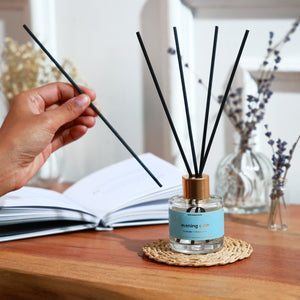

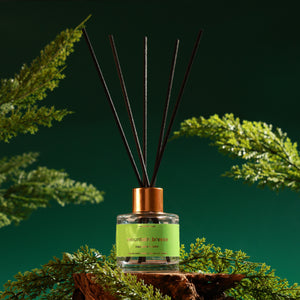
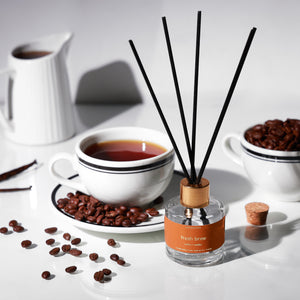
Second: it has run less than 48 hours and the reeds have not saturated yet.
Third: the reeds have clogged after several weeks — fit the fresh set from your next bottle, not more liquid.
2. Count the days since you set it up. Under 48 hours and it has not started: the fibre must saturate along its whole length before the tips throw. Three days to a fortnight and you are adapting. Two good months followed by a fade points at the reeds, not the liquid.
3. Look at where the bottle is standing. A still corner, the back of a shelf, inside a cabinet or low down near the floor will each flatten a perfectly good bottle. Nothing pushes scent out of a reed — the room carries it, so the bottle needs gentle air movement to work with.
4. Then reed count, then reed condition. Six fibre reeds come in the box and six is full strength. If you started with three or four in a room you want noticed, put the rest in. If the set has sat in the liquid for over two months, swap it — clogged fibre wicks slowly.
5. Last of all, ask whether the room is too big. One bottle is rated to about 150 sq ft. Against a 400 sq ft living room that is a scented zone, honestly described, and no amount of reed-fiddling turns one source into two. A second bottle at the far end is the only real answer.
Made in India, composed by an ISIPCA Versailles-trained perfumer — and a portion of every order supports girl-child education through Nanhi Kali.
Why your nose stops reporting a smell that is still there
Olfactory adaptation is not a quirk and not a weakness in your sense of smell. It is the design. Receptors fire hard when a molecule first arrives and then progressively stop signalling while that molecule stays at a steady level, and the brain compounds it by filing the signal as unchanged and therefore uninteresting. The system exists to keep you alert to what is new — smoke, gas, food, a stranger — rather than to keep describing the room you were already standing in. A reed diffuser is the purest possible trigger for it, because a reed never varies: no switch, no burst, no gap, the same output hour after hour. A candle lit for ninety minutes never gets the chance to become background. A reed becomes background inside a week, and does it fastest in the rooms you occupy most.
The consequence is that you cannot be the judge of your own reed diffuser, and any diagnosis starting with your own nose starts with a broken instrument. Somebody arriving from outside has spent twenty minutes in different air, so their receptors are unadapted and their first ten seconds inside your door are worth more than a fortnight of your impressions. It also explains why the fade feels sudden rather than gradual: the signal drops out of your attention altogether, which reads exactly like a product that has stopped. So run the visitor test first, and if it comes back positive, resist improving a system that is already working — adding reeds to a bottle you simply cannot perceive spends money and bottle life to fix nothing.
The three steps, in the order that saves you money
Symptom, likely cause, and what to do about it
Find the line that matches what is actually happening rather than the line you would prefer. The first three rows account for most of the messages I get, and none is a reason to buy anything.
| What you are experiencing | Most likely cause | What to do |
|---|---|---|
| I cannot smell it, visitors can ★ | Olfactory adaptation — normal, near-universal, not a fault | Nothing. Leave it alone and judge it by what guests say |
| Nothing on the first day or two | The reeds have not saturated along their length yet | Wait 48 hours before forming any opinion |
| Strong for weeks, then faded | Clogged reeds — heavier molecules have saturated the fibre | Fit the fresh set of six from your next bottle. Change reeds, never the liquid |
| Only noticeable beside the bottle | Still air — nothing is carrying scent away from the source | Move it near a doorway or a route between rooms, at waist to chest height |
| Never strong, in a normal room | Too few reeds for the job you are asking of it | Bring it up to all six. Never add more than the six supplied |
| Faint everywhere in a large room | One bottle rated to about 150 sq ft in a much bigger space | A second bottle at the far end — liquid buys weeks, a second source buys room |
| Diagnosis before purchase: four of those six rows cost nothing to fix and a fifth uses reeds you already own. See all five reed diffusers only after working through them. | ||
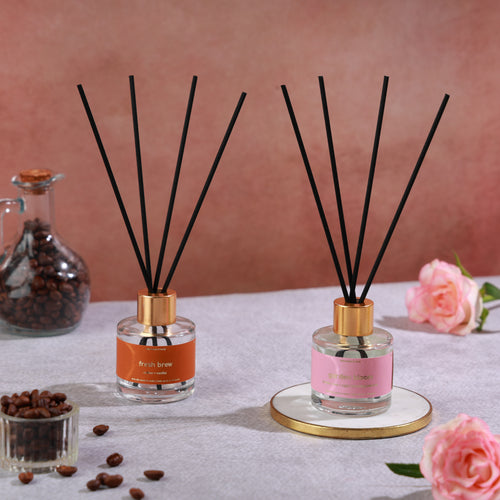
The reed range · five scentsFrom ₹749Shop → 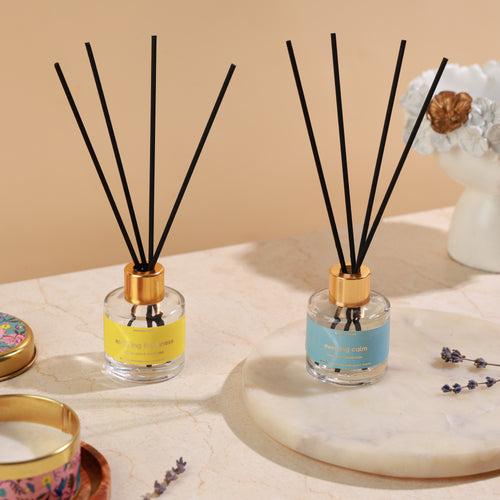 Day & Night duo · two rooms₹1,498Shop →
  Refills · 300ml₹2,399Shop →
Reeds, placement and flipping — the three things you control
Reed count is the strength control, and in a diagnosis it is the third thing to reach for rather than the first. Six fibre reeds come with every bottle: six is full strength, four suits a bedroom, two or three a small bathroom. If you set up with a reduced count and now cannot hear it in a hall you wanted scented, that is the dial set low — put the rest in. What you must not do is add reeds beyond the six supplied; a packed neck does not make a bottle behave like a larger one, it empties faster and wicks unevenly. Never top up or thin the liquid either.
Placement is free and, for a bottle that has never performed, it is where the biggest change usually lives. A reed needs gentle air movement to carry evaporated fragrance away from the tips — a console near a doorway, a shelf on the route between two rooms, a windowsill out of direct sun. Behind furniture or on the floor, the same bottle can be undetectable at three feet. Three placements to avoid: direct sunlight, which fades the fragrance and warms the oil; the blast of an AC vent or fan, which empties the bottle fast and pins the scent to one wall; and bare polished wood or untreated stone, which reed oil marks permanently if the bottle is knocked. Use a tray, keep it from children and pets, never decant.
Flipping is the smallest of the three levers and the one most misused during a panic. Turning the reeds saturated-end up every three to five days genuinely refreshes throw, because you expose fully loaded fibre to open air — but the lift is temporary and costs bottle life, so flipping every morning buys a louder room and a materially shorter run. Do it with a tissue. And remember what flipping cannot do: it will not clear a clogged set, and it will not make an adapted nose notice anything. If throw dropped after two or three months, fresh reeds are the fix, and a 300ml refill at ₹2,399 is the moment to fit them.
What to do, in order of what it costs you
The ladder starts with the free fixes and only reaches a product at the bottom. If a step solves it, stop there — there is no prize for reaching the last row.
| The fix | When it applies | What it costs |
|---|---|---|
| 1. Ask a visitor ★ | You cannot smell it and nothing else has changed | Free |
| 2. Wait 48 hours | The bottle was set up in the last day or two | Free |
| 3. Move it into moving air | Still corner, behind furniture, low shelf, inside a cabinet | Free |
| 4. Use all six reeds | Fewer than six in a room you want clearly scented | Free — but shortens the bottle |
| 5. Fit fresh reeds | It performed for two months and then faded | Included with each new bottle |
| 6. Add a second bottle | Room far bigger than 150 sq ft and a visitor agrees it is faint | 50ml ₹749 · 130ml ₹1,249 |
Versailles
The message I receive most often is some version of I think mine has stopped working, and it usually arrives about ten days after delivery. I have learned to reply with a question rather than a solution: has anybody visited since you set it up, and did they say anything. Far more often than not, the reply is that a guest remarked on it the previous weekend.
That is a strange thing for someone selling fragrance to keep saying, and I know it. It would be far easier to agree the bottle was weak and suggest a larger one. But a customer who buys a 130ml to solve a problem that was never in the glass is a customer who will be disappointed twice, and right to be.
So use the order here. Ask a visitor, count the days, look at where it stands, count the reeds, then change them. Buy something only if all of that fails and a second person agrees the room is quiet. A portion of every order supports girl-child education through Nanhi Kali.
Frequently asked questions
- My reed diffuser smells weak: what should I do? — the ten-minute triage.
- Why did it stop smelling after a few days? — why the timing rules out clogging.
- Does placement affect scent throw? — the free lever, in detail.
- The complete scent throw guide — all three levers in one place.
- Brand: the SOSA founder story.
SOSA products & prices (verified August 2026): Hotel Collection water-based ultrasonic diffuser fragrance 15ml ₹299 · 100ml ₹999 · 300ml ₹1,799 · Pack of 7 (15ml, all fragrances) ₹1,799; refills 100ml from ₹999. Seven scents: The Ritz-Carlton-inspired (white tea · bergamot · cedar), Westin-inspired (white tea · aloe · cedar), 1 Hotels-inspired (cedarwood · vetiver · green leaves), The St. Regis-inspired (amber · violet · woods), Shangri-La-inspired (jasmine · green tea · white tea), Four Seasons-inspired (citrus · floral · sandalwood), W Hotels-inspired (citrus · pepper · amber). Diffusers: Boond 300ml ₹899 · Sukoon 500ml ₹1,899 · Megh 6L ₹3,499. Water-based, phthalate-free, composed to IFRA standards for home diffusion; 3–6 drops per tank. Made in India, Pune. The Hotel Collection scents are SOSA's own interpretations inspired by the world's finest hotels; all hotel names are trademarks of their respective owners and are used only to describe the scent style — SOSA is an independent Indian fragrance house, not affiliated with or endorsed by any hotel brand. Prices and availability subject to change — see the live product pages.