



Three metres or more from the corridor mouth, pointing away from it. This is the measurement that protects the clinical side. A source two feet from a corridor behaves nothing like the same source across the room.
Out of the draught, off the counter, not facing the chairs. A supply vent turns a source into a delivery system for wherever that air is going; a return grille is an accidental duct mount. Waist-to-chest, on a solid surface, out of patient reach.
What this page will not claim: fragrance does not calm anyone, shorten a wait, improve comfort or affect footfall, reviews or revenue. Nothing here is medical, clinical or safety advice, and none of it is guidance on ventilation standards or infection control — those are yours and your clinicians' entirely. Some people are sensitive to airborne fragrance, which is why the clinical pathway stays clear and a fragrance-free seat should always exist.
2. At least three metres from the mouth of the corridor to consultation, and turned away from it. Corridors behave like flues, taking whatever is near their opening and carrying it. Distance and direction are free, and both matter more than the dial.
3. Out of every air-conditioning draught. Not in the throw of a supply vent, which will decide where your fragrance goes and rarely chooses well; and not near a return grille, because a source beside a return is an HVAC mount by accident, feeding the system that serves the whole floor. And never duct it in deliberately.
4. Off the counter, out of the sightline, not facing the chairs. A machine in plain view with a plume over it is read before anything is smelled, and a source aimed at a seating bank gives a strong row of chairs and a weak room. Behind the desk line at waist-to-chest height, on something solid, is nearly always the answer.
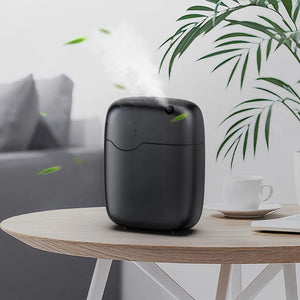
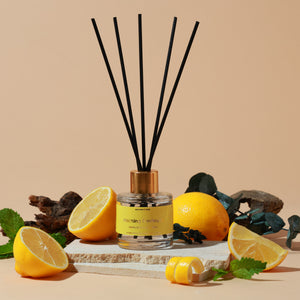
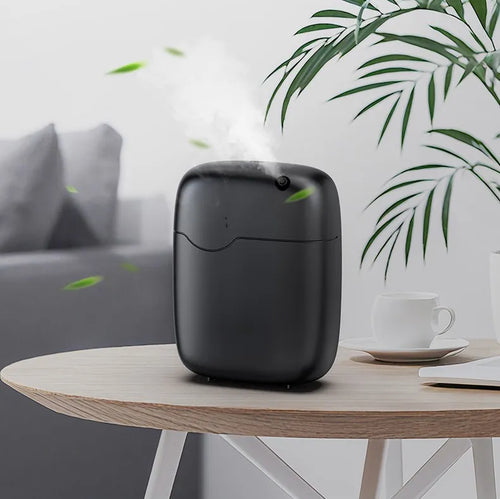
5. Out of reach, and away from what a clinic keeps near its desk. Patients, particularly children, should not be able to reach it. An ultrasonic such as a Sukoon adds humidity, so keep it clear of paper records, spectacle displays and equipment. A reed diffuser goes on a tray — the oil marks stone and wood — and out of the entrance draught, which strips the reeds and empties the bottle weeks early.
6. Keep a fragrance-free seat, and take nothing here as clinical advice. Some seats will be closer to the source than others; know which are furthest and let reception offer them. Ventilation standards, infection control, cleaning protocol and patient suitability are for you and your clinicians alone — I am advising on where an object stands in a waiting room.
Everything SOSA makes is composed and made in small batches in Pune, and a portion of every order supports girl-child education through Nanhi Kali.
Part one — the three placement rules
Retail placement guidance optimises for even coverage and the entrance impression. A clinic optimises for containment first, evenness second, appearance third — and where they conflict, containment wins. Three rules, in the order to apply them.
 Sukoon₹1,899 · behind the desk lineAir-conditioning creates two hazards and they are opposites. A supply vent throws air across the room at speed, so a source in that throw is not diffusing into a room but injecting into a jet — and wherever the jet lands is where your fragrance lives, often the far corner or straight down the corridor. A return grille does the reverse, drawing air into the system, so a source beside one is feeding the ducting that serves the whole floor. That is an HVAC installation performed by accident, and it produces the exact outcome this cluster exists to prevent. Deliberate duct-mounting is worse again, and I would never specify it in a clinic whatever the machine supports. Find both the supply and the return before choosing a position — and note that a reed diffuser in a draught also empties in a fraction of its stated life.
Part two — nine positions in a reception, judged
Every position a practice has proposed to me, with a verdict. Only three of the nine are worth having.
| Position | Verdict | What it does | If you have no alternative |
|---|---|---|---|
| Behind the desk line, mid-zone, away from vents ★ | Best | Even distribution, contained, invisible, out of reach | Nothing to work around — design for this one |
| A console or side table between entrance and seating | Good | Similar distribution, slightly more visible | Turn it away from the chairs; run the tissue test |
| Corner of the room, away from door and corridor | Acceptable | Contained, but slower and less even | Fine on a machine; poor for a reed, which has no push |
| On the reception counter, facing the seating | No | Visible plume, two over-scented chairs, at reach height | Eighteen inches back and down — the cheapest fix here |
| Within a metre or two of the corridor to consultation | No | Feeds the corridor, and the corridor feeds the cabins | No version of this works. Move it or switch it off |
| Directly under or in front of an AC supply vent | No | The vent decides where it goes — far wall, or the corridor | Move out of the throw; on reeds it also empties a bottle early |
| Beside an AC return grille | No | An accidental HVAC mount, feeding every room on the system | None. Find the return and keep several metres clear |
| High on a shelf above the seating | No | Warm air holds it near the ceiling; the room reads empty | Bring it down to waist-to-chest height |
| Duct-mounted into the central air-conditioning | Never, in a clinic | Distributes fragrance to every room on the system, clinical ones included | Decline it however it is proposed. Freestanding instead |
| The honest caveat: this table is guidance on where to stand a fragrance product in a waiting room. It is not advice on ventilation design, air handling, infection control or any clinical or regulatory matter, and nothing here is medical or safety advice. No claim is made that fragrance affects comfort, anxiety, perceived waiting time, recovery, footfall, reviews or revenue. Whether fragrance belongs in your building at all is a judgement for you and your clinicians. | |||
Vaayu · freestanding, never ducted₹11,999Shop →  Sukoon · behind the desk line₹1,899Shop →
 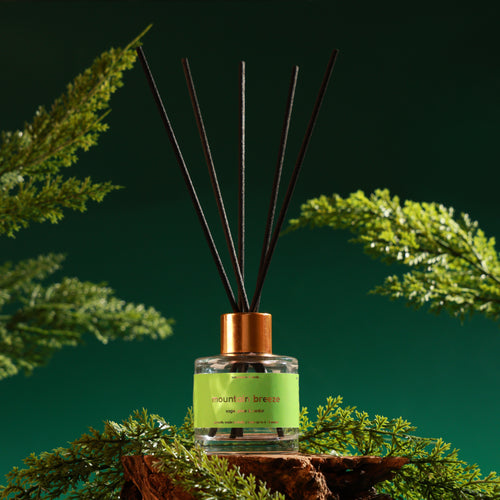 Mountain Breeze · on a tray, no draught₹849Shop →
Part three — when a clinic should not do this at all
The first case is a reception in which no compliant position exists. If every candidate is within two metres of the corridor mouth, in an air-conditioning draught, or on a counter in full view, the room is telling you something: it is not an arrival zone with a clinical route off it, but a clinical route with a desk in it. No machine and no setting rescues that geometry, and the correct outcome is to leave the air alone until a refit gives you the depth.
The second is a proposal that arrives from a contractor rather than from you. Duct-mounting a diffuser into the central air-conditioning is a normal specification in hotels and offices, so an architect, an AC vendor or a scenting installer may well suggest it — and in a clinical building it should be declined every time. It is not a question of the machine's quality; the ducting goes to the consulting rooms, the diagnostic areas and the procedure suite, and no damper arrangement is worth trusting with a boundary that ought to be absolute. The third is a children's eye clinic or a large paediatric caseload, which I would decline outright; the fourth is a practice whose front-desk team would rather work without it — they sit closest to whatever position you choose, and their answer settles it.
The fifth is supply, and it becomes real once a machine has been sited, cabled and made part of the room. SOSA does not currently sell a separate cold-air refill oil for the Vaayu. The 400ml in the box lasts roughly ninety days or more at a mid setting and is the whole supply available at the time of writing. For a home that is an inconvenience; for a practice that has designed a reception around a permanent installation, or is repeating it across branches, it is a business problem. The water-based Hotel Collection is not a substitute — it is for ultrasonic machines and must not be used in a Vaayu. Confirm availability through the contact page before committing.
Part four — placement when the room fights you
Most receptions have one awkward feature that rules out the obvious position. Find yours in the first column.
| The obstacle | The rule it breaks | Where the source goes instead | Product |
|---|---|---|---|
| Only free surface is the reception counter ★ | Sightline, reach and direction | A low shelf behind the desk, or a console on the side wall | Sukoon ₹1,899 |
| Wall AC blows across the room | The supply-throw rule | The same wall as the unit, below and to one side | Sukoon ₹1,899 or a reed diffuser |
| Return grille sits above the desk | The accidental HVAC mount | The far side of the zone, several metres clear | Mountain Breeze ₹849–₹1,349 |
| Long narrow reception, corridor at one end | Distance from the boundary | The entrance third, facing inward — never the corridor end | Sukoon ₹1,899 |
| Open waiting hall, no anchor, 320+ sq ft | Distribution over a large volume | Freestanding at the gathering point, key-lock on, back from any corridor | Vaayu ₹11,999 |
| Every candidate position breaks a rule | All of them | Nowhere. Leave the air alone until the layout changes | ₹0 |
Versailles
A surgeon called me about consultation cabins that smelled faintly of his reception by mid-afternoon. He had set the machine correctly and chosen a dry composition. The unit stood about a metre from the mouth of the corridor, because that was where the only spare socket was. Nothing else was wrong with the installation, and nothing else needed to be.
We moved it four metres, to a console on the far side of the seating, with an extension run tidily under the skirting. The cabins were clear within two days. It cost him nothing, and it is the commonest fault I see — placement decided by a socket rather than by the floor plan, which is the argument for settling this at layout stage with whoever draws the room.
The half I say less profitably is that some receptions have no compliant position at all, and a few practices have been offered an HVAC integration by a contractor who was being helpful rather than careless. Both of those end in the same recommendation: buy nothing, or buy the machine and put it where the room allows, never in the duct. Made in Pune in small batches, and a part of every order funds a girl's classroom through Nanhi Kali.
Frequently asked questions
- One zone, one scent, one level — why a gradient inside one space cannot be held.
- Which composition suits a waiting room — chosen for the fortieth minute.
- How strong the level should be and what a busy reception changes.
- Should patients notice it at all — the intensity doctrine.
- Brand: the SOSA founder story.
SOSA range, specifications and prices used in this guide (verified August 2026): Vaayu ₹11,999 — waterless cold-air nebulisation of undiluted fragrance oil; no water, no heat, no added humidity, no white mineral dust. Coverage up to 1000 m³, about 2,000–3,000 sq ft. 400ml refillable tank lasting roughly 90+ days at a mid setting. Bluetooth app plus onboard controls, 1h / 4h / 8h / 24h run windows, day selection, adjustable intensity, auto-stop and key-lock. Under 38 dB. DC 12V / 1A, 5W. Freestanding or wall / HVAC mount. CE, RoHS and SGS certified. SOSA does not currently sell a separate Vaayu cold-air refill oil; the 400ml supplied in the box is the fragrance available at the time of writing, so a practice planning continuous or multi-site use should confirm current refill availability with SOSA before committing. The water-based Hotel Collection is made for ultrasonic machines and must not be used in a Vaayu. Other machines: Boond 300ml ₹899 (~150 sq ft, ultrasonic) · Sukoon 500ml ₹1,899 (270–320 sq ft, 16–18 hours on low, remote and steady/2H/4H timers, three 15ml fragrances included, ultrasonic) · Megh 6L ₹3,499 (~215 sq ft — a runtime and humidity machine that covers less than a Sukoon, never a coverage upgrade) · Safar ₹3,999 (waterless cold diffusion, cordless, 20ml, about 6.9cm, three speeds, 1/2/3-hour auto-off — sold as a car and travel diffuser, personal-scale only; SOSA publishes no coverage figure for it) · Aangan ₹25,999 (HVAC nebulising, ~8,000–10,000 sq ft) · Meenar ₹38,500 (commercial HVAC, 12,000–18,000 sq ft). Water-based Hotel Collection for ultrasonic machines: 15ml ₹299 · 100ml ₹999 · 300ml ₹1,799 · pack of seven ₹1,799; scents are inspired by the atmosphere of well-known hotels — SOSA is an independent Indian brand and is not affiliated with, endorsed by or supplying any hotel group. Reed diffusers ₹749–₹1,349 (50ml 6–8 weeks, 130ml 14–18 weeks, six fibre reeds, no 100ml size; replacement reeds are not sold separately). Reed oil cannot be used in an ultrasonic machine and Hotel Collection oil cannot be used in reeds. SOSA sells no room spray or home spray — every SOSA spray is a car perfume. Nothing in this guide is medical, clinical or safety advice. A fragrance diffuser adds a scent to the air. It does not clean, purify, filter, sanitise or disinfect air, does not remove or neutralise disinfectant, damp or occupancy smells, and has no effect on comfort, anxiety, waiting time, recovery or any clinical outcome. Some people are sensitive to airborne fragrance, which is why this guide recommends that examination rooms, diagnostic areas, consultation cabins, procedure suites and post-operative areas remain fragrance-free, that a fragrance-free seating option always exist, and that a diffuser is never mounted into shared HVAC in a clinical building. Decisions about clinical policy, ventilation standards, infection control and patient suitability rest entirely with the practice and its clinicians. A persistent stale, damp or disinfectant smell is a ventilation, moisture or cleaning problem — SOSA sells no dehumidifier and no air purifier, and fragrance should never be used to cover one. Coverage, runtime and longevity figures are manufacturer specifications and typical ranges, not guarantees, and vary with room volume, ceiling height, air exchange, occupancy and season. SOSA publishes no commercial or bulk pricing, no corporate account, no annual maintenance contract, no installation service, no stated warranty term and no multi-location programme; warranty length, spare parts, servicing and app platform availability are unconfirmed, and larger or multi-site enquiries should go through the contact page before any commitment. Composed and made in small batches in Pune, India. Free shipping above ₹499. A portion of every order supports girl-child education through Nanhi Kali. Prices subject to change — see the live product pages.