


Before any product: water down every drain trap at opening, move the main mopping out of the hour before the doors open, empty dressing and clinical waste on a written schedule, and have the air-conditioning drain pan checked. Those four cost nothing and they settle most of it.
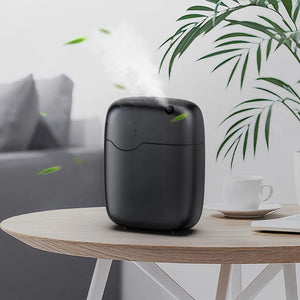
Then, and only then: the Westin-inspired White Tea Serenity — white tea, aloe and cedar, the lightest of the seven — run at the lowest useful setting through a Vaayu at ₹11,999 in the entrance, reception and waiting volume. Consultation and examination rooms, treatment and procedure rooms, the laboratory, sample collection, pharmacy dispensing and paediatric clinical areas stay fragrance-free. Fragrance here is housekeeping and presentation. It is not treatment and it makes no clinical difference to anybody.
2. Start with the drain traps, because they are free and they are the most common single cause. Any toilet, any floor gully, any hand basin in a room that is used twice a month will dry out in about three weeks, and once the seal is gone the drain is an open pipe. Two minutes with a jug at opening, on a written round, removes a smell that no machine could have covered.
3. Then the schedule, not the chemical. Move the main mopping away from the hour before the doors open, check the dilution somebody is actually using rather than the one on the label, and get the dressing and clinical waste out of the building on a fixed timetable rather than when a bin looks full.
4. Then the air, because a busy waiting hall is an occupancy problem wearing a fragrance problem's clothes. Forty people in a 1,200 sq ft room for three hours will make the air smell of forty people, and the only thing that answers that is air changes. A room that is fine at nine and unpleasant by six is telling you about its ventilation.
5. Only then a fragrance, and only in the public volume. The Westin-inspired White Tea Serenity at ₹299 through a Vaayu at ₹11,999, at the lowest setting that still registers, in the entrance, reception, waiting and corridor volume. Consultation rooms, treatment rooms, the laboratory and sample collection stay fragrance-free, and that is not a concession.
6. And nothing beyond that is claimed. A diffuser is not an air purifier, it does not clean or disinfect anything, and it has no effect on any patient or any condition. It is presentation and housekeeping, and that is the only thing a clinic should ever say about it.
A portion of every order supports girl-child education through Nanhi Kali.
What a clinic already smells of before you add anything
Every enquiry I get from a medical centre opens at the wrong end. The question is which fragrance, and the useful question is what the building currently smells of and why. A multi-speciality clinic is not a neutral box waiting to be given a character. It is a twelve-hour building with clinical waste in it, a hundred litres of mop water going across its floors every day, a café at one end, a queue of people in the middle and at least four plumbing fixtures that nobody has run water through since the last inspection. Each of those produces a smell on its own schedule, and the reason most clinics read as slightly unpleasant is not that they lack a fragrance. It is that two or three of these are live at once and nobody has been given the job of closing them. Work through the list below before you spend anything, because every item on it is cheaper than a machine and several of them are free.
The seven scents, ranked for a medical facility
All seven Hotel Collection scents with their real note profiles, ranked against the brief a clinic actually has, which is narrower than any other commercial space I work with: clean, dry, quiet, unmemorable as a product and impossible for anybody in a waiting hall to object to. The third column is how each behaves in a public medical space with a queue in it, and the fourth is the verdict. Four of the seven are wrong here, and the table says so rather than stretching them to fit.
| Scent | Notes | How it reads in a waiting hall | Verdict | 15ml |
|---|---|---|---|---|
| Westin-inspired · White Tea Serenity ★ | White tea · aloe · cedar | The quietest composition in the range — cool, dry and thin enough that a full hall never accumulates it | The default. Lowest useful intensity, public areas only. Nobody will ask what it is | ₹299 |
| Ritz-Carlton-inspired · Quiet Luxury | White tea · bergamot · cedar | The same family with a little more lift from the bergamot, so it carries further across a large lobby | The second choice, and the first if a double-height entrance swallows the Westin-inspired | ₹299 |
| 1 Hotels-inspired · Forest Suite | Cedarwood · vetiver · green leaves | Bone dry and low, and it sits at a different address in the nose from food | Right where a café, canteen or pantry smell reaches the seating. Dry rather than fresh | ₹299 |
| Four Seasons-inspired · Warm Welcome | Citrus · floral · sandalwood | Warm and gracious, and the sandalwood base is the most persistent in the range | Too much personality for a medical building. Fine in a hotel lobby, not in front of a queue | ₹299 |
| Shangri-La-inspired · Tea Garden | Jasmine · green tea · white tea | The jasmine accumulates through a long afternoon in a closed hall rather than staying level | No. A night-blooming floral in a waiting area is the sort of thing patients remember and mention | ₹299 |
| The St. Regis-inspired & W Hotels-inspired | Amber · violet · woods / citrus · pepper · amber | Both are plush and deliberately memorable, which is exactly the property a clinic does not want | The two to leave out entirely. They are evening scents for rooms people choose to be in | ₹299 each |
The lowest useful setting, and the volumes a door closes
Start with the sum, because it usually saves a clinic money. Cubic metres are floor area in square feet divided by 10.76, multiplied by ceiling height in metres — and the only areas that go into the sum are the ones you are actually scenting. A 3,000 sq ft floor at three metres is about 836 m³, which one Vaayu covers comfortably at ₹11,999. But almost no clinic scents 3,000 sq ft. Take out the eight consultation cabins, the two procedure rooms, the sample-collection room, the laboratory, the pharmacy store and the imaging room, all of which are fragrance-free and all of which have their doors shut, and the public volume is frequently half the plan area. A 3,000 sq ft clinic with a 1,400 sq ft public footprint at 3.2 metres is about 416 m³, which is less than half of one machine's rating. Count the volumes a door closes rather than the square feet on the architect's drawing, and a facility that arrived expecting to buy two units usually leaves with one. Where the sum genuinely runs past 1000 m³ — a double-height atrium, a whole-floor air handling unit, an integrated centre of 8,000 sq ft and upward — the Aangan at ₹25,999 is the right machine and the comparison is worth reading properly. For anything smaller than that, recommending it would be overselling.
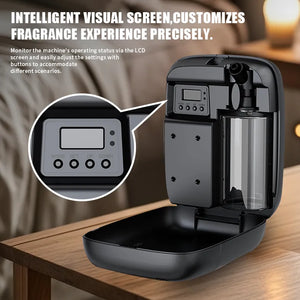
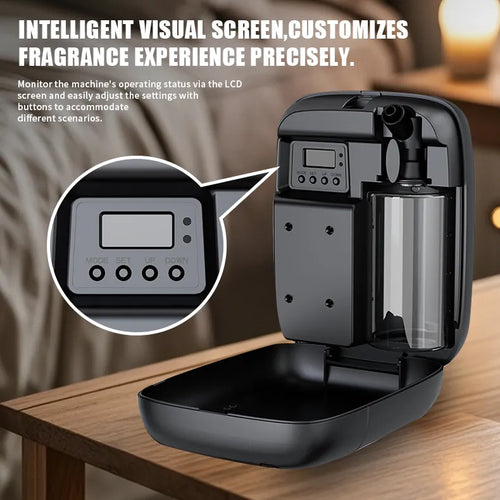
Then the hours, which in a clinic are simpler than in any other commercial building because the building itself has a timetable. Night before: bins out, clinical waste out, mop heads dried flat rather than left standing in buckets. Sixty minutes before opening: housekeeping opens up, windows open where there are windows, and water goes down every drain trap in every toilet and every unused sink. Forty-five minutes before: air conditioning on, so the building reaches temperature before the first patient does. Thirty minutes before: the diffuser starts, on low, in the entrance and reception zone. It reaches its level well inside that window, which is the point — at the first appointment the climb is over and the room is simply how it is. The Vaayu runs 1h, 4h, 8h and 24h timers with app control, so the schedule is set once and never touched again. And the midday rule, which I would print and stick inside the reception cupboard: nobody turns it up at lunchtime because the hall got busy. Busy is an air-change problem, and adding fragrance to a room that is short of fresh air makes it worse rather than better. At close, the timer stops it with the last appointment. A machine running overnight into an empty building is wasting oil and telling you nothing.
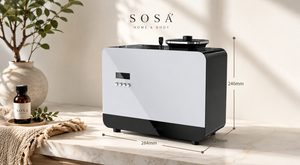
Then placement and the discipline around it. Mount it high — around two metres, on a wall or a column, in the return-air path if there is one — and never on the registration counter. A machine on a desk is at nose height for everybody standing at it and at nose height for nobody sitting in the seating, which gets you a strong smell exactly where the conversation happens and no smell at all where the wait happens. Keep it out of the direct throw of a wall-mounted split unit, because a draught strips the light top off a composition and leaves the heavier end standing alone, and that is how a well-chosen scent starts reading as thick without anybody having changed the dose. Keep it out of the doorway, where half the output goes to the street. The 0.9 kg body at 165 × 80.5 × 215 mm mounts on a wall or ties into the HVAC, and the key-lock is there so that nobody passing through a public hall can adjust it on a whim — which, in a building where six departments all have opinions, matters more than it sounds. On the constraints: the water-based Hotel Collection bottles are for ultrasonic machines only and do not go into the Vaayu or the Aangan, which take their own undiluted oil. An alcohol-free reed diffuser from ₹749 needs 24 to 72 hours to reach its working level and is barely noticed past about a metre, which makes it right for an administrative cabin and wrong for a forty-seat hall. Candles are not appropriate in a healthcare facility at all: SOSA makes them from ₹379 and an open flame in a clinic is a fire-safety and insurance matter, so that is a plain no rather than a hedge. And SOSA does not make a room spray — the sprays in the range are car perfumes.
The SOSA edit
In buying order for a multi-speciality clinic that has already dealt with the housekeeping list above. The first two rows cost nothing and come before any purchase. The last row states what we do not make, because a clinic reading this page will otherwise go looking for it.
| Step | What it is | Why it comes here | Cost |
|---|---|---|---|
| 1. The drain-trap round ★ | A jug of water down every trap, gully and unused basin, on a written opening round | The most common single cause of a clinic that smells, and the only fix that is genuinely free | ₹0 |
| 2. The schedule | Mopping moved out of the hour before opening, clinical waste out at a fixed time, linen off the public route | Three timetable changes that between them close most of what a patient actually notices | ₹0 |
| 3. Vaayu | Waterless, no standing tank, up to 1000 m³, 400ml for about 75 days, under 38 dB, timers, app, key-lock | The machine for the entrance, reception, waiting and corridor volume of a clinic up to roughly 3,000 sq ft | ₹11,999 |
| 4. White Tea Serenity 15ml | White tea, aloe and cedar — the lightest and quietest of the seven scents | The default for a medical facility. Buy the 15ml first and settle the choice before committing to a refill | ₹299 |
| 5. Aangan or 300ml refill | Up to 3,000 m³ and HVAC-ready, or about ₹6 per millilitre once a scent is settled | The Aangan only for an atrium or a whole floor above 8,000 sq ft. The refill once you are sure | ₹25,999 / ₹1,799 |
| Not made: a room spray for commercial space | The sprays in the SOSA range are car perfumes, formulated for about three cubic metres of moving air | Said plainly because several clinics ask. A morning spray is a twenty-minute product in a twelve-hour building | — |

Versailles
I have walked into a lot of clinics in the last four years, and the ones that impressed me were never the ones with a fragrance I could identify. They were the ones where I stood at the desk for a minute, tried to find something to notice, and could not. One of them was a modest polyclinic in Nagpur with vinyl flooring and twenty-two chairs, and what its owner had actually done was give one housekeeping supervisor a laminated card with six items on it and a time against each. No fragrance at all when I first visited. It was the best-smelling medical building I had been in that year.
So when a centre head asks me what their clinic should smell like, I try to make the answer boring on purpose. Nothing in particular. Then, if the building has genuinely reached that, a level of background so low that the only way to test it is to step outside for a minute and come back in. I would rather sell one machine to a clinic that has fixed its drains than three to a clinic that has not, partly because the second clinic will be unhappy in a month and blame the fragrance, and partly because covering a smell in a medical building removes the signal that told housekeeping something was wrong. A persistent smell is information. Find it and fix it, and scent a facility that is already clean.
Everything is made and supported from Pune, and a part of every order funds girl-child education through Nanhi Kali. You get a space that smells like somewhere looked after; a girl gets a classroom. That equation has always felt right to me.
Frequently asked questions
- The best fragrance for a polyclinic reception and waiting area — the lightest of the seven, run low.
- Should a clinic smell of cleaning chemicals, or of nothing at all — the sharper version of this question.
- Which areas of a medical centre should always be left fragrance-free — the list, in full.
- What a multi-speciality clinic should fix before it spends anything on fragrance — the housekeeping order.
- Brand: the SOSA founder story.
Facts verified August 2026: Product facts used in this guide. SOSA Vaayu ₹11,999: waterless cold-air nebulising diffuser, atomises undiluted fragrance oil to a dry residue-free nano-mist with no water reservoir, coverage up to 1000m³ (approximately 2,000–3,000 sq ft), 400ml refillable tank lasting up to about 75 days per fill, Bluetooth app plus onboard control, 1h/4h/8h/24h timer scheduling, adjustable intensity, under 38 dB, DC 12V/1A at 5W, 165 × 80.5 × 215 mm and 0.9 kg, freestanding or wall or HVAC mounted, auto-stop and key-lock, CE, RoHS and SGS certified, supplied with four hotel-inspired fragrances. SOSA Aangan ₹25,999: HVAC-connected or standalone commercial nebulising diffuser, coverage up to 3,000m³ (roughly 8,000–10,000 sq ft), 800ml reservoir, metal body, programmable schedules, under 42 dB. Ultrasonic machines are water-based, hold standing water and consume 30–50 ml of water an hour: Sukoon ₹1,899 (500ml, 270–320 sq ft, 16–18 hours on low, 3–6 drops per tank, steady/2H/4H timers, three 15ml Hotel Collection scents included), Boond ₹899 (300ml), Megh ₹3,499 (6 litres). Hotel Collection water-based fragrance 15ml ₹299, 100ml ₹999, 300ml ₹1,799, Pack of 7 at 15ml ₹1,799 against ₹2,093 bought singly; the Vaayu and Aangan take their own undiluted oil rather than these water-based bottles. Alcohol-free reed diffusers from ₹749, requiring 24–72 hours to reach their working level. Free shipping above ₹499. Coverage arithmetic: cubic metres equal floor area in square feet divided by 10.76 and multiplied by ceiling height in metres, counting only the volumes that are actually scented. This guide makes no medical, therapeutic or clinical claim of any kind for fragrance: a diffuser does not purify, disinfect or clean air, and does not treat, calm or affect any patient or condition. Fragrance is housekeeping and presentation. Clinical areas should be left fragrance-free, and a persistent odour should be traced to its source and corrected rather than covered. SOSA is not affiliated with or endorsed by any hotel brand. Prices subject to change — see the live product pages.