


Failure two — the creep. A crowded neck wets the rim; oil films down the outside of the glass and marks wood and stone. Always stand the bottle on a tray.
Failure three — the crowded neck. Reeds pressed against each other and against the glass wick unevenly. Past a point, adding reeds stops adding working surface.
Failure four — the room turns. In a small or sealed space the result is not richer, it is oppressive — and your own nose will be the last to notice.
2. Oil creeps down the outside of the glass. A crowded neck holds a film of oil at the rim, and that film travels. It reaches the shoulder, then the base, then whatever the bottle is standing on. Reed oil marks wood and stone, so the bottle belongs on a tray whatever your count.
3. The neck crowds and the reeds wick worse. Reeds pressed hard against each other and the glass have less free surface meeting the air, and they lean, which lowers the exposed height. Past a certain point you are adding sticks without adding working surface.
4. A small room turns unpleasant — and you will not be the one who notices. Your nose stops reporting a constant within minutes and adapts hardest at home. Guests are the honest witnesses. A bathroom or a compact bedroom is where this bites first.
5. The correction is free. Pull reeds out until you are back at six, wipe the neck and glass, and wait two days. Nothing has been damaged. Keep the spares standing upright in a small glass, not lying on furniture.
Composed and handmade in small batches in Pune, and a portion of every order supports girl-child education through Nanhi Kali.
Part one — the three mechanical failures, in the order they appear
The first three failures are physics rather than taste, which makes them easy to describe and easy to verify at home. They arrive in sequence: the burn starts on day one, the creep becomes visible somewhere in the first fortnight, and the crowding shows itself when you lift a reed and find it barely wet halfway up. None of them are faults in the diffuser and none are reversed by buying anything.
 Oil refill₹2,399 · 300mlA bottle neck is sized for a certain bundle of reeds. Crowd it and the reeds displace oil upward and hold a wet film against the rim, and once the rim is wet the film has a path — over the lip, down the shoulder, along the base, into the wood. People read this as a leaking bottle. It is not; it is a wicking surface being asked to work at the rim rather than in the air. Reed oil marks wood and stone, and the marks are not always removable, which is why the standing advice is a tray under every bottle regardless of count. The same film is why an overloaded bottle looks like it is emptying faster than even the reed maths suggests: some of that oil never reached the room at all.
Part two — the four failure modes, side by side
Four modes, what each looks like from the sofa, what causes it and what it costs. Most overloaded bottles are running at least three of them simultaneously, which is why the experience is usually described as the diffuser behaving oddly rather than as too many sticks.
| Failure mode | What you notice | What is actually happening | What it costs | The correction |
|---|---|---|---|---|
| 1. The burn ★ | The bottle is visibly low far ahead of schedule | Evaporating surface has risen, so throughput has risen with it | 6–8 weeks becomes 4–5 on a 50ml at ten reeds | Remove reeds; the rate drops the same day |
| 2. The creep | A sticky film on the glass and a ring on the furniture | A crowded neck holds oil at the rim and it travels down the outside | Oil that never reaches the room, plus marked wood or stone | Wipe the glass and rim, reduce the count, use a tray |
| 3. The crowd | Reeds barely wet above the oil line despite a full bottle | Reeds pressed together expose fibre to each other, not to air | You pay for surface you are not receiving | Back to six, standing clear, and flip weekly |
| 4. The turn | Guests comment; you notice a faint headache and nothing else | Small sealed volume plus raised output, with your own nose adapted | A room nobody wants to sit in for long | Remove reeds, air the room, wait two days before judging |
| The honest caveat: none of these is a defect and none is permanent. Reed count is the only genuinely free, genuinely reversible control this format has, and running eight or nine reeds for a hosting week is a sensible use of it. The four failures above are what happens when a temporary setting becomes a permanent one, or when the count goes well past what the neck was built to hold. Week figures are SOSA's working guidance, not laboratory measurements. | ||||
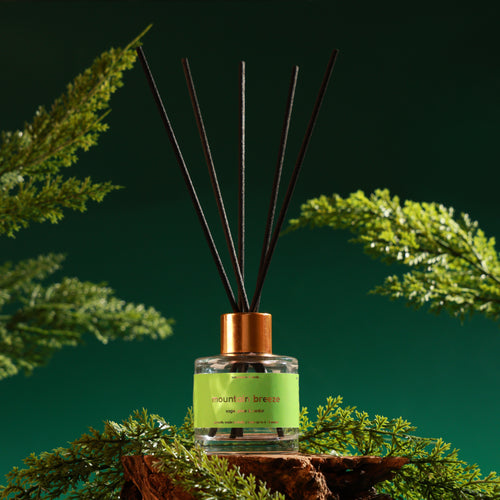 Mountain Breeze · 9.4/10from ₹849Shop →
  Oil refill · 300ml₹2,399Shop →
  Sukoon · 270–320 sq ft₹1,899Shop →
Part three — the fourth failure, and why you are the last to know
The three mechanical failures are visible. The fourth is not, because it happens inside your own head. Olfactory adaptation is the reason overloading persists: your nose stops reporting a constant within minutes, and it adapts hardest to your own home, which you walk into a dozen times a day. So the person running twelve reeds is very often the only person in the building who cannot tell. They add reeds because the room reads quiet to them, the room gets heavier, they adapt to the new level, and a fortnight later they add more. Meanwhile a guest opens the door and gets the whole of it at once. If you want an honest reading, leave the flat for fifteen minutes and come back in through the front door without thinking about it, or simply ask somebody who does not live there. That fifteen-minute doorway test costs nothing and settles the argument in both directions.
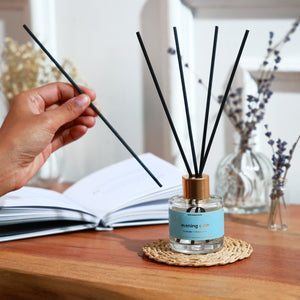
Where the turn bites hardest is small, sealed volume. A compact bathroom, a box bedroom with the door shut and the AC on, a nursery — these are rooms where six reeds is already generous and ten is genuinely too much. The result is not a richer version of the fragrance; it is a heavier, base-dominant version of it, because a raised surface preferentially burns off the light materials early and leaves the slow ones to carry the room. That is why an overloaded bottle can smell simultaneously too strong and slightly wrong. A nursery or a room where somebody gets migraines should be at three or four reeds of something soft such as Evening Calm, and I would rather say that than sell an upgrade. There is one more thing worth naming here: never run a diffuser hard over live cooking. Extractor on, window open ten minutes, close up, wait half an hour. Fragrance layered onto cooking makes a third smell nobody designed, and extra reeds make it worse rather than better.
And then the honest ceiling, which overloading is usually an attempt to climb. A reed diffuser is constant, passive and deliberately low. It cannot surge, it cannot be turned up for an evening, and past roughly 250 to 300 square feet of connected open volume it is simply the wrong tool. Piling reeds into one bottle to cover a large hall is the most expensive way to discover that, because output per bottle is fixed — the only way to raise the total is another source. Two 50ml at opposite ends of an open living-dining beat one crowded bottle in the middle, and if what you actually want is a strong room on demand, the Sukoon at ₹1,899 covers 270–320 sq ft, runs 16–18 hours on low with steady, two-hour and four-hour timers, and comes with three 15ml Hotel Collection scents in the box. Those are water-based and never go into a reed bottle, just as reed oil never goes into a machine.
Part four — the de-escalation ladder
If you are reading this with ten or twelve reeds in a bottle, here is the order I would work in. Nothing on the first four lines costs money, and most people stop before the fifth.
| Step | Do this | What you should see within 48 hours | Price |
|---|---|---|---|
| Step one ★ | Remove reeds down to six and wipe the neck and glass with a cloth | The room settles; the rate of loss visibly slows on the glass | Free |
| Step two | Put the bottle on a tray and check the surface underneath for marks | No new ring; existing marks stop spreading | Free |
| Step three | Do the wet-line test on the six you kept — lift one and find the boundary | A clear, mid-height line means wicking has recovered | Free |
| Step four | Leave the flat for fifteen minutes, then walk back in | An honest reading of the room, uncontaminated by adaptation | Free |
| Step five | If the reeds are dark, crusted or months old, refresh them | Wicking restored properly rather than propped up with extra sticks | Not sold separately — see the note below |
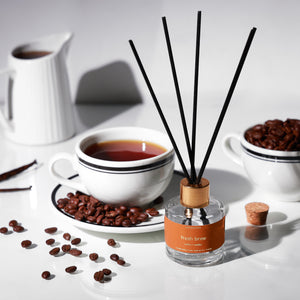
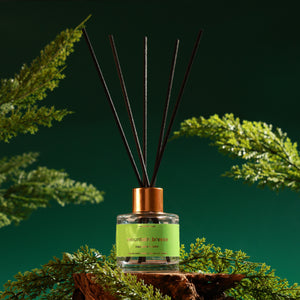
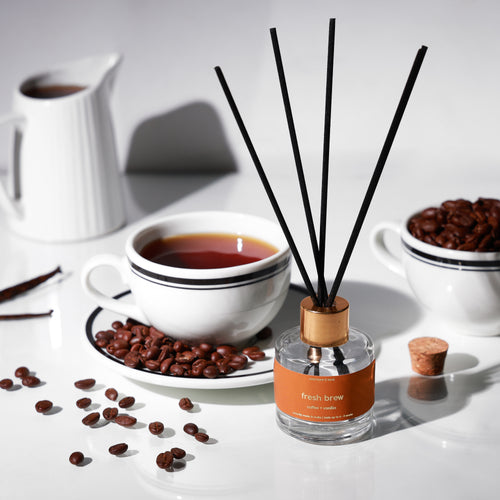
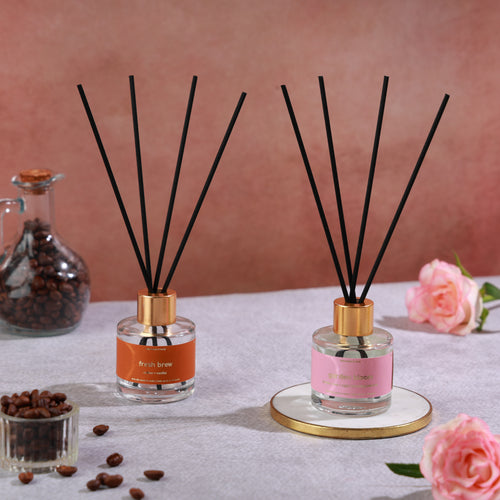
| Step six | If six in the right place is still too quiet, change composition — Fresh Brew or Mountain Breeze | 9.5 and 9.4 against 8.9 — strength bought where it lives | ₹849 · 50ml |
| Step seven | If you want the room loud on demand rather than constantly | Timers, 16–18 hours on low, 270–320 sq ft | Sukoon ₹1,899 |
Versailles
The photograph I get sent most often is a bottle with a dozen reeds fanned out of it like a bouquet, usually with the question of why it has emptied so quickly. It is a completely reasonable thing to have tried. Nobody explains reed count at the point of sale, the sticks are right there in the box, and adding them is the only control the object appears to have.
What I would want you to know is that the second half of that bundle is almost pure cost. The room gains very little between nine reeds and fourteen, and the bottle pays the same rate for every one of them — plus a film of oil on the glass and, quite often, a mark on a sideboard that does not come out. If the room is not what you hoped for at six, the reed count is rarely the variable that will fix it.
So take them out. Nothing is spoiled and nothing needs replacing. Then work the free things — flip, move, close the room for an hour — and if you still want more, buy it in the composition rather than in the neck of the bottle. Everything is composed and handmade in small batches in Pune, and a part of every order funds a girl's classroom through Nanhi Kali.
Frequently asked questions
- How many reeds should you put in? — why six is a dose rather than a default.
- What happens if you use too few? and how many for a strong fragrance — the other end of the dial.
- How many sticks by room size — the room-by-room count table.
- The complete guide to choosing a reed count — the whole sub-cluster in one place.
- Brand: the SOSA founder story.
SOSA reed diffuser range & prices (verified August 2026): alcohol-free, phthalate-free, paraben-free and IFRA-compliant compositions on a heat-stable coconut-derived (CCT) carrier, low-VOC, supplied in a refillable glass bottle with six fibre reeds; 50ml lasts 6–8 weeks and 130ml lasts 14–18 weeks. Morning Freshness (Malabar lemon · peppermint · Nilgiri eucalyptus) 50ml ₹749 · 130ml ₹1,249 · 9.0/10; Garden Bloom (British rose · night-blooming jasmine) 50ml ₹799 · 130ml ₹1,299 · 8.9/10; Evening Calm (Kashmir lavender · chamomile) 50ml ₹799 · 130ml ₹1,299 · 8.9/10; Fresh Brew (Coorg coffee · Kerala vanilla) 50ml ₹849 · 130ml ₹1,349 · 9.5/10; Mountain Breeze (Himalayan pine · sage · Indian cedar) 50ml ₹849 · 130ml ₹1,349 · 9.4/10. Reed diffuser refills are oil only — you reuse your own vessel and reeds: 300ml ₹2,399 (roughly 8–11 months) · 500ml ₹3,499 (roughly 14–18 months), about ₹7–8 per ml against ₹15–17 per ml for a 50ml bottle. Duo sets ₹1,498–₹1,598 for 2 × 50ml and ₹2,498–₹2,598 for 2 × 130ml. Strength figures are positions on SOSA’s own internal strength scale, not an industry standard. Replacement reeds are not sold as a separate SKU; SOSA guidance is to refresh reeds every few months. The reed line is separate from the water-based Hotel Collection for ultrasonic machines (15ml ₹299 · 100ml ₹999 · 300ml ₹1,799) and the two are not interchangeable. Diffusers: Boond 300ml ₹899 · Sukoon 500ml ₹1,899 · Megh 6L ₹3,499 · waterless Vaayu ₹11,999. Composed and handmade in small batches in Pune, India; tested through 45°C summer heat and 85% monsoon humidity. Free shipping above ₹499. A portion of every order supports girl-child education through Nanhi Kali. Prices subject to change — see the live product pages.